

Leaburg Hatchery
Leaburg, Lane County, Oregon. Fish hatchery; Year-round.
Details

- Where
- 90700 Fish Hatchery Road, Leaburg, OR 90700. Directions
- When
- Daylight hours.
- Getting there
- Along the McKenzie River 4 miles east of Leaburg, Oregon, on Highway 126 at River Mile 38.8.
- Access
- Camp host on site; ADA accessible; restrooms available; picnic area and trails on the grounds.
- Phone
- (541) 896-3294
- Managed by
- Oregon Department of Fish & Wildlife.
- Established
- 1953.
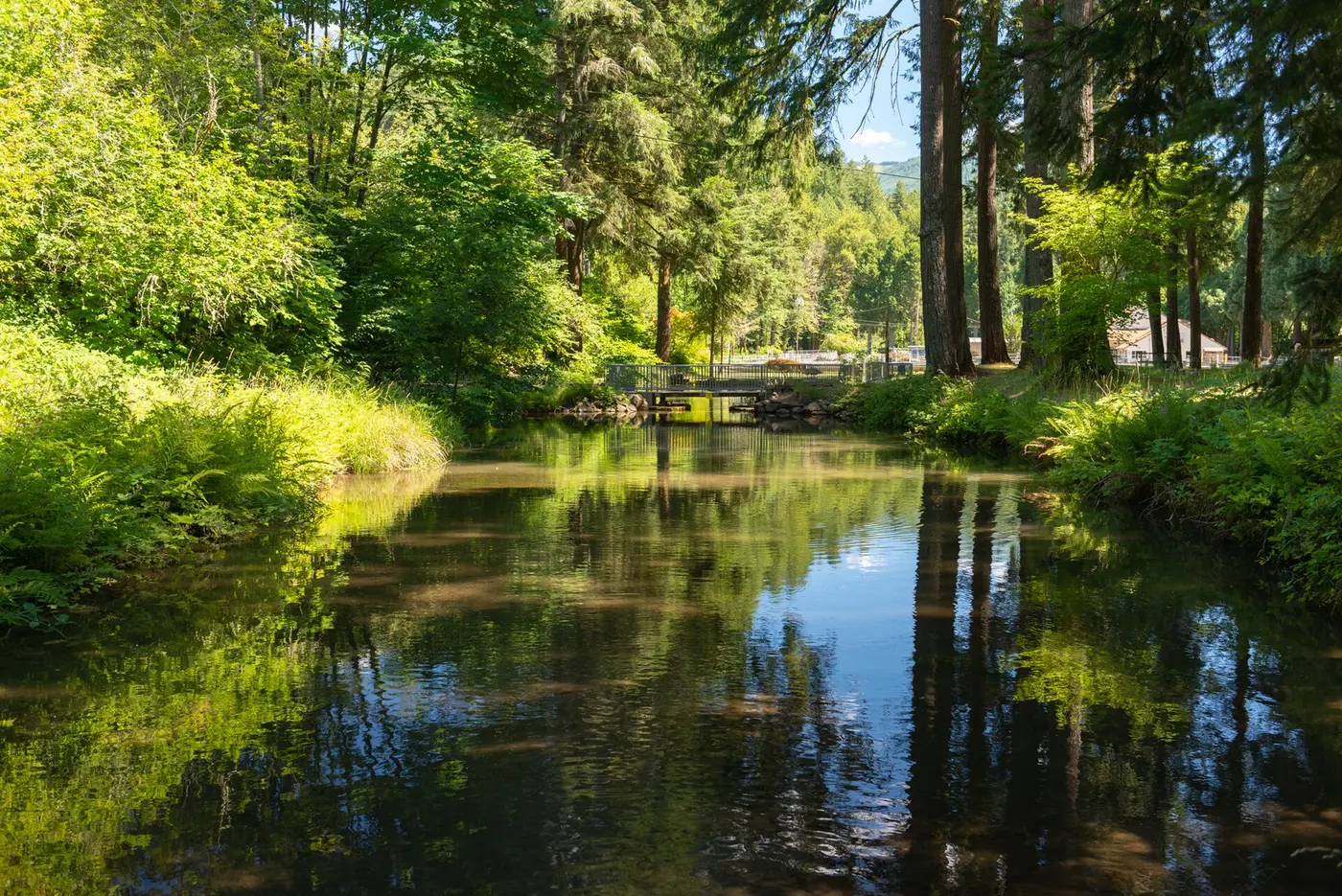
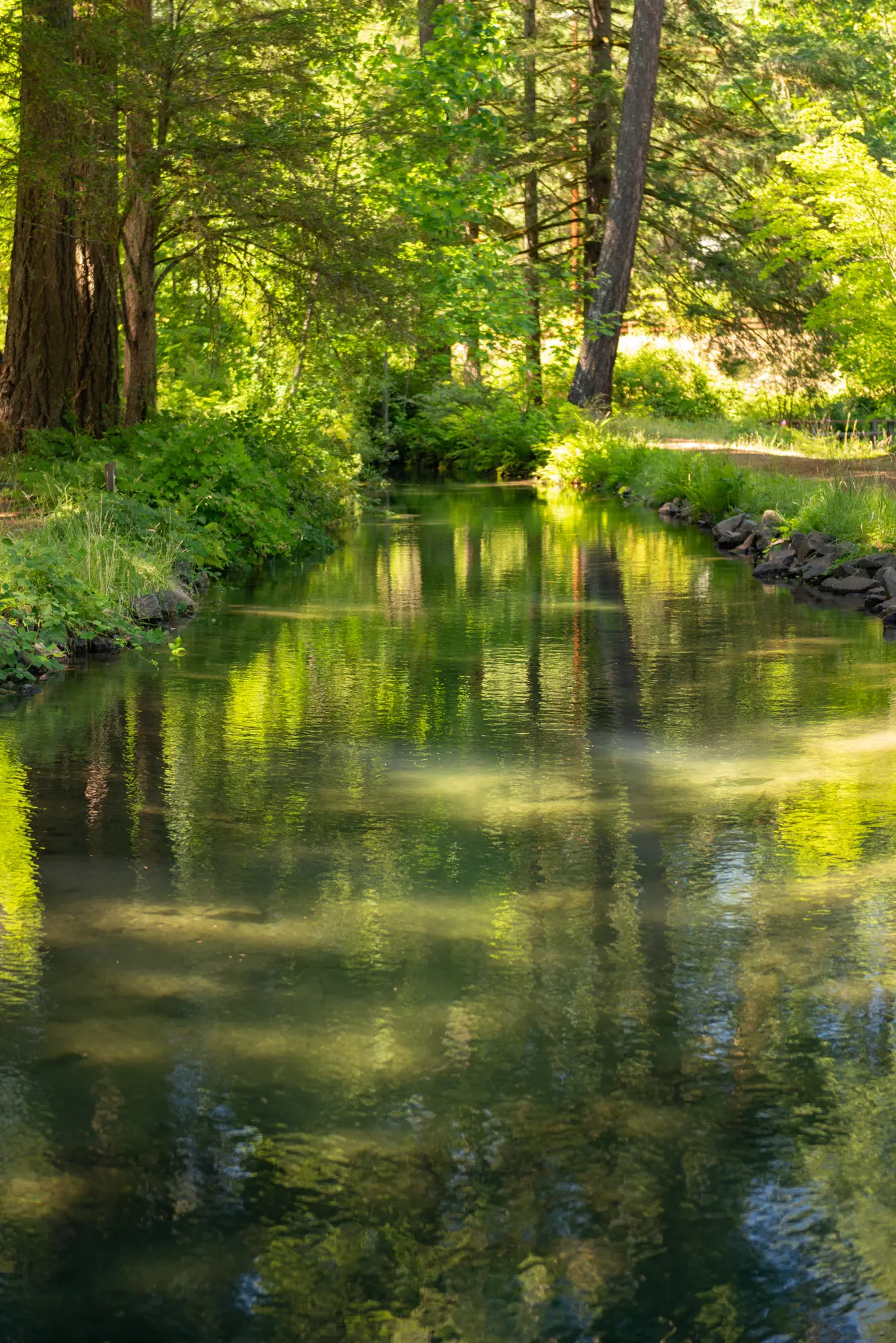
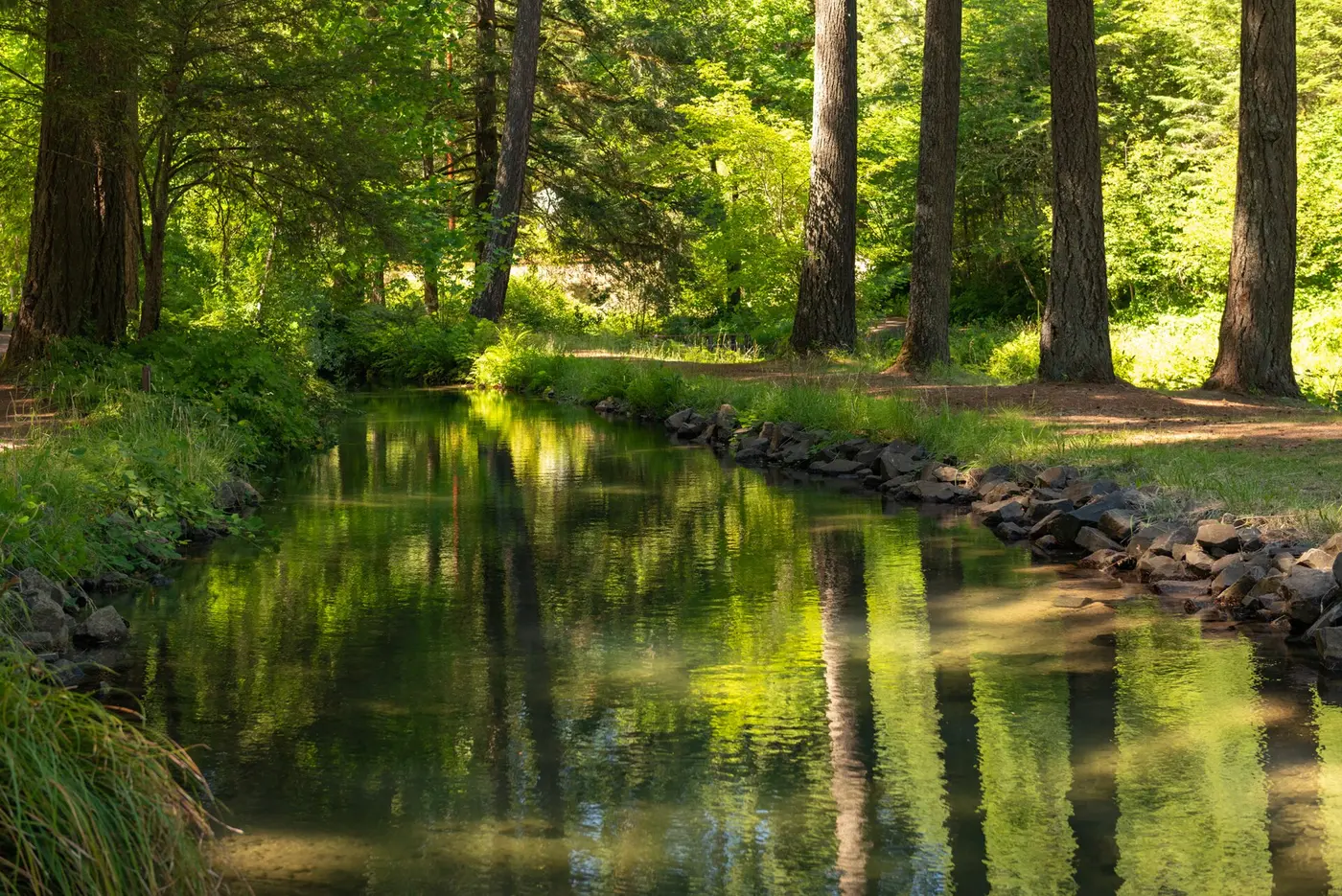
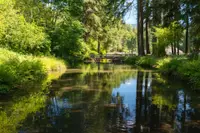
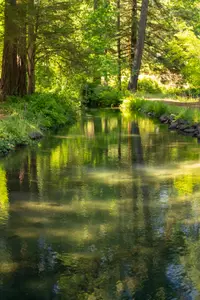
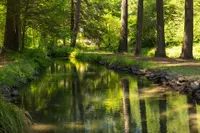
The show ponds at Leaburg Hatchery are earthen. The Oregon Department of Fish & Wildlife’s visitors’ guide lists huge white sturgeon and rainbow trout in them, on view the year round. The hatchery lies along the McKenzie River 4 miles east of Leaburg, on Highway 126 at River Mile 38.8. It covers 21.6 acres at 740 feet above sea level and is open during daylight hours. A camp host stays on the grounds, which have restrooms, a picnic area and trails. Osprey hunt the river in spring and summer, and the guide adds birds of prey, wading birds and waterfowl to the list.
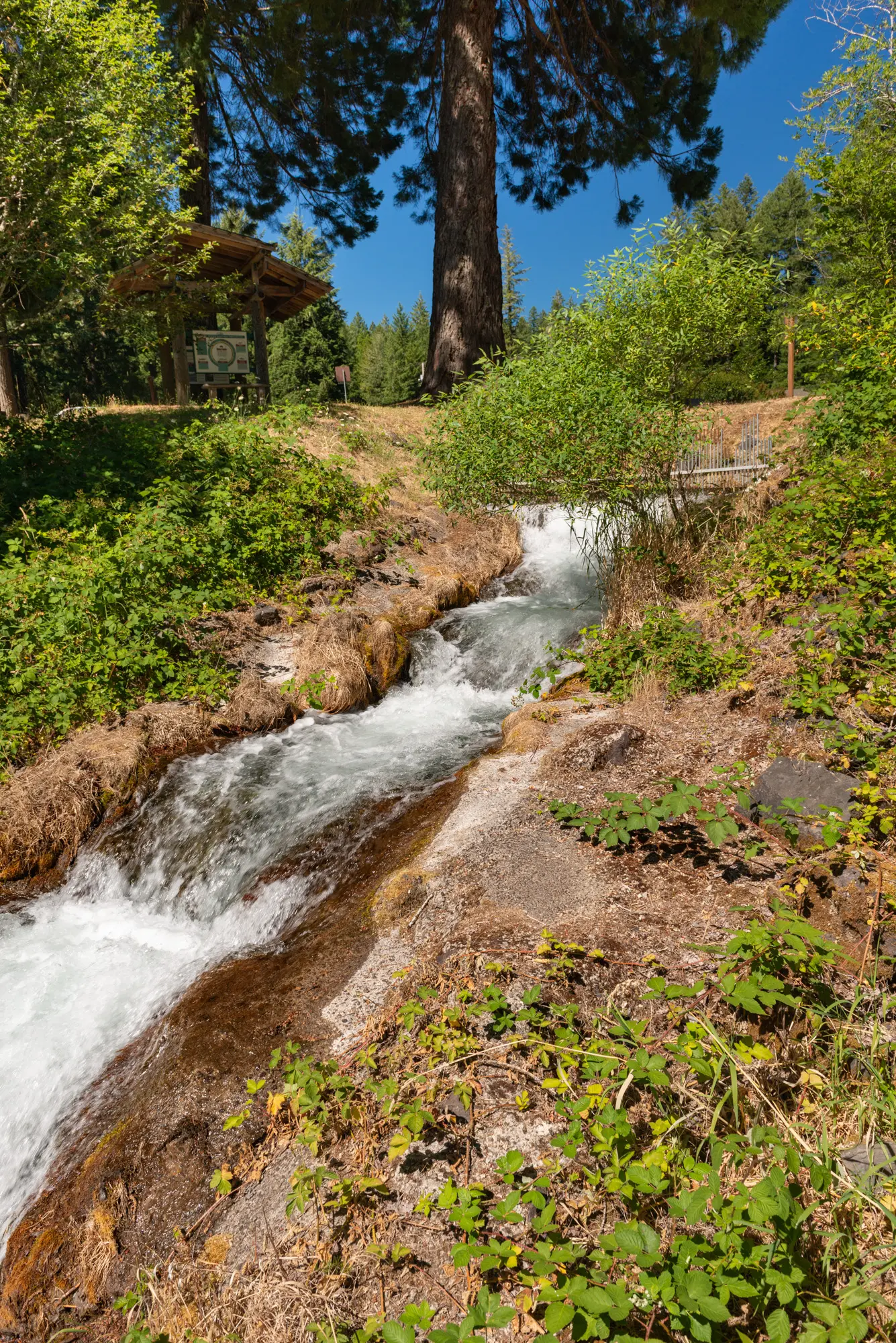
In the fall, spring Chinook salmon spawn in the creek below the hatchery. A viewing platform built in 1993 by the McLaren School for Boys gives visitors a close look down at them. Anglers park in the designated visitor lots and drive through the facility to the fishing water on the McKenzie directly below.
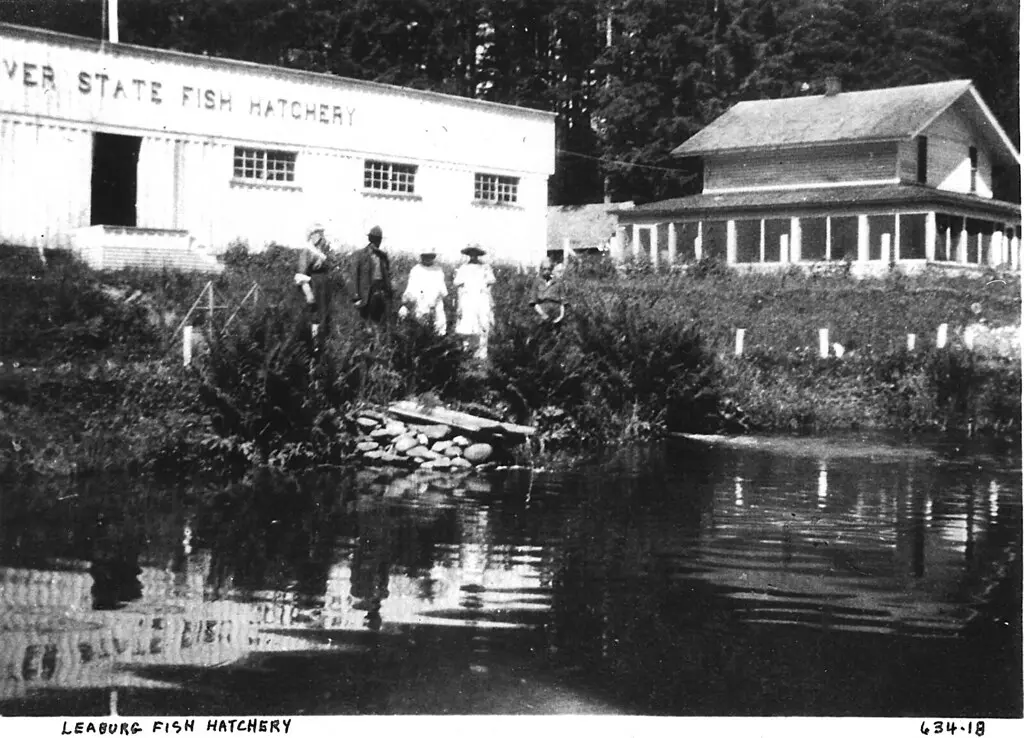
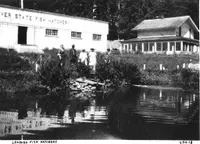
An undated panel on the McKenzie History Highway describes the ponds at another time. It lists albino cutthroat, Columbia River sturgeon and Atlantic salmon, some weighing up to 20 pounds, and a pond where children fed the fish with pellets sold for a quarter. The panel puts the hatchery’s yearly output at 750,000 fish, mostly rainbow trout.
Forty raceways on gravity water
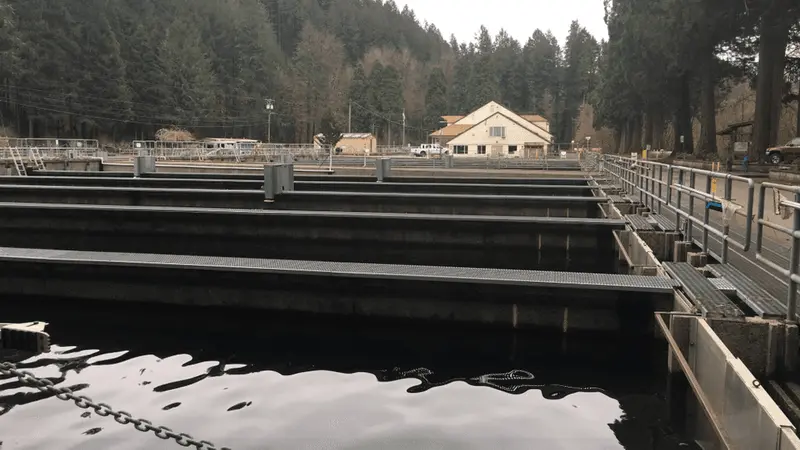
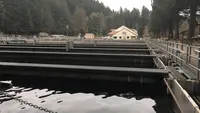
The working hatchery lies beyond the ponds. Forty concrete raceways, each 100 feet long and 20 feet wide, date from 1953, along with six concrete circular ponds. Fiberglass Canadian troughs were added in 1987 and 2002, and vertical incubators, six stacks of eight trays, in 1990. Water rights total 44,900 gallons a minute from the McKenzie. The water arrives by gravity and passes through each rearing unit once. ODFW’s 2023 program plan staffs the place with three full-time positions. The visitors’ guide says four employees.
The 2023 plan lays out the year’s work.
- Rainbow trout: 200,000 Cape Cod triploid trout are raised to half a pound each and released from January through December into reservoirs, streams and standing water across the Willamette Basin. Another 70,000 Oak Springs triploid trout are grown to trophy size, about a pound apiece, and go out in April.
- Summer steelhead: 108,000 smolts leave in early April. Half are released at the hatchery and half are trucked to the McKenzie.
- High-lakes fingerlings: Small lots pass through on their way to the high country. There are 1,300 cutthroat fingerlings for Irish Camp and Melakwa lakes in July, and 1,000 Crane Prairie rainbow fingerlings for backpack stocking in early July.
Every released trout and steelhead is fin-clipped. No fish are spawned at Leaburg.
Adult summer steelhead come back up the McKenzie from April through December. Those collected at the hatchery are recycled back to the river for anglers. The plan’s goal is an average sport catch of 1,200 adult summer steelhead on the McKenzie. Adults trapped in December and January are stocked in Junction City Pond.
Thirteen dams and a closing date
The U.S. Army Corps of Engineers built the hatchery in 1953. Its purpose was to make up for trout habitat lost to the Blue River and Cougar dams on the McKenzie and to the Corps’ other Willamette Valley projects. McKenzie River Reflections counts those projects at 13 dams, built after the Flood Control Act of 1938. The visitors’ guide also names Carmen-Smith, Lookout and Dexter. The Corps owned the hatchery and paid the state to run it. From 1953 on, Oregon raised Chinook, summer steelhead and trout there for the Corps.
In 2017 the Corps revamped its production contracts at six Oregon hatcheries and planned to abandon Leaburg. On September 15 of that year, according to River Reflections, it awarded a $1.3 million annual trout contract to Desert Springs Trout Farm, a private operation in Summer Lake. Leaburg was scheduled to close June 30, 2018. That year the Corps stopped summer steelhead production at Leaburg and moved rainbow trout production to Summer Lake, some 277,000 pounds a year. The Legislature then funded the hatchery for one year, from July 1, 2018, to June 30, 2019, using General Fund dollars and Columbia River Basin Endorsement funds.
In September 2017, during that same uncertain stretch, Leaburg took in evacuees from the Eagle Creek Fire in the Columbia River Gorge. Storms over the burn threatened debris flows that could overwhelm the water intake at Cascade Hatchery in Cascade Locks. ODFW’s March 2018 account says 1.75 million juvenile fish were evacuated from Cascade in all. One million of them were coho bound for the Lostine and Umatilla rivers, and those went to Leaburg. River Reflections later wrote that 1.75 million fish went to Leaburg, and gave the year as 2018.
Half of the Leaburg coho were released into the Lostine River in northeast Oregon in March 2018, in cooperation with the Nez Perce Tribe. The other 500,000 went to acclimation ponds at Pendleton under the care of the Confederated Tribes of the Umatilla Indian Reservation. “Our ability to move these fish to Leaburg Hatchery was critical to salvaging production after the fires,” said Andrew Gibbs, ODFW’s acting east region hatchery manager.
Two in the morning, September 8, 2020
Between September 7 and 9, 2020, fires burned an estimated 11 percent of the Oregon Cascades, including the McKenzie valley from Rainbow to Leaburg. At 2 a.m. on September 8, the Holiday Farm Fire drove Leaburg’s staff from the hatchery and from their homes.
Downstream, the Eugene Water & Electric Board opened the rollgates of Leaburg Dam. It feared fire debris coming down the river would clog or overtop the dam. Opening the gates dewatered Leaburg Lake and, with it, the hatchery.
Staff came back later that morning. “Those fish would not have survived very long without new incoming fresh water,” said Erik Withalm, the hatchery manager. “We pulled tail screens to get fish out as quickly as we could before evacuating again as the fire approached.” About 1.16 million fish went into the McKenzie: yearling spring Chinook, summer steelhead and rainbow trout. An estimated 5 to 10 percent did not get out before the water was gone. Fish being held for another basin, Rock Creek spring and fall Chinook and summer steelhead, were not released and died on site, because ODFW hatcheries do not release out-of-basin stocks. Only the wellhouse and a tractor burned.
The sturgeon survived. McKenzie Fire & Rescue was among the agencies that helped save them. ODFW said at the time that the sturgeon might eventually be released into the river, because it expected water supply problems in the months ahead.
The cost showed up three years later. In July 2023, ODFW reported very few hatchery Chinook returning to the McKenzie basin. It blamed poor survival of the smolts released early and small during the fire, along with poor ocean conditions. To protect the wild Chinook holding below Leaburg Dam, and to secure enough broodstock, ODFW closed the mile of river from the dam to the mouth of Trout Creek to salmon angling from July 15 through December 31, 2023.
A transfer “without consideration”
The Water Resources Development Act of 2020 directed the Corps to hand Leaburg Hatchery to Oregon “without consideration,” in the words of Corps spokesperson Tom Conning. “Operation and maintenance of aging infrastructure, such as the Leaburg Hatchery, is expensive and time-consuming,” he told River Reflections in January 2022.
The Corps had already stopped funding the hatchery on July 1, 2018, and was leasing it to ODFW at no cost. The 2021 Legislature approved $302,681 from the General Fund and $1,111,578 from the License Fund to keep the hatchery running. The lease was set to expire June 27, 2022.
Then the Eugene Water & Electric Board found safety problems with the Leaburg Canal. The canal was closed, and so was the nearby McKenzie Hatchery that it supplied. Summer and fall rearing for McKenzie Hatchery moved to Leaburg under a Corps contract that runs until 2025. The Legislative Fiscal Office therefore did not expect the transfer before 2025 at the earliest. ODFW’s January 11, 2022, letter to lawmakers called it likely to be a multi-year process, 8 to 10 years or more.
ODFW Fish Propagation Manager Scott Patterson raised a longer worry. “I believe fish pathogen will be more a problem going forward placing hatcheries, such as Leaburg, more at risk, as well as wild salmonids,” he said, as warming water lasts longer each year.
In December 2023 the Corps told ODFW it planned to stop funding trout, steelhead and Chinook production in the Upper Willamette Basin. Trout would drop from 277,000 pounds a year to 97,000 in 2025. River Reflections figured the McKenzie’s share could fall from nearly 50,000 pounds to under 20,000.
By the next spring, returning visitors could not find the biggest fish in the show ponds. Hatchery technicians and Springfield District biologists had wrangled the sturgeon out ahead of draining the ponds. Martyne Reesman, the Springfield STEP biologist, fixed an identification tag to one of them.
On May 24, 2024, ODFW closed Leaburg and McKenzie hatcheries for the summer to comply with Department of Environmental Quality permit conditions. No fish were left in the raceways or the show ponds. ODFW said the trout and spring Chinook meant for release in 2025 would come back to the raceways in November.
Notable Events
- 1953The Corps built the hatchery to mitigate lost trout habitat caused by the Blue River and Cougar dams and its other Willamette Valley projects. mckenzieriverreflectionsnewspaper.com
- 1993The McLaren School for Boys built a platform allowing visitors a close-up look at spring Chinook spawning in the creek below. myodfw.com
- 2017After revamping hatchery production contracts at six Oregon hatcheries, the Corps planned to abandon its Leaburg facility. mckenzieriverreflectionsnewspaper.com
- 2017One million juvenile coho bound for the Lostine and Umatilla rivers were evacuated to Leaburg in September. mckenzieriverreflectionsnewspaper.com
- 2018After a scheduled closure, the Legislature passed funding for one year using General Fund dollars and Columbia River Basin Endorsement funds. dfw.state.or.us
- 2018The newspaper reports that some 1.75 million juvenile fish were evacuated from Cascade Hatchery to Leaburg because of potential debris flows after the Eagle Creek Fire. mckenzieriverreflectionsnewspaper.com
- 2018The Corps ceased summer steelhead production and outsourced the hatchery's rainbow trout production to privately owned Desert Springs Trout Farm in Summer Lake, Oregon. mckenzieriverreflectionsnewspaper.com
- 2020The fire damaged Leaburg Hatchery and forced early release of small Chinook smolts, reducing their survival rates. dfw.state.or.us
- 2020Reduced survival was expected to show up several years later when those fish would normally return to the McKenzie as adults. mckenzieriverreflectionsnewspaper.com
- 2020Conning said the Water Resources Development Act directed transfer of the hatchery to Oregon without consideration, rather than a sale. mckenzieriverreflectionsnewspaper.com
- 2021The state was funding spring Chinook, summer steelhead and trout production, while the Corps continued contracting with ODFW for fish produced at the hatchery. mckenzieriverreflectionsnewspaper.com
- 2021The Legislature approved $302,681 General Fund and $1,111,578 License Fund to continue hatchery operations. olis.oregonlegislature.gov
- 2025Because of the production shift to Leaburg and the contract timeline, the potential hatchery ownership transfer was not anticipated until then; this was not a completed transfer. olis.oregonlegislature.gov
- Evacuated staff returned that morning and released approximately 1.16 million fish into the McKenzie River as the hatchery lost water. dfw.state.or.us
People
- Andrew Gibbs, ODFW acting east region hatchery manager explaining Leaburg's role in salvaging fish production after the fires.
- Erik Withalm, Manager of Leaburg Hatchery explaining the relocation of show fish before pond dewatering.
- Martyne Reesman, Springfield STEP Biologist applying an identification tag to a sturgeon.
- Scott Patterson, ODFW Fish Propagation Manager explaining the no-cost arrangement for ODFW to use the hatchery.
- Tom Conning, Corps spokesperson explaining the cost of operating Leaburg Hatchery.
Sources
- myodfw.com/leaburg-hatchery-visitors-guide
- dfw.state.or.us/news/2024/05_May/052424b.asp
- kval.com/news/local/leaburg-and-mckenzie-river-hatcheries-temporarily-closed-for-summer
- mckenziehistoryhwy.org/settlements/leaburg
- mckenzieriverreflectionsnewspaper.com/story/2022/01/20/news/army-corps-transferring-leaburg-hatchery-to-odfw/4300.html
- mckenzieriverreflectionsnewspaper.com/section/rec
- olis.oregonlegislature.gov/liz/2022r1/Downloads/CommitteeMeetingDocument/252258
- dfw.state.or.us/fish/HGMP/docs/2024/Leaburg%20HPMP%202024.pdf
- dfw.state.or.us/news/2018/03_march/031418.asp
- dfw.state.or.us/news/2020/09_Sep/091520.asp
- dfw.state.or.us/news/2023/07_Jul/070723.asp
- mckenzieriverreflectionsnewspaper.com/home/cms_data/dfault/photos/stories/id/4/9/6649/515258.pdf
- mckenzieriverreflectionsnewspaper.com/home/cms_data/dfault/photos/stories/id/5/7/9657/7034500.pdf