Klaskanine Hatchery
Astoria, Clatsop County, Oregon. Salmon and steelhead fish hatchery; Best time to visit: September - October.
Details

- Where
- 82635-202 Hatchery Road, Astoria, OR 82635. Directions
- When
- Staffed 7:30 a.m. - 4:30 p.m. but visitors are welcome dawn to dusk.
- Getting there
- From Astoria: Proceed 12 miles east on Hwy. 202 to the hatchery. From Jewell: Proceed 17 miles west on Hwy. 202 to the hatchery.
- Access
- Camp host, fishing, restrooms.
- Walk-in or reserve
- Visitors are welcome dawn to dusk.
- Phone
- (503) 325-3653
- Managed by
- Oregon Department of Fish and Wildlife (ODFW).
- Established
- 1911.
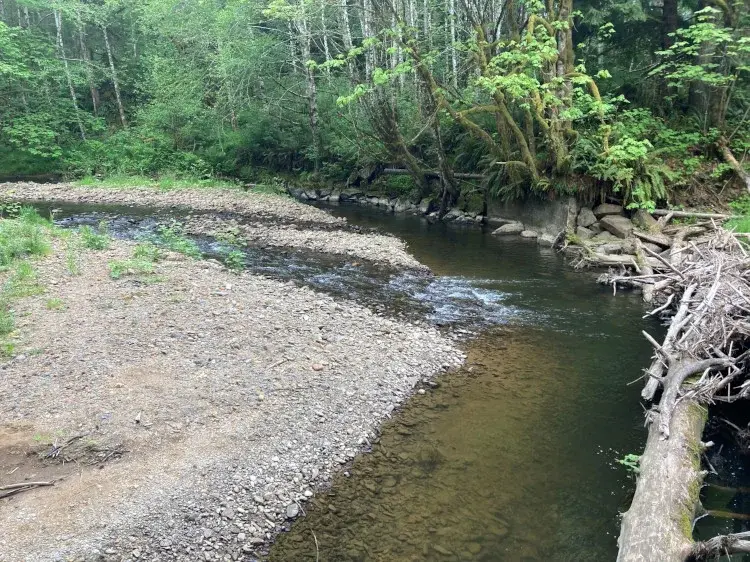
Twelve miles east of Astoria on Highway 202, the North Fork Klaskanine River runs past a hatchery of concrete raceways and a shotcrete rearing pond three-quarters of an acre across. The grounds cover 16.56 acres at about 25 feet above sea level. The Oregon Department of Fish and Wildlife keeps the place with three full-time staff and one seasonal hand for three months of the year. Visitors are welcome from dawn to dusk. The department names September and October as the best months to come, when adult Chinook salmon can be seen in the river. A camp host stays on the grounds, and fishing and restrooms are listed among the facilities. The department’s wildlife list for the site reads fish, hoofed mammals, wading birds and waterfowl. Elk gather at Jewell Meadows Wildlife Area, 17 miles farther east on the same highway.
The trap below the Ogee Dam
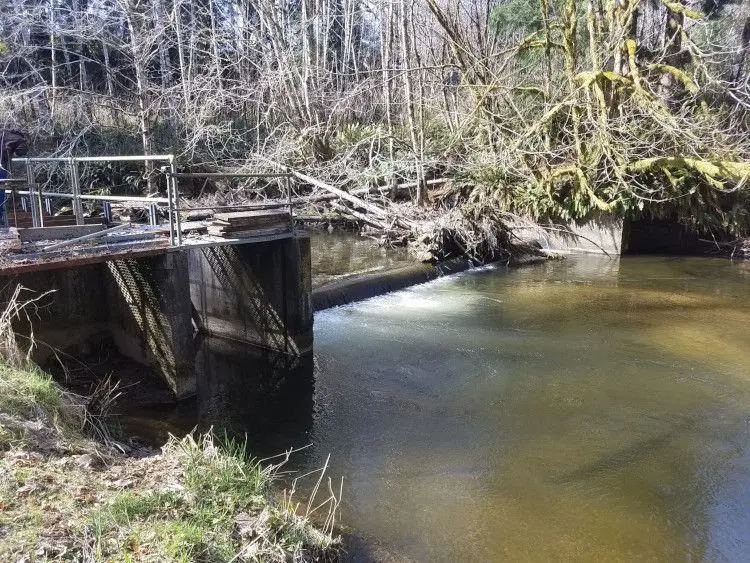
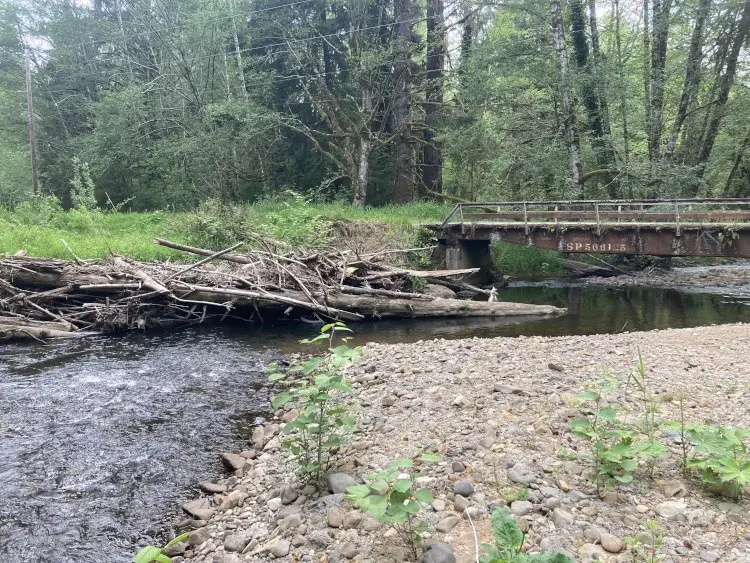
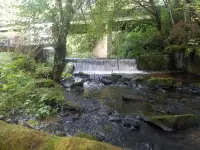
The river reaches the hatchery over the Ogee Dam, also called intake one. Here, as KMUN reporter Katie Frankowicz put it in 2022, “hatchery fish make a right turn to the hatchery but many wild fish are stuck.” Hatchery staff have had to sort the wild fish by hand and carry them above the dam. “Right now, there’s a big concrete dam with a big apron that comes down, and it’s sheet flow over the top of that,” Robert Bradley, a North Coast fish biologist for the department, told The Astorian in January 2024. “Fish could get to the base of the concrete, but there’s no way they can get over it now.” He put the water above the dam at 10 or 15 feet higher than the water below. Few wild fish live in the miles of river beyond, apart from a handful of coho and steelhead the state passes over.
That January, The Astorian reported a federal grant of more than $3 million under the Bipartisan Infrastructure Law. The money would pave the way for removing the Ogee Dam and building a grade-control roughened channel in its place. The state also planned to make the hatchery’s trapping and water use more efficient, according to Beth Quillian, a regional communications coordinator for the department. Waterways Consulting, which engineered the work upstream, wrote that removal or modification of the dam was scheduled for the next several years. Once it is done, fish will have access to 12 miles of habitat on the North Fork and the North North Fork.
The river sets the hatchery’s limits. Water comes by gravity from intakes on the North Fork and on the North Fork of the North Fork. In summer and fall the hatchery uses the river’s entire flow, which can drop to about 1,600 gallons a minute.
Coho, brights, and tules
The department’s 2024 plan describes four kinds of fish reared here. The site works with Clatsop County Fisheries and the Select Area Fisheries Enhancement program, known as SAFE. Its salmon feed the gillnet fishery out of Youngs Bay as well as the sport catch. All of the hatchery’s programs are classed as harvest programs, intended to make up for fishing lost to the Columbia Basin hydropower system.
Coho adults may be held for spawning from September to November, with spawning at its height from late October to early November. The plan calls for 1.4 million coho smolts a year, released into the North Fork in late April and early May. Fall Chinook of the Select Area Bright stock are trapped and held from October to November. Only hatchery fish are kept for broodstock. A million of their young go out in mid-July at 30 to the pound, every one clipped on the left ventral fin. Spring Chinook of North Santiam stock come from the Minto Fish Facility, and 500,000 of them are acclimated here and let go in spring. About 40,000 winter steelhead arrive from Big Creek Hatchery in late November and leave in mid-April at six to the pound, for an angling fishery on the Klaskanine. Excess hatchery adults are sold or put into streams for enrichment, and spawned Select Area Bright carcasses go into the streams as well. Wild adults of the Klaskanine River stock are passed above the barrier to spawn on their own.
The brights descend from Rogue River eggs sent from Cole Rivers Hatchery to Big Creek Hatchery in 1982. A 2005 department plan explains why they were wanted. Select Area Bright fall Chinook return to the estuary less mature and in prime condition. The lower-river tule stock, by contrast, matures rapidly and has poor flesh. Being Rogue fish, the brights also migrate south of the Columbia after release, where tules go north. The broodstock was kept at Big Creek through 1995. Releases there strayed, so beginning with the 1996 brood the program moved to Klaskanine. The year before, budget constraints had scheduled Klaskanine for closure, and SAFE and department funding kept it open. In 2017, Big Creek manager Rob Dietrichs told The Astorian that Klaskanine was largely funded by the Bonneville Power Administration. While federal cuts halved Big Creek’s Chinook, he said, Klaskanine would go on producing a maximum of more than 2.4 million Chinook.
Frans Kankkonen’s hatchery at Olney
The department’s visitors’ guide and management plans say only that the state of Oregon first operated Klaskanine Hatchery in 1911. The Swedish Finn Historical Society names a builder. Its account, drawn from K-G Olin’s Egen lyckas smed in June Pelo’s translation, says Frans Kankkonen established “The Klaskanine Fish Hatchery” in Olney in 1911 and that his brother Frithiof worked on building it.
Frans came from Gamlakarleby in Finland. He had studied architecture in Helsingfors and served as a railroad engineer before reaching Astoria around 1893. After the failed fishermen’s strike of 1896, Finnish gillnetters formed the Union Fishermen’s Cooperative Packing Company, and Frans became its first manager. He patented a method that simplified the making of tin cans. He designed and built the Finnish Apostolic Church in Astoria and served as its minister. He died in 1919. Frithiof had arrived in 1902, and he led the cooperative from 1921 to 1945. Some of the younger relatives called him Uncle Fish.
By 1944 the hatchery’s returns were in question. That year The Astorian printed an explanation offered by Henry McGowan, a veteran packer of McGowan, Washington. He thought the poor returns of salmon from Klaskanine fry might come from bark and splinters deposited on the Lewis and Clark and Young’s rivers. Concrete raceways went in by 1951. The department’s 2005 plan says the hatchery was rebuilt with Mitchell Act funding in 1953. The department’s visitors’ guide and later plans give 1959 as the year it was enlarged and renovated under the same act’s Columbia River Fisheries Development Program, meant to shore up declining runs in the basin. The facility table lists five 150-foot raceways from 1959 and sixteen 80-foot ones from 1951. All of them are rated in poor condition.
In 1964, The Astorian reported that big runs of silverside salmon climbed the Klaskanine and Big Creek after a Saturday night’s rain. That Sunday, the stream at the Klaskanine hatchery was “thick with writhing, fighting salmon” for many yards below the dam. The fish fought their way up the spillway and fell back into the pool. Superintendent George Samley said every fish that could be held had been taken into the egg-taking pen. “We couldn’t let in any more,” he said, “for fear they would all suffocate.”
The rearing lake was shot in concrete in 1981. In 1985 the bottoms of eight ponds were replaced, and the incubators were installed: forty stacks of seven trays each. Adelbert “Dell” Warren, a longtime state hatchery manager who died in 2017, counted Klaskanine among the hatcheries where he worked.
A dam in the middle, a channel at the top
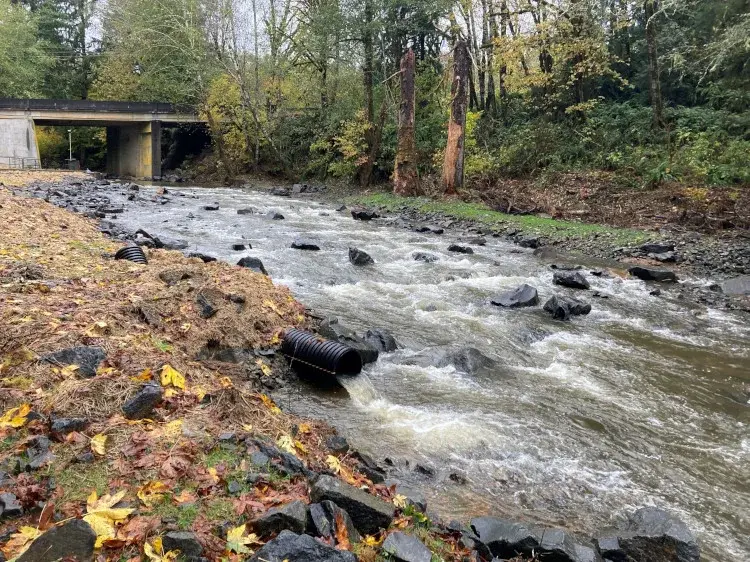
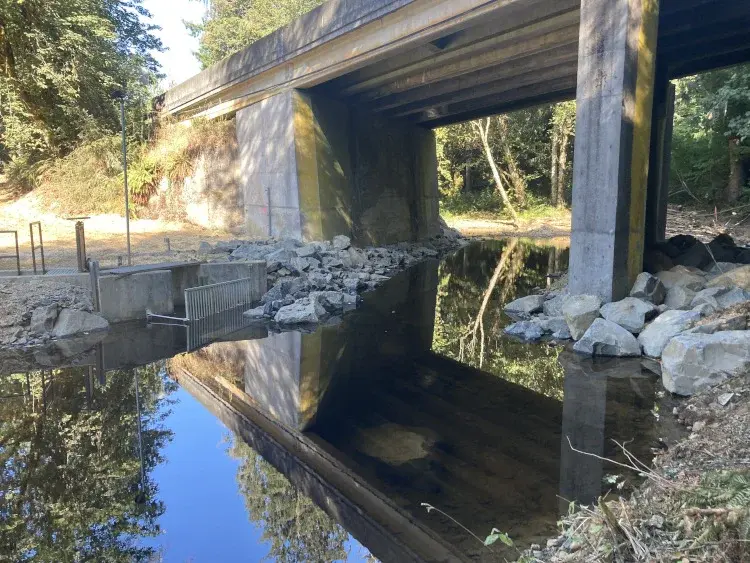
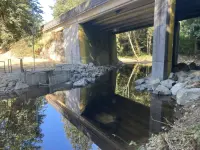
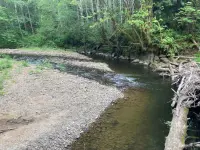
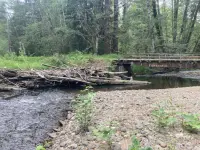
Three diversion dams long supplied the hatchery’s water, and all three blocked fish. The middle dam, intake two, was removed in 2020, according to The Astorian and KMUN. Waterways Consulting dates the demolition of that concrete, channel-spanning dam to the summer of 2021. Rock was placed by a bridge to steady the channel, and large wood was set to hold the bank. The department’s 2020 plan still lists three intakes. The 2024 plan lists two.
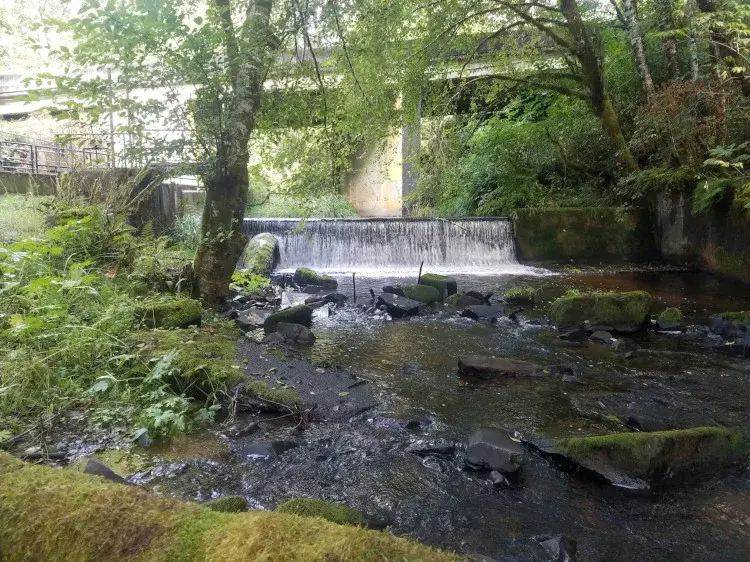
Intake three is a six-foot concrete dam and apron on the North North Fork, about 80 feet below the Highway 202 crossing. The North Coast Watershed Association led the work there, with the U.S. Fish and Wildlife Service and the state as partners. In the summer of 2022, crews built a roughened channel over the dam, a graded streambed that fish can climb. The dam still diverts water to the hatchery. Graham Klag, the association’s executive director, planned to watch for Pacific lamprey above the dams as the first sign that the work had succeeded. Later, he said, might come coho and steelhead, “potentially even chum.” Whether chum could make it that far was uncertain. “You never know,” he said.
In mid-September 2022, as contractors finished at intake three, hatchery fall Chinook came up the North Fork. They turned toward the hatchery, flashing forward in bursts, fins breaking the surface over speckled backs. Klag watched them, then walked back toward the new channel, where crews were letting the river through again. Water began to run along the North North Fork into the North Fork Klaskanine, first as a trickle, then slowly, steadily more.
Notable Events
- 1911The state of Oregon first operated Klaskanine Hatchery. myodfw.com
- 1911Frans established the Klaskanine Fish Hatchery; brother Frithiof worked on building it. swedishfinnhistoricalsociety.org
- 1951The facility table dates a set of concrete raceways to this year. dfw.state.or.us
- 1953The hatchery was rebuilt with Mitchell Act funding. dfw.state.or.us
- 1959The hatchery was enlarged and renovated under the Columbia River Fisheries Development Program to enhance declining Columbia Basin fish runs. dfw.state.or.us
- 1981The facility table dates the shotcrete rearing lake to this year. dfw.state.or.us
- 1985Bottoms were replaced in 8 ponds. dfw.state.or.us
- 1995Budget constraints led to a scheduled closure, but SAFE program and ODFW funding kept the hatchery operating. dfw.state.or.us
- 1996Beginning with this brood, the broodstock program moved to Klaskanine to address excessive straying from Big Creek releases. dfw.state.or.us
- 2003An alternative broodstock-collection method was evaluated with assistance from a contracted test fisher. dfw.state.or.us
- 2020The hatchery-associated dam referred to as intake two was removed. dailyastorian.com
- 2021The concrete channel-spanning dam at Intake #2 and associated infrastructure were demolished. watways.com
- 2022The state partnered with the North Coast Watershed Association to build a fish-passage structure at intake three. dailyastorian.com
People
- George Samley, Hatchery superintendent who described filling the egg-taking holding pen to capacity (1964).
- Rob Dietrichs, Big Creek Hatchery manager who commented on Klaskanine's BPA funding and continuing Chinook production.
- Scott Patterson, Discussed staff shared between Big Creek and Klaskanine, expecting no short-term staffing effect from Big Creek's Chinook production cut.
- Adelbert Malcolm Warren, Longtime ODFW hatchery manager who also worked at Klaskanine among several other hatcheries (1927–2017).
- Henry McGowan, Veteran packer who suggested that bark and splinters in the Lewis and Clark and Young's rivers might explain poor returns from Klaskanine hatchery fry (1944).
- Beth Quillian, ODFW regional communications coordinator who described planned hatchery trapping- and water-efficiency improvements.
- Graham Klag, North Coast Watershed Association executive director monitoring for lamprey above the hatchery dams after fish-passage modifications.
- Robert Bradley, ODFW North Coast fish biologist who described the Ogee Dam's barrier to fish passage.
- Alan Meyer, ODFW hatchery manager at Klaskanine Hatchery.
- Kregg Smith, ODFW senior policy analyst who discussed habitat above the Ogee Dam and low wild-fish returns.
- Frans Kankkonen, Established the Klaskanine Fish Hatchery in Olney (1911).
- Frithiof, Frans's brother; worked on building the hatchery (1911).
- John Dvorsky, Project manager for the hatchery fish-passage improvements.
Sources
- myodfw.com/klaskanine-hatchery-visitors-guide
- watways.com/klaskanine-hatchery-fish-passage-improvements
- clatsopcounty.gov/537/About-Us
- swedishfinnhistoricalsociety.org/2021/02/21/tha-kankkonen-brothers-astoria-oregon-fishing-industry
- dfw.state.or.us/fish/HGMP/docs/2006/06-SAB-Fall_Chinook.pdf
- dfw.state.or.us/fish/HGMP/docs/2024/Klaskanine%20HPMP%202024.pdf
- digitalcollections.library.oregon.gov/assets/displaypdf/135677
- dailyastorian.com/2024/01/10/new-federal-funding-to-support-fish-passage-on-north-fork-klaskanine-river
- dailyastorian.com/2014/10/28/water-under-the-bridge-47
- dailyastorian.com/2019/10/08/water-under-the-bridge-oct-8-2019
- dailyastorian.com/2017/07/05/adelbert-malcolm-warren
- kmun.org/project-opens-habitat-to-wild-fish
- dailyastorian.com/2017/02/02/hatching-a-new-fish-plan