
Klamath Hatchery
Chiloquin, Klamath County, Oregon. Fish hatchery; May - October.
Details

- Where
- 46161 Hwy. 62, Chiloquin, OR 46161. Directions
- When
- 7:30 a.m. - 4:30 p.m. daily.
- Getting there
- Travel north on Hwy. 97 from Klamath Falls. Turn left on Hwy. 62, heading toward Crater Lake. Proceed eight miles. The hatchery entrance is on the right.
- Access
- The access road to the hatchery has soft shoulders in several sections due to past fire damage, and visitors are encouraged to drive carefully.
- Phone
- 541-381-2278
- Website
- myodfw.com
- Managed by
- Oregon Department of Fish & Wildlife.
- Established
- 1929.
- Coordinates
- 42.6514, -121.9464.
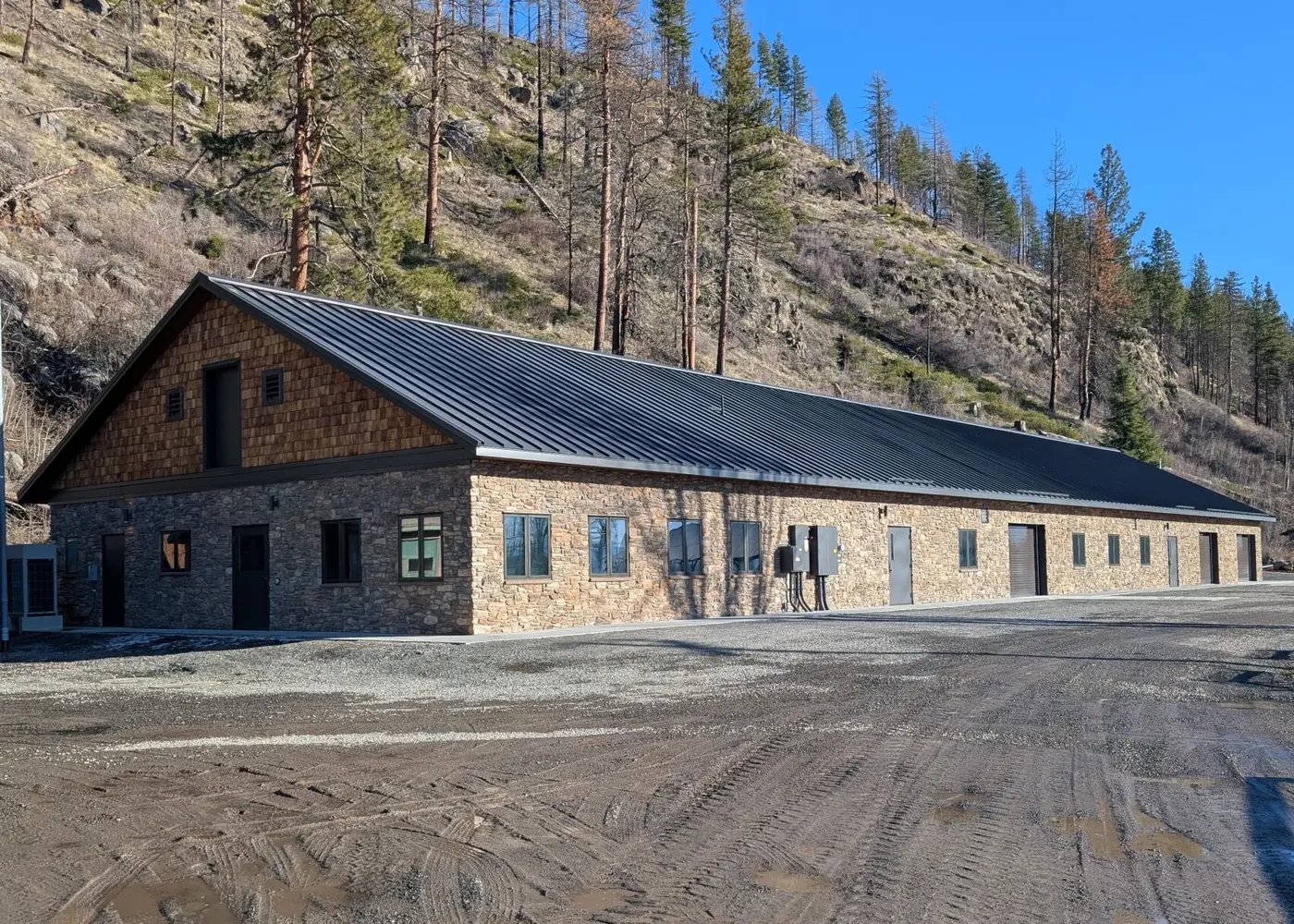
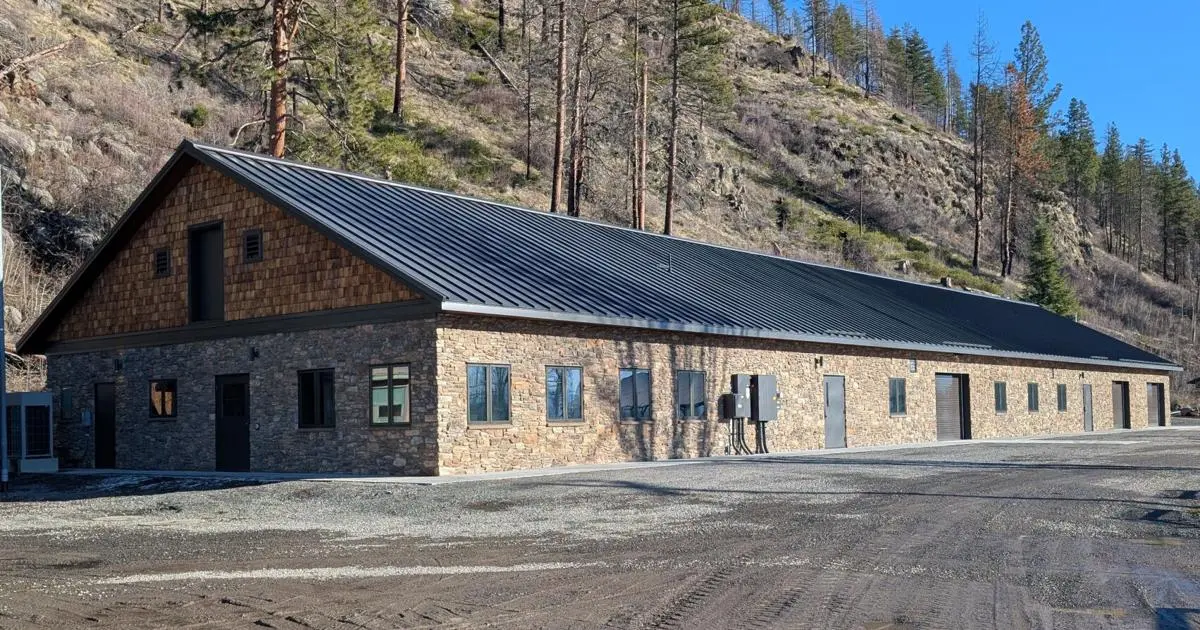
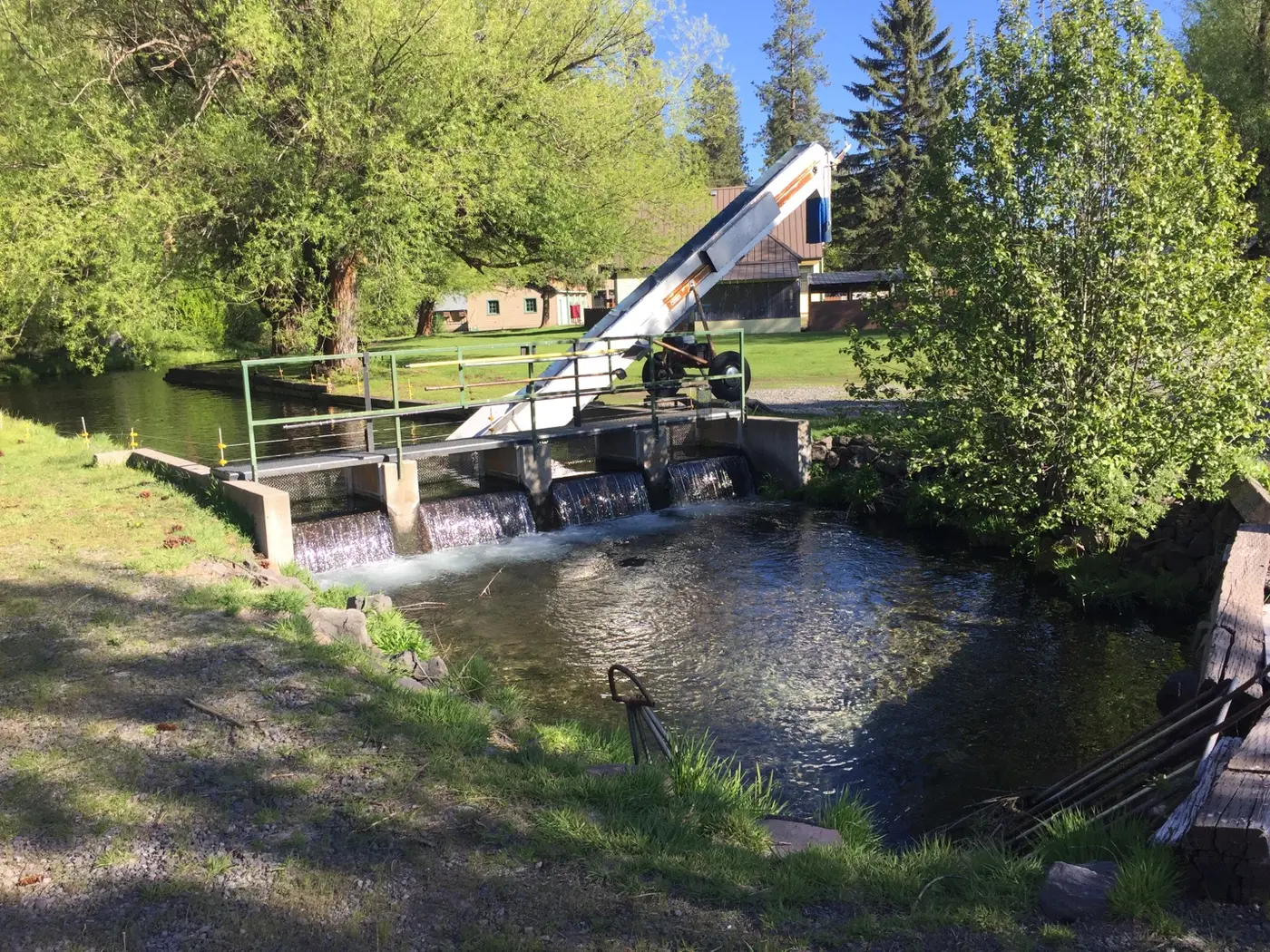
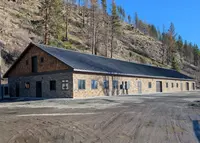
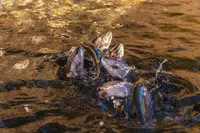
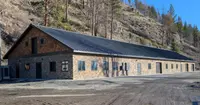
Families come to the outdoor ponds at Klamath Hatchery to watch the trout grow, and fish food can be bought to throw to them. The ponds lie along Crooked Creek off Oregon 62, the road to Crater Lake, eight miles west of Chiloquin and short of Fort Klamath, at an elevation of 4,120 feet. Behind them stands the hatch house the Oregon Department of Fish and Wildlife opened to the public on June 1, 2026. It is concrete, slightly larger than the wood-framed building it replaced, with a tall retaining wall at its back. The 57-acre grounds also hold fish-viewing areas, a picnic area, restrooms, and trails. The department’s guide lists birds of prey, songbirds, upland birds, wading birds, waterfowl, and freshwater mammals among the wildlife to be seen. Fishing is closed on the grounds. The department points anglers to nearby Klamath Lake and its “monster wild rainbow trout.” The access road still has soft shoulders in several sections from fire damage.
Spring water and a hatch house
The water rises from hillside springs. The department’s marker at the hatchery counts a dozen of them, forming Crooked Creek. Its 2024 management plan names five. Both give their temperatures as 45 and 49 degrees. Because the hatchery is spring-fed, water kept running through it even after the power failed, and the cold water suits trout.
Gayle Mitchell, the hatchery manager, lives on the grounds with other employees in the staff homes. Inside the hatch house, rows of incubation trays hold eggs shipped from hatcheries in Oregon and California. Klamath produces none of its own. “We get eggs in, and we put them in these baskets here,” Mitchell told a Jefferson Public Radio reporter on June 5, 2026, pulling open a tray. “Depending on the size of eggs, we can put 5,000 to 10,000 eggs or so in here.” The eggs hatch in one to three weeks, depending on how far along they are when they arrive, and incubation runs from October through July. One tank holds a small number of salmon raised for conservation research. In another, brown trout keep to the bottom. They are Mitchell’s favorite fish. “They don’t like a lot of activity. They don’t like to be hand fed,” she said, so they are kept on automatic feeders. Of the building’s new lighting and heating, she said: “It’s given us all gray hair because we can’t figure it out.”
Most of the fry go out to the concrete ponds and raceways. Behind the hatch house runs a stream where fish left over after the stocking season are turned loose to grow to trophy size. On free fishing days, children are let in to catch one there. “It’s just a great place to come sit, watch some fish, hang out, see them in a more natural setting,” Mitchell said.
Saddle packs and helicopters
The counts differ by source. The visitors guide gives about 3 million fish a year. Mitchell put it this way: “Every year we put out about a million fish, 100,000 pounds, give or take.” About three quarters are sterile triploid trout, which cannot breed with wild fish. “It lets the wild fish be wild,” she said.
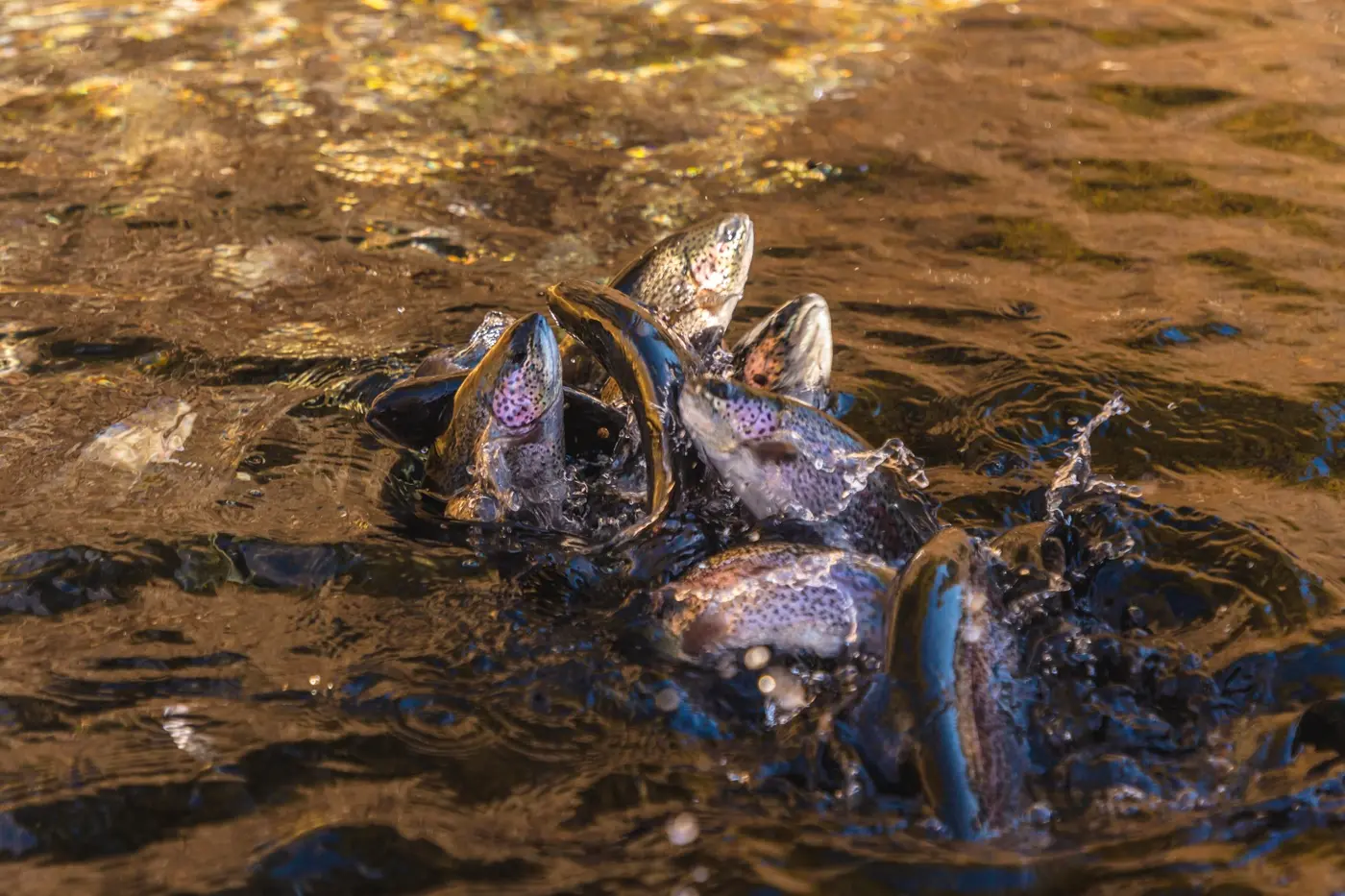
Rainbow trout make up most of the output, with brown trout alongside. Legal-size fish go to more than 30 waterways in Klamath, Lake, and other counties. Fingerlings go to lakes from the southern Cascades east to the Idaho border. In 2023 the manager then, Greg Lipsiea, described the rainbows at release as fingerlings of 2 to 4 inches, 10-inch fish, and upward of 16,000 two-pound trophies. He called Diamond Lake, one of their destinations, “one of the best productive lakes in the state.” Every other year, fingerlings go by helicopter into lakes in the Mountain Lakes and Sky Lakes wilderness areas. Other fish are held back in small indoor tanks so they will not grow too big for the trip by horse. “They put them in bags of oxygen and put them in saddle packs,” Mitchell said. “And then they take them three, four miles up to a lake that otherwise would not be accessible.”
At Lake of the Woods, George Gregory manages the resort. “Our lake is not really conducive to trout self-propagating,” he said. “So without the stocking program, the fishing here wouldn’t be nearly as good.”
The hatchery has also taken part in a pilot to return spring Chinook to the Klamath Basin, about 10,000 fish over four years by the 2026 count. In 2023 some of the 6-inch fingerlings carried radio transmitters, to learn whether they could migrate from the rivers that run into Upper Klamath Lake. “So far we’ve seen the first release was successful,” Lipsiea said then. The marker records an older program: coho salmon, “desert adapted” cutthroat for the warm, alkaline waters of southeast Oregon, and native Willamette River rainbows for the Klamath Basin. That work earned the place the name of an “exotic trout” hatchery.
Crooked Creek and the CCC boys
The marker dates the start to the 1920s. That was when the Oregon State Game Commission began raising trout in sections of Crooked Creek, on land and water leased from the Klamath Indian Reservation. The department gives 1929 as the year of original construction. Bill Miller, writing in the Medford Mail Tribune in 2008, put it that “the fish hatchery we see wasn’t begun until 1929, and from then on it slowly grew in size.”
In the 1930s, men came up from the Klamath Falls camp of the Civilian Conservation Corps. They built rectangular wooden fish ponds and many of the residences. Around 1937, by Miller’s account, “the CCC boys” built the long headquarters building. It held offices, apartments for senior staff, two garages, and incubation nurseries for eggs and fry. In 1938, William Howland, superintendent of the Klamath Hatchery, went up to the first ranger training school at Crater Lake National Park, held July 5 to 20. He was one of its outside instructors, and fish planting was on the course list. In 1939 the Public Works Administration paid for workers to build a concrete dam and begin some of the concrete ponds.
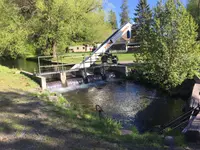
The Living New Deal survey takes issue with the marker on two counts: part of the work was the PWA’s, not the CCC’s, and no wooden ponds remain, everything being concrete. It places the PWA marker on the large pond that regulates the flow. After the Second World War, more buildings went up and the property was at last purchased from the Klamath tribe. The marker sets that purchase in the 1940s or 1950s.
The Two Four Two Fire
In late summer 2020 the Two Four Two Fire started on Fremont-Winema National Forest land and spread quickly on gusty winds. By the time it was contained in late September, it had burned nearly 14,500 acres between Highway 97 and Highway 62. On September 8, hatchery staff secured the facility, gathered what they could, and evacuated. “We were like, ‘Okay, we’ll evacuate, but it’s not going to do anything,’” Mitchell said. “We found out how wrong we were.”
The next morning the manager tried to get back in. He could see the hatchery only from half a mile off, with flames moving across the hillside above it. Smoke rose from the hatch house and office complex, and someone called 911. Firefighting crews were stretched thin across the region, and only a few volunteer firefighters reached the site. They ran the hatchery’s pumps to draw water from the rearing ponds and used its tractor to clear brush and cut a fire line. The main building caught fast and was fully engulfed within minutes, so they turned to the rest. The four staff residences and several outbuildings stood. About 50,000 triploid brown trout were lost inside the building, 20,000 of them bound for Diamond Lake, along with the egg trays.
The accounts of what burned do not agree. The department called it the original 100-year-old hatchery building. Lipsiea said it had been built in the 1950s, a 225-by-75-foot office complex that also housed the main shop, and he called it “the heart of the hatchery.”
Staff worked out of a construction trailer for nearly five years. During the pandemic they met in a garden shed. “So it’s like 14 degrees out, and they’d open the roll-up door, and we’d sit there for our meetings in the morning,” Mitchell said. With the trays gone, already-hatched fish had to be trucked in from other hatcheries. Lipsiea said in 2023, “We haven’t had a hiccup in production.” Mitchell recalled a dip of a few years, then more than 900,000 fish going out in 2025. Gregory said of the department’s people that “you really wouldn’t have noticed that they were struggling at the hatchery by the fish they were catching here.”
Steel piles under the hatch house
Design work began within months. During debris cleanup, the department reports, crews found Indigenous and historic cultural resources within the project area. In 2023 Scott Patterson, the department’s fish propagation manager, said archaeological studies with the Klamath Tribes had found no evidence of artifacts. A full survey commissioned by the department concluded that the building could go back on its old footprint. Then engineers found the ground there too wet to carry a concrete building. The foundation was redesigned on 81 driven steel piles, with 50 more under the retaining wall. “Installing more than 130 steel piles was a major undertaking, but it ensured this facility will stand for generations,” said Ryan McCormick, the department’s chief engineer. The piles added roughly $2 million, and the whole construction came to $8.1 million. In 2023, Lipsiea had hoped to reopen to visitors in 2024.
In the new office hangs a framed photograph of the old wooden building in flames. “It was completely destroyed by the time they got it out,” Mitchell said, looking at it.
Notable Events
- 1920sThe Oregon State Game Commission began raising trout in sections of Crooked Creek with land and water leased from Klamath Indian Reservation. hmdb.org
- 1929The Klamath Fish Hatchery was originally constructed. myodfw.com
- 1930sThe main buildings and wooden ponds were built by the Federal Civilian Conservation Corps (CCC). hmdb.org
- 1930sMen from the Klamath Falls CCC camp made the first major improvements, constructing rectangular wooden fish ponds and many residential buildings. livingnewdeal.org
- 1937The CCC boys built the long hatchery headquarters building, with offices, apartments for senior staff, two garages, and incubation nurseries for fish eggs and fry. livingnewdeal.org
- 1939The Public Works Administration paid for workers to construct a concrete dam and begin work on some of the concrete fish ponds. livingnewdeal.org
- 1940sCement ponds and additional buildings were added; the hatchery property was also purchased in this time period. hmdb.org
- 1950sLipsiea said the destroyed structure was built in the 1950s. heraldandnews.com
- 2020The main building was totally destroyed in the September 2020 Chiloquin 242 Fire, but the hatchery was still operating and producing legal and trophy-size rainbow trout. heraldandnews.com
- 2020The hatchery manager at the time returned after the evacuation and saw smoke coming from the 100-year-old building; firefighters could not save the hatchery itself. ijpr.org
- 2020As the Two Four Two Fire burned near Chiloquin, hatchery staff secured the facility, gathered what they could, and evacuated, uncertain whether the site would stand when they returned. myodfw.com
- 2020Although the hatchery lost its main building, fish production continued. opb.org
- 2026The Oregon Department of Fish and Wildlife reopened the hatchery's main building in a new facility built to better withstand wildfire. ijpr.org
- Total cost of the construction was $8.1 million. heraldandnews.com
- After World War II more structures were built and the hatchery property finally was purchased from the Klamath tribe. livingnewdeal.org
- After more than five years of recovery, redesign, archaeological review and complex engineering, ODFW announced the reopening of Klamath Hatchery to the public on June 1. myodfw.com
- Mitchell said production dipped for a few years after the fire but last year was back up at over 900,000 fish going out. opb.org
People
- Shannon Hurn, ODFW Deputy Director speaking about emergency response and hatchery-staff evacuations after the wildfires.
- Greg Lipsiea, Hatchery manager.
- Scott Patterson, ODFW fish propagation manager involved in plans to rebuild the hatchery.
- Gayle Mitchell, Klamath Hatchery manager (June 5, 2026).
- Ryan McCormick, ODFW Chief Engineer speaking about the Klamath Hatchery rebuild.
- W.I. Howland, Klamath Fish Hatchery representative included among outside instructors at Crater Lake's ranger training school.
- William Howland, Superintendent of the Klamath Hatchery, included among instructors at Crater Lake's ranger training school.
- George Gregory, Manager of the Lake of the Woods Resort, one of the many lakes stocked by Klamath Hatchery; commented on hatchery staff's resilience after the fire.
Sources
- heraldandnews.com/klamath-fish-hatchery-reopens-after-extensive-rebuild/article_23bcd8cb-4bae-460c-9b4b-241eab9ae88e.html
- myodfw.com/news/klamath-hatchery-open-public-after-extensive-rebuild-2020-fire
- dfw.state.or.us/fish/HGMP/docs/2024/Klamath%20HPMP%202024.pdf
- traveloregon.com/things-to-do/oregon-attractions/museums/klamath-fish-hatchery
- myodfw.com/klamath-hatchery-visitors-guide
- myodfw.com/visit-odfw-hatcheries
- hmdb.org/m.asp?m=113208
- livingnewdeal.org/sites/klamath-fish-hatchery-chiloquin-or
- opb.org/article/2026/06/14/oregon-fish-wildfire-hatchery-klamath
- heraldandnews.com/news/burned-fish-hatchery-still-producing-trout/article_78948876-bd38-11ed-a935-c7f2a52977cf.html
- dfw.state.or.us/news/2020/09_Sep/091520.asp
- npshistory.com/publications/crla/adhi/chap11.htm