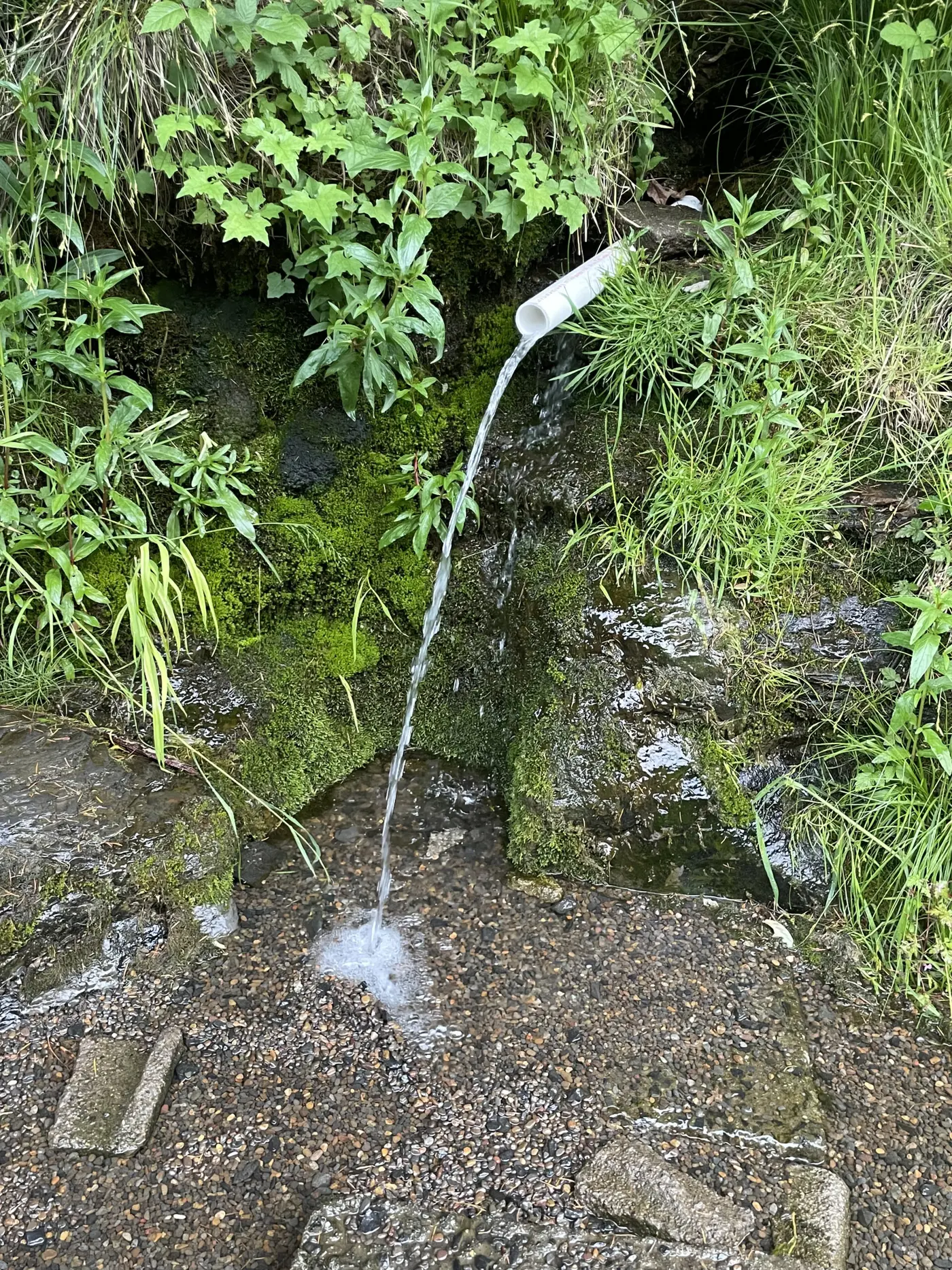
Kings Valley Hwy Spring, Monmouth, OR
Monmouth, Polk County, Oregon. Roadside spring; Year round.
Details

- Where
- Between Mile post 15 & 16 on Kings Valley Hwy., Monmouth, OR. Directions
- When
- 24/7/365.
- Getting there
- On the west side of the highway between mileposts 15 and 16, a ways south of Monmouth; the pullout is on the east side of the road.
- Fees
- No Fee.
- Access
- Easy to miss. Straight across from the "Adopt a Highway Program" sign.
Between mileposts 15 and 16 on Kings Valley Highway, a ways south of Monmouth, a short length of PVC pipe juts from a hillside and runs water day and night, every day of the year. The Find A Spring register, where Jenny Dowen submitted the spring, records the flow as continuous. It describes the water as cold enough to instantly chill glass jugs and notes that many locals stop daily to fill up. It lists the temperature at 50° F. There is no fee and no sign.
The pull-out is large, gravel, unmarked, and easy to pass. A commenter named Max described the approach in 2017 as a drive out from Salem along the eastern foothills of the Coast Range. He gave the landmark: the pull-out sits straight across from an “Adopt a Highway Program” sign. The written accounts place the spring differently. The poster OddNicky, writing on Reddit, put the spring on the west side of the highway and the pullout on the east. A 2021 visitor, Ashley, advised following the written directions and not the GPS points.
The pipe itself has drawn argument. In 2012 an anonymous poster warned that the PVC and its joint glue were toxic. In 2014 a commenter signed JWJones answered that there is no joint and no epoxy. By that account the pipe is a short piece set up to a stone “spout,” there only to channel the water into bottles, and it “could just as easily be removed.”
OddNicky reported that no official test results exist, though “people do check periodically and it’s always been clean.” One check is on the record. On Saturday, March 22, 2014, Joseph Hill tested the water and posted his results. He found total dissolved solids of 32 ppm and a pH of 6.6, and the water tested negative for bacteria, lead, and the pesticides atrazine and simazine. Nitrates came in at about 0.5 to 1.0 ppm, which he noted was far below the EPA level of 10 ppm. He put the slight acidity down to acid rain falling on a spring “coming off the side of a hillside.”
The highway takes its name from the valley, and the valley from Nahum King. He came to Oregon in 1845 from St. Joseph, Missouri, with his wife Sarepta and more than two dozen of their family. King and others of the party filed so many donation land claims along the Luckiamute River that by 1854 the area had become known as Kings Valley.
Notable Events
- 1854Nahum King and other members of the party had filed donation land claims along the Luckiamute River; so many, in fact, that by 1854 the area had become known as Kings Valley. guides.library.oregonstate.edu
- 2014A visitor tested the spring's water: TDS 32 ppm, pH 6.6, and negative bacteria, lead and pesticide tests. findaspring.org
People
- Nahum King, the first settler of Kings Valley, the valley whose name the highway this spring stands beside carries (an Oregon pioneer of 1845).
- Jenny Dowen, submitted the spring to the Find A Spring register.
- Joseph Hill, tested the spring's water and posted the results on its register page (2014).