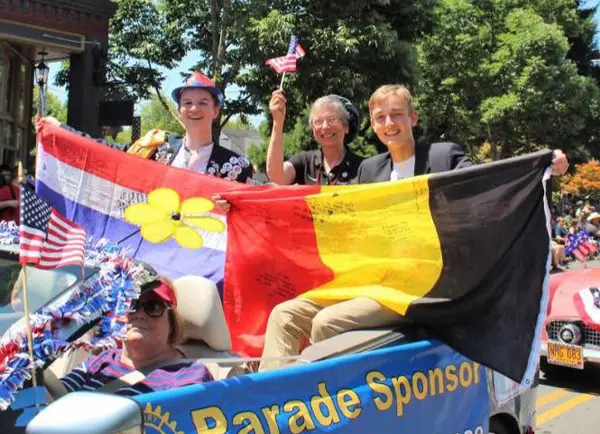
July 4th Festival and Grand Parade
Monmouth, Polk County, Oregon. July 4th Festival.
Details

- Where
- 151 Main St W, Monmouth, OR 97361. Directions
- When
- July 3 at 12:00 PM through July 4 at 5:00 PM PDT.
- Getting there
- Parade starts at WOU in Monmouth and ends at Riverview Park in Independence, approximately 3 miles and 2 hours.
- Hours
- Parade steps out at 12:00 noon.
- Access
- Parade participant staging is on Monmouth Avenue at the north end of Western Oregon University at Stadium Drive.
- Walk-in or reserve
- No entry needed for the children's mini parade.
- Phone
- 541-760-0295
- Website
- mirotaryclub.org
- Managed by
- City of Monmouth, Oregon - Government.
Two days before the parade, the chairs go out. Folding chairs line the curbs of Monmouth, Oregon, holding places along a route that runs from the north end of the Western Oregon University campus down Monmouth Avenue, along Main Street past Main Street Park, and on to Riverview Park in neighboring Independence. The parade is the center of a celebration the two towns hold together, with Monmouth’s July 4th Festival at one end of the route and Independence Days at the other.
Main Street Park, July 3 and 4
The City of Monmouth sponsors the festival in Main Street Park, which has an amphitheater and a stand of sequoias. The city bills it as a family arts festival built around music, dance, and theater, with food, live entertainment, and vendors selling handcrafted goods from rows of ten-by-ten booths. Children make their own pieces of art at a crafts area. The 2026 festival ran from noon to 8 p.m. on July 3 and from 9 a.m. to 5 p.m. on July 4. A city listing shows Monmouth Taiko on the park stage at 1:15 on the afternoon of July 3, playing traditional Japanese taiko drums with flute and dance.
Other events have grown up around the festival. An annual tennis tournament has been part of the celebration for 46 years, according to the city. A vintage car show has been part of it for about 20.
The Fourth, from campus to the river
In 2016 the “MI Town” column in the Polk County Itemizer-Observer described the Fourth beginning with a fireman’s breakfast of scrambled eggs, pancakes, and ham, served by firefighters, volunteers, and their families. Cub Scouts and Boy Scouts kept the tables tidy and helped people through the line. That year the columnist marched in the parade with the Chemeketa Chapter of the Daughters of the American Revolution.
At 11 a.m. the Mini-Marathon starts at City Hall in Monmouth and ends at City Hall in Independence. The Willamette Valley Road Runners sponsor it, and the city says it has been part of the celebration for over 40 years. A children’s mini parade follows. It runs from Jackson Street and Monmouth Avenue down to Knox Street, and any child can join without signing up by lining up before 11:30.
At noon the Grand Parade steps out. The Monmouth-Independence Rotary Club, founded in 1960, sponsors it, and Jim Birken served as parade chair for 2026. Entries gather on Monmouth Avenue at Stadium Drive and are judged between 10 and 11 that morning. The university’s own float joins the line. The WOU calendar gives the parade an hour, noon to 1 p.m. The Rotary puts the route at about three miles and two hours of travel time.
Ribbons go to first, second, and third place in categories that include Best Youth Equestrian, Family Group, Farm Equipment, Highway Trucks, and Antique Vehicle, meaning fifty years and older. The vehicle classes are judged on cleanliness and decoration. A Grand Ribbon goes to the entry that best represents the theme. Marchers are asked to walk candy to the curb rather than throw it, because children may run into the street after it. They may squirt water at spectators only if the spectators ask. Confetti is banned. Confetti guns at an earlier parade, the Rotary notes, “looked super cool” but left a mess that took the city’s Public Works crew months to clean.
The parade ends at Riverview Park in Independence. Friends of Community Parks runs Independence Days there and says the celebration has brought the community together since 1902.
Seid Back’s fireworks
Friends of Community Parks reports that “numerous sources” credit the first Fourth of July fireworks in Independence to Seid Back, a prosperous Chinese immigrant. Its history page shows a photograph of him with his son, Seid Gain, in front of the family’s mercantile store in Portland.
The Oregon Encyclopedia gives his life. Seid Back was born in 1851 in a Cantonese-speaking region of China. He came to the United States at seventeen and worked as a railroad laborer and cook. By 1875 he had opened a general store in Portland and a labor-contracting firm that supplied as many as sixteen hundred railroad workers a season. Among his acts of patriotism toward his adopted country were annual donations of hundreds of dollars in fireworks so Oregon children could celebrate the Fourth of July.
He also bought a ranch in Independence. During a particularly hard winter he gave work and lodging there to hop pickers and their families, and he paid triple wages to the hardest workers. He died on November 1, 1916, from injuries he suffered in a fall at the ranch. Judge Henry McGinn gave the eulogy: “I have known all the eminent men of Oregon for the past 50 years, and I never knew any of them who measured up to Seid Back in honor, love for his kind, desire to help others and faithfulness to ideals.”
A Winter Olympics in July
The modern celebration traces to 1970, when Denver, Colorado, was awarded the 1976 Winter Olympics. Friends of Community Parks credits this account to Amy Christensen and the Independence Heritage Museum. By 1972 Colorado voters had refused to pay for the Games, and the International Olympic Committee chose Innsbruck, Austria, instead. During the search for a new host, Monmouth sent in a lighthearted bid of its own, despite having no snowy terrain and no winter sports facilities. The IOC ignored it.
The town held its own “Winter Olympics” during the Fourth of July in 1973. A newly formed Monmouth Independence Festival Association, with representatives from both towns, organized it. The history notes that Monmouth was a dry town at the time and that participants might want a drink, so the two towns worked together.
The program included a shorter version of the parade route, a bike race from Falls City, a mini-marathon from Monmouth to Independence, river rafting, frisbee challenges, track and field, and rock skipping on the Willamette. A dance and concert followed, and the day ended with fireworks at Polk Marine Park, now Riverview Park. In a 2021 city newsletter, Mayor Cecelia Koontz added a downhill ski race run on grass and a cow-pie throwing contest. She also explained the length of the 2.6-mile mini-marathon: it was one-tenth of a regular marathon, “about what they figured they could run.”
Koontz credited the idea to Scott McArthur, Dee Bridges, and Don Milligan. McArthur practiced law in Monmouth from 1967 and served as city attorney from 1969 to 1975. In 2004 he wrote Monmouth Oregon: The Saga of a Small American Town. When the business associations of the two towns merged, McArthur was president of the Monmouth group. He proposed a coin flip to Independence’s business leader, Al Oppliger, to decide whose name would come first, and his call settled it. The resulting Monmouth-Independence Chamber of Commerce later took over the festival, and a Western Days Commission followed.
By 1983 the Olympic joke had worn thin, and the theme turned Western. Independence’s celebration was still called Western Days in 2016, when it opened on a Friday with carnival booths and an evening showing of Jurassic World. The Willamette Valley Concert Band closed that weekend with patriotic songs on Sunday. In the mid-2010s the name changed to Independence Days.
McArthur died in August 2021 at 88. Among the funds he left with the community foundation he co-founded is the Monmouth Bicentennial Endowed Fund. When he started it, he said: “Just in case I’m not around in 2056, I want to make sure they can throw a hell of a party.”
Notable Events
- 1902Friends of Community Parks says Independence Days has brought the community together since 1902. friendsofcommunityparks.org
- 1973The town of Monmouth created its own 'Winter Olympics' during the Independence Day celebrations in 1973, organized by the newly formed Monmouth Independence Festival Association. friendsofcommunityparks.org
- 1983In 1983, the theme shifted from the playful 'Winter Olympics' to a Western theme, as the Winter Olympics joke began to lose its relevance over time. friendsofcommunityparks.org
- 2010sIn the mid 2010s, the theme changed from Western Days to Independence Days. friendsofcommunityparks.org
People
- Dee Bridges, Co-creator of the Winter Olympics in Monmouth.
- Don Milligan, Co-creator of the Winter Olympics in Monmouth.
- Kent Scott McArthur, Co-author of the Winter Olympics idea and the author of Monmouth Oregon: The Saga of a Small American Town.
- Seid Back, Chinese immigrant, merchant, and labor broker whose annual donations of hundreds of dollars in fireworks brought the first Independence Day fireworks to Independence; bought a ranch in Independence where he provided work and lodging for hop pickers.
- Willamette Valley Concert Band, Patriotic concert performers who closed the Western Days with a Sunday presentation of patriotic songs.
Sources
- ci.monmouth.or.us/pview.aspx?id=26838&catid=554
- calendar.wou.edu/event/independence-day-grand-parade
- ticketsignup.io/TicketEvent/MIRotaryGrandParade2026
- mirotaryclub.org
- facebook.com/MIChamber
- facebook.com/CityOfMonmouthOregon
- instagram.com/monmouthcity
- facebook.com/events/2206800983391968
- friendsofcommunityparks.org/history-of-independence-days