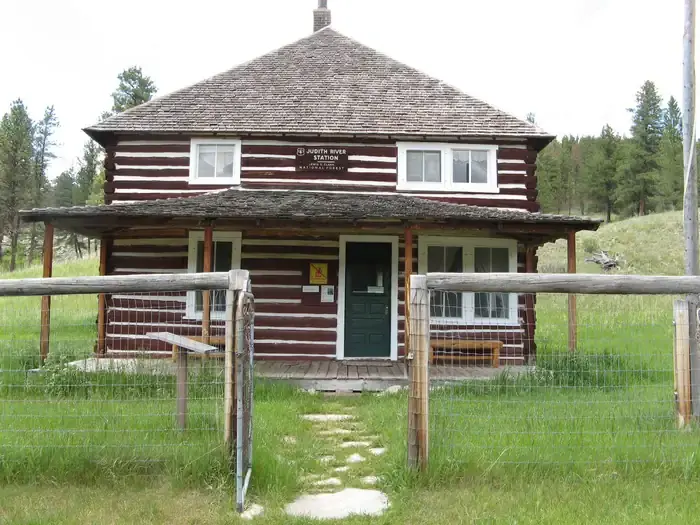
Judith Guard Station
Stanford, Judith Basin County, Montana. Historic ranger station.
Details

- Where
- Stanford, Judith Basin County, MT. No street address stated. Directions
- When
- Check out time 11:00 AM.
- Getting there
- From Windham, turn off Montana Highway 200/US 87 heading south for about ten miles to Utica, MT. At the Oxen Yoke Inn, turn south onto the gravel county road. Continue south for 13 miles, turn right at the "Y" junction. Continue southwest for about one mile; at the second "Y" junction stay to the left and continue about one mile to the cabin.
- Fees
- $60 per night for single unit.
- Access
- The facility is accessible in a highway vehicle except when the roads are snow covered.
- Walk-in or reserve
- Walk-in reservations no longer accepted.
- Managed by
- Helena-Lewis and Clark National Forest.
- Established
- early 1900s.
- Coordinates
- 46.84833333, -110.2905556.
The road to Judith Guard Station leaves Montana Highway 200 at Windham, runs about ten miles south to Utica, and turns onto gravel at the Oxen Yoke Inn. Thirteen miles on, past two “Y” junctions, it comes down to a log house on the northern bank of the Middle Fork of the Judith River. The house sits about 30 miles south of Stanford, at an elevation of 5,000 feet.
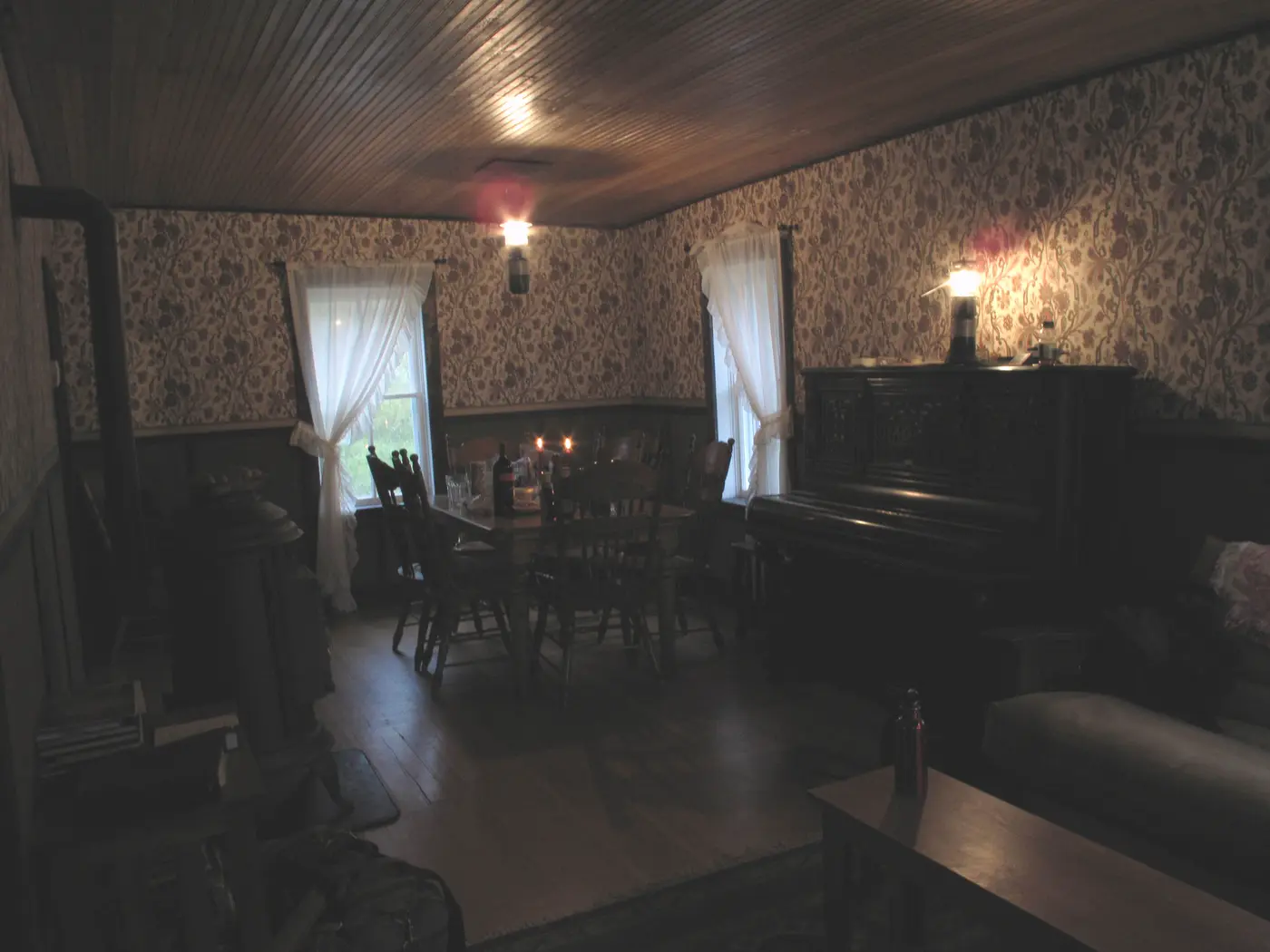
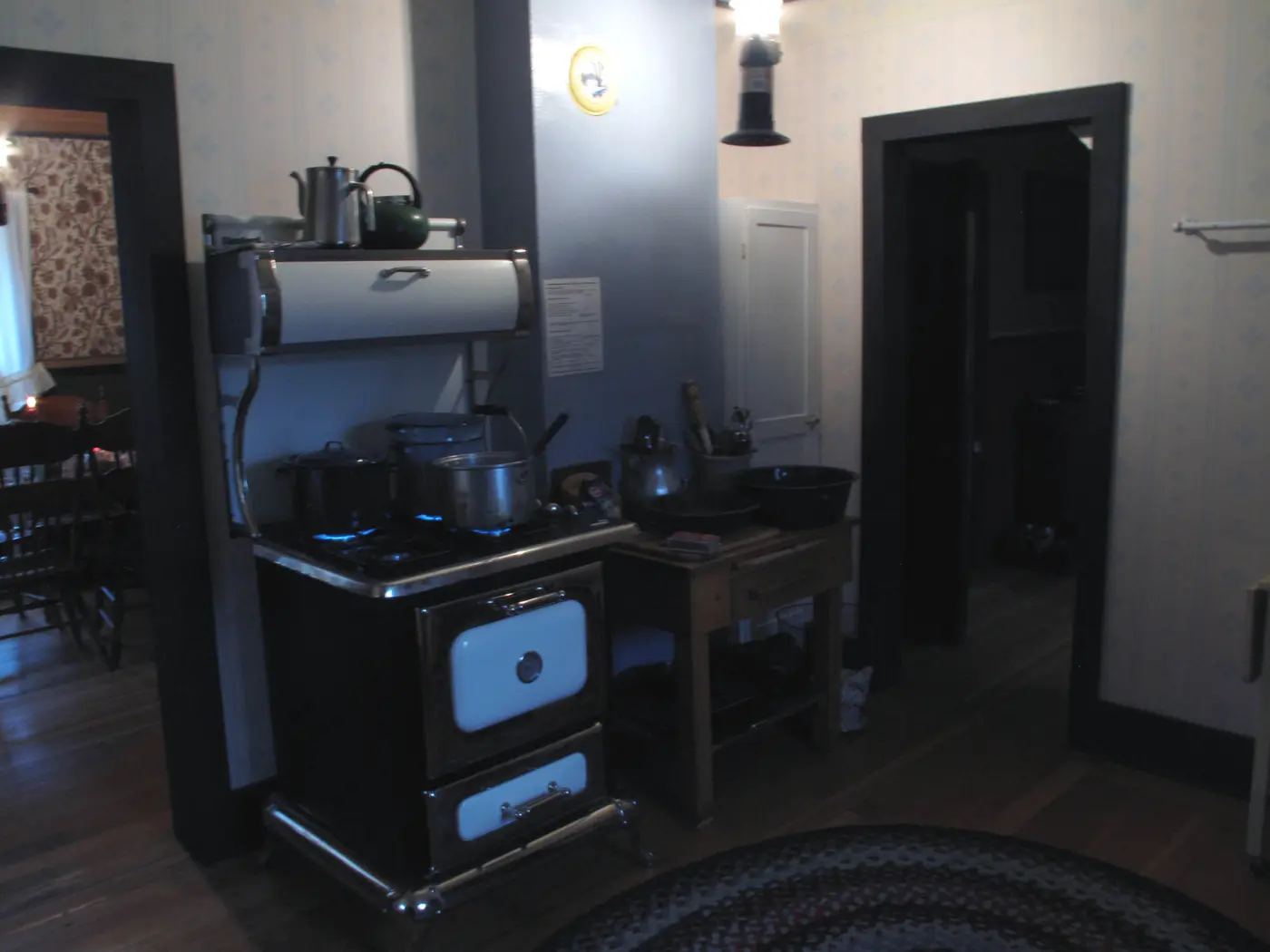
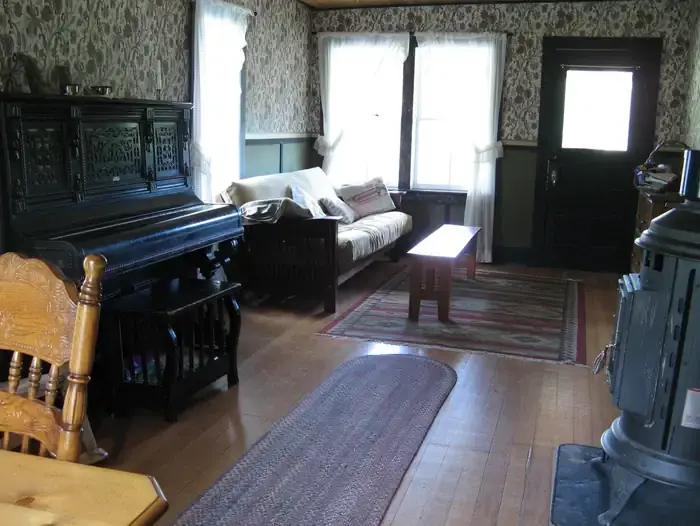
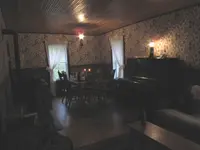
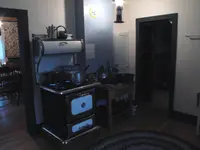
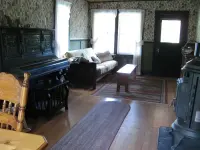
The Helena-Lewis and Clark National Forest rents the house by the night, and it sleeps eight. A propane stove cooks and heats. The kitchen has a table, chairs and cooking utensils, and there are portable propane lanterns, though guests bring their own cylinders. There is no electricity. A hand well outside gives drinking water from May to September and none in winter. A modern vault toilet stands outside, and chairs line the porch. Recreation.gov describes the furnishings and wallpaper as historically accurate.
Guests pack out their own garbage. Campers and RVs may not park in front of the station, under a historic preservation rule. They go instead to the small campground just down from it, which has a picnic area near the river. In winter the road is usually plowed to within two miles of the station, and in heavy snow the last half-mile may take a snowmobile, skis or snowshoes. Deer, elk, bear, bobcats and mountain lions range the surrounding country, and food storage against bears is mandatory.
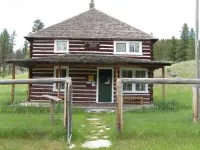
The Forest Service pages call the building a two-story frame cabin. The National Register nomination, written by historical architect Ken Sievert in 1990, describes it as a square, 24-by-24-foot, story-and-a-half log structure.
The meadow in the bend of the river
The nomination places the station in a mountain meadow at a big bend of the Middle Fork, on the timbered eastern downslope of the Little Belt range, among ponderosa pine and other conifers. The recreation listing adds lodgepole pine and Douglas fir. According to the nomination, the pocket made by the bend is sheltered from the open prairie nearby and faces the winter sun.
The buildings run in a line from northeast to southwest. The house comes first, with a single-car garage beside it. Farther off stands a tall log horse barn, with a round corral at its northeast corner and pasture running south to the river. The old road comes down the hillside from the northeast, passes the front of the house, and turns south to ford the river. A log bridge once crossed there; it has been removed.
The house walls are peeled native logs six to ten inches through, joined at the corners with a plain half-lap. The gaps between the logs are chinked with hand-split wood billets. Willow saplings nailed along the outside of each lower log hold the lime-mortar daubing in place, and a single strand of barbed wire runs inside each joint. The pyramidal roof is laid in sawn wood shingles, with a brick chimney north of center. An open hip-roof porch runs across the full southeast front, and a shed-roofed lean-to covers half the back.
Ranger Myers and the 1876 cabin
The barbed wire came from earlier occupants of the meadow. Thomas Guy Myers sat the first ranger examination, held at Neihart in August 1905, and was appointed to the Little Belt Reserve effective May 1, 1906, at $900 a year. In 1944 he wrote his recollections for the Forest Service collection Early Days in the Forest Service. In them he says he went over to the Judith on the first of August 1906 to take charge of the district. There he found “an old log cabin that was built in 1876,” which he learned was to be his home, along with an old log barn and a shed but no fenced pasture. He and the other rangers “gathered up a lot of barbed wire scattered through the timber, left by the sawmill outfit that had been located here for years.” In his telling the wire went into fence. The Montana National Register Sign Program says he used it to reinforce the daubing. The nomination names the mill as Burke’s, across the Middle Fork, and says it was abandoned when Myers arrived. When the Supervisor wrote that there were no funds for wire to finish the fence, Myers bought it himself.
The Sign Program describes his charge as administering public use of the newly set aside “federal” timber, range, water and mineral resources of the Judith District. He did it, in the Sign Program’s words, “armed with this pocket-sized ‘Use Book’ of Forest Regulations.” In his own account the trouble came mostly from the Supervisor’s office. At the end of August 1906 he was called to a ranger meeting on the Musselshell. The Supervisor got lost in fog near Haymaker Creek, and the party took four days on a trip Myers later found could be made in one. Twelve days after setting out he rode back into the Judith Station: “I found about 100 head of cattle in the patch of oats I had planted for hay. Some ranger meeting!”
For his first advertised timber sale, promised help from the office never came. He worked from the Use Book and wrote it up in longhand, and the office returned it with a six-page letter listing his mistakes. He rode to Neihart the next day, “put his letter and everything on his desk, and asked him what the hell he wanted.” The sale went through.
In 1907 he had six cattle and horse permittees and rode from ranch to ranch collecting their applications. When the office insisted that a rancher named Ethen apply for 500 head, Myers took his own winter counts to Neihart; he had never found 350 on the Forest at one time. The permit was approved for 350. Paul G. Redington took charge of the Forest in November 1907 and put W. S. Perrine in charge. Perrine then gave Myers the job of finishing the telephone line to Judith Station. Myers recalled completing it the last of November, after cutting the crew from 28 men to 12.
The nomination records a second story about the 1876 cabin. Local people report that it may have been built by an 1870s squatter called “Dirty Emil,” who is alleged to have buried many $20 gold pieces on the site in a bean pot. Emil was murdered, and the gold was never recovered. The form notes that the story is not widely accepted. Myers used the old cabin as a garage from the time he built the station until the present garage went up in 1925.
A roof to split a raindrop
In 1908 Myers received an authorization for $450 to build the dwelling, “blueprints and all made by an engineer by the name of Work.” The building was to be 24 by 24 with a hip roof. The lumber was bought in Great Falls, shipped to Benchland and hauled 26 miles to the station by team. The logs were cut about 13 miles away at $1.25 a log. Ellen Baumler, interpretive historian at the Montana Historical Society, writes that Myers built from a catalog-ordered “house kit,” supplemented with native logs.
The blueprint called for hip rafters 24 feet long. Myers told the office they should be 20, and the office told him to follow the plan. “When I put two of them up I saw the roof with that pitch would split a raindrop,” he wrote. He cut off two feet, found the roof still too steep, cut off two more, “and it was still quite steep, but I let it go at that.” When the office had no money for a level, he bought one himself.
With the walls up and the roof on, he had one big room downstairs and an upstairs with no floor. A neighbor at the American Sapphire Mine lent a team and sled to haul logs to the mine’s mill. There Myers sawed about 3 M feet into boards and 2x4s for partitions and a rough upstairs floor. With lumber to spare, he built a porch across the front and another halfway across the back, but he had no shingles for the porch roofs. When the Supervisor came by and asked where the lumber came from, Myers answered that “the porches looked awful without shingles, and by gosh I got them.” At the end of the fiscal year the office turned back about $3,300 in unspent funds. “Was I mad? NO.” According to Forest archives cited in the nomination, he built the horse barn in 1909.
Emily McLaury’s timeline
Baumler writes that Myers married Emily McLaury in the early 1910s and brought her to the station. In his own account, he “had just got back to the Judith Station from my honeymoon trip” in 1910 when he was ordered to Missoula for fire duty and sent on to Wallace, Idaho. He walked nine miles from Mullan to a fire camp at the head of Boulder Creek and was there the night of the big blow-up. “All of us were burned quite badly and one boy lost his life.” He spent the rest of that season in the hospital and returned to duty after the first of January 1911.
At the station, Baumler writes, the couple added bead board walls and wallpaper, Emily taught school, and they raised their son, Robert. Myers counted twenty-five years at the Judith District, under fifteen supervisors, and retired in 1936 as Senior Forest Ranger, Procurement & Supply. The family lived at the station year-round until the early 1930s, and the house roof was re-shingled in that decade. After the family left, rangers occupied the station seasonally until 1981. In the 1960s, according to a local informant, District Ranger Doc Cornell built the round corral of posts and rails, about 40 feet across.
In June 1989 the Forest Service hired Bernie Weisgerber, a National Park Service restoration specialist, to evaluate the complex. In 1990 the nomination’s preparers interviewed long-time residents, among them Esther Hansen Knoepke, a former resident of the station. The property was listed in the National Register of Historic Places on April 10, 1992, under its historic name, Judith River Ranger Station.
Baumler writes that carpenters on the Forest Service restoration found the house kit’s shipping crate framing the doorway between the living and dining rooms. Wallpaper samples and opened mail had been used to fill the gaps around windows and doors. In Robert’s upstairs bedroom, beneath a layer of sheetrock, they uncovered a timeline Emily had drawn on the wallpaper as a teaching tool, running from the Stone Age through ancient Mediterranean history.
Notable Events
- 1876A small old cabin stood on the north terrace of the Middle Fork before the Station was established; the initial site form dates it to 1876. npgallery.nps.gov
- 1906Forest Service Ranger Thomas Guy Myers took up residence in the newly created Jefferson National Forest, tracing the station's origin. greatfallstribune.com
- 1906The Ranger arrived at the site; Burke's sawmill across the Middle Fork was abandoned when Myers arrived. npgallery.nps.gov
- 1907After Redington took charge and put Perrine in charge, Perrine assigned Myers to complete the Judith Station telephone line; Myers recalled finishing at the end of November. npshistory.com
- 1908The Ranger built the station himself; the cabin was both the Ranger's office and his home. npgallery.nps.gov
- 1908Myers received $450 authorization for the Judith Station dwelling with blueprints by engineer Work. npshistory.com
- 1909Forest Archives indicate the horse barn was built by Myers in 1909. npgallery.nps.gov
- 1910sMyers married Emily McLaury and brought her to the station. greatfallstribune.com
- 1910Myers recalled returning to Judith Station from his honeymoon and receiving orders to report to Missoula for fire-duty assignment during the 1910 fires. npshistory.com
- 1925Myers used the old cabin as a garage from the time he built the Station until the present garage was built in 1925. npgallery.nps.gov
- 1930sThe family lived at the station year-round until the early 1930s; rangers thereafter occupied it seasonally. greatfallstribune.com
- 1930sThe nomination describes the house roof as re-shingled in the 1930s. npgallery.nps.gov
- 1960sAccording to a local informant, the round corral was built by Doc Cornell, the District Ranger. npgallery.nps.gov
- 1981Rangers occupied the station seasonally until 1981. greatfallstribune.com
- 1992The Judith River Ranger Station was listed in the National Register of Historic Places, NRIS Reference Number 92000333. npgallery.nps.gov
People
- Emily McLaury, Myers's wife and station resident; schoolteacher; the couple added bead board and wallpaper and raised Robert at the station (early 1910s).
- Robert, The couple's son, raised at the station.
- Thomas Guy Myers, Ranger of the newly created Jefferson National Forest; built the station (1906).
- Barbara Twiford, Long-time area resident and oral informant for the station nomination (1/30/90 (oral interview)).
- Bernie Weisgerber, National Park Service Restoration Specialist hired to evaluate the complex (June, 1989 (report on Judith Guard Station)).
- Bert Goodman, Former area resident and Forest Service employee; oral informant for the station nomination (3/2/90, 3/29/90 (oral interviews)).
- Bill Trask, Former area resident and letter informant for the station nomination (2/21/90 (letter)).
- Dirty Emil, Squatter at the site in local telling; possibly built the old cabin (1870s).
- Doc Cornell, District Ranger; built the round corral (1960s).
- Ed Arnott, Long-time area resident and oral informant for the station nomination (1/30/90, 3/29/90 (oral interviews)).
- Esther Hansen Knoepke, Former Station resident and oral informant (3/18/90 (oral interview)).
- Evan DeBloois, USDA Forest Service contact who confirmed the amended period of significance.
- Kelly Keim, Archeological Tech., USDA Forest Service Judith District; co-preparer of the nomination.
- Ken Sievert, Historical Architect, Davidson Kuhr Architects; prepared the National Register form (4/4/90).
- M. Jean Setter, Former area resident and oral informant for the station nomination (3/2/90, 3/29/90, 4/12/90 (oral interviews)).
- Mr. Burke, Ran the sawmill across the Middle Fork from the Station; abandoned when Myers arrived (1906).
- Norman Walker, Long-time area resident and oral informant for the station nomination (2/8/90, 3/29/90 (oral interviews)).
- Phil Korell, Former area resident and oral informant for the station nomination (2/19/90 (oral interview)).
- John F. Preston, District Office officer who visited Judith for inspection (1911 or 1912).
- Mrs. Myers, Present at the station when a District Office officer visited (1911 or 1912).
- Paul G. Redington, Took charge of the Forest and put Perrine in charge before Myers completed the Judith Station telephone line (November 1907).
- Thomas G. Myers, Senior Forest Ranger, Procurement & Supply; recalled his Judith District service (twenty-five years at the Judith District).
- W. S. Perrine, Put in charge by Redington; assigned Myers to complete the Judith Station telephone line (November 1907).
- Work, Engineer who made blueprints for the Judith Station dwelling (1908).
Sources
- fs.usda.gov/r01/helena-lewisclark/recreation/judith-guard-station-cabin
- recreation.gov/camping/campgrounds/234427
- greatfallstribune.com/story/life/2018/02/15/great-place-gather/331622002
- npshistory.com/publications/usfs/region/1/early-days/1/sec18.htm
- npgallery.nps.gov/NRHP/GetAsset/e351414d-fd3c-4ab0-9435-10d319287937
- historicmt.org/items/show/668
- fs.usda.gov/r01/helena-lewisclark/recreation/judith-guard-station-cabin