Jones Hole National Fish Hatchery
Vernal, Uintah County, Utah. National fish hatchery; At any time of the year.
Details

- Where
- 24495 East Jones Hole Hatchery Road, Vernal, UT 24495. Directions
- When
- Monday - Sunday, year-round except holidays 7:00am to 3:30pm.
- Getting there
- Take Diamond Mountain Road from Vernal, which will merge into Jones Hole Road 20 miles in, until you reach the dead-end at which the hatchery is located.
- Access
- Expect zero cell service. Download your maps or take screenshots of your trail info before you leave Vernal.
- Walk-in or reserve
- Educational programs and hatchery tours are provided to school groups and visitors when scheduled in advance.
- Phone
- (435) 789-4481
- Website
- fws.gov
- Managed by
- U.S. Fish and Wildlife Service.
- Established
- 1968.
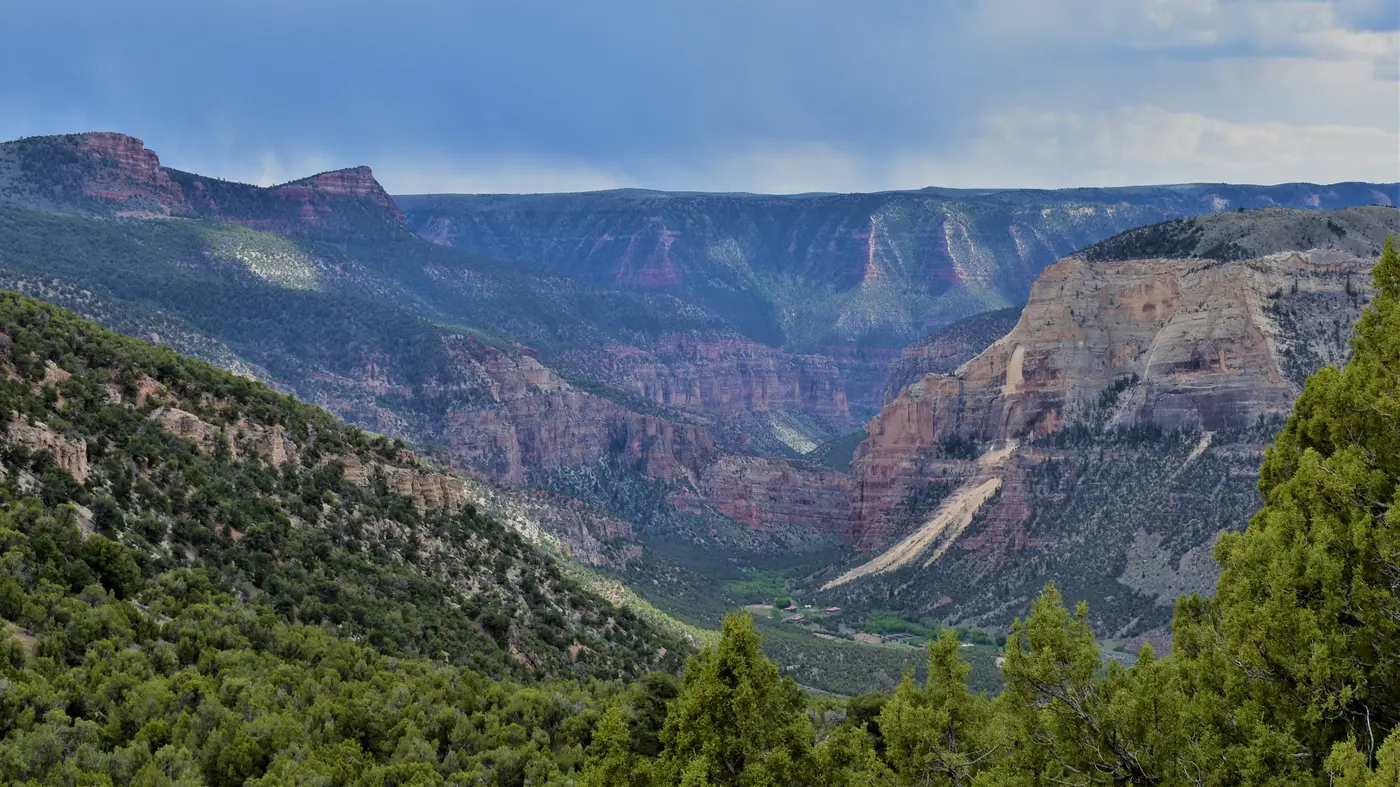
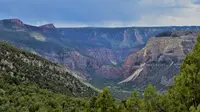
The road from Vernal ends at the hatchery. Diamond Mountain Road leaves town, merges into Jones Hole Road about 20 miles out, and finishes with a winding descent into a sandstone canyon on the Utah-Colorado border, some 40 miles from where it began. There is no cell service at the bottom. In winter, snow drifts periodically close the paved road. During the spring thaw, meltwater freezes on the pavement when the temperature drops.
At the foot of the canyon a spring comes out of the ground at 54 degrees Fahrenheit in every season, up to 15,000 gallons a minute. The U.S. Fish and Wildlife Service has raised trout on that water since 1970. Jones Hole National Fish Hatchery covers 390 acres in Uintah County, and the creek that leaves it runs down to the Green River through Dinosaur National Monument.
Raceways below the spring
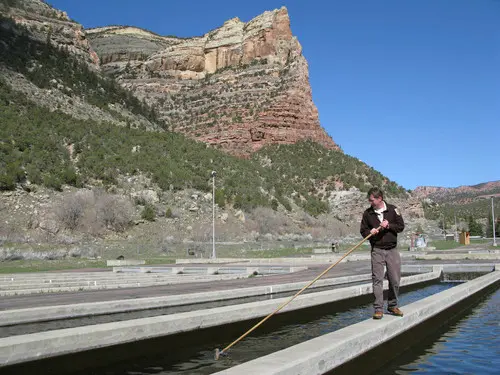
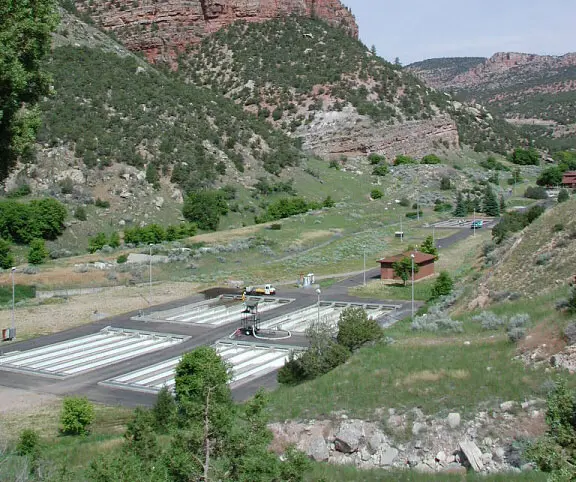
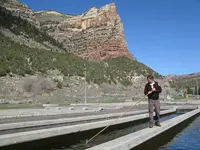
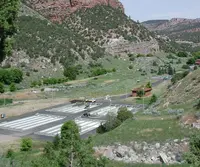
The hatchery works 40 rearing tanks and 50 raceways, and visitors may walk among the outdoor raceways where the fish grow. The sources name the species differently. Visit Dinosaurland lists rainbow and cutthroat trout at various stages of growth. The National Park Service names Bonneville cutthroat trout and kokanee salmon, raised to stock waters in Utah, Wyoming, and Colorado. The Service’s own page gives the current species as Bonneville cutthroat, kokanee, and tiger trout.
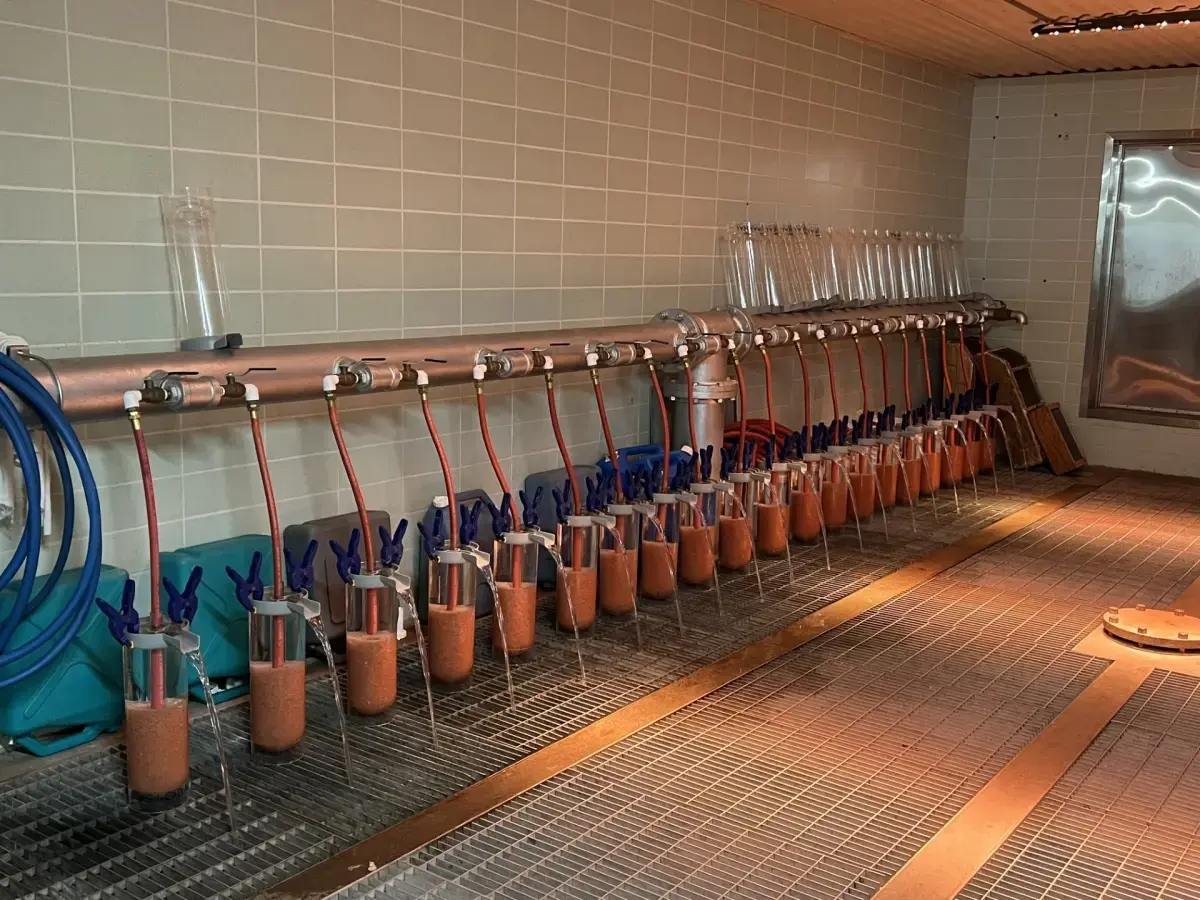
Jones Hole keeps no broodstock. About 2 million rainbow, cutthroat, or kokanee eggs arrive each year from other federal and state hatcheries. A 2011 KSL report followed the fish from hatching jars to fry, then to larger concrete tanks, and at last to the outdoor raceways. At 5 to 10 inches most were trucked to dozens of waters in northeastern Utah and southeastern Wyoming, and three trucks made up to 100 deliveries a year. “We do 1.1 million fish every year; 700,000 of those go to Flaming Gorge - 400,000 rainbows and 300,000 Kokanee Salmon,” Justin Perkins told the station.
Counts vary by year and by source. The Service reported almost 2 million trout reared in fiscal year 2000, and it now gives up to 1.2 million a year. About 85 percent go into Colorado River Storage Project waters, among them Flaming Gorge, Steinaker, and Red Fleet reservoirs. The rest go to the Wind River Indian Reservation in Wyoming and to some state-managed waters.
More than 7,000 people come each year. The visitor center is open daily from 7:00 a.m. to 3:30 p.m., holidays excepted, and staff answer questions on the grounds. Tours and educational programs are given when arranged in advance. A shaded picnic ground with tables and restrooms sits beside the parking lot and an information kiosk, and most hikers start from there.
Down Jones Hole Creek to the Green
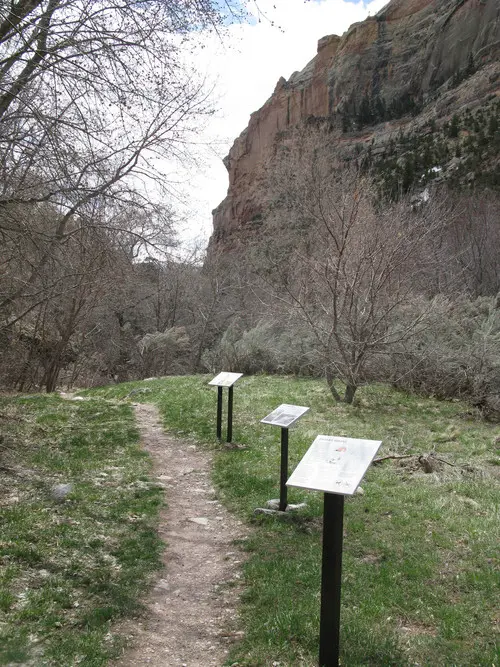
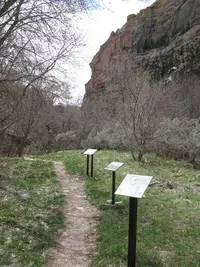
Jones Hole Creek begins as the hatchery’s spring. The trail leaves from the south end of the grounds and soon crosses onto monument land. It follows the creek 4 miles through a narrow canyon in the Diamond Mountain range to the Green River. The Service calls the walk easy, with about 200 feet of elevation change. Visit Dinosaurland puts it as mostly downhill going in and uphill coming out. Pets are not allowed, and creek water is not recommended for drinking. The creek is clear and cool and holds brown and rainbow trout. Visit Dinosaurland calls it a “Blue Ribbon” fishery, with lure and bait restrictions and a Utah license required.
About a mile and a half down, past the footbridge, is Deluge Shelter. Its canyon wall carries panels of petroglyphs and pictographs left by the Fremont people, who made Jones Hole their home a thousand years ago. The pictograph paint was made from iron minerals mixed with plant juice or animal oil. The Service notes that it has lasted against time but cannot resist the acids of human skin, and asks that no one touch it.
At about 2 miles Ely Creek comes in from the west. The Island Park Trail follows it roughly a quarter mile to a small waterfall shaded by Douglas fir and birch. A hike-in backcountry campsite stands at the confluence and requires a reservation. Black bears have been active around it, so proper food storage is required. The hatchery itself has no overnight camping.
The trail ends near the mouth of Jones Hole Creek, in the Whirlpool Canyon section of the Green. Bighorn sheep are often seen near the river, and river rafters commonly tie up here to hike up and see the fish. The river campsites at the confluence are held for permitted rafting groups from about mid-May to mid-September. The rest of the year, hikers with a backcountry permit may use them.
The canyon walls do not always hold. On June 18, 2013, a large slab broke from a cliff face less than a quarter mile from the hatchery. On June 20 a small slide came in the morning and a larger one about noon. In the third, a section of Weber sandstone 100 by 50 feet and more than 10 feet thick sheared off the cliff. Kip Bottomley, the hatchery’s program manager, saw it. “The whole slab just separated and fell,” he later told a Park Service geomorphologist, Eric Bilderback. “It was in one piece until it hit that ledge. When it hit there, it just exploded.”
The largest boulder stood more than 10 feet tall and 10 feet wide. Bilderback said it came off the cliff more than a thousand feet up and traveled 1,200 feet past its base, much of the way through the air, before crashing into a tree that then blocked the trail. A month later cream-colored dust still coated the ground, and the trail stayed closed from the hatchery boundary to Ely Creek. Bilderback found evidence on the same slope of two earlier events of about that size within the last couple thousand years.
A topographer and a man in hiding
After the Fremont, visitors came by way of the Green. Major John Wesley Powell camped on its banks in 1871 and named the canyon for his expedition’s topographer, Stephen Vandiver Jones. The Fish and Wildlife Service says the name took hold after an incident in 1883. A man named Charley Jones believed he had killed someone and hid out in the canyon for a winter. When he learned the man had lived, he is said to have cried in relief, “You mean I can finally get out of this hole?”
A road before a hatchery
The spring brought the government here. In May 1966 Senator Frank E. Moss called Jones Hole a superior site for a hatchery. He cited a water supply of 30 second-feet issuing from springs at a nearly constant temperature.
The road came first, and slowly. Congress provided money for an access road in 1965, and the Bureau of the Budget froze it. That spring the Vernal Chamber of Commerce heard a letter from Elmer Staats, deputy director of the Bureau of the Budget, to Senator Wallace F. Bennett. “We still believe that funds should not be spent on an access road until a final decision is made to construct a hatchery at this location,” Staats wrote. He added that the road’s estimated cost had grown almost to the cost of the hatchery itself. “Consideration should also be given to the additional expense of operating in this remote area.” The Vernal Express ran the news under the headline “Jones Hole Hatchery Road Outlook Dims.”
By May 1966 the outlook had turned. A telegram from Moss’s office told the paper that the Bureau of Public Roads and the Fish and Wildlife Service were preparing plans for both road and hatchery. The road had to be finished before hatchery construction could begin. The Senate Appropriations Committee approved funds to complete the hatchery, whose trout were meant for reservoirs of the Colorado River Storage Project and the Central Utah Project. A Vernal Express photograph dated May 25, 1967, shows Mayor Alvin Kay at Jones Hole on a visit with the Bureau of Fisheries to the proposed site. The caption has him looking for “outlaw gold treasure.”
The hatchery was founded in 1968 and produced its first trout in 1970. According to The Salt Lake Tribune, it was built as mitigation for the dam at Flaming Gorge Reservoir.
Mitigation fish and a closure threat
That obligation came back into question four decades later. President Barack Obama’s proposed 2012 budget, released in 2011, considered eliminating $600,000 for Jones Hole. Utah answered with a letter reminding the federal agency of its legal responsibility to provide mitigation for the Flaming Gorge dam.
In November 2013 the Service released its Strategic Hatchery and Workforce Planning Report. The report ranked propagation of non-native species last among the hatchery system’s priorities, and it counted all of Jones Hole’s production as non-native. Ninety percent was for mitigation and 10 percent for tribal obligations. Reimbursement would have come from the Bureau of Reclamation. That agency classed the fish as enhancement and did not pay. “This report sounds the alarm on a hatchery system unable to meet its mission responsibilities in the current budget climate,” said Dan Ashe, the Service’s director.
Utah’s response was quick. “Losing those rainbows and kokanee would not only impact anglers at Flaming Gorge, but the surrounding economies and anglers across both states as well,” said Ryan Mosley, Flaming Gorge project leader for the Utah Division of Wildlife Resources. Greg Sheehan, the division’s director, went further. “We are pretty upset about how this is being handled. We feel they are violating their obligation to states to provide mitigation fish,” he said. “Maybe they want to hand that hatchery over to Utah. We would be willing to have serious dialogue about that.”
Notable Events
- 1871Major John Wesley Powell named the canyon for expedition topographer Stephen Vandiver Jones. fws.gov
- 1883According to the FWS account, Charley Jones believed he had killed a man and hid in the canyon for a winter; the incident helped the name Jones Hole take hold. fws.gov
- 1965Congress provided funding for the hatchery access road. newspapers.lib.utah.edu
- 1965The article says that the Bureau of the Budget had frozen funds in 1965. newspapers.lib.utah.edu
- 1966Public Land Order 4090 withdrew Utah land for an administrative-site addition to Jones Hole National Fish Hatchery. blm.gov
- 1968Jones Hole National Fish Hatchery was founded to produce trout for Colorado River Storage Project mitigation and Tribal trust responsibilities. fws.gov
- 1991Interior's Inspector General found it unlikely that project beneficiaries could be required to repay operating and maintenance expenses for Jones Hole and three other national hatcheries under the applicable project legislation. govinfo.gov
- 2011The first indication that Jones Hole was targeted for closure came with President Barack Obama's proposed 2012 budget, which considered eliminating $600,000 for the hatchery. archive.sltrib.com
- 2011Utah sent the national agency a letter reminding it of the legal responsibility to provide mitigation for Flaming Gorge Reservoir's dam. archive.sltrib.com
People
- Barack Obama, President whose proposed budget considered eliminating hatchery funding (2011).
- Dan Ashe, Fish and Wildlife Service director who warned that the national hatchery system could not meet its mission in the budget climate discussed in the Jones Hole closure-threat report.
- Greg Sheehan, DWR director who criticized the handling of mitigation obligations and said Utah would discuss taking over the hatchery.
- Ryan Mosley, Flaming Gorge project leader for Utah DWR who warned of impacts if Jones Hole's rainbow trout and kokanee production were lost.
- Alvin Kay, Mayor who visited the proposed fish-hatchery site with the Bureau of Fisheries; the archival description depicts him looking for "outlaw gold treasure".
- Kip Bottomley, Jones Hole National Fish Hatchery program manager and witness to the nearby rockslide.
- Charley Jones, Man in the FWS naming account who hid in the canyon for a winter, believing that he had killed a man (1883).
- Major John Wesley Powell, Explorer who named the canyon in honor of his expedition's topographer (1871).
- Stephen Vandiver Jones, Topographer of Powell's expedition and the canyon's namesake (1871).
- Justin Perkins, Explained Jones Hole's fish production and its deliveries to Flaming Gorge.
- Elmer II Staats, Bureau of the Budget deputy director who wrote to Senator Bennett about the hatchery access-road funds; middle initial is preserved from the page's OCR.
- Wallace F Bennett, Senator who received a Bureau of the Budget letter about funds for the hatchery access road.
- Frank E Moss, Senator whose Washington office relayed the hatchery and access-road planning information to the Vernal Express.
Sources
- fws.gov/fish-hatchery/jones-hole
- nps.gov/dino/planyourvisit/jonescreekarea.htm
- fws.gov/fish-hatchery/jones-hole/visit-us
- fws.gov/fish-hatchery/jones-hole/about-us
- archive.sltrib.com/article.php?id=57135593&itype=CMSID
- newspapers.lib.utah.edu/details?id=21574920
- newspapers.lib.utah.edu/details?id=21585112
- newspapers.lib.utah.edu/details?id=21585118
- collections.lib.utah.edu/details?id=2506730
- blm.gov/sites/blm.gov/files/uploads/programs_lands-and-realty_land-tenure_withdrawals_public-land-orders_2251-4975.pdf
- govinfo.gov/content/pkg/GAOREPORTS-RCED-00-151/html/GAOREPORTS-RCED-00-151.htm