International Car Forest of the Last Church
Goldfield, Esmeralda County, Nevada.
Details

- Where
- 1111 E. Crystal, Box 5, Goldfield, NV. Directions
- When
- Open and accessible 24/7, best enjoyed from sunrise to sunset.
- Fees
- No admission fee.
- Access
- Free; donations appreciated; portable restroom and visitor log at the entrance; current artistic minds working to recruit specific artists rather than encouraging tagging.
- Phone
- (775) 319-6383
- Managed by
- International Car Forest of the Last Church (non-profit registered with the State of Nevada).
- Established
- April 1, 2020 (Nevada non-profit incorporation).
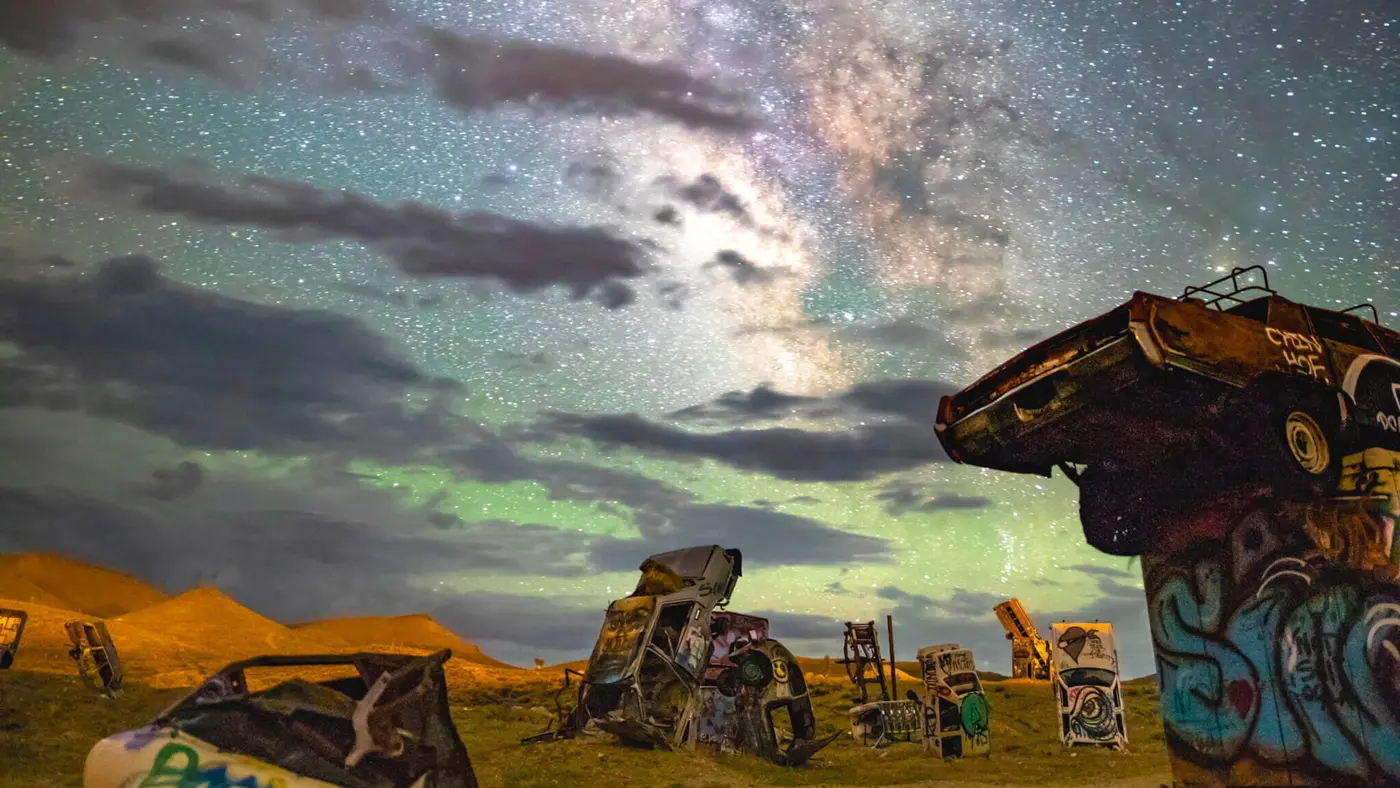
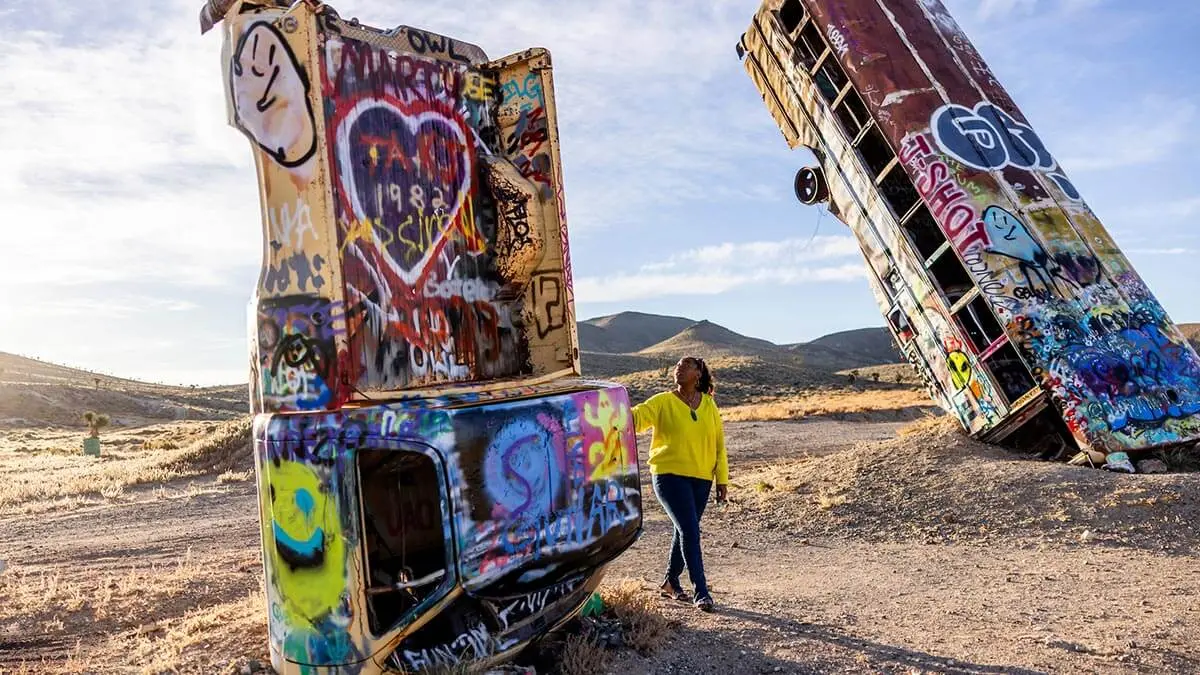
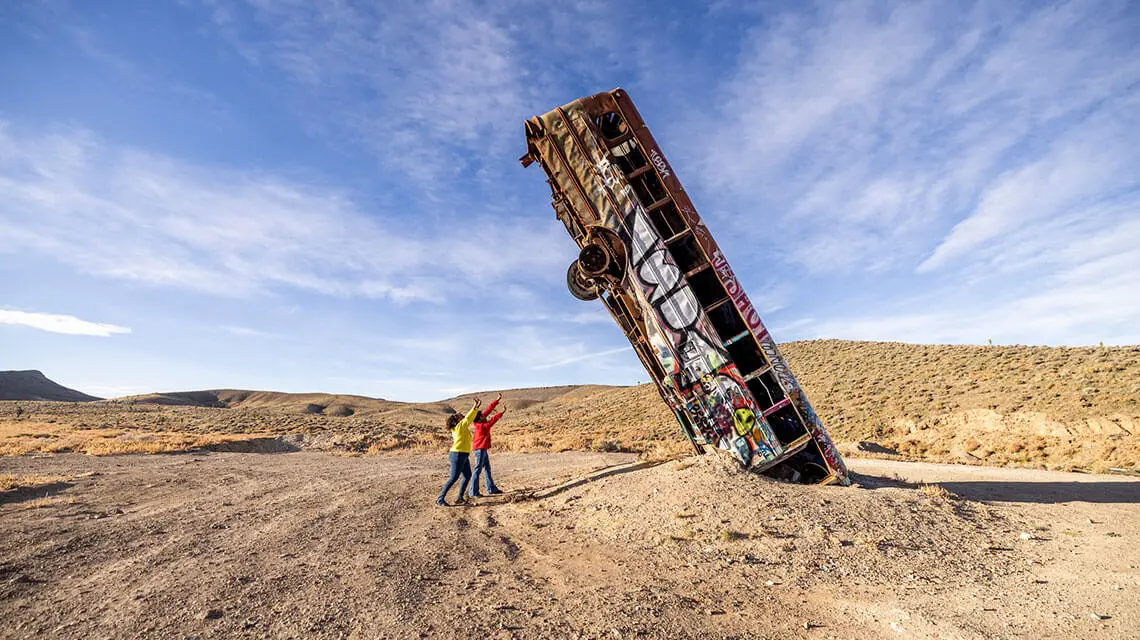
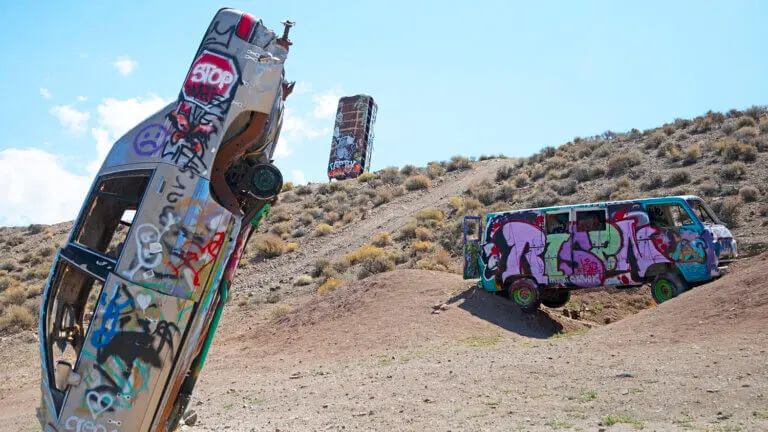
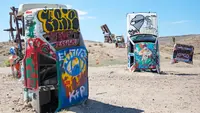
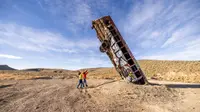
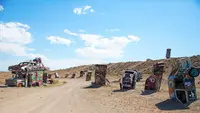
From US 95 only one vehicle shows. High Country News described it in 2014: a big white-and-turquoise school bus on a hilltop about a quarter mile off, pointing upward at a 45-degree angle out of a steep dirt mound, set so it throws sunlight toward the highway. The rest lie beyond it, on the southern edge of Goldfield beside tailing piles from what Travel Nevada calls the “Last Great Gold Camp.” By Travel Nevada’s count there are more than 40 cars, vans, trucks, and buses among sparse Joshua trees, driven into the ground or balanced one atop another. This is the International Car Forest of the Last Church.
Crystal Avenue and the valley
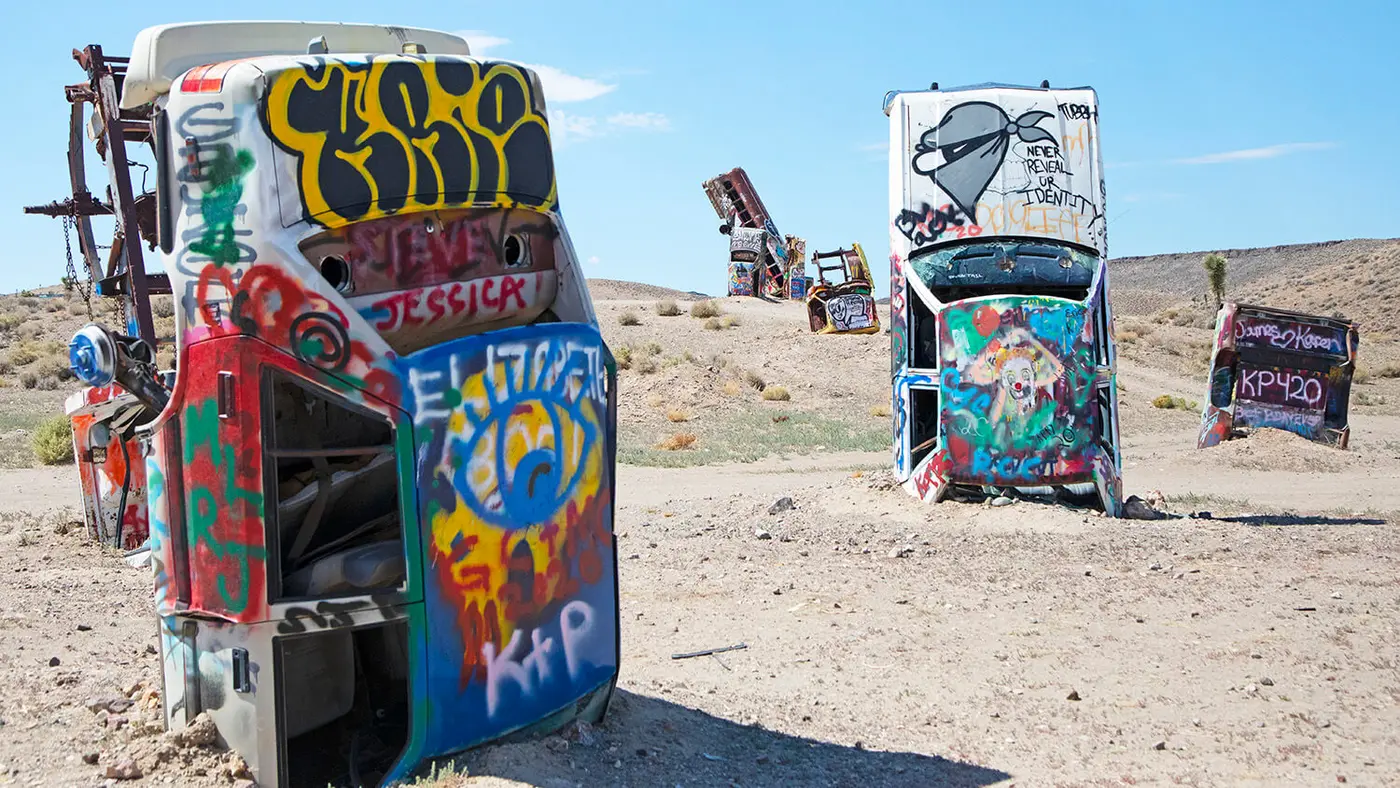
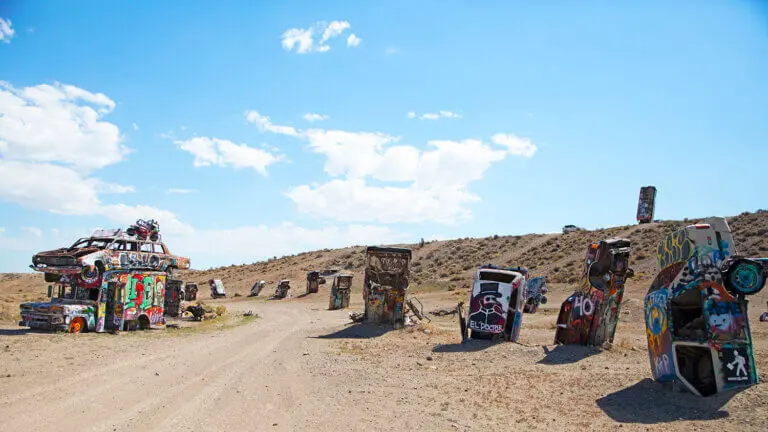
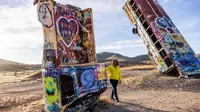
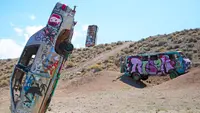
The turn is onto a gravel road called Crystal Avenue. It runs two blocks, then becomes a steep, rocky dirt path. HCN advised parking there to spare the car; the walk takes about 10 minutes. Most of the installation lies in a small valley under steep cliffs, with small bunny hills rising erratically between the vehicles. Some lie facedown as though they fell from the sky, others point at the clouds, and some straddle crevices.
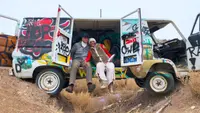
The paint changes. In 2014 an immense skull covered the roof of a ‘70s Chevy Impala, and a portrait of Ron Paul smiled from the roof of a blue hatchback with its hood sunk in the dirt. A faded black 1975 Oldsmobile Cutlass pointed skyward. On its roof a fat bluebird rose from the mouth of a Picasso-style face. Beside it a white 1982 Ford Mustang stood nose-down. Its roof carried a drooping swan’s head and a blue human body in handcuffs, arms stuck in a birdhouse. A ‘50s-style ice-cream truck sat on the ground with a vintage limousine on its roof. The limo, Chad Sorg told HCN, once rode on a different truck. “I think some kids must have gone out there and blown it up. I remember showing up one time and the truck was gone and the limo sat where the truck used to be. It was weird. So we decided to put the limo on the ice-cream truck.”
At the entrance are a visitor log to sign, a portable restroom, and printed material on the region. There is no admission fee, though donations are asked. The site is open around the clock; Travel Nevada says it is best between sunrise and sunset. HCN illustrated its 2014 story with long exposures, the cars “light painted” by strobes and flashlights under swatches of colored theatrical gel.
Bring paint, or don’t
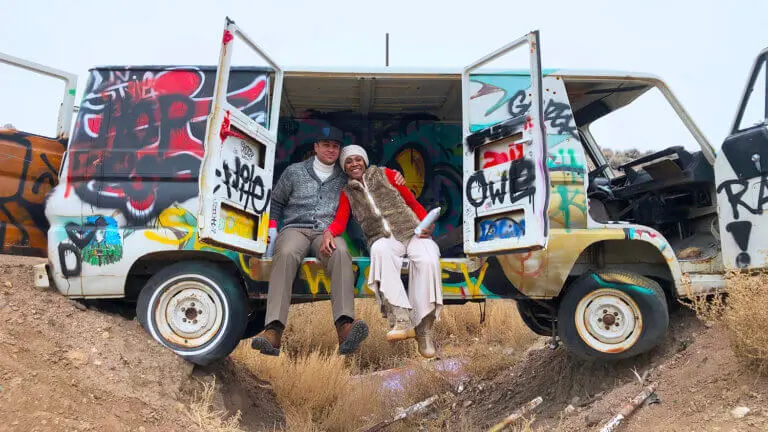
The sources disagree about the spray can. Tahoe Quarterly, in its winter 2025–2026 issue, reported that the owner encourages visitors to leave their mark. “We go out to the car forest every week and find new art,” said Richard Dizmang, the site manager, secretary and treasurer. “Our motto is, ‘Bring paint, make art.’” Travel Nevada’s page tells visitors to swap the spray paint for a camera. It says past owners welcomed anyone inspired to leave a mark, but the current artistic minds are recruiting specific artists toward a more curated forest. It asks visitors not to tag the cars or smash windows.
The nonprofit has also resumed planting vehicles. “We turn away most cars that are offered to us,” Dizmang told Tahoe Quarterly. “We’re only looking for vehicles that have a large surface that can be used as an art canvas.” The group’s own website lists an ArtCar Meet and Greet every day, all day, at a Community Space, with a short walk or drive to each part of the venue. Above it the site states: “Right now The Car Forest is in a state of Transition.”
A backhoe after midnight
The forest began in 2002 with Michael “Mark” Rippie, then in his late 50s, who owned these 80 acres. He had spent decades around Goldfield, HCN wrote, often in a wispy gray beard, “running the high desert looking for gold, antique treasures and junk vehicles.” The town had boomed after gold was found nearby in 1902. Tahoe Quarterly puts its population at 20,000 by 1906; HCN gives an early-1900s peak of 30,000. Most mines went bust by 1910, and in 1923 a fire set off by an explosion at a moonshine still destroyed most of the town. HCN counted maybe 250 residents in 2014. Tahoe Quarterly counts fewer than 200.
Rippie climbed onto his backhoe, dug the first hole, and dropped a car in upright, drawing on his own boneyard of junk vehicles. He wanted a Guinness record for the most cars planted vertically. Tahoe Quarterly notes that Guinness did not recognize such a category and still does not. Rippie hoped it would if he beat the 39 cars of Nebraska’s Carhenge.
In 2004 Chad Sorg came to Goldfield and stayed. He was a Reno artist and co-founder of that city’s NadaDada Motel. He found the town “perfect … for an art retreat. There’s nothing much around to distract you from your work,” and he was taken with what he called Rippie’s “insane project.” Tahoe Quarterly credits Sorg with giving the project its creative vision and painting the planted vehicles. Travel Nevada’s account adds a third artist, Zak Sargent.
The planting went on at night. “We actually wouldn’t start working until after midnight (to avoid the summer heat),” Sorg told HCN. “Our trucks and backhoes were equipped with spotlights. The feeling was spooky and quirky. … Mark would drive the backhoe and I would guide the vehicle into the hole. Then we would backfill dirt in.” Over time they learned how to weight each vehicle and which end to bury. “In all the times we did this, surprisingly, we never had any mishaps.” In Tahoe Quarterly’s telling, the pair treated the place as an “artist’s playground.” They let the public in free and welcomed graffiti artists.
The name came in two halves. “To call it an International Forest was my idea,” Sorg said, “as a sort of spoof on ‘national forest’ and because people from all over the world visit Goldfield.” The rest was Rippie’s: “I came up with The Last Church as representation of the last church being inside each of us. Meaning that we should pass knowledge to each other from one heart to another about two things: unconditional love and compassion.”
The last car and the last church
They planted the last car in 2011, seven years after Sorg arrived. By Tahoe Quarterly’s account the forest by then held more cars than Carhenge. Once, a mysterious fire in one of the buses brought out the local fire department. That gave Sorg and Rippie the idea for an end-of-the-world party. “We rented porta-potties, had food there, and lit one of the other buses on fire,” Sorg said. “Only 20 people showed up.” Afterward the two went their separate ways. Tahoe Quarterly calls it a falling out.
In 2013 Rippie was caught trying to buy a gun without disclosing his history. HCN quoted the U.S. Department of Justice: “In 1971, Rippie was adjudicated not guilty by reason of insanity for a 1970 armed robbery in Colorado and was committed to a mental institution.” Investigators found 15 firearms, including assault rifles, in his Goldfield home, along with more than 22,000 rounds of ammunition. That November he was sentenced to two years in federal prison. Work on the forest stopped. A few years later he sold the property to another Goldfield resident.
The cars kept drawing visitors. In December 2016 the Las Vegas Review-Journal reported on a fashion video by visual director Philippa Price, inspired by Stella McCartney’s spring/summer 2017 collection. In it a man and a woman with overdrawn clown lips loaf around Tonopah’s Clown Motel, then turn up among the cars “plunged into the dirt, rear fenders sticking into the sky.”
The new owner formed a nonprofit to maintain the property, registered with the State of Nevada on April 1, 2020. “It seemed like the right date,” the website says. The group is working toward 501(c)(3) status and raising money for the paperwork and for the property itself.
Rippie died in 2023 and asked to be laid to rest in the forest. “We went through the process of making a portion of the property a legal private cemetery so he could be buried there,” Dizmang told Tahoe Quarterly.
Notable Events
- 2002Mark Rippie began the project and dug the first hole for the forest with his backhoe. hcn.org
- 2004Reno artist Chad Sorg visited Goldfield and stayed to work on Rippie's project. hcn.org
- 2011Rippie and Sorg finished planting the last car, seven years after Sorg joined the project. hcn.org
- 2013Rippie's legal trouble halted work until the property was sold to another Goldfield resident a few years later. tahoequarterly.com
- 2020The International Car Forest officially became a nonprofit in Nevada. internationalcarforestofthelastchurch.com
- 2020The new owner started a nonprofit to help maintain the property and preserve the installation. tahoequarterly.com
- 2023Rippie died and asked to be laid to rest in the forest. tahoequarterly.com
People
- Chad Sorg, Artist working with cars, buses and trucks.
- Michael “Mark” Rippie, Originator of the forest; Goldfield resident and landowner.
- Philippa Price, Visual director of the Stella McCartney video that used the Car Forest as a setting.
- Stella McCartney, Designer whose collection inspired a video using the Car Forest as a setting.
- Richard Dizmang, Site manager, secretary and treasurer.
- Zak Sargent, Artist who joined Mark Rippie and Chad Sort in bringing vehicles to the Car Forest.