.jpg)
.jpg)
Indian Ridge Lookout
Blue River, Lane County, Oregon. Fire lookout rental; Late June - October.
Details

- Where
- 57600 McKenzie Highway, McKenzie Bridge, Blue River, OR 57600. Directions
- When
- Open 24 hours/day.
- Getting there
- From Highway 126, travel south on Forest Service Road (FSR) 19 (Aufderheide Scenic Byway) to FSR 1980. Turn west on to FSR 1980 and travel to FSR 1980-247. Follow to the top where the road ends at the lookout.
- Fees
- Overnight Use: $75 per night.
- Access
- There is no water or heat at the lookout. Propane lamps, stoves and heaters are recommended. Due to the height of the tower and the sheer cliffs near the lookout, this location is not recommended for small children. There is no tent, trailer or RV camping at the site.
- Walk-in or reserve
- Overnight stays are by reservation only.
- Phone
- (541) 822-3381
- Managed by
- McKenzie River Ranger District, Willamette National Forest.
- Established
- Built in 1958.
- Coordinates
- 44.005211, -122.255371.
The cab at the end of road 1980-247
Forest Service Road 1980-247 ends at the lookout. To reach it from Blue River, drive 4 miles east on Highway 126 to Aufderheide Drive, Forest Service Road 19. Bear right at the Y and climb to the top of Cougar Reservoir. Continue 7 miles past the reservoir to Road 1980, then turn west and climb Indian Ridge. Recreation.gov calls the last of this road rocky.
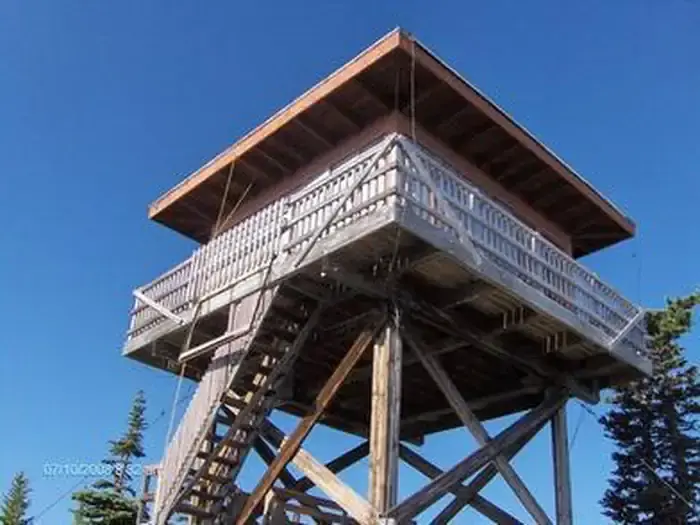
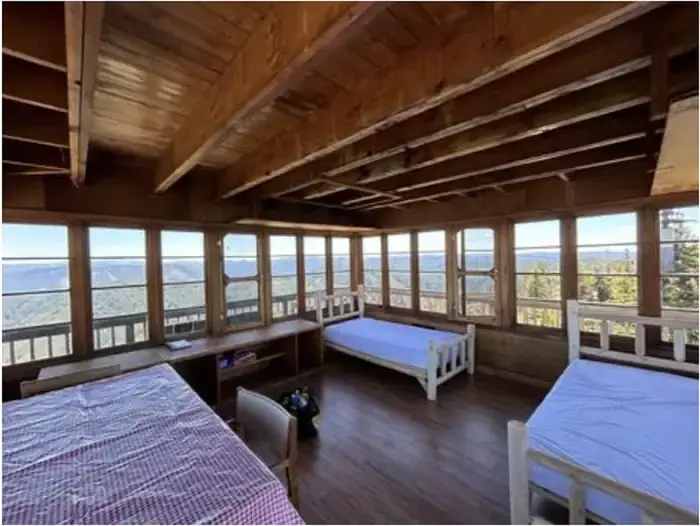
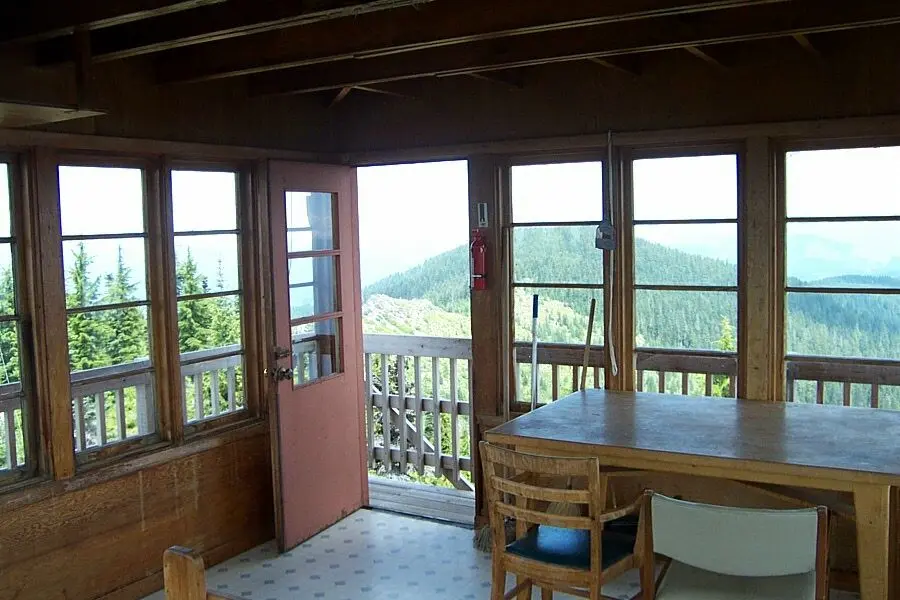
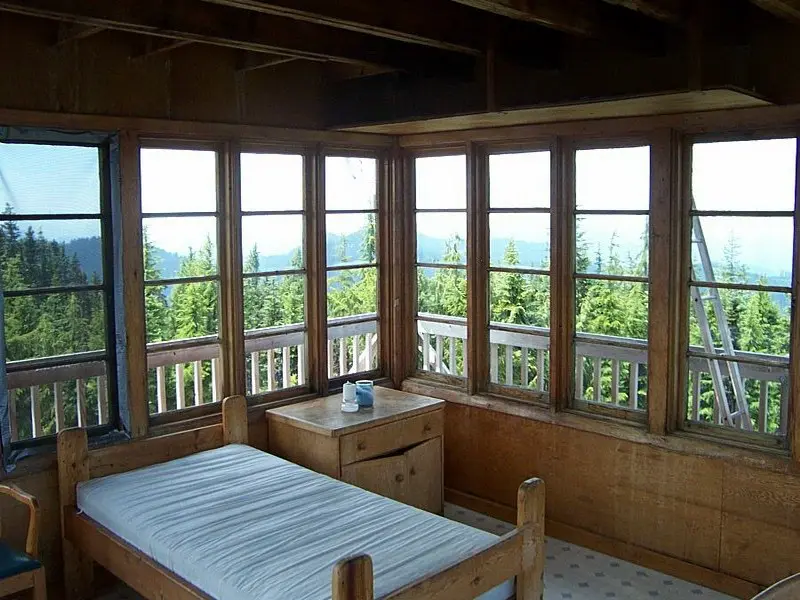
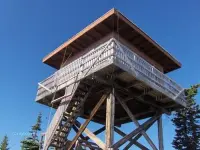
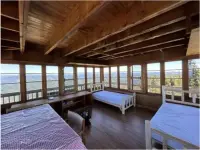
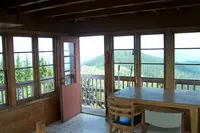
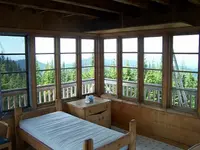
At the top, a steep, narrow flight of steps rises up the tower to a small cabin. Recreation.gov gives the tower as 30 feet. The door opens by combination lock, and the code comes with the reservation. The Forest Service lists the cabin at 16 by 16 feet, sleeping four. It holds two twin beds with foam mattresses, a table with chairs, a broom and dust pan, a mop, and storage shelves. There is no heat, electricity, or water. Guests carry in water for drinking, cooking, and washing, along with their own stove, bedding, lights, dishes, and ice chest. Propane lamps, stoves, and heaters are recommended because they give off fewer fumes than liquid gas, and liquid gas appliances are not allowed. Outside are a picnic table and a fire ring, and a vault-toilet outhouse stands 50 feet from the lookout. The Forest Service gives the elevation as 5,405 feet. Because of the tower’s height and the sheer cliffs near it, the site is not recommended for small children. The rental season runs from late June through October.
Beargrass, huckleberries, and Hidden Lake
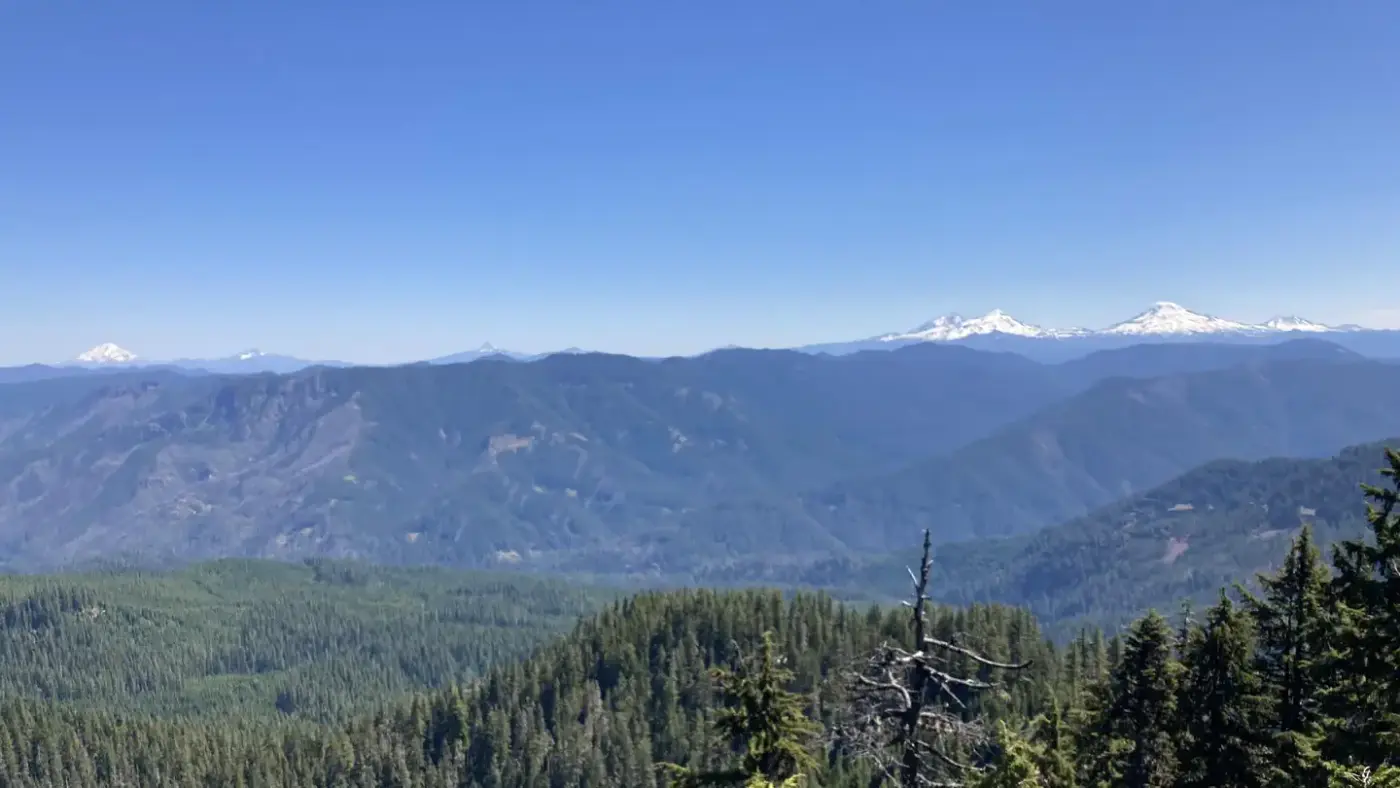
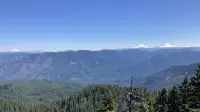
The cab sits above the tree line. The Three Sisters stand close and prominent to the northeast, and the Cascade Crest runs off to the north and south. With binoculars, the Sand Mountain and Carpenter Mountain lookouts can be picked out. Hidden Lake lies below the northern edge of the mountaintop, and a short trail leads down to it for alpine swimming and sunbathing.
The open ridge is covered with beargrass and huckleberries. Depending on the season, its rocky outcroppings carry wildflowers and moss. An unmaintained trail wanders the summit through alpine trees and beargrass. Indian Ridge Trail #3315 is listed nearby. Several outbuildings and radio installations stand near the tower and can be explored. Recreation.gov names Roosevelt elk, black bear, bald eagles, black-tailed deer, and bobcats among the wildlife of the forest. Far from city lights, the ridge also offers dark night skies for stargazing.
The ridge takes its name from the old Indian hunting trail that runs along the summit.
From cupola to flattop
The National Historic Lookout Register says Indian Ridge has been the site of a lookout since 1918. A photograph on its page is captioned “Cupola, 1918-1928.” The register says the ridge was best known for “a classic 29’ ‘cathedral style’ structure.” That building stayed in service until 1958 and, in the register’s words, “regrettably was not maintained.” No example of the type remains.
The Lane County Historical Society’s journal, the Lane County Historian, recounts one summer on the ridge. In its Summer 1992 issue, Doug Newman wrote about the solo life of the county’s fire lookouts. He records that in the summer of 1938, lookout Jim Drury was inside the lookout house on Indian Ridge, then in the Blue River Ranger District, when lightning struck it. The other lookouts telephoned the ranger station to report that the station had been hit. Newman puts the heyday of the fire lookout from the 1930s through the 1950s. He adds that once lookouts were no longer needed, many were burned to the ground.
The cab that stands now is dated differently by different sources. The Forest Service and Recreation.gov say it was built in 1958. The register says 1957 and describes it as a 15-by-15-foot R-6 flattop with a catwalk on a 20-foot wooden tower. It also gives a lower elevation, 5,337 feet. All the sources agree that Forest Service crews used it to watch for fire until 1973. In 1972, the year before that service ended, the University of Oregon carried out archaeological investigations at the Indian Ridge site under contract with the Willamette National Forest. Sharilyn Reyna, then with the university and later with the forest, is named as directing the forest’s archaeological studies.
The lookout entered the National Historic Lookout Register on November 24, 1995, as US 133 and OR 17. Ron Johnson and Rebecca Eash nominated it in memory of her father, John W. Koning, Jr. The register notes that the cab has since been restored, placed in the cabin rental system, and is still used occasionally to watch for fire in emergencies.
Notable Events
- 1918Indian Ridge, in the Willamette National Forest in Oregon's central Cascade Mountains, has been the site of a lookout since 1918. web.archive.org
- 1938The Lane County Historical Society's lookout history tells of fire lookout Jim Drury's summer of 1938 on Indian Ridge in the Blue River Ranger District, when lightning hit the lookout house and the other lookouts called the ranger station to report the station hit. ir.library.oregonstate.edu
- 1957The register states that the present 15 by 15 foot R-6 flattop cab with catwalk, on a 20-foot wooden tower, was built in 1957 and remained in service until 1973. web.archive.org
- 1958The register calls Indian Ridge the location of a classic 29-foot cathedral-style structure that remained in service until 1958; it was not maintained and no examples of that type remain. web.archive.org
- 1972Under contract with the Willamette National Forest, the University of Oregon conducted archaeological investigations at the Indian Ridge site on the Blue River Ranger District. npshistory.com
- 1973The lookout was used for firefighting by Forest Service personnel until 1973; it is still staffed occasionally during emergencies. fs.usda.gov
- 1995The register records the date of registration and shows the entry nominated by Ron Johnson and Rebecca Eash, in memory of her father, John W. Koning, Jr. web.archive.org
People
- Jim Drury, Old-time fire lookout who served on Indian Ridge in the Blue River Ranger District and told of being inside the lookout when lightning hit it (summer of 1938).
- Sharilyn Reyna, Then with the University of Oregon and later with the Willamette National Forest, named as directing the forest's archaeological studies that include the Indian Ridge site investigations.
- John W. Koning, Jr., The person in whose memory Ron Johnson and Rebecca Eash nominated the Indian Ridge Lookout entry to the National Historic Lookout Register.
Sources
- recreation.gov/camping/campgrounds/234173
- fs.usda.gov/r06/willamette/recreation/indian-ridge-lookout
- web.archive.org/web/2023/https://nhlr.org/lookouts/us/or/indian-ridge-lookout
- ir.library.oregonstate.edu/downloads/1544bp28w
- npshistory.com/publications/usfs/region/6/willamette/history/chap6.htm
- fs.usda.gov/r06/willamette/recreation/indian-ridge-lookout