Imnaha Guard Station
Prospect, Jackson County, Oregon. Guard station cabin rental.
Details

- Where
- 47201 Highway 62, Prospect, OR 47201. Directions
- Season
- Late spring through early fall for wheeled-vehicle access, depending on snow.
- Getting there
- From Butte Falls: east on the Butte Falls - Fish Lake Highway, left onto the Butte Fall - Prospect Highway (County Road 992); go 9 miles to Forest Road 34; right, 8 miles to Forest Road 37; northeast 4.5 miles to the Imnaha Campground turn-off and the cabin.
- Fees
- $80 per night.
- Access
- Entry gate and cabin open by combination lock; the code comes in the confirmation letter. No indoor lighting; bring lanterns or flashlights. Potable water from the faucet; flush toilet and hot shower. No tents in the fenced cabin area; extra campers may use the nearby Imnaha Campground. Pets welcome, leashed near the springs. Pack out all garbage and food. No smoking; firewood not guaranteed. Wheeled-vehicle access only late spring through early fall, depending on snow.
- Walk-in or reserve
- Reserve on Recreation.gov.
- Phone
- (541) 560-3400
- Website
- recreation.gov
- Managed by
- U.S. Forest Service, Rogue River-Siskiyou National Forest (High Cascades Ranger District).
- Established
- 1930s.
- Coordinates
- 42.70382, -122.33212.
From Prospect, the way in begins at the Prospect Hotel. County Road 992 runs east two or three miles to Forest Road 37, which bends south to the Imnaha Campground turn-off. The cabin stands past the last campsites, at 3,800 feet in the southwest Cascades, inside a fenced yard. Gate and door both open by combination lock, with the code printed in the renter’s confirmation letter. After the numbers are dialed, the shank has to be pressed down into the body of the lock and released before it gives. Wheeled vehicles get through only from late spring to early fall, as the snow allows.
Four rooms under a shingled gable
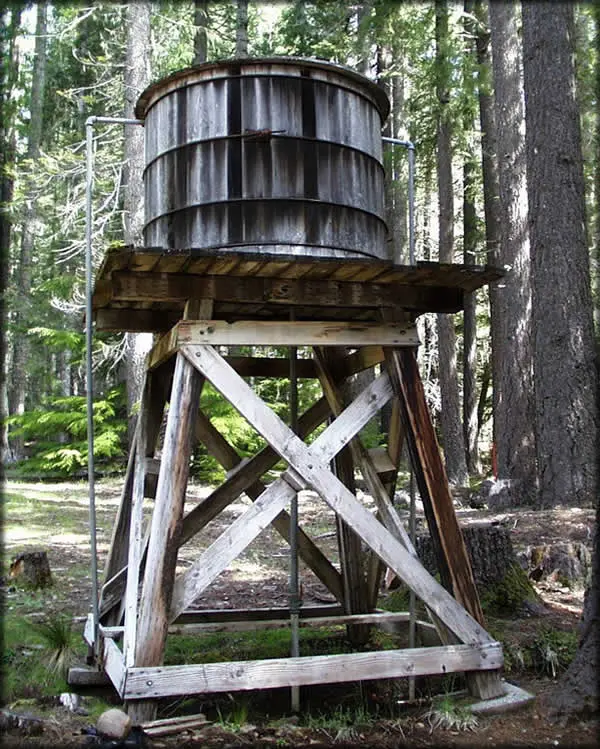
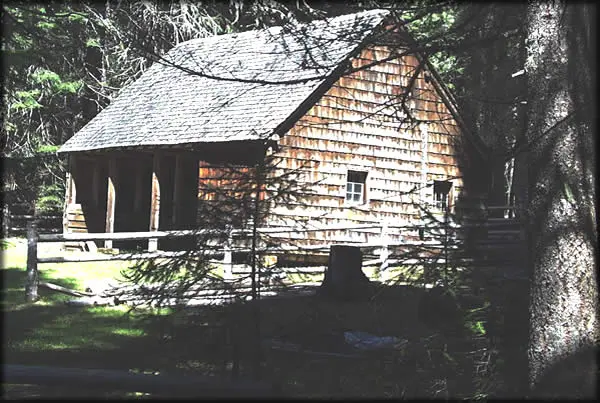
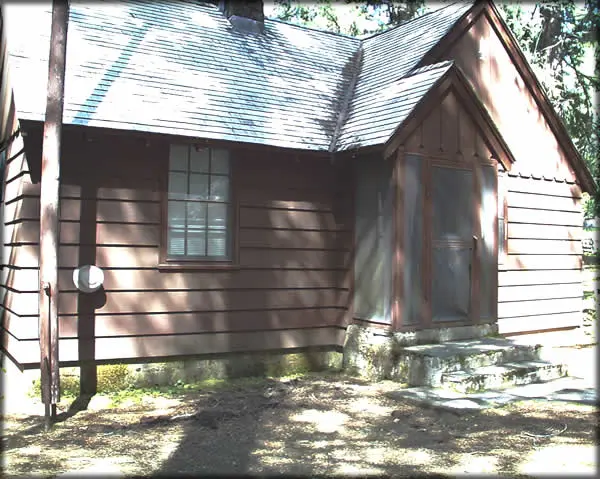
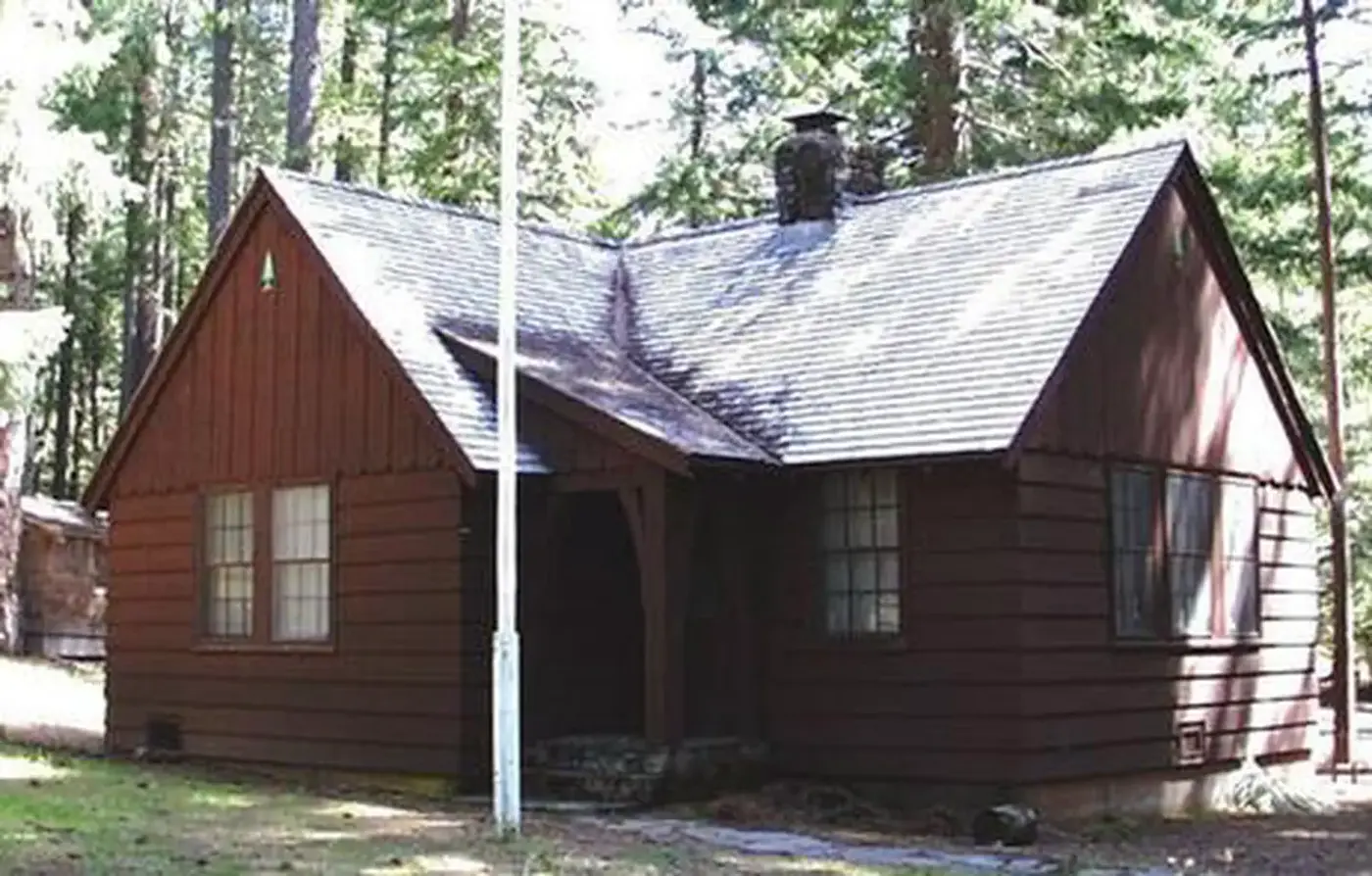
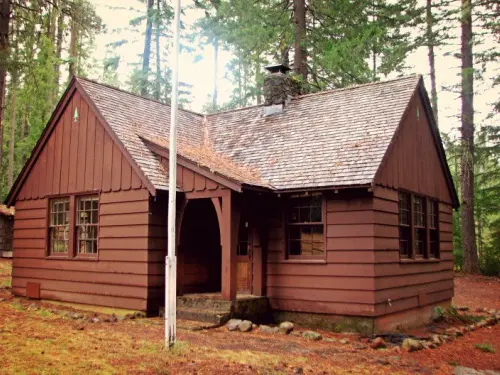
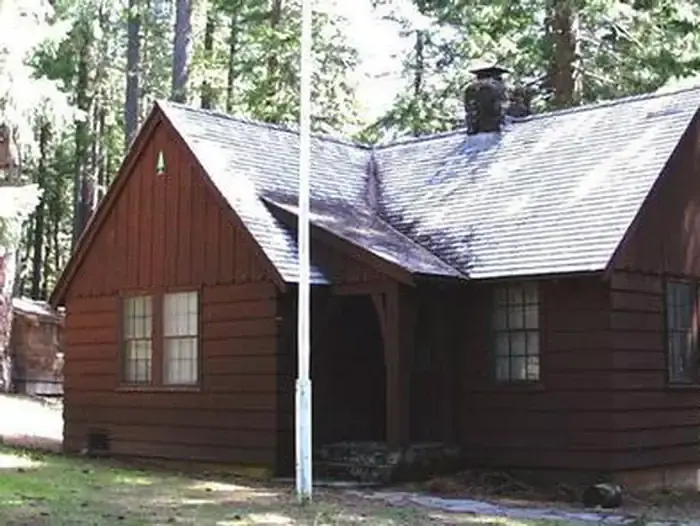
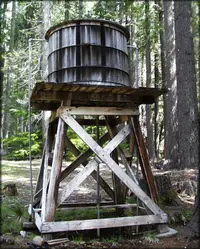
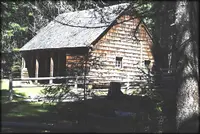
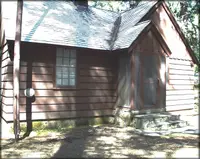
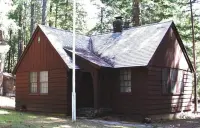
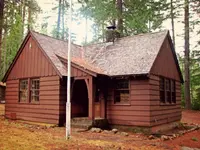
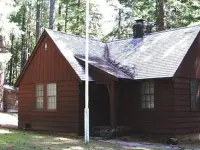
The building is T-shaped and one story, with horizontal clapboard to the eaves and vertical boards in the gable ends. Its roof is wood-shingled. A porch faces west on squared ten-by-ten timber posts with curving brackets. A pine tree cut from a single board is fixed beneath the peak of each gable, and a rubble-stone chimney straddles the ridge. Beside the cabin a cable-wrapped wood-stave water tank sits on a raised post-and-beam tower. The frame garage nearby carries its own pine tree, slender and elongated, on each gable end.
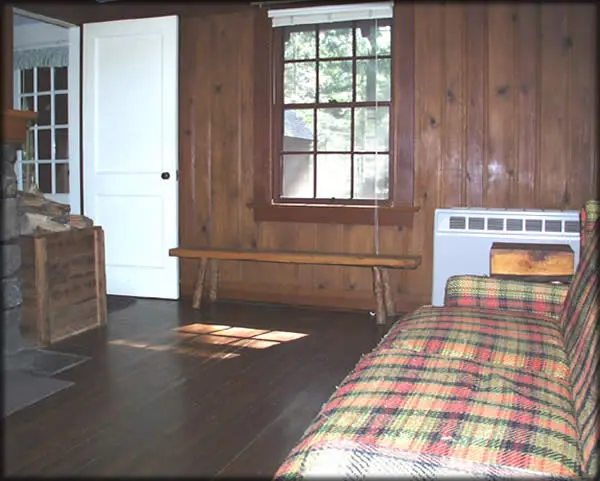
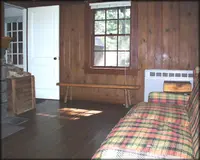
Inside, the living room is paneled in pine and built around a lava-rock fireplace. The kitchen has a table and chairs, a sink, and a small counter. The stove and refrigerator run on propane, and the water from the faucet is safe to drink. The bathroom has running water, a hot shower, and a flush toilet. The listings differ on several points:
- Lighting: The Forest Service lists a propane kitchen light. Recreation.gov and Travel Southern Oregon both say the cabin has no indoor lighting and that guests should bring lanterns or flashlights.
- Bed: The Forest Service lists a queen-size bed. The other two list a full-size bed.
- Capacity: Recreation.gov says the cabin sleeps four. Travel Southern Oregon says up to six.
Travel Southern Oregon says firewood is stocked outside and in the garage at the start of each season, and that when the supply runs low, visitors may have to split their own with the tools provided. No listing guarantees firewood. Meals can be taken at a picnic table in the backyard.
Tents are not allowed inside the fence. Extra people camp at the numbered sites of the Imnaha Campground, which lies within sight of the cabin. Travel Southern Oregon counts four sites there, though Recreation.gov’s listing notes the campground closed for the season. All garbage and food leave with the visitor.
The springs and the Big Tree
The forest around the yard is old growth: mainly Douglas-fir, white fir, and incense cedar, with some ponderosa pine, sugar pine, and western white pine. The Forest Service notes that those pines were more common before the fire suppression that followed the 1930s. Most of the mature trees are three to four feet in diameter.
A maintained spur trail runs a few hundred feet from the campground and cabin to the Big Tree, a Douglas-fir the Forest Service puts at about 300 years old or more. It has a little fence around it.
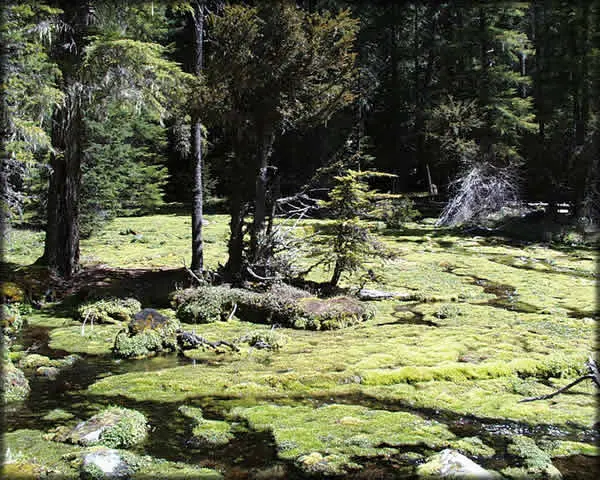
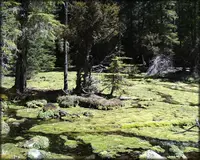
Up a trail behind the cabin, Imnaha Springs comes out of the ground in a large volume of clear, ice-cold water. It splits into separate rivulets that run through yellow monkeyflower and moss. The Forest Service asks visitors not to walk on or remove the moss and to keep dogs leashed there, or “far better yet, leave your dog back at the guard station.”
In the dense timber, the songs of the varied thrush and the hermit thrush are often heard and the birds seldom seen. Now and then comes the loud drumming of the pileated woodpecker. Nuthatches, chickadees, and Steller’s jays are common. Within a short drive, the Blue Canyon and Alta Lake trailheads lead into the Sky Lakes Wilderness, and the Lower South Fork trail has several trailheads of its own.
A shack, a fireman, and a CCC camp on the South Fork
According to the Forest Service, a one-room Forest Service “shack” stood at Imnaha Springs almost twenty years before the present cabin. A forest-guard roster for 1933 lists Walter Marshall as fireman at Imnaha Guard Station, in the Butte Falls District under District Ranger John D. Holst. The roster is marked “may be incomplete.” That was the first year of Karl L. Janouch’s tenure as supervisor of the Rogue River National Forest. The same roster puts Bud Henshaw, fireman, at Lodgepole Guard Station in the same district.
The Forest Service’s documentation of historic structures on the Rogue River National Forest credits crews from CCC Camp South Fork with building administrative and residential structures at the Lodgepole and Imnaha guard stations and at the Butte Falls Ranger Station. The forest’s own history lists a South Fork side camp at Imnaha Guard Station. A photograph in that history shows enrollees at the South Fork Rogue River Camp listening to the “Showboat” program.
The Forest Service web page dates the cabin only to the 1930s. The Living New Deal and the National Register nomination both give 1939, and the nomination credits the design to the USDA Forest Service Architecture Group together with the Civilian Conservation Corps. The station was built to house patrol and fire crews.
The nomination, filed among Oregon’s Depression-Era Buildings, found the property excellent, unaltered, and on its original site, a parcel of one acre. It describes the station as aiding the local community through “employment of youth and experienced craftsmen, purchase of building materials and camp supplies, and personal expenditures of enrollees.” It also calls the station “an outstanding example of an architectural location invested with special aesthetic and associative values by the agency that created it.” The cabin is listed on the National Register of Historic Places.
From the Depression until well into the 1950s, the station lay at the “end of the road” from Butte Falls. Where a horse trail once went on, Forest Road 37 now connects Butte Falls with Prospect to the north. The Butte Falls Ranger District kept the cabin as a fire-watch or guard station through the late 1970s. The Living New Deal adds that, unlike other guard stations, Imnaha has been used every summer since it was built, even before similar stations were rented to the public.
Fifteen summers on the Butte Falls District
One of the men who spent those summers there was Bob, who wrote as JB Poet. His plan from the eighth grade was to be a “forest ranger.” He could not afford to go away to Oregon State for forestry, so he lived at home, studied math education, and taught for almost thirty years, most of them at Pleasant Hill, ten miles from Eugene.
Beginning in 1958 he worked summers for the Forest Service: first on a road crew on the Mount Hood, then on a survey crew in the Applegate District, where he got his first fire experience. After that came 15 years at Imnaha Guard Station. “When people asked me what I did for a living I used to tell them I was a fireman for the Forest Service and in the off-season I taught school,” he wrote. Later he flew as an aerial observer over the Willamette, looking for smokes from a small plane, and his oldest son, John, joined him in that job in 1987.
His account, Fifteen Years at Imnaha Guard Station, appeared in 2005 and runs 74 pages. In it he writes that each of his four sons worked for the Forest Service for a time.
Notable Events
- 1930sThe Civilian Conservation Corps built the cabin during the Great Depression, replacing the earlier shack. fs.usda.gov
- 1930sA one-room Forest Service shack was built at Imnaha Springs. fs.usda.gov
- 1933The Forest Service historic-structures dossier credits crews from CCC Camp South Fork with building administrative and residential structures at Lodgepole and Imnaha Guard Stations and at the Butte Falls Ranger Station, under its CCC/FERA recreation development context for the Rogue River National Forest. heritagedata.prd.state.or.us
- 1939The Civilian Conservation Corps built the station, which was originally used to house patrol and fire crews. livingnewdeal.org
- 1939The nomination sheet dates the Imnaha Guard Station to 1939 and describes a T-shaped wood-frame building with poured concrete foundation and wood-shingled gable roof, with a matching frame garage and a cable-wrapped wood stave water tank on a raised tower adjacent to the cabin. npgallery.nps.gov
- 1950sImnaha Guard Station lay at the end of the road from Butte Falls. fs.usda.gov
- 1970sThe Butte Falls Ranger District used the cabin as a fire-watch or guard station. fs.usda.gov
- The forest history's record of Civilian Conservation Corps side camps in the Medford District lists South Fork at the Imnaha Guard Station among the side camps of the South Fork or Applegate camps during the years. npshistory.com
People
- Walter Marshall, Forest Service fireman posted at Imnaha Guard Station on the Rogue River National Forest's Butte Falls District forest-guard roster.
- JB Poet, Teacher and Forest Service man who wrote 'Fifteen Years at Imnaha Guard Station' from his time at the station in the Butte Falls District; he says each of his four sons worked for the Forest Service for a time (15 years at Imnaha Guard Station, after Forest Service summer work beginning in 1958).
Sources
- recreation.gov/camping/campgrounds/234165
- fs.usda.gov/r06/rogue-siskiyou/recreation/imnaha-guard-station
- npshistory.com/publications/usfs/region/6/rogue-river/history/2/chap6.htm
- heritagedata.prd.state.or.us/historic/index.cfm?do=main.loadFile&load=NR_Noms%2F64500516.pdf
- npgallery.nps.gov/NRHP/GetAsset/NRHP/86000835_text
- xlibris.com/en-AU/bookstore/bookdetails/573458-fifteen-years-at-imnaha-guard-station
- fs.usda.gov/r06/rogue-siskiyou/recreation/imnaha-guard-station
- npgallery.nps.gov/GetAsset/ab8ea1bf-d8c6-4f6a-a528-6522e062ae5f
- npgallery.nps.gov/AssetDetail/NRIS/86000835
- livingnewdeal.org/sites/imnaha-guard-station-siskiyou-national-forest
- southernoregon.org/cities/prospect/outdoor-recreation/campgrounds/imnaha-guard-station