Idaho Potato Museum and giant baked potato
Blackfoot, Bingham County, Idaho. Unique museum.
Details

- Where
- 130 NW Main St, Blackfoot, ID 83221. Directions
- When
- September - April: Monday - Saturday 10:00 am to 4:00 pm. May- August: Sunday- Saturday 10:00 am to 6:00 pm.
- Season
- Closed on Thanksgiving, Christmas Eve, Christmas Day, New Year's Eve and New Year's Day; open regular hours all other holidays.
- Getting there
- I-15 exit 93. Drive east into downtown for one mile. Turn left at the stoplight onto US-91/NW Main St. Drive two blocks.
- Fees
- Adults - $8; Seniors(65+)/AAA-$7; Military/First Responders- $7; Students/Teachers - $6.50; Idaho Resident- $6; Children(5-12) - $4.50; Children age 4 & under - Free!; Group Rate of 15 or larger - $6.50 each.
- Access
- 50,000+ annual visitors.
- Phone
- 208-785-2517
- Managed by
- A private non-profit organization that runs independently off its admission, donations, gift shop and cafe sales.
- Established
- 1913.
On NW Main Street in Blackfoot, two blocks past the stoplight at US-91, a giant sculpted potato sits on the right, topped with fake sour cream and butter. Roadside America compared it to “something that fell off a truck on a novelty postcard.” A custom-built holder takes a smartphone for a timed spud-selfie. The potato got a fresh coat of paint in 2020. It is the second one on the spot. Local high school kids stole an earlier model in 2006, and Tish Dahmen, then the museum’s director, told Roadside America, “It broke when they moved it.”
Behind the potato stands a long, low depot of rusticated pink and gray stone, built by the Oregon Short Line Railroad in 1913. Since 1988 it has housed the Idaho Potato Museum. The museum is a private non-profit that rents the building from the city and pays its way with admission, gift shop and cafe sales. Beside it are a small park with a picnic area and a lot with room for motor coaches and RVs. Manager Mandy Alexander says many visitors stop on their way to or from Yellowstone, and some have come from as far as Germany. In September 2026 the Post Register put attendance at 50,000 or more a year. Leashed dogs are welcome. A few resident “Potato Pups” appear from time to time and are kept apart from visiting dogs.
Mashers, a Pringle, and a signed “potatoe”
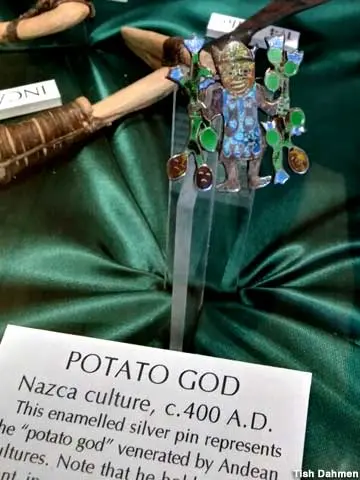
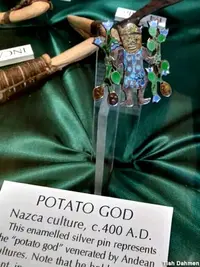
The exhibits begin with the potato’s origins. Murals trace its roundabout route to North America, which the museum says usually surprises visitors. The first recorded planting on the continent was at Port Royal, Nova Scotia, in 1623. One case holds a small Nazca Potato God amulet and a chakitajlla foot-plow, labeled “The most advanced agricultural tool known in the Andes.” Dahmen told Roadside America that the display corrects a common belief among visitors that potatoes came from Ireland. Further on, exhibits show the back-breaking work of cultivating and harvesting before modern machinery eased it in the late 1950s. The labor-saving inventions on view include a potato digger used in the late 1800s. More farm machinery stands outdoors.
A wall-size display, “How the Potato Changed the World,” notes that Philo Farnsworth got the idea for television while plowing a potato field. Under the heading “The Future,” it states that “Many professionals believe growing potatoes on Mars is possible.”
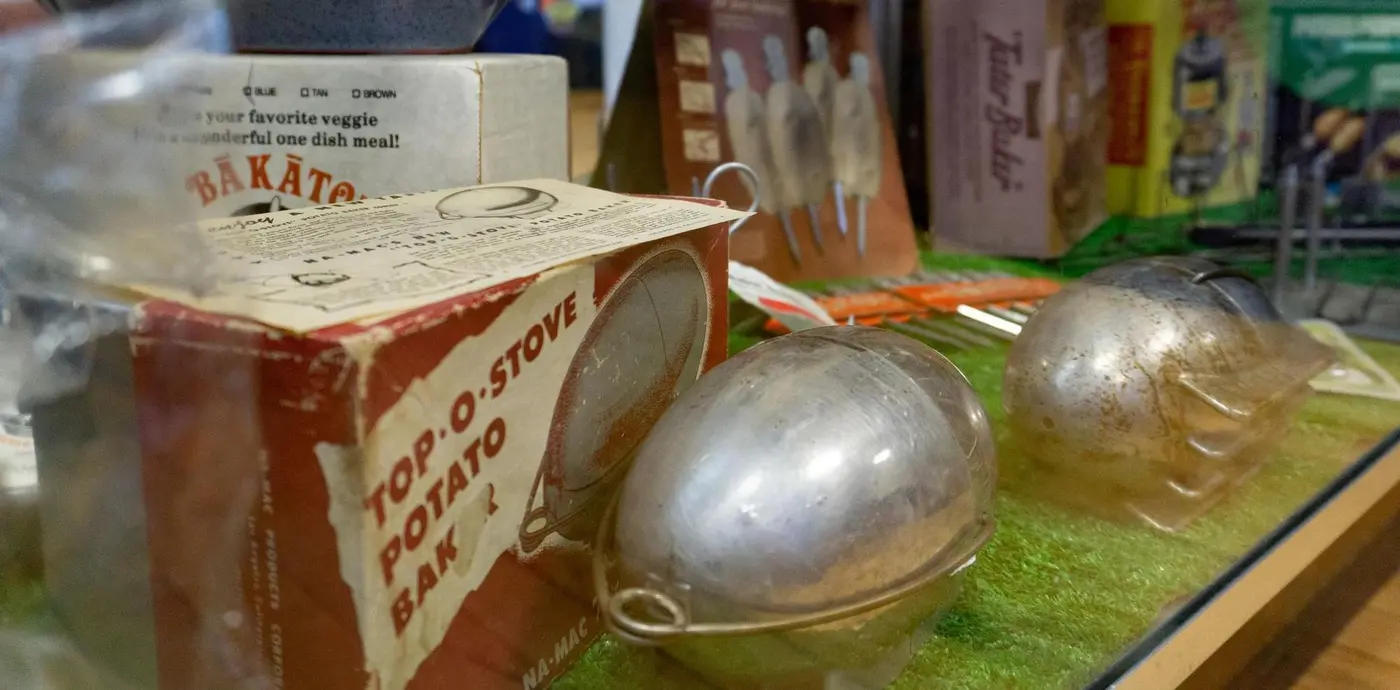
Collections fill much of the rest of the building. There are potato mashers, and the museum says it may have the largest collection of them in the world. There are also peelers, a Mr. Potato Head collection, and old cooking contraptions such as the Tater Baker and Spud Spikes. A crowned potato that Roadside America dubbed King Spud appears throughout. The largest potato crisp ever made, 23 by 14.5 inches, lies in its own case beside a Guinness World Record certificate. The museum’s facts page says the Pringle’s Company produced it in Jackson, Tennessee, in 1990. Roadside America dates it to June 3, 1991, and credits a team of Procter & Gamble engineers. It also reported that after more than 30 years on display, the crisp was beginning to crack.
Nearby, next to a jar of fermented potato beer, is a shriveled potato autographed by former Vice President Dan Quayle. At a spelling bee Quayle had insisted that “potato” had an “e” in it, and he signed the spud afterward as atonement. “He was a good sport,” Dahmen said. Another showcase holds a rodeo queen’s vest and skirt sewn from burlap potato sacks, along with the burlap tuxedo worn by Idaho’s first Potato Commissioner. Visitors could once have their own burlap outfits made. Farmers stopped using the sacks in 2014, and the museum’s sack sewing machine is now retired. A life-size cardboard cutout of Marilyn Monroe in a potato sack dress stands ready for photographs. One case holds a hollow potato from the bad growing season of 1993 and a potato found inside another potato in a field in 1997.
In a simulated root cellar, a video-projected potato family sits together, and the mother sings to the tune of the Mexican Hat Dance: “Sometimes we ditch the skin, to eat what it’s holding in.” Roadside America reported that the song repeats constantly and echoes through the building. The Potato Cinema offers four short films, one of them on how McDonald’s French fries are made. In “Potato VR,” sponsored by the farm equipment maker Spudnik, visitors sit in a tractor cab during a harvest. Dahmen said Idaho farmers prefer virtual visitors to real ones because they do not want their crops contaminated.
Bakers, two hours ahead
The Potato Station Cafe serves baked potatoes, which locals call bakers. The cafe asks that bakers be ordered at least two hours ahead so they reach the right fluffiness. Fries are fresh-cut and best ordered on the spot. Alexander lists jalapeño tots, cheesy tots, potato cupcakes made in house, and chili cheese fries, “which you’ve got to have.” Potato donuts come from Amazing Glaze Donuts of Pocatello and Idaho Falls. Roadside America found potato ice cream, and chocolate milk with potato in it. Out-of-state visitors who pay admission can collect free “taters for out of staters” in the gift shop.
The Spud Sellar Gift Shop carries:
- potato soap made with potato starch, and potato baker bags
- Idaho Potato Field Force comics, which portray potato salespeople as superheroes
- “When Potatoes Go Bad” motorcycle patches
- replicas of the Potato God
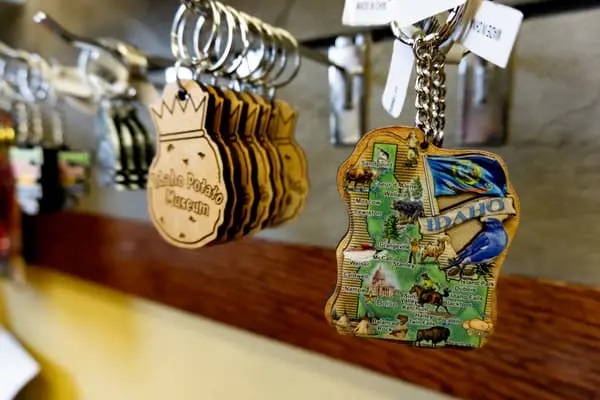
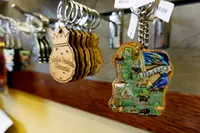
- Christmas ornaments of the big potato outside
Anna Summers directs the museum. She arrived in September 2024 as operations manager and was named director when her predecessor retired in November 2025. “Growing up around historic mining towns in Nevada, I had a passion for local history and jumped at the chance to work at the Potato Museum,” she told the Post Register. Alexander, an Idaho Falls native, was hired in October 2024 to improve the gift shop and is now a museum manager. Her 11-year-old golden retriever, Thor, has become an honorary member of the staff. Hanna Adams, a Blackfoot local, started in the cafe and gift shop at 15 and is also a manager now. At parades and festivals she is often inside one of the museum’s Mr. Potato Head costumes. Twenty to 30 part-time workers staff the cafe and shop, among them high school students who work weekends during the school year. A six-member board meets monthly with the staff. It is headed by Shirley Brumfield, owner of Perfect Day Alterations in Blackfoot.
Eight passenger trains a day
The Oregon Short Line was a Union Pacific subsidiary. It set aside $27,000 for a new passenger depot at Blackfoot, and according to the National Register nomination, that decision gave the town priority over several others that had asked for depots. Work on the long-awaited building began in October 1912. The stone was quarried at Rexburg and hauled to Blackfoot, where the builder laid it as fast as it came in.
The depot is a bungalow-style building of about 42 by 132 feet. Its exterior details include:
- lighter stone quoins at the corners and openings
- a light stone band under the wide eaves
- a stone block bearing the name Blackfoot, set in the gable of a small ell on the track side
- oak doors in double sets enclosing the vestibule
The original plan ran from the southwest end through the express office, the baggage room, the men’s smoking room, the general waiting room, the newsstand, the ticket office and the women’s toilet. In 1913 the depot was considered equal to any in the state.
The need for it was plain before it opened. In May 1913 the station sold 600 tickets, one every six minutes day and night, and eight passenger trains came and went daily on the main line. The depot was finished August 15, 1913, and more than 2,000 people came to a community party the next day. Freight mattered too, as the building’s many freight doors show. The freight platform is still in use as the museum’s Potato Lab area. The 1895 frame station that the stone depot replaced was moved elsewhere in town and served as a freight station for a time. By 1974 that building was gone, and the stone station handled freight instead of passengers. On 1 April 1974, Idaho’s State Historic Preservation Officer nominated it to the National Register of Historic Places as the Blackfoot Railway Depot.
Borrowed dividers and a broken pipe
For years, people from every part of Blackfoot’s potato industry, along with city and county officials, had talked about a way to show off potatoes and their importance to the local economy. Then the depot was decommissioned, and Union Pacific gave it to the City of Blackfoot. The planners now had a building. In the museum’s own history, they had “no money, no manpower, and no idea how to make it happen.” One frequent comment ran, “People won’t come to Idaho just to look at a potato museum.” In February 1988 the planners brought the director of the Buffalo Bill Museum in Cody, Wyoming, to speak on specialized museums at a Chamber of Commerce meeting. His message was “Sometimes we don’t see the gold in our own backyard.”
The sources give differing accounts of the first opening:
- The museum’s history: after a heavy cleanup, a two-week trial opening was held in June 1988 and drew about 2,000 people, most of them local. There were no real displays, only dividers borrowed from the Blackfoot School District, with notes written on them describing what the displays would show.
- The Post Register: a one-week run in the summer of 1988 attracted more than 2,000 visitors.
- The museum’s tour page: the first Idaho Potato Expo opened in August 1988.
Maureen Hill, a Blackfoot woman, volunteered as unpaid director to get the Expo ready for tourists, and some 5,000 came that year. Most of the early money came from Basic American Foods, Nonpareil, local growers and Bingham County. Pringles donated the giant crisp.
Nancy Batchelder became the first full-time paid director and served four years. She and Hill are credited with the idea of free baked potatoes for out-of-staters. The potatoes were cooked in a small restaurant set up in the old freight room with donated kitchen equipment. It was hard to run and never paid its way, and in the winter of 2002 a broken pipe closed the kitchen. Basic American Foods then donated boxes of dehydrated hash browns so the free taters could continue. Meanwhile the gift shop, which began with a few items on consignment, grew into the museum’s main source of revenue.
In May 2002, Mayor Scott Reese asked Chamber of Commerce executive director Merlin Wright whether the Chamber would take over the Expo and move its offices into the depot. The move came in mid-June 2002. A new board was appointed, the Expo became the Idaho Potato Museum, and the merger let both organizations operate year-round. They soon found they were too different to share one board. Instead they shared the building, the utilities and a director for the next 10 years.
By 2016 each organization needed its own office and its own director. Tish Dahmen, executive director since June 2012, stayed with the museum, and in December 2016 the Chamber moved to 76 Judicial Street. That same year, a renovation paid for by a Blackfoot Urban Renewal Agency grant was completed. It brought long-needed repairs, refreshed exhibits and a reopened cafe.
The museum’s history records growth from 5,000 visitors a year to 45,000. The Post Register put the figure at about 10,000 in 2010. Staff repainted and redid exhibits over the winter before the first Spud Bazaar, held Friday, May 29, 2026. Admission was free that day, and Nonpareil, one of the Expo’s first backers, provided a potato dinner. Alexander’s invitation to Idahoans was “Check out (the museum) for free, get yourself a potato, and be a tourist in your own town.”
Notable Events
- 1895The long-inadequate 1895 frame structure the stone depot replaced was moved to another location in town and served as a freight station for a time. history.idaho.gov
- 1912Oregon Short Line Railroad, a Union Pacific subsidiary, built the gray stone station; construction began in 1912 and finished in August 1913. idahopotatomuseum.com
- 1913Construction began in October 1912 and was completed August 15, 1913; a community party the next day drew more than 2,000 people to celebrate the depot's opening. idahopotatomuseum.com
- 1988The director of the Buffalo Bill Museum in Cody, Wyoming, spoke on specialized museums at a general Chamber of Commerce meeting in February 1988. idahopotatomuseum.com
- 1988Approximately 2,000 people attended, mostly local or from the immediate area. idahopotatomuseum.com
- 1988After a lot of hard work and elbow grease, the first Idaho Potato Expo was opened in the depot in August 1988. idahopotatomuseum.com
- 1988It opened for a one-week run in the summer of 1988 and attracted over 2000 visitors. postregister.com
- 2002Under Chamber direction a new board for Potato Museum, Inc. was appointed; the Expo became The Idaho Potato Museum and the merger allowed year-round operation. idahopotatomuseum.com
- 2002After Mayor Scott Reese approached the Blackfoot Chamber in May 2002, the Chamber took over the Expo and moved its offices into the building in mid-June 2002. idahopotatomuseum.com
- 2002A broken pipe during the winter of 2002 caused enough damage that the kitchen had to be closed. idahopotatomuseum.com
- 2016With a grant from the Blackfoot Urban Renewal Agency the museum began an extensive building and exhibit renovation; construction was completed in 2016. idahopotatomuseum.com
- 2016Both organizations required separate office space and directors. idahopotatomuseum.com
- 2016The Chamber moved to 76 Judicial Street, still in downtown Blackfoot, in December 2016. idahopotatomuseum.com
- 2016The museum's small cafe devoted to potatoes opened in 2016. postregister.com
- The museum announced its first-ever Spud Bazaar in Blackfoot. eastidahonews.com
People
- Anna Summers, Operations Manager, later Museum Director (from September 2024).
- Hanna Adams, Idaho Potato Museum manager.
- Mandy Alexander, Idaho Potato Museum manager.
- Maureen Hill, Blackfoot volunteer unpaid director preparing the Expo for tourists.
- Merlin Wright, Blackfoot Chamber executive director approached about taking over the Expo (May 2002).
- Nancy Batchelder, First full-time paid director; served four years.
- Scott Reese, Mayor who approached the Chamber about taking over the Expo (May 2002).
- Tish Dahmen, Executive director who agreed to remain with the museum (Hired June 2012).