
Ice Age Fossils State Park
North Las Vegas, Clark County, Nevada. State Park.
Details

- Where
- 8660 N Decatur Blvd, North Las Vegas, NV 89085. Directions
- When
- Wednesday - Sunday 8:00am - 4:30pm.
- Getting there
- Only 20 minutes north of The Strip.
- Fees
- $3 per person; visitors ages 12 and under are free.
- Access
- Last entry is 4 pm. Admission to the park is $3 per person; kids 12 and under are free.
- Walk-in or reserve
- Please pay admission in the visitor center.
- Phone
- 702-478-9300
- Website
- parks.nv.gov
- Managed by
- Nevada Division of State Parks.
- Established
- 2017.
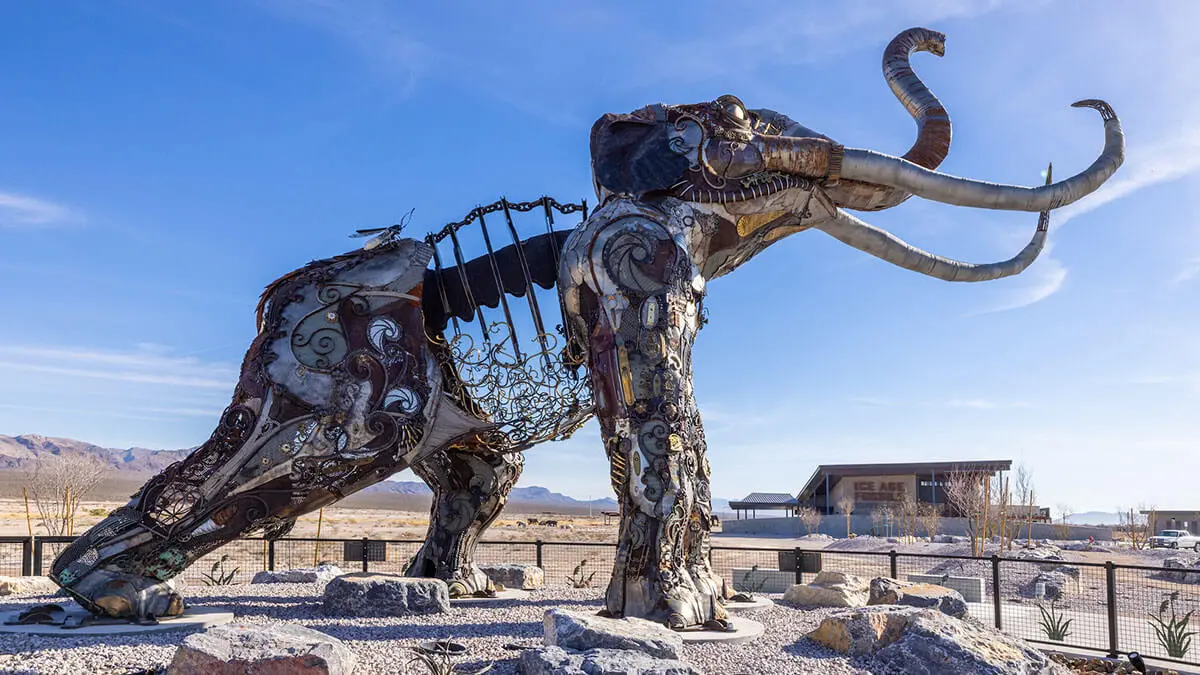
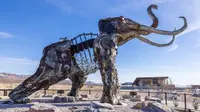
The first thing a visitor sees at Ice Age Fossils State Park, on North Decatur Boulevard about 20 minutes north of the Strip by Travel Nevada’s reckoning, is the Monumental Mammoth. Its steel skin was made from metal gathered during public cleanups of the adjacent Tule Springs Fossil Beds National Monument. The Nevada Division of State Parks runs the 315 acres, which take in a stretch of the upper Las Vegas Wash.
A steel mammoth and three trails
Admission is paid in the visitor center. Inside are natural history exhibits, a gift shop, drinking water and covered seating outdoors. A video projection shows the valley green and full of animals, and a 10-minute film introduces the park. Interactive displays and dozens of excavated finds fill in the rest.
From the back patio the Megafauna Trail runs 0.3 mile on flat ground among life-sized metal sculptures of the animals that once lived at Tule Springs, with interpretive signs along the way. The 1.5-mile Las Vegas Wash Trail begins and ends at the Monumental Mammoth and follows the wash, where streams cut into the old valley floor and left pockets of badlands along the banks. A 0.5-mile connector leads from the Megafauna Trail to the Trench K Trailhead, where the 1.2-mile Big Dig Trail passes through the trenches bulldozed by the Tule Springs Expedition. The park says the ground is dry most of the year but asks hikers to check with staff about conditions in the wash and the trenches. Near the visitor center a large shade structure covers picnic tables.
The rules are posted plainly. No fossil, rock, plant or artifact may be disturbed or taken, and state and federal law protect the ground. Visitors stay on the trails. Bikes, horses, drones and camping are prohibited, and dogs go on a leash no longer than six feet.
Sloth salad and a costumed night hike
The rangers keep a weekend calendar, and the October 2026 schedule shows its range: Candy Scat on the 3rd, Tortoise Time on the 4th, a Megafauna Walk & Talk at 9 a.m. on the 10th, Pop-Up Science: Insects vs. Arachnids on the 11th, a Monumental Mammoth Scavenger Hunt on the 17th, and Coffee Talk on the 18th. The annual Halloween Costume Night Hike on October 24 begins with crafts in the Picnic Pavilion and then goes out on the Las Vegas Wash Trail after dark, with trick-or-treat stops along the way. It filled in September. Spooky Skeletons follows on the 25th, a Nevada Day Celebration on the 30th, and Pop-Up Science: Sloth Salad on the 31st. The $3 entry fee covers every program.
October is also Bobtober. According to the park’s posts, Bob arrives each October to help staff with daily tasks and to make occasional mischief. Visitors who mention Bob at check-in pick a prize from Bob’s cauldron.
The summer of 2026 ran on a different clock. Sunrise hikes set out as early as 4:30 a.m., and one went off-trail for 2.5 miles over rough ground not normally open to visitors. Night hikes went out under a crescent moon to listen for desert wildlife. On September 19 the park held a Homecoming night hike for the dance at Shadow Ridge High School. “Our neighbors at Shadow Ridge High School are throwing their Homecoming dance, so we’re joining the fun by hosting a Homecoming-themed night hike right across the street!” the park announced, and invited hikers to wear corsages, crowns and sashes over their trail clothes. At a Coffee Talk on August 22, Dr. Steve Rowland spoke about the proposed Rainbow Gardens National Monument. The third annual Extinction of Summer, August 5 through 9, brought in the Desert National Wildlife Refuge, the Moapa Valley National Wildlife Refuge, the Mojave Max program and the Las Vegas-Clark County Library District. In the hot months the park also reminds drivers to look under their cars before leaving, because tortoises, lizards and stray cats shelter in the shade there.
Springs across the valley floor
The park’s history page describes the scene at the peak of the last Ice Age, roughly 25,000 years ago. The Las Vegas area was wet and green, marshes spread across the valley floor, and herds of ancient bison, camels and Columbian mammoths would have been a common sight. Travel Nevada puts the herds here more than 100,000 years ago.
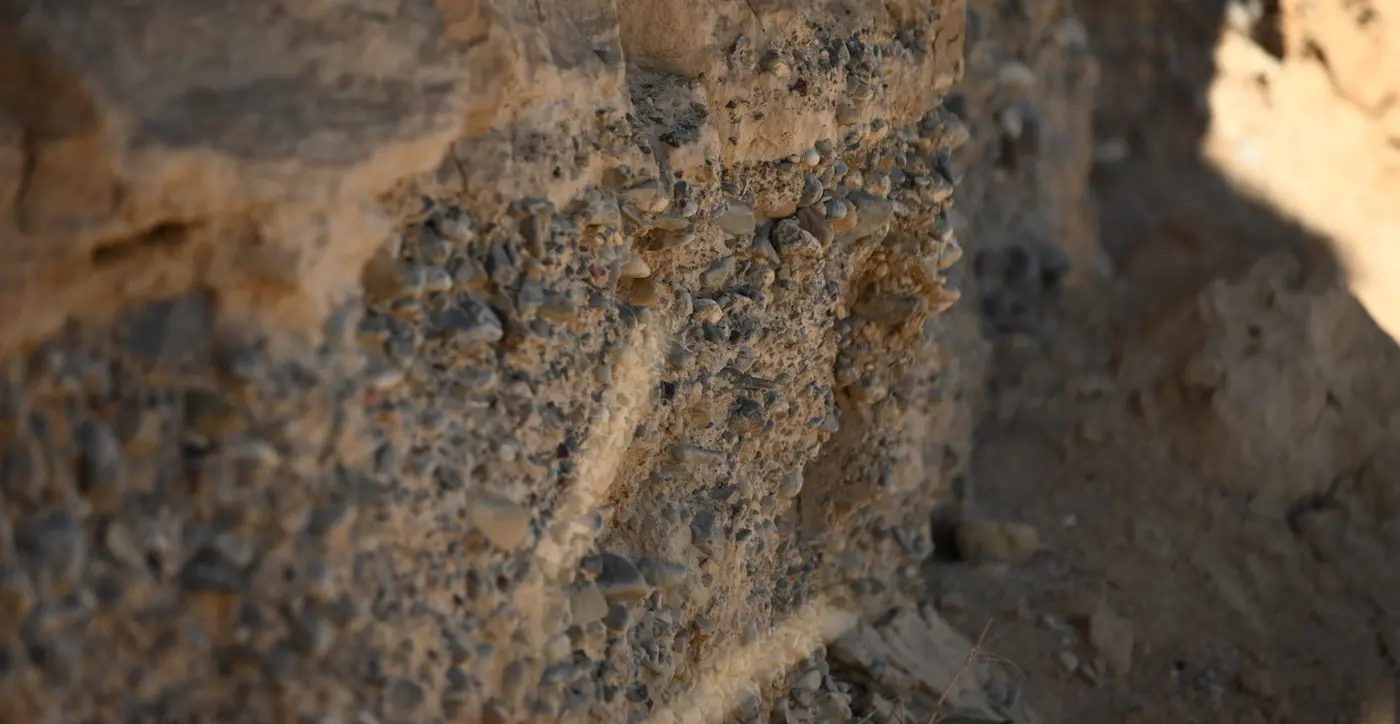
The ground holds the record. U.S. Geological Survey geologists Kathleen Springer and Jeff Pigati describe the light-colored silts of the Las Vegas Formation, once read as the bed of a large Pleistocene lake, as the deposits of a vast spring ecosystem that at times covered nearly the whole valley. In a wetter climate the water table rose until groundwater flowed out at the surface. Soggy ground and dense plants trapped dust and sand carried by wind and water, and these mixed with organic matter and chemical precipitates. The USGS divides the formation into 17 units dated from about 573,000 to 8,530 years ago. The wetlands grew and shrank with abrupt warming events that also appear in the Greenland ice core record. Between wet periods came megadroughts, usually a few centuries long, when the springs dried up entirely.
The animals buried in those layers are known as the Tule Springs local fauna, which spans about 100,000 to 12,500 years ago. Mammoth remains are the most numerous. Yesterday’s camel is second. The fauna also includes two species of bison, three kinds of horse, and Jefferson’s and Shasta ground sloths, along with rare American lion and newer finds of dire wolf and saber-toothed cat. There are frogs, lizards, snakes, birds, rodents, snails, tiny clams and ostracodes as well. The USGS writes that about 10,600 years ago spring-fed streams wandered across the Tule Springs area and were preserved as tufa, and it calls Tule Springs home to the only braided fluvial tufa system in North America. The state park’s account says that around 12,000 years ago, as the large animals were disappearing, people began leaving their mark in the valley.
Trench K and the Big Dig
The first fossils on record came in 1903, when Josiah Spurr of the USGS reported teeth and bones in the wash between Corn Creek Springs and Tule Springs. Researchers kept returning for decades. The park’s history says that “exciting discoveries” led the Nevada State Parks Commission to acquire the 315-acre parcel in 1958.
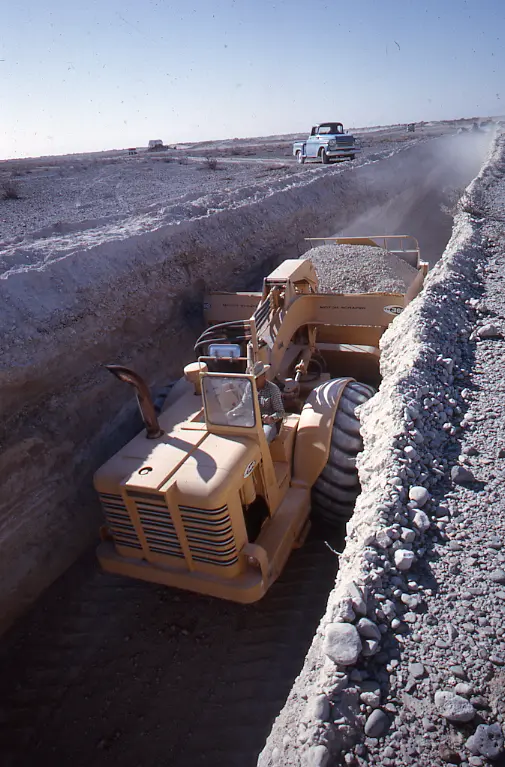
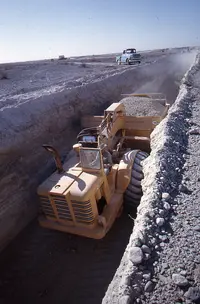
Then came the Tule Springs Expedition of 1962–63, known as the Big Dig. Its purpose was to learn whether people had lived in North America alongside the Pleistocene animals. The four-month expedition brought heavy construction equipment onto the wash. By Travel Nevada’s count the machines cut two miles of trenches, and the USGS says the trench walls ran as deep as 13 meters, nearly 43 feet. Geologist C. Vance Haynes, Jr., directed the geology. He divided the exposed sediments into units of the Las Vegas Formation and dated them with radiocarbon, a method then newly developed. The USGS says no fossil site had ever been dated that way before. A later USGS fact sheet calls Haynes “the godfather of desert wetland research in the southwestern United States.”
The two agencies describe the result differently. The National Park Service and USGS write that Haynes found human-made artifacts only in the youngest layers, where no Pleistocene animal fossils occur, so the idea that people and megafauna lived together at Tule Springs was disproven. The state park’s history calls the findings inconclusive. Both agree that interest faded quickly afterward. One of the expedition’s cuts was Trench K, and the Big Dig Trail now begins there.
From a 1958 parcel to a 2024 opening
The wash stayed quiet until the late 1990s and early 2000s. Kathleen Springer, Eric Scott and a team from the San Bernardino County Museum then excavated the area systematically, recording nearly 600 new fossil localities and curating more than 40,000 vertebrate fossils. Congress established the neighboring national monument, nearly 23,000 acres, on December 19, 2014. In January 2017 Governor Brian Sandoval designated the state land Ice Age Fossils State Park under his Explore Your Nevada Initiative.
The Division of State Parks then built the park from bare desert with architects, designers and content experts. They added the visitor center and museum gallery, restrooms, a group area, interpretive signs, and shade structures along almost four miles of trail. The park’s history page carries a photograph of park interpreter Dawn Reynoso inspecting a trench. The gates opened to visitors on January 20, 2024.
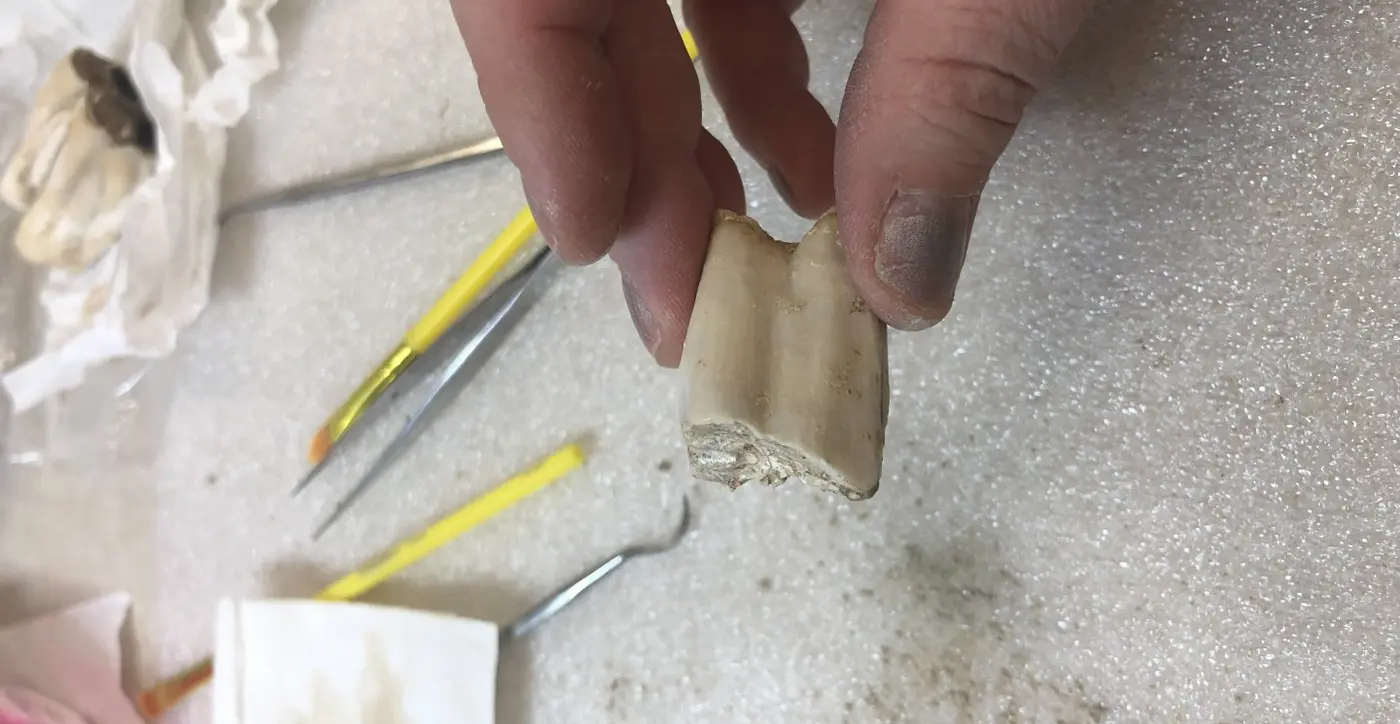
In late March 2024, hikers spotted something on a trail and alerted the rangers, who went out and excavated a partial Columbian mammoth tooth.
Notable Events
- 1903The USGS made the first fossil discoveries at the site, beginning the modern history of the park. parks.nv.gov
- 1958Exciting discoveries led the Nevada State Parks Commission (now Nevada Division of State Parks) to acquire the 315-acre parcel of land. parks.nv.gov
- 1962The expedition combined traditional field techniques with massive earth-moving activities to determine if humans and Pleistocene megafauna coexisted. nps.gov
- 1962NPS says the hypothesis of human-megafauna coexistence at Tule Springs was disproven and interest faded. nps.gov
- 1962A multidisciplinary study with the goal of uncovering evidence of the earliest human inhabitants in North America; it became known as the Big Dig. parks.nv.gov
- 1990sResearchers returned to describe fossil history and geology and discovered hundreds of sites around Tule Springs. parks.nv.gov
- 2017Governor Sandoval designated the property as Ice Age Fossils State Park as part of his Explore Your Nevada Initiative. parks.nv.gov
- 2024The park staff welcomed visitors to the new state park. parks.nv.gov
People
- C. Vance Haynes, Jr., Began wetland-deposit studies at Tule Springs in the Upper Las Vegas Wash to investigate ancient people and megafauna coexistence (1962).
- Eric Scott, San Bernardino County Museum scientist conducting systematic paleontological excavations (2000s).
- Jeff Pigati, USGS scientist expanding Las Vegas Formation stratigraphy and chronology with Kathleen Springer.
- Josiah Spurr, USGS scientist who reported teeth and bones in Upper Las Vegas Wash sediments (1903).
- Kathleen Springer, San Bernardino County Museum scientist conducting systematic paleontological excavations (2000s).
- Brian Sandoval, Governor who designated the property as Ice Age Fossils State Park (2017).
- Dawn Reynoso, Park interpreter inspecting a trench.
- Governor Sandoval, Governor who designated the property Ice Age Fossils State Park (2017).
Sources
- parks.nv.gov/parks/ice-age-fossils
- parks.nv.gov/learn/park-histories/ice-age-fossils-history
- parks.nv.gov/ice-age-fossils-state-park-park-rules
- travelnevada.com/state-national-parks/ice-age-fossils-state-park
- facebook.com/IceAgeFossils
- instagram.com/iceagefossilsstatepark
- nps.gov/articles/park-paleo-spring-2019-tulesprings.htm
- hmdb.org/m.asp?m=29960