

Hull-Oakes Lumber Co
Monroe, Benton County, Oregon. Steam-driven sawmill.
Details

- Where
- 23837 Dawson Road, Monroe, OR 23837. Directions
- Getting there
- At the end of Dawson Road off Oregon 99W, on 28 acres on the east slope of the Coast Range; the site was once the Southern Pacific railhead known as Dawson Station.
- Access
- Tours by appointment only.
- Walk-in or reserve
- Tours by appointment only.
- Phone
- 541-424-3112
- Managed by
- Todd Nystrom.
- Established
- 1938-1939, as the Ralph Hull Lumber Company.
The end of Dawson Road
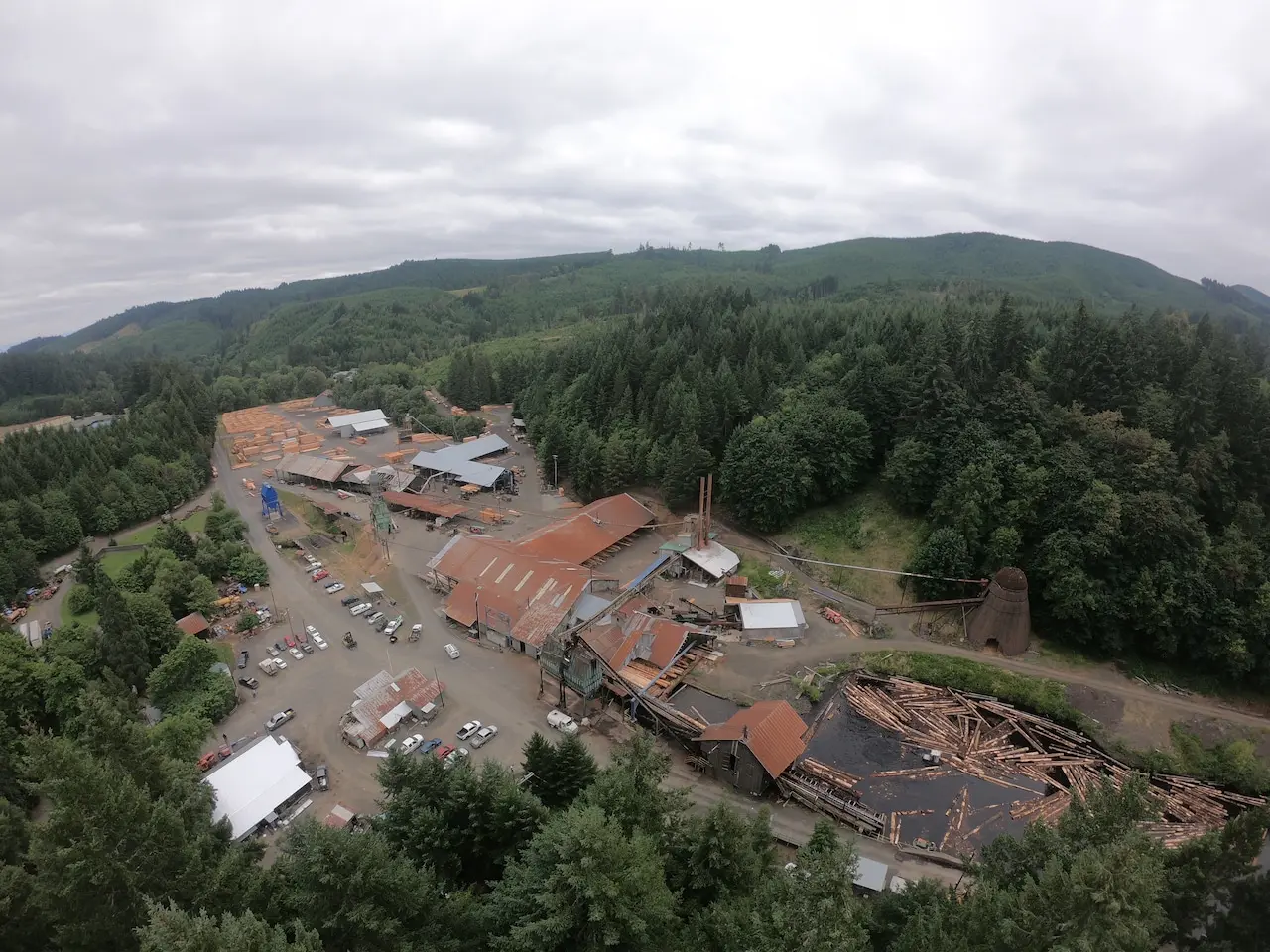
Dawson Road leaves Oregon 99W and runs west through Bellfountain, an unincorporated community of some 75 people. Bellfountain has a church and a county park, both more than a hundred years old, and the shell of Country Boy Gas, whose pumps are decaying under a “Gone Fishin’” sign. The road ends at the Hull-Oakes Lumber Co., two miles west of Bellfountain by The Oregonian’s 2022 reckoning and about three by the National Register nomination. The mill covers twenty-eight acres on the east slope of the Coast Range, on a former Southern Pacific railhead called Dawson Station. Green Peak rises 2,900 feet behind it.
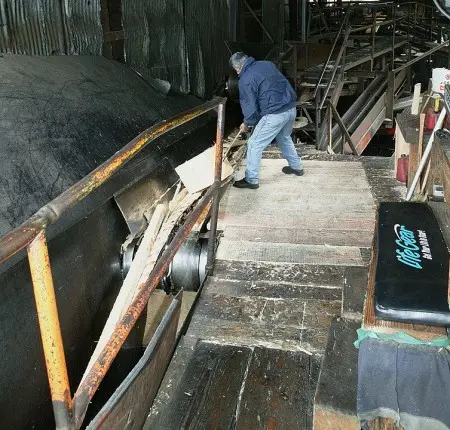
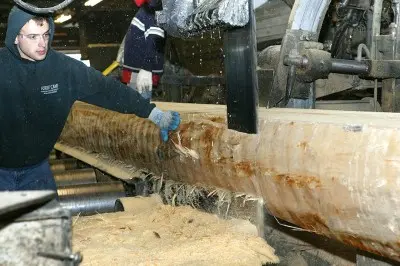
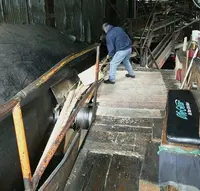
Log trucks unload at the pond. A log-handling machine the crew calls the waggoner grabs the load before the binders are released, lifts it clear, and drops it over the log brow into the water. The pond covers about two acres and is fed by a tributary of Oliver Creek. In the early twentieth century a pond man walked the floating logs with a pike pole. Since then a pond boat has done the sorting, and its operator goes by “pond bronc.” A lift hoists the logs one at a time onto a chain conveyor called the long transfer, which carries them through the barker. Bark and waste go to the chipper.
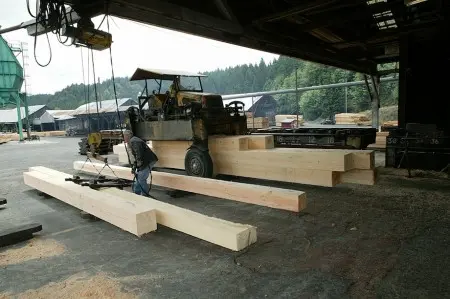
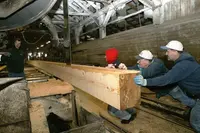
The mill cuts what most mills will not: large Douglas-fir timbers from logs up to nine feet in diameter, in lengths to 85 feet. Its work has included bridge stringers, beams for gold dredges, deck-support planks for the restoration of the frigate U.S.S. Constitution, and lumber to rebuild the 1895 lumber schooner C.A. Thayer at San Francisco’s Maritime Museum. “We’ve been in business so long that people know if they want large and long timbers, they can at least come ask us,” company president Todd Nystrom, Ralph Hull’s grandson, told The Oregonian in 2022. “Whether we can do it or not is another question.” The company does not advertise. That year it had about 50 employees and cut 15 to 20 million board feet, with at least a fifth of its logs coming from its own timberlands.
Nathan Nystrom, Hull’s great-grandson, buys the logs and serves as the mill’s forester. “We’re not just making 2-by-4s for housing construction,” he said. “There are times when I might be meeting with different landowners, and we’re selecting particular trees for certain projects.” On the grounds stands a wigwam refuse burner, which the visitor bureaus count among the largest left in Benton County. It was built in the 1950s to meet the state’s air-quality standards of that time. The state later outlawed such burners, and this one has been cold since about 1970. Tours are by appointment.
Hand signals at the headrig
The tourism listings still describe Hull-Oakes as one of the last steam-driven sawmills in the nation. According to Nathan Nystrom, the company switched completely to electric production in 2013 and phased in the new equipment over a year or two. The steam plant was kept as a backup, but by 2022 no one had fired the boiler for production in years.
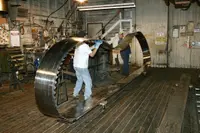
That steam plant sits at the center of the mill. Its main engine is an Ames Iron Works twin-cylinder engine built in 1906. It weighs eight tons and has two 16-inch cylinders, an 18-inch stroke, and a pulley 8 feet across. The engine is 13 feet long and 10 feet 5 inches wide, and it turned a cowhide belt that drove the headrig and the edger. A second steam engine, bought in 1972 from the Bohemia sawmill at Row River, worked the log carriage. Two boilers supplied 140 to 150 pounds of steam. In 1997 Jolin Bell stoked them with sawdust, planer dust and bark to between 1,800 and 2,300 degrees.
Nathan Nystrom gave three reasons for giving up steam. The first was repairs. “We did an analysis on what we would do if we had a major failure, and it would have been months and months of downtime to get that thing rebuilt.” The second was the daily labor. “We’d have a person come in at midnight every night to get the fires stoked and the pressure built up.” The third was insurance. Underwriters, he said, “would come out here and see us burning shavings and sawdust and our boilers surrounded by a wood-frame building, it just made them very uncomfortable.”
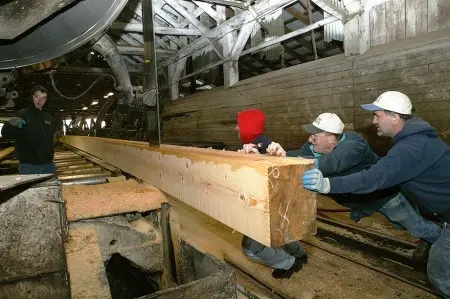
Gary Katz photographed the steam mill at work in February 2011, on a day it was cutting an 80-foot timber for a new mast for the C.A. Thayer. Steam cylinders worked the log turner’s steel arms, which can throw a log six feet thick and eighty feet long onto the carriage. The sawyer rode the carriage lever and gave orders by hand, because no voice carried over the noise. Two fingers meant a two-inch cut. A fist, or a finger joined to the thumb, followed by four fingers meant fourteen inches. The ratchet setter read the signals and moved the log toward the blade or away from it. In 2004 the Gazette-Times photographed sawyer Tanner Gibson signaling this way and called the ratchet setter’s job the last of its kind in the U.S.
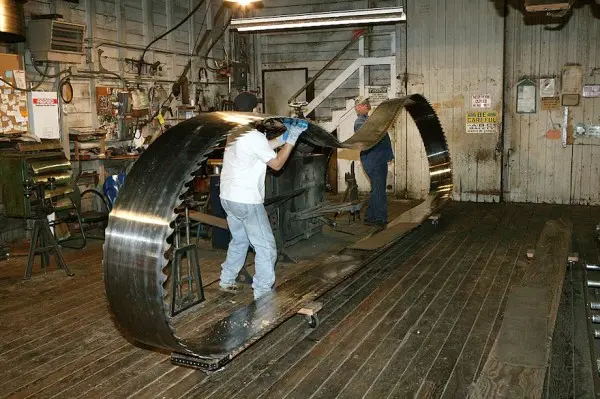
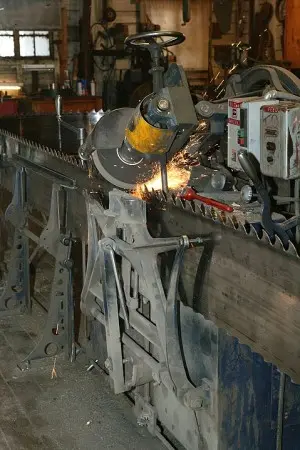
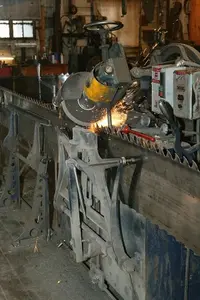
The bandsaw blade came off every two hours for sharpening. Its teeth were, in Katz’s phrase, shark-size. Bill Oakes tended the steam pressure that day. His father, Ken Oakes, had felled timber for the mill for forty years, and his grandson was pulling and sorting lumber on the green chain. Most of the chips went to a paper company at Toledo.
Three mills and two fires
Ralph Hull was born April 13, 1912, in a place called Hell’s Canyon northwest of Monroe. His family raised cattle, goats and sheep, and he grew up logging on the family’s stump ranch. Watching relatives in the sawmill trade, he settled on sawmilling himself. In 1934 he leased a mill north of Bellfountain from Merle Gragg. In 1935 he leased an all-electric mill in Monroe, which burned after three or four months. That fall, with help from a local steam man named Hubert K. McBee, he built a steam mill north of Bellfountain. It burned to the ground in May 1938.
Hull then bought the Dawson site, which had held sawmills for two decades. The 1986 county survey says Fred Malcom built one there about 1913, and the National Register form says Fred Malcolm was operating there by 1914. W.J. Miller leased that mill, in 1919 by one account and 1920 by another, and in 1922 he built his own mill on the site, which burned in 1936. The Oregon Encyclopedia calls the seller of the remains Hull’s cousin Wes Miller. The Oregonian calls him Hull’s uncle.
Hull built the new mill over the winter of 1938-1939, of heavy timbers and without formal plans. He reused parts of the Miller plant, including a boiler house from about 1920 and a planer building of about the same date, and the mill began cutting lumber in the spring of 1939. It ran entirely on steam because industrial-strength power did not reach Dawson until 1949. During the Second World War it ran double shifts, cutting long timbers for government warehouses in California.
In late 1946 Hull’s brother Homer bought the mill and renamed it Hull Lumber Co. Inc. Ralph stayed on to manage it until 1949, when he left for a venture in northern California. He came back in 1955, when he and his brother-in-law Chester Oakes, a longtime area logger, bought the mill and formed the Hull-Oakes Lumber Co. Hull bought out Oakes’s half in 1963.
The machinery changed piece by piece. About 1953 a band saw replaced the twin circular saws. In 1954-55 a twin-cylinder engine from a sawmill at Lorane replaced a single-cylinder one, and a Filer and Stowell head rig went in. In the 1960s Hull converted parts of the mill to electricity. He meant to convert all of it, The Oregonian reported, but power rates quadrupled and he backed off. An AC/DC motor installed in 1966 for the purpose was never used. About 1980 a boiler from the Freres sawmill replaced a worn-out one. In 1989 Hull gave minority shares to select workers, among them his grandson Todd Nystrom.
A pulley built in a day
In 1997 the company spokesman, Wayne Giesy, showed a radio reporter the oldest equipment in the plant, a wooden pulley. “This is a wooden pulley that was built in 1938. It’s been on there ever since. So we have a little saying here at Hull-Oakes: if it ain’t broke, don’t fix it.” Hull’s own account, recorded in the National Register nomination, is that a millwright built the pulley in one day with a hand saw and that it had been running since 1939.
The mill entered the National Register of Historic Places in 1996, after the Oregon State Advisory Committee approved the nomination unanimously on February 15 of that year. The Western Wood Products Association counted it among the last commercially viable steam-powered sawmills in the country, and possibly the last. Hull was 84 by then. He walked each day from his small brown house across the yard to the office, which was full of the sound of adding machines. “Mr. Hull doesn’t believe in computers,” Giesy said. “We’re so old-fashioned, we’ve become newsworthy,” Hull said.
The owners proposed in 1997 to make the place a working museum, with an elevated walkway, an interpretive center and free tours. In return they asked Congress to guarantee them the right to buy federal timber at market value. Doug Heiken of the Oregon Natural Resources Council called the plan a timber grab. “Whaling museums exist in Boston, but they aren’t working whaling museums,” he said. He also alleged that the log pond, which had run without government permits for more than 17 years, was polluting cutthroat trout water. Representative Peter DeFazio questioned whether the plan was fair to other independent mills. Senator Ron Wyden wanted the American Association of Museums to endorse it first. Eric N. DeLony, head of the Historic American Engineering Record, wrote after his visit that “the site appeared to have remarkable integrity.”
The mill was also drawn into a dispute over timber it bought at Tobe Creek on the South Fork of the Alsea River. One protest there drew 500 people, and the story reached “60 Minutes.” Correspondent Ed Bradley signed the Hull-Oakes guest book. Ralph Hull kept checking on operations until he died in May 2002.
On a Tuesday night in December 2010, two night watchmen found fire in the sawdust bunker of the boiler house, one of the mill’s two original structures. Dave Hull and his son Cody, who live nearby, smelled the smoke at home and came over. Crews from Monroe and Philomath had it under control by midnight, and heavy rain washed away the haze.
Tables eighty-five feet long
In the 1980s, probably 1984, Ralph Hull had the mill cut six slabs from a single Douglas fir. Each was 4 inches thick, 36 inches wide, and 85 feet 10 inches long. The slabs became picnic tables. The first went down the road to Bellfountain Park, and others went to parks and fairgrounds around the region and to a Boy Scout camp in Canada. Ralph and Margaret Hull donated the one at Avery Park in Corvallis on May 8, 1987. It stands under the Lions Shelter, with a plaque giving the age of the tree.
Notable Events
- 1909The Corvallis and Alsea River Railway built the main line later used by the mill's railroad spurs. npgallery.nps.gov
- 1911The Portland, Eugene and Eastern Railway bought the line. npgallery.nps.gov
- 1913Fred Malcom built a sawmill in Dawson on or near the current Hull-Oakes site. heritagedata.prd.state.or.us
- 1915The Southern Pacific Railroad bought the line serving Dawson. npgallery.nps.gov
- 1919Miller leased a mill on the same site from Fred Malcolm. npgallery.nps.gov
- 1919The log pond was built to support previous sawmill operations and was later enlarged. npgallery.nps.gov
- 1919The former Southern Pacific railhead known as Dawson Station has been occupied by sawmills since 1919. oregonencyclopedia.org
- 1920The boiler house was built to house boilers supplying steam to W.J. Miller's earlier sawmill. npgallery.nps.gov
- 1920The contributing-feature list dates the planer building to approximately this year. npgallery.nps.gov
- 1920sThe former office was built as an office, storage area and depot for the rail line serving W.J. Miller Lumber Co. and Corvallis Logging Co. npgallery.nps.gov
- 1922Miller built a mill on the site after leasing Malcom's mill. heritagedata.prd.state.or.us
- 1934Hull became interested in lumbering during the early Great Depression and made a deal for his first sawmill. npgallery.nps.gov
- 1934Beginning in 1934, Hull operated three mills near Monroe in quick succession; two of them burned down. oregonencyclopedia.org
- 1935After his previous lease expired, Hull leased an all-electric sawmill in nearby Monroe; it burned after three or four months of operation. npgallery.nps.gov
- 1935With help from local steam man Hubert K. McBee, Hull built a steam-powered sawmill north of Bellfountain. npgallery.nps.gov
- 1936The Miller mill burned down before Hull purchased the site and built a new sawmill. heritagedata.prd.state.or.us
- 1938Hull built the present mill without formal plans in the vernacular tradition. npgallery.nps.gov
- 1938Ralph Hull turned an existing mill site into the Ralph Hull Lumber Company. oregonlive.com
- 1939When Hull first started the mill, it was entirely operated by steam. npgallery.nps.gov
- 1940sThe building later used as the company office was built for the mill's night watchman. npgallery.nps.gov
- 1941A lumber-storage shed was attached to the planer building. npgallery.nps.gov
- 1941The truck and lumber-carrier maintenance garage was built north of the main sawmill and Dawson Road. npgallery.nps.gov
- 1946Ralph Hull sold the mill to Homer Hull, who operated it as the Hull Lumber Co. Inc. heritagedata.prd.state.or.us
- 1949Hull left for a new venture in northern California and did not resume his owner/manager role at this mill until the Oakes partnership. npgallery.nps.gov
- 1949Mountain States Electric Co. first put an industrial-strength electric line to Dawson, according to company records later held by Pacific Power & Electric. npgallery.nps.gov
- 1950sThe night-watchman's bungalow used as company office was modified by additions. npgallery.nps.gov
- 1950sA wigwam-style refuse burner was built to meet then-new state air-quality standards; the state later outlawed such structures. npgallery.nps.gov
- 1950sHull gradually switched some systems to electrical power when electricity arrived. oregonencyclopedia.org
- 1953The saw-filing room was built when the building was modified to install a band saw in place of twin circular primary saws. npgallery.nps.gov
- 1954A twin-cylinder engine from a Lorane sawmill replaced the earlier single-cylinder engine. npgallery.nps.gov
- 1954A photo caption shows construction of the concrete tunnel diverting Oliver Creek away from the mill. npgallery.nps.gov
- 1955Ralph Hull and Chester Oakes purchased the mill and organized the Hull-Oakes Lumber Company. heritagedata.prd.state.or.us
- 1955The new head rig was built by Filer and Stowell, purchased and installed to replace the double circular saw arrangement. npgallery.nps.gov
- 1955Hull teamed up with long-time local logger Chester Oakes, his brother-in-law; three corporate configurations have guided the plant since that year. oregonencyclopedia.org
- 1960A concrete water reservoir was built to supply boiler feed water. npgallery.nps.gov
- 1960A wood-chip bin was built northwest of the boiler house, also housing the company's chipper. npgallery.nps.gov
- 1960sThe equipment-history table dates the edger saw installation to this decade. npgallery.nps.gov
- 1960sHull converted parts of the mill to electricity but backed off a complete conversion when power rates quadrupled. objects.lib.uidaho.edu
- 1963Hull bought out Chester Oakes' half of the business. npgallery.nps.gov
- 1966An AC/DC motor and related equipment were installed for converting the rest of the mill; the conversion never happened and the equipment remained unused. npgallery.nps.gov
- 1967A concrete reservoir was built primarily for fire suppression. npgallery.nps.gov
- 1967An offset carriage with pantograph was purchased from Lulay Brothers at Scio and installed the following year. npgallery.nps.gov
- 1970A Salem Brunette log debarker was installed. npgallery.nps.gov
- 1970The refuse burner ceased use in conformance with state air-quality standards. npgallery.nps.gov
- 1972The equipment-history table lists the carriage steam engine as installed after purchase from the Bohemia sawmill at Row River. npgallery.nps.gov
- 1974The equipment-history table describes installation of a resaw from the Rex Clemens sawmill, converted to right-hand feed. npgallery.nps.gov
- 1980A boiler from the Freres sawmill replaced an older worn-out and unusable boiler. npgallery.nps.gov
- 1980sHull considered automation but said the large-and-long-timber operation was necessarily slow and installation would have been very expensive. objects.lib.uidaho.edu
- 1986The first Hull-Oakes corporation was dissolved and operated as Ralph Hull, doing business as Hull Oakes Lumber Co. npgallery.nps.gov
- 1989Hull gave select workers minority control as a first step toward turning the business over to a new generation of owners. npgallery.nps.gov
- 1989A second Hull-Oakes Lumber Co. was formed with Ralph Hull as president and six employees. npgallery.nps.gov
- 1993Willamette and Pacific Railroad in Albany leased the railhead. npgallery.nps.gov
- 1994The mill cut special deck-support planks for a proposed restoration of the U.S.S. Constitution. npgallery.nps.gov
- 1996The Oregon State Advisory Committee unanimously approved the mill complex for nomination to the National Register. npgallery.nps.gov
- 1996National Register status recognized the mill as a rare example of a working mill using Steam Age lumber manufacturing equipment and methods. oregonencyclopedia.org
- 1997The owners proposed making the mill a working museum with tours and exhibits, asking Congress for a guaranteed supply of federal timber in return for free tours and an interpretive center. loe.org
- 2002Ralph Hull, who built the mill, passed away; right up until then he continued to check in on operations, which his grandson Todd Nystrom now runs. thisiscarpentry.com
- 2013The company switched completely to electricity-based production, phasing in equipment over a year or two; steam technology remained as backup. oregonlive.com
- The mill cut large and long timbers for government warehouses in California and operated double shifts to meet government demands. npgallery.nps.gov
People
- Tanner Gibson, Hull-Oakes sawyer who used hand signals to tell the ratchet setter how thick to cut boards.
- Cody Hull, Dave Hull's son and mill neighbor who came to the fire after smelling smoke at home.
- Dave Hull, Mill neighbor who came to the fire after smelling smoke at home; Cody Hull's father.
- Rick Smith, Monroe fire chief who directed discussion with fire crews at the Hull-Oakes fire.
- Chester Oakes, Area logger, Hull's brother-in-law, and eventual partner in the mill.
- Fred Malcom, Built a predecessor sawmill in Dawson on or near the present Hull-Oakes site (about 1913).
- Homer Hull, Sold the mill and some timberlands back to Ralph Hull and Chester Oakes (1955).
- Merle Gragg, Owner of a mill north of Bellfountain leased by Ralph Hull (1934).
- Ralph Hull, Founder of the Ralph Hull Lumber Company on an existing mill site; grandfather of Todd Nystrom and great-grandfather of Nathan Nystrom (1938).
- W.J. Miller, Owner of the former Dawson mill site Hull arranged to purchase after his own mill burned.
- Doug Heiken, Oregon Natural Resources Council opponent of the proposed working museum and dedicated timber supply (1997).
- Peter DeFazio, Representative who visited the site and took an interest in the proposed working museum.
- Ron Wyden, Oregon senator who wanted American Association of Museums endorsement before supporting the proposal.
- Wayne Giesy, Hull's friend and retired sales manager.
- Arlene Lee, One of the named recipients of a minority interest sold by Hull.
- Bill Reeser, Plant millwright who built a companion wooden wheel to operate a conveyor.
- Donald Oakes, One of the named recipients of a minority interest sold by Hull.
- Fred Malcolm, Predecessor mill operator from whom Miller leased a mill (1919).
- Homer, Ralph's brother who purchased the mill, then named Hull Lumber Co. Inc (late 1946).
- Hubert K. McBee, Prominent Benton County resident and local steam man who helped Hull build a steam-powered sawmill (fall of 1935).
- Jerry King, Hull fireman firing the sawmill boilers (18 years, in the quoted account).
- Margaret Hull, Pictured in front of the former mill business office with a large timber.
- Phil Kundert, One of the named recipients of a minority interest sold by Hull.
- Ralph Kundert, Retired Hull millwright who described maintaining steam engines by listening.
- Todd Nystrom, Company president and Ralph Hull's grandson.
- Virgil Hall, Helped Hull set up the mill and remembered a worker's fatal accident.
- Ed Bradley, Television correspondent who signed the Hull-Oakes guest book.
- Eric N. DeLony, Head of the Historic American Engineering Record who visited the mill and remarked on its integrity.
- Jeff Stier, Congressman's spokesman who discussed a possible hearing for the working-museum concept.
- Jolin Bell, Worker stoking the mill's boilers.
- Mike Wiard, Worker shown hooking a log raft against a gathering machine in the mill pond.
- Wes Miller, Hull's uncle, from whom Hull acquired the property; operated a mill on the site since World War I (since World War I).
- Nathan Nystrom, The family-operated mill's log buyer and forester.
Sources
- visitcorvallis.com/account/hull-oakes-lumber-co
- traveloregon.com/things-to-do/culture-history/historic-sites-oregon-trail/hull-oakes-lumber-co
- oregonlive.com/business/2022/09/benton-county-sawmill-out-of-steam-but-still-going-strong.html
- oregonencyclopedia.org/articles/hull_oakes_lumber_company_and_mill
- visitcorvallis.com/tour-hull-oakes-lumber-tables-around-corvallis
- kezi.com/news/local/monroe-sawmill-donates-hubert-k-mcbee-campground-to-benton-county/article_88a7f414-ba49-11ee-95b9-476476c3c004.html
- heritagedata.prd.state.or.us/historic/index.cfm?do=main.loadFile&load=28444.pdf
- thisiscarpentry.com/2011/02/25/hull-oakes-sawmill
- loe.org/shows/segments.html?programID=97-P13-00011&segmentID=3