
Hull Cabin
Tusayan, Coconino County, Arizona. CABIN NONELECTRIC.
Details

- Where
- Tusayan, Coconino County, AZ. No street address stated. Directions
- When
- Checkin Time: 2:00 PM; Checkout Time: 11:00 AM.
- Season
- 2026: Available May 1 through September 30.
- Getting there
- Begin south on US Highway 67 for approximately 0.5 miles, Turn left onto Forest Road 302 and follow for approximately 15 miles, Turn left onto Forest Road 310 and follow for approximately 1.3 miles, Turn left onto Forest Road 307 and follow for approximately 1.5 miles, Turn left onto Forest Road 2801 and follow for approximately 0.4 mile to Hull Cabin.
- Fees
- Overnight Use: $140 per night.
- Access
- Driveway Surface: Gravel.
- Walk-in or reserve
- For fees and reservations go to www.recreation.gov or call 877-444-6777. All bookings are subject to a one-time $8 reservation fee.
- Phone
- 928-638-2443
- Website
- fs.usda.gov
- Managed by
- Tusayan Ranger District.
- Established
- This rustic cabin was built in the late 1880s by the Hull brothers, who maintained a sheep ranch.
- Coordinates
- 35.8964, -112.0612.
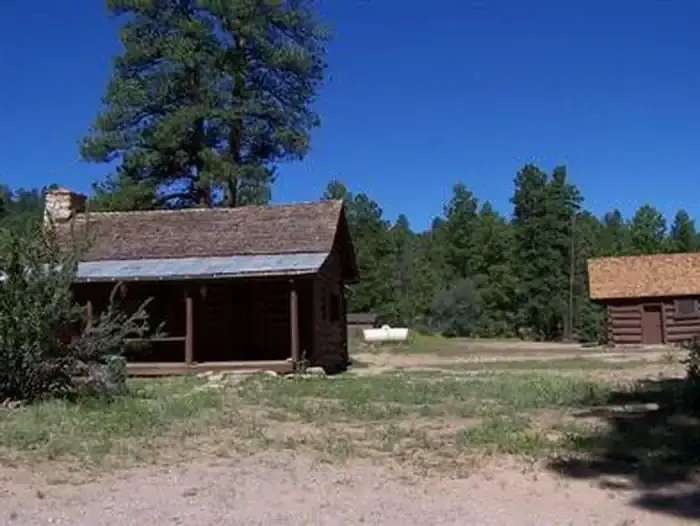
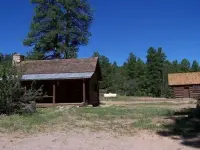
The last leg to Hull Cabin is Forest Road 2801, four-tenths of a mile long. Before it come some sixteen miles of graded gravel east of Tusayan. The road ends in a meadow ringed by old-growth ponderosa pine at 6,500 feet. Three log buildings stand in the meadow: the cabin, a smaller storage cabin about thirty feet to its northwest, and a barn about 180 feet north. The Grand Canyon is close. The Forest Service puts it one mile north, and the National Register nomination puts it about a mile and a half. The canyon cannot be seen from the site.
The cabin in the pines
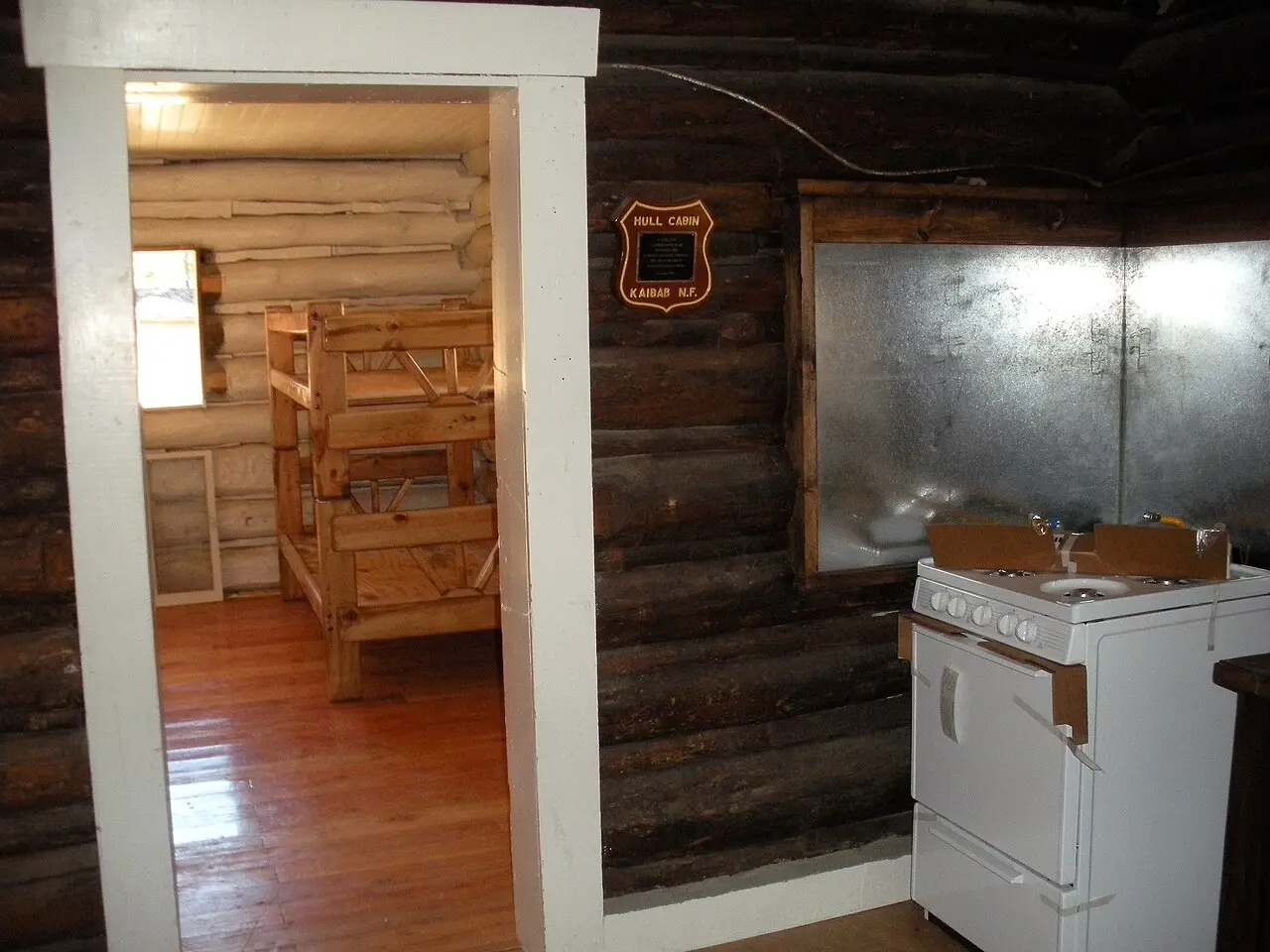
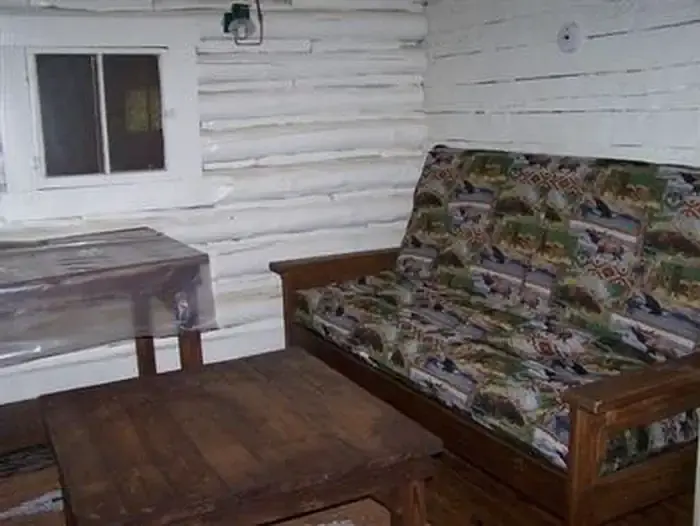
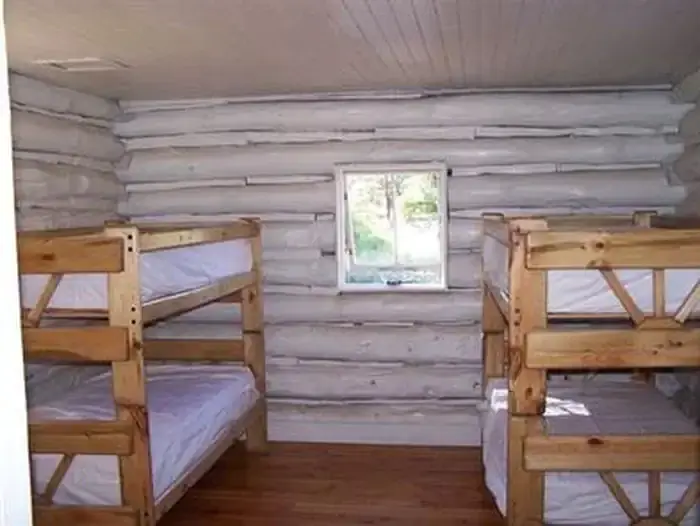
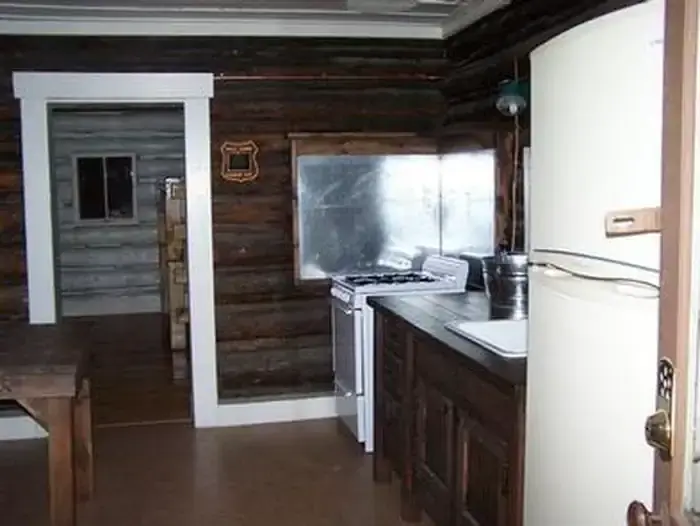
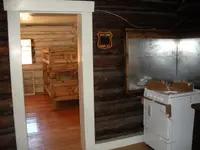
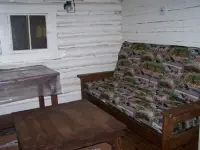
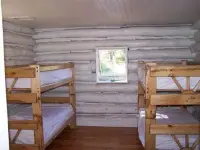
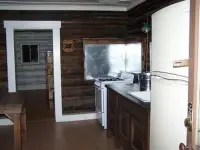
The Tusayan Ranger District of the Kaibab National Forest rents the cabin through Arizona’s Rooms with a View program. In 2026 it was offered from May 1 through September 30. It sleeps six. The bedroom holds two sets of twin bunk beds, and a queen-sized futon stands in the living room. The kitchen has an oven, stove, refrigerator, dishes, pots and pans. Water for the indoor plumbing is hauled in from Grand Canyon National Park. Heat comes from a woodstove, and there is a fire ring outside. Guests bring their own axe to split wood for it.
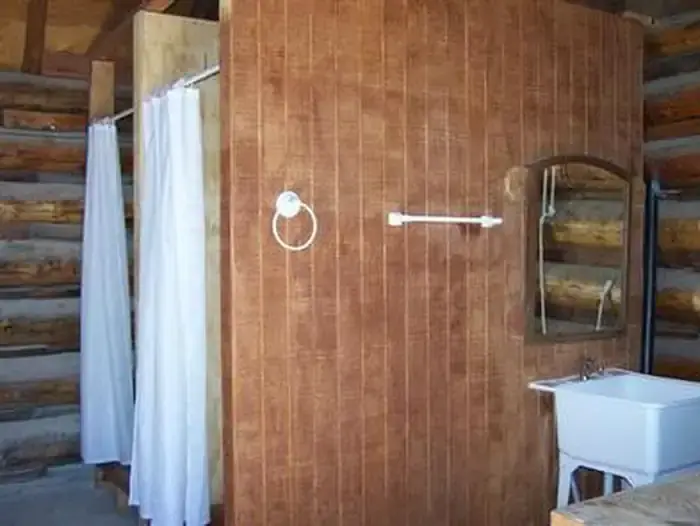
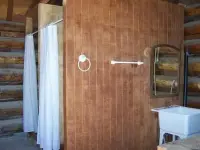
A separate shower house holds a vault toilet and two stalls fitted with solar shower attachments. Visitors supply the bladder bags. The cabin and the shower house each open with their own combination code. A cabin manual inside answers questions. No tents or RVs are allowed within half a mile.
The small Hull Tank on the grounds draws elk, mule deer, black bear, wild turkey, javelina, and birds and raptors. Recreation.gov adds that a visitor may see an endangered California condor. Grandview Lookout Tower stands about 0.9 mile away and gives 360-degree views of the canyon and forest. The Arizona Trail, an 800-mile national scenic trail, crosses the district and is open to hikers, riders and mountain bikers. Russell Tank can usually be fished in an average or high water season. The forest warns of cold nights, thunderstorms, and snow.
Round logs and a meat locker
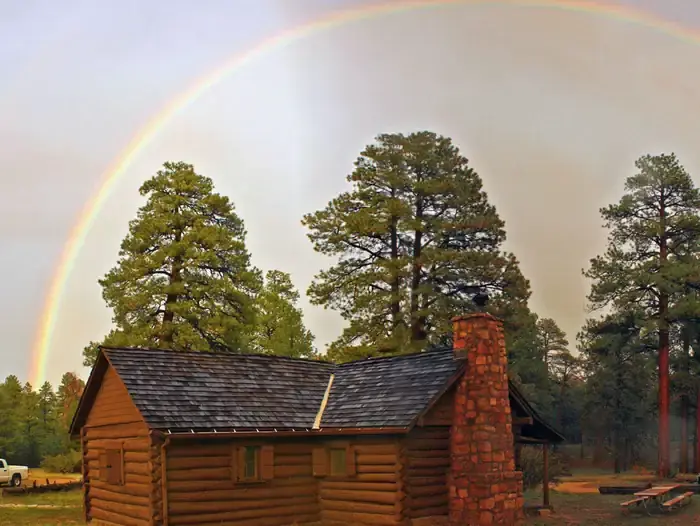
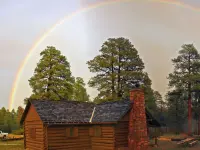
The National Register nomination describes the buildings closely. Hull Cabin is an L-shaped, three-room log house with three gables. It measures 37 by 26 feet and rests on a foundation of native Coconino sandstone. Its walls are ponderosa logs, debarked and left round. The Forest Service painted them a deep rust with preservative paint. The corners are V-notched, so the log ends appear pear-shaped and shed water. Recreation.gov describes the building as a one-room homestead of hand-hewn logs. The nomination finds the broad-axe work inside, in the square logs of the wall between kitchen and living room.
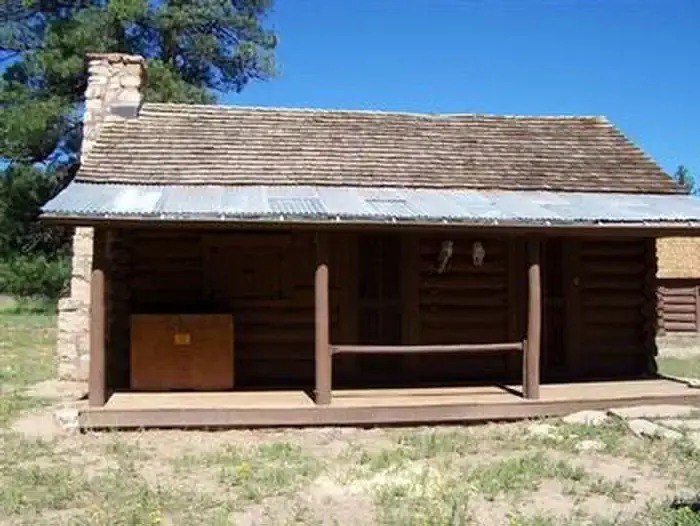
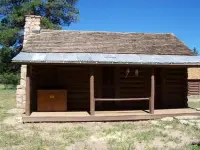
A three-bay porch on four round posts runs across the east front, reached by a sandstone walk and steps. Beside the living room door is a small wooden window on hinges. It held a telephone during the years the cabin served as summer ranger headquarters, 1907 to 1940. A massive sandstone chimney rises on the south end. On the north wall a screened “refrigeration” box served as a meat locker. The front door opens into the kitchen, and a doorway leads from it into a whitewashed living room with a painted sandstone fireplace and a plain wooden mantel.
The cabin grew from one or two rooms to three between 1901 and 1911. A 1901 photograph shows it without porch or bedroom, and a 1911 map shows both, probably added after the Forest Service took possession in 1907. The telephone, telegraph and electricity once installed had been removed by the time of the nomination. Recreation.gov now lists the site as a nonelectric cabin.
The barn is built of square, unpainted, hand-hewn pine logs joined with full-dovetail corners and chinked with mud. It has a corrugated tin roof, a dirt floor, and a feed trough along the north wall. The remains of a root cellar lie in an embankment north of the storage cabin. James E. Kintner, ranger here from about 1919 to 1923, described it in a 1969 letter to Tusayan District Ranger Ray Page: “the old root cellar was partly caved in and was a skunk’s paradise.” Joe Gibson lived at the cabin as a boy between 1924 and 1930. In 1984 he could name only two changes since then: the flagpole and the corral around the barn were gone.
The Hull brothers’ tank
In the 1880s the South Rim was remote and seldom visited. Tourists came by wagon over dirt roads, sixty miles from Williams or eighty-five from Flagstaff. Water was scarce, and few men ran stock near the rim. In 1888 the brothers Philip and William Hull built a reservoir for their sheep ranch. It is some 200 feet square and 14 feet deep and lies about 1,500 feet southeast of the cabin. According to the nomination, the tank was apparently first built by the Anasazi. Philip Hull died in November 1888.
The sources date the cabin variously. The Kaibab forest gives the late 1880s, the regional Forest Service page gives 1889, and the nomination and the marker on the grounds give circa 1890. The nomination adds that Forest Service records point to about 1889. The builder is named as the Hull brothers, as the Hull family, and as William Hull alone. The nomination counts William among the earliest Euramerican settlers in the region and records him as a rancher, a prospector, and a pioneer tour guide.
An 1898 photograph shows the tank looking much as it does now, with stacked pine logs lining the inside of the embankment. In it a tourist, S.B. Foote, is filling canteens, so the tank watered people as well as sheep. Large pines now grow out of the embankment.
Hull Tank Ranger Station
On February 20, 1893, President Benjamin Harrison proclaimed the Grand Canyon Forest Reserve, and Hull Tank lay inside it. The Forest Service came into being in 1905. On February 21, 1907, the Secretary of the Interior gave the Hull cabins and barn to the Coconino National Forest for a ranger station.
George Reed was probably the first ranger assigned here, according to the nomination, and he lived at the cabin for several years. The dossier dates his tenure from as early as 1905 to about 1919. The Kaibab forest places him in the cabin in 1907. A 2010 Forest Service photograph caption, printed in the Arizona Daily Sun, says he was stationed there in 1893. In 1912 Reed raised the tank about three feet, cleared gravel from its bottom, and laid a pipeline to the three buildings. One outdoor spigot from that line remains.
Rangers of that time were paid $75 to $95 a month under the 1908 Use Book. Out of that they bought their uniforms and kept their horses. In 1910 the station became headquarters of the new Tusayan National Forest. The Grand Canyon National Park boundary drawn in 1919 left it outside the park. Kintner followed Reed. Arthur Gibson held the post from 1924 to 1930. In May 1929 he moved the ranger office into the storage cabin and built the shed on its north side. Bill Vogelsang served from 1930 to 1940. The Tusayan forest was merged into the Kaibab in 1934. In 1940 the district headquarters moved to Tusayan, and afterward Forest Service work crews spent their summers at Hull Cabin.
A Forest Service history dates the cabin’s listing on the National Register of Historic Places to October 1984, while the forest’s own pages give 1985. In May 2010 the Arizona Daily Sun reported that the cabin would join the rental program that July. The forest’s 2010 monitoring report records it added. In the barn, on the wall to the left of the door, the nomination records a carved inscription: “Geo. Reed ‘07.”
Notable Events
- 1888The Hull brothers, continuing in the ranching business, built a reservoir at their canyon sheep ranch. npgallery.nps.gov
- 1893When President Benjamin Harrison established the Grand Canyon Forest Reserve, Hull Tank was located within its borders. npgallery.nps.gov
- 1907The Secretary of the Interior gave the Hull Cabins and Barn to the Coconino National Forest for use as a ranger station. npgallery.nps.gov
- 1910The Hull Tank Ranger Station became the headquarters for the Tusayan National Forest, created from the Coconino Forest in 1910; the 1919 Grand Canyon National Park boundary excluded the facility. npgallery.nps.gov
- 1929Ranger Arthur Gibson moved the ranger office from Hull Cabin into the storage cabin and built the shed onto its north side. npgallery.nps.gov
- 1940The Forest moved district headquarters to Tusayan, just south of Grand Canyon Village; since then Forest Service work crews spent summers operating out of the buildings at Hull Cabin. npgallery.nps.gov
- 1984The Kaibab National Forest nominated the Hull Cabin Historic District to the National Register of Historic Places, and it was officially listed. archive.org
- 2010Hull Cabin was to become one of the newest additions to the cabin rental inventory once available in July 2010. azdailysun.com
People
- George Reed, First ranger assigned to Hull Cabin (as early as 1905 until about 1919).
- Arthur Gibson, Ranger at Hull Cabin (1924 to 1930).
- Bill Vogelsang, Ranger at Hull Cabin (1930 to 1940).
- James E. Kintner, Ranger stationed at Hull Cabin (approximately 1919 to 1923).
- Phillip Hull, Jr., Co-founder of the sheep ranch; built Hull Tank with his brother (died November 1888).
- William Hull, Builder; pioneer tourguide, rancher, and prospector in the Grand Canyon region.
Sources
- recreation.gov/camping/campgrounds/233242
- recreation.gov/camping/campsites/93158
- fs.usda.gov/r03/kaibab/recreation/hull-cabin
- fs.usda.gov/r03/recreation/cabin-rentals-rooms-view
- npgallery.nps.gov/NRHP/GetAsset/NRHP/85003370_text
- hmdb.org/m.asp?m=310705
- azdailysun.com/historic-cabins-for-rent/collection_b8fbdf5c-652d-11df-8663-001cc4c002e0.html
- fs.usda.gov/media/93486
- archive.org/stream/CAT91949389/CAT91949389_djvu.txt