

Hornet Lookout
Columbia Falls, Flathead County, Montana. Lookout; Available June 15 - October 15.
Details

- Where
- Columbia Falls, Flathead County, MT. No street address stated. Directions
- When
- Check-in 2 pm; check-out 1200 pm.
- Getting there
- From Columbia Falls, take Nucleus Avenue north through Columbia Falls and turn east on Railroad Street. At the stop sign, the road becomes the North Fork Road. Continue on North Fork Road for about 45 miles and over the railroad overpass. Turn left (west) on Whale Creek Road 318 and drive 4 miles, then turn right on the narrow Hornet Road 9805 and go 5.2 miles to the trailhead of Hornet Trail 349.
- Fees
- Overnight Use: $40 per night.
- Access
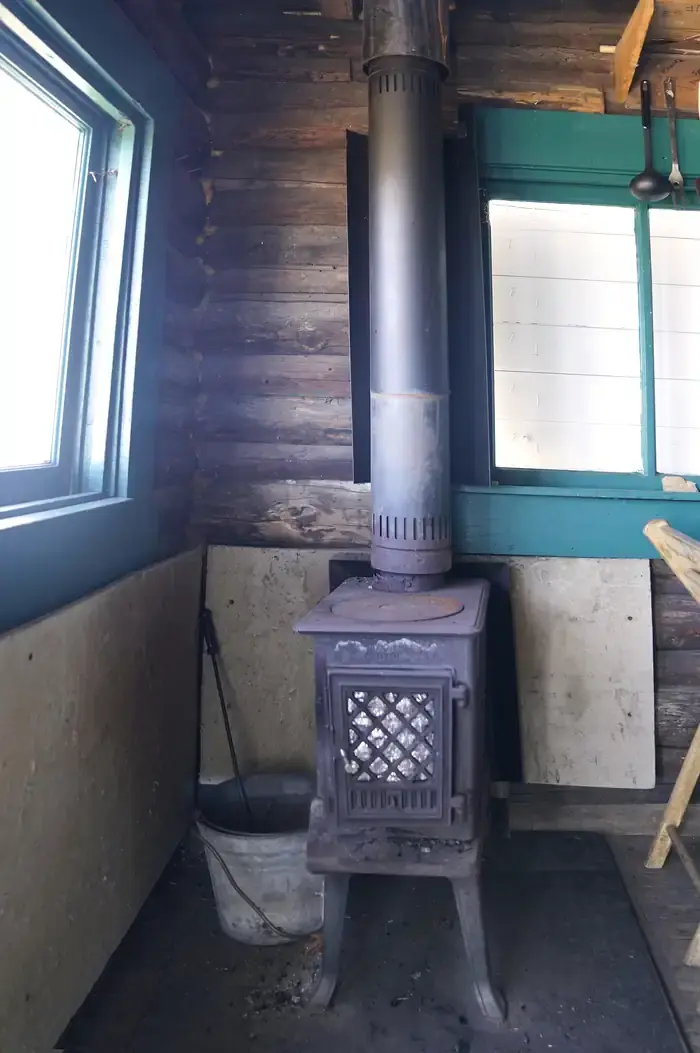
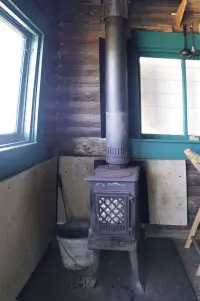
- Water, electricity and sewer is not available at the cabin. A wood stove is available at the lookout, however wood is not provided. There is a hand saw provided at the lookout and wood can be gathered near the lookout.
- Walk-in or reserve
- The cabin remains locked; a combination lock code will be contained in the reservation confirmation letter.
- Phone
- 406-387-3800
- Website
- fs.usda.gov
- Managed by
- Hungry Horse-Glacier View Ranger District.
- Established
- 1922.
- Coordinates
- 48.87967625, -114.5129064.
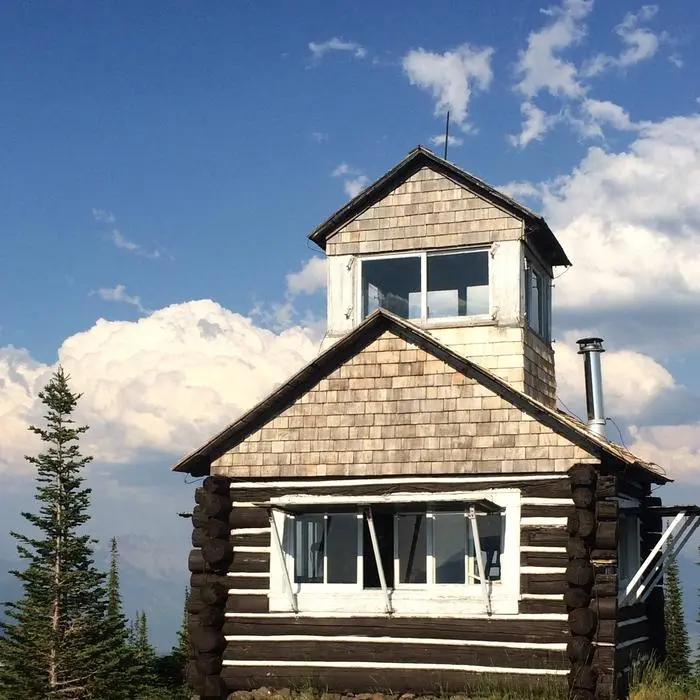
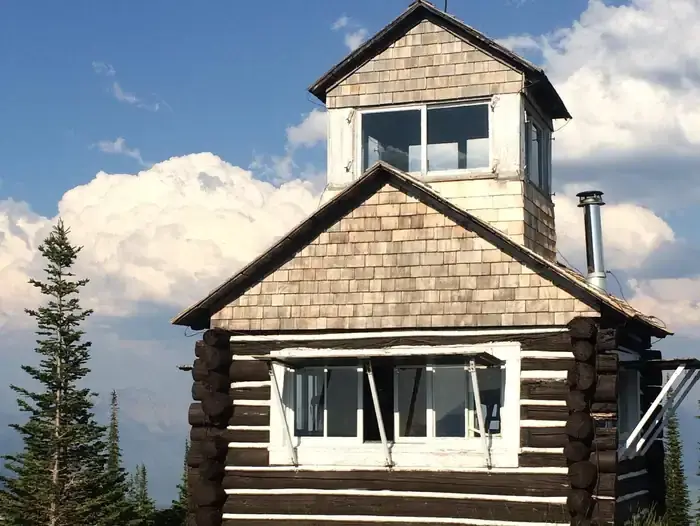
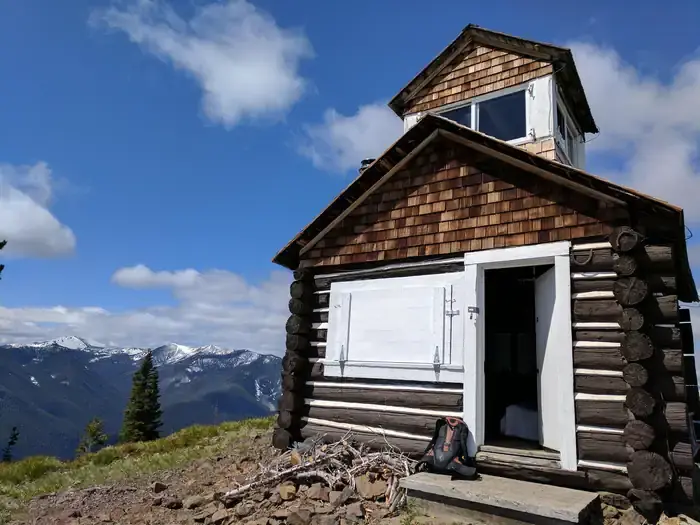
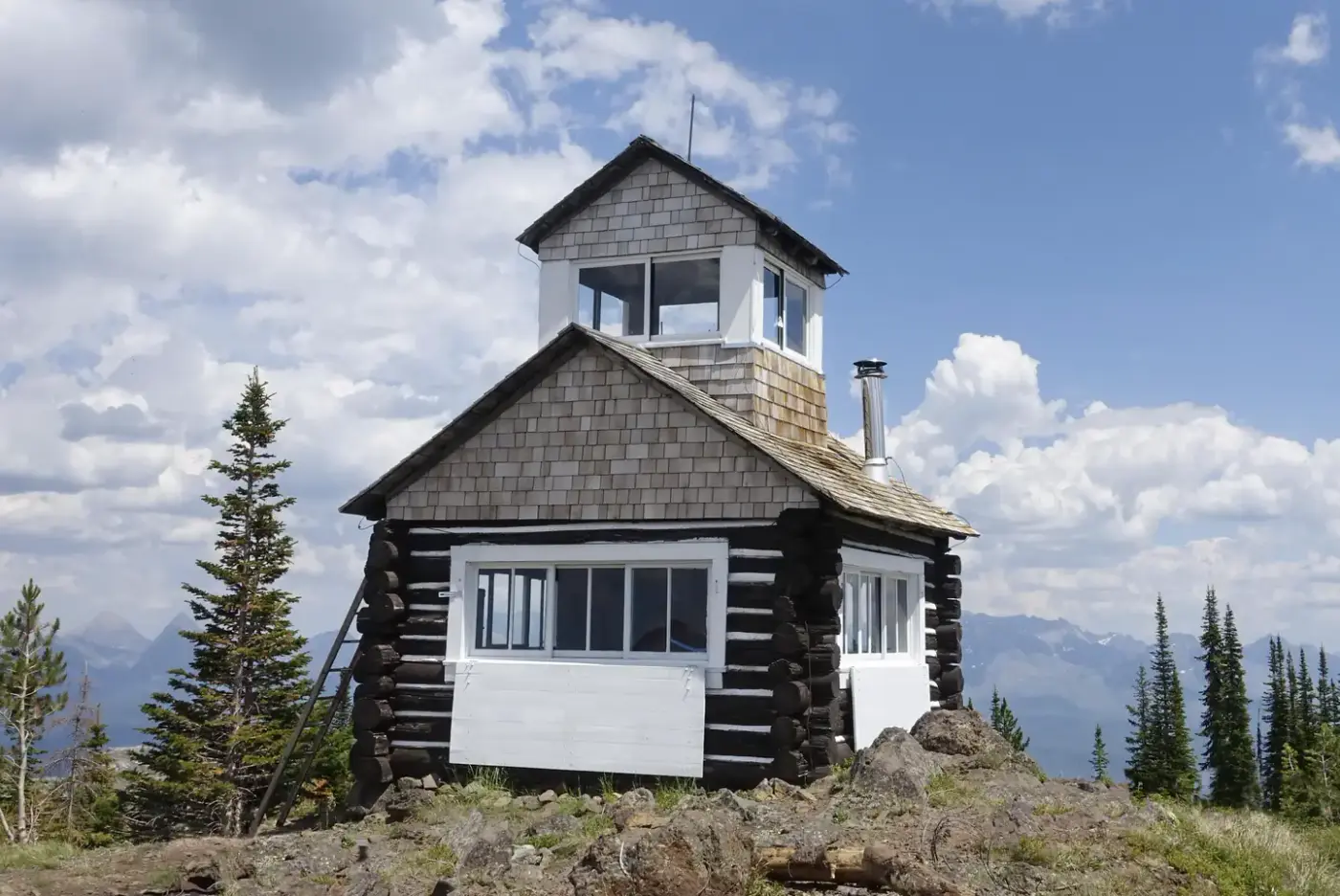
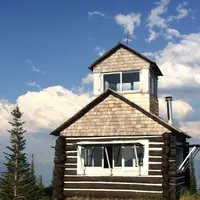
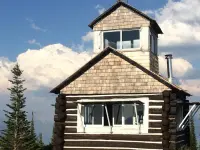
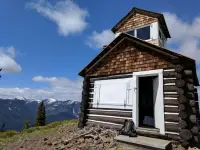
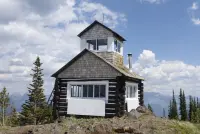
From the trail, Kay Bjork wrote in the Flathead Beacon in 2023, the lookout shows first as its cupola, “popping up through spiky fir trees like a tall hat.” Below the cupola is a log cabin fourteen feet square. It is built of eight- to ten-inch logs saddle-notched at the corners and set on a native rock foundation, with large windows on every side behind heavy wooden shutters and a single door on the east. It stands at 6,744 feet on the summit of Hornet Mountain in the Flathead National Forest, about 45 miles north of Columbia Falls. Seventy-five feet east of the door, the words “Hornet L.O.” are laid out on the ground in rock letters about four feet high, painted white.
The lookout was built in the early 1920s to watch the North Fork country for smoke. Since 1991 it has been rented by the night to parties of two, from June 15 to October 15.
Whale Creek Road and the last mile
The way in follows the North Fork Road north out of Columbia Falls for about 45 miles. It then turns west on Whale Creek Road 318 for 4 miles and onto Hornet Road 9805, which runs 5.2 miles to the trailhead. The Forest Service warns that 9805 is narrow, with few pullouts. In early to mid-summer, snow on the road can stop a car short of the trailhead and leave an extra distance to walk. Bjork described the final leg as “a narrow, coarse road that clung to the steep hillside of Hornet Mountain.” It ends on a flat saddle between the mountains, where a new sign marks Hornet Trail 349.
The trail runs about a mile and climbs nearly 800 feet. It passes through silver snags left by the Wedge Fire of 2003, which burned the surrounding country. The Forest Service reports wildflowers and bear grass coming back. On an autumn day Bjork found the almost treeless slopes in “crimson red, fiery orange and canary yellow.” Bears frequent the area, and the reservation notices call for proper containers for food and garbage.
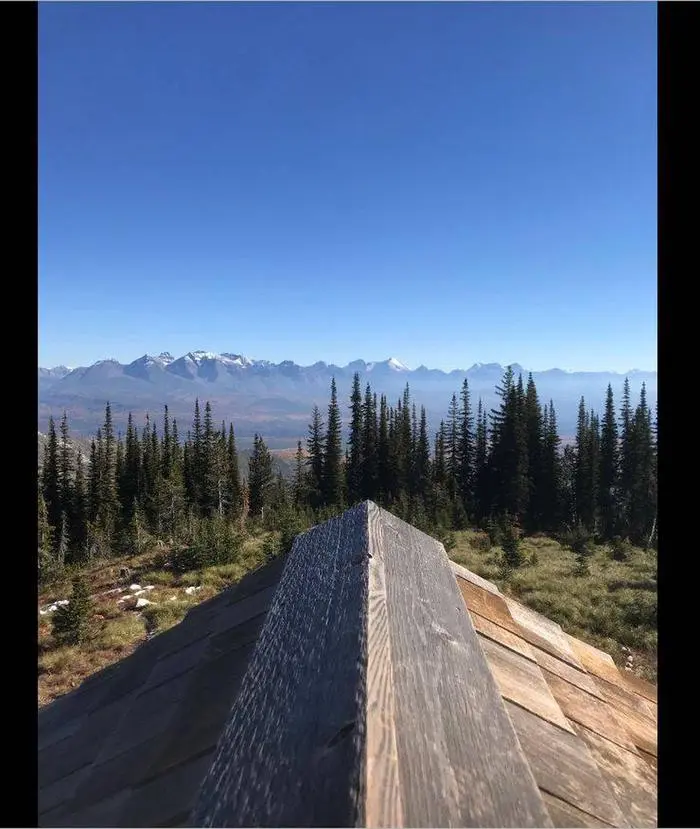
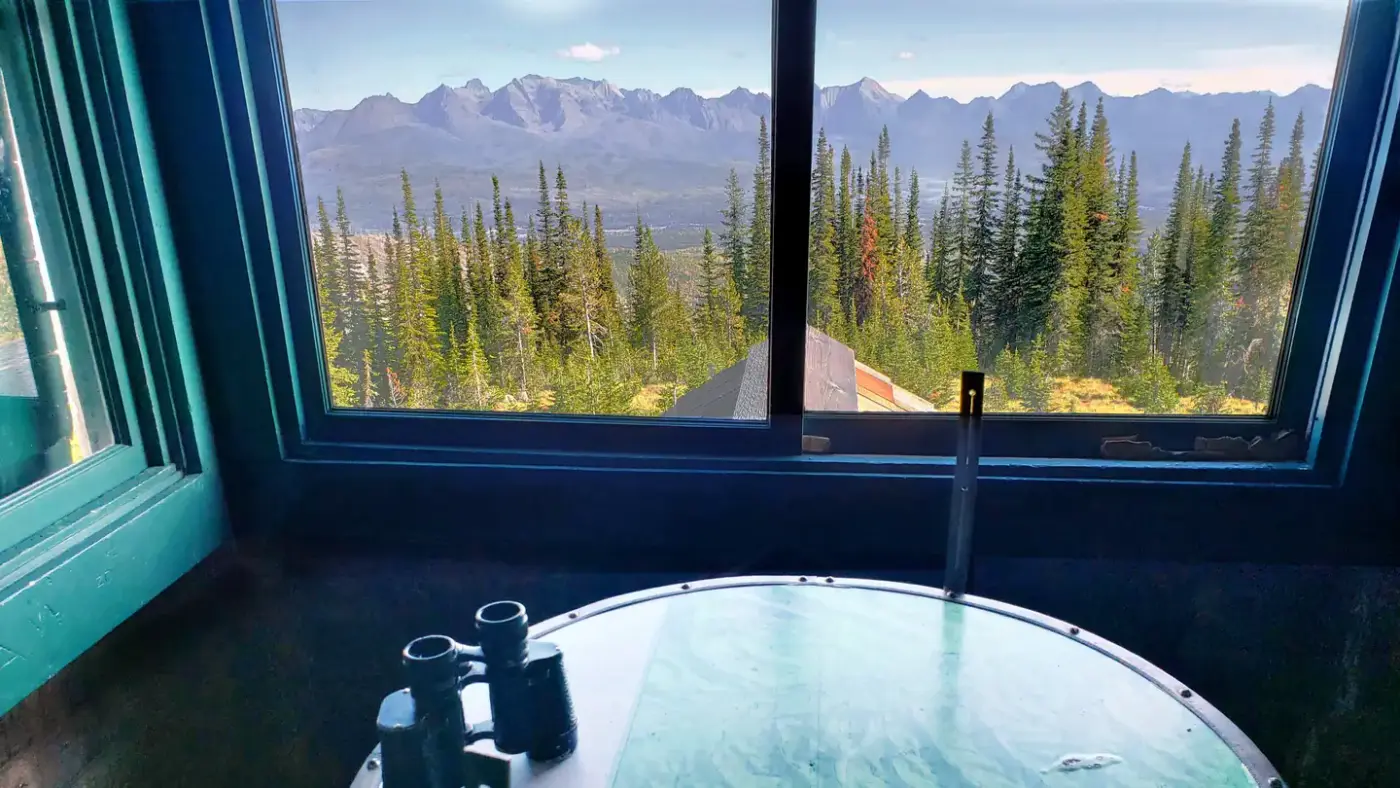
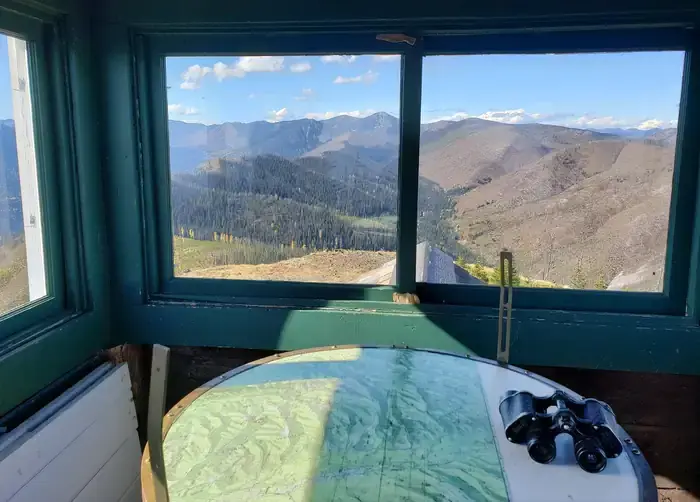
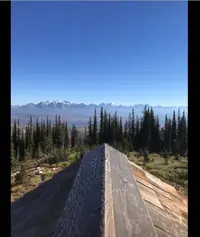
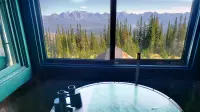
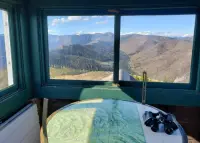
From the summit the view runs all the way around. Recreation.gov names Glacier National Park and, on clear days, Kintla Lake. The Beacon’s Micah Drew names the Livingston Range on one side and the Whitefish Range on the other. Bjork adds Canada and the Cabinet Mountains. Wedge Mountain and Akinkoka Peak are the near summits. On some nights the Northern Lights appear.
Two cots, a propane lantern, a hand saw
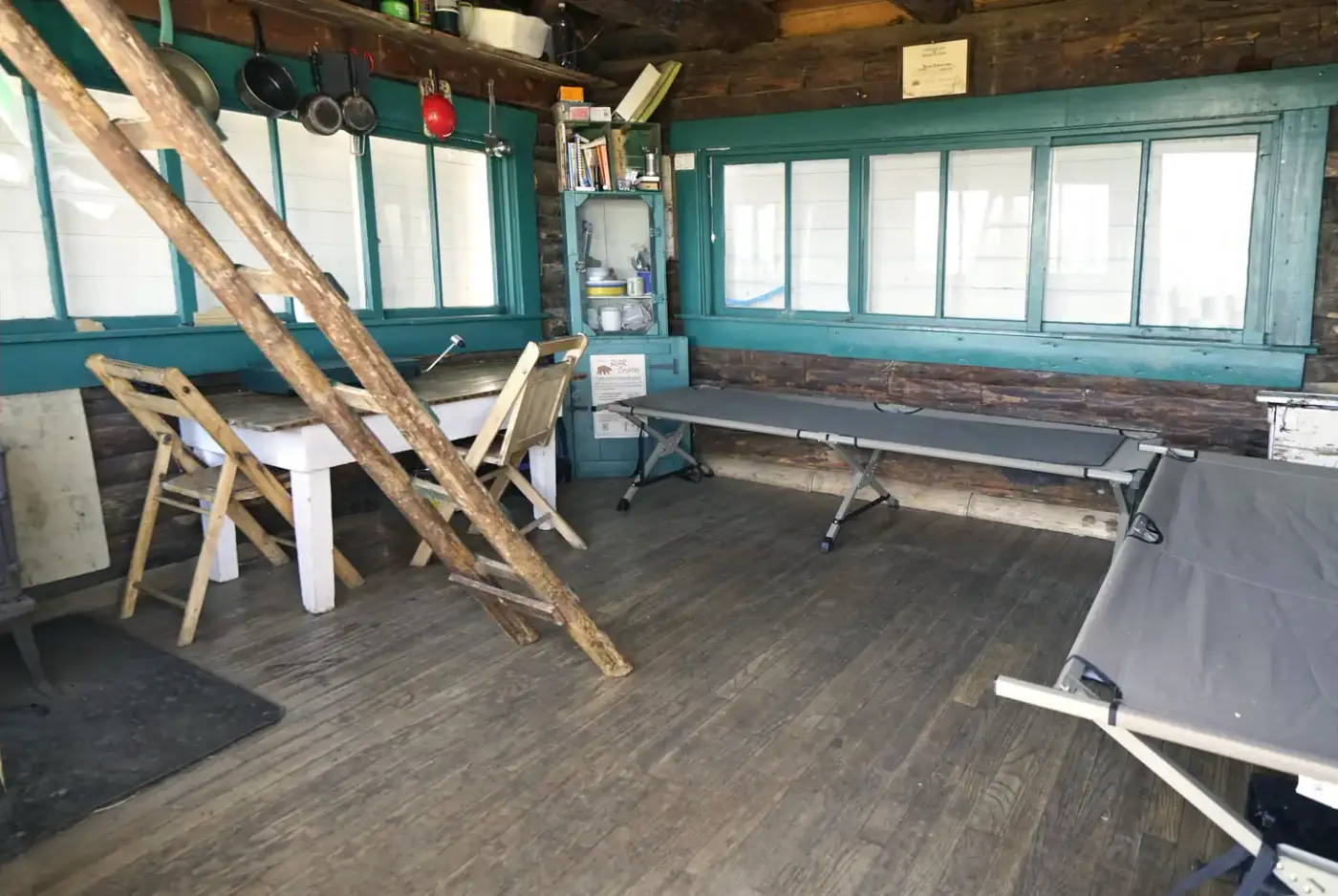
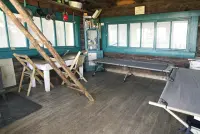
The cabin is kept locked, and renters receive the combination in their confirmation letter. The ground floor is the living space, with two cots, a propane cook stove, a propane lantern, and a small wood stove for heat. There is no water, electricity, or sewer. No firewood is supplied, but a hand saw is left for cutting wood gathered near the lookout. The toilet is a pit toilet outside. The upper story is the cupola, a small loft used only for looking out. Its windows are shuttered against the weather in late September or early October. The cabin may stand empty for long stretches, and mice may be in residence, so trapping supplies are kept inside.
When the building was nominated to the National Register, the form prepared by forest archaeologist Gary A. McLean in January 1983 listed what was inside:
- a wood-burning stove
- built-in storage bins
- two metal bed frames
- a hand-built chair
- a small triangular wall platform where a magneto-type telephone had rested
A fixed ladder led to the cupola, where a metal alidade stand sat in the center. Outside, McLean recorded the remains of a privy 50 feet north. About 200 feet west lay an oval depression holding rusted tins, wire, and broken glass. The whole hilltop had been clearcut before construction so the cupola could see.
The journals in the corner
Bjork first came up on June 15, 2000, with her husband Dewey and daughters Risa and Kelsey, to mark the oldest daughter’s high school graduation. They were, she wrote, “the first visitors of the millennium.” Snow still lay in the shade, and Dewey started a snowball fight before they worked the padlock combination. The girls helped their father lift the heavy wood shutters. Light came in on a floral tablecloth, a Coleman lantern, the woodstove, a mishmash of kitchenware, and handmade wooden tables. That afternoon a lightning storm spilled over the surrounding mountains and closed around the cabin while the windows rattled. That evening a full moon rose over the snow in Glacier. With only two cots, the daughters slept on ground pads on the floor.
She returned on October 4, 2022, a month after the building’s centennial. The lookout had been repaired and the outhouse replaced. She climbed the log ladder to the cupola, where an Osborne Fire Finder was mounted. It is a rotating circular device for taking the compass point of smoke or fire. Food left by earlier renters sat in the cupboards. In a corner among the books were two warped journals speckled with mildew, holding several decades of entries.
The resident mice and the deer that grazed near the cabin turned up again and again. Renters wrote of snowstorms and of sleepless nights stuffing the woodstove and plugging drafty window frames with socks and hats. One couple had packed a computer to watch “The Thing.” A man traveling alone from the east coast wrote of his search for purpose and answers. Bjork found her family’s 2000 entry: signatures and a date.
A D-1 house on Hornet Mountain
Before the present cabin, Hornet was an observation post with a crude pole tower and a cabin. In 1917 that one-room building housed the lookout employee, who did the actual fire patrol outdoors. According to the 1983 nomination, most Region 1 lookouts of the period worked the same way. After the fires of 1910 burned about 3 million acres in Montana and Idaho, the region took up fire prevention and suppression in earnest. In 1920 Region 1, then called District 1, designed a standard cupola lookout, the D-1. The Beacon and the regional history “The National Forests of the Northern Region” name its designer as Dwight L. Beatty.
Forest Service seasonal employees built Hornet’s D-1 in 1922 and 1923 for $719.38. The Forest Service gives 1922 as the building year, while the forest history “Trails of the Past” dates it from 1923. In Bjork’s account, the logs were cut on site, and mules packed in the other materials and dragged the logs into place. The lookout was staffed from 1923 to about 1946, then only sporadically, as the Forest Service turned to air patrols. The nomination called the style short-lived and “not represented today anywhere else in Region 1.”
“Trails of the Past” records how lookouts of the 1930s lived. They stayed on site 24 hours a day from June 15 to September 15, and a packer brought supplies and mail once or twice a summer. In the evenings along the North Fork, men sang and played music to one another over the open phone line. The lookouts “considered it amusing to post the fire slogan reading ‘Stay With It ‘Til It’s Out’ inside the outhouse door.”
After standing vacant, Hornet was restored and entered on the National Register on August 19, 1983. In 1991 it joined the rental program. On September 10, 2022, the Flathead National Forest, the Glacier Institute, and the Northwest Montana Lookout Association marked its 100th birthday at the Big Creek Outdoor Education Center. A year later, Drew wrote that Hornet was 101 that fall, “but it doesn’t look a day over 65.”
Notable Events
- 1917The original one-room building was used as accommodations for a lookout employee while actual fire patrol occurred outside. flatheadbeacon.com
- 1917The observation post had a crude pole tower and a cabin. npshistory.com
- 1922The present structure was erected as a D.L. Beatty D-1 standard lookout house with a church-like tower. npshistory.com
- 1923Hornet Lookout was in operation from 1923 to about 1946; the Forest Service later abandoned manned lookouts in favor of air patrols. npgallery.nps.gov
- 1923The new log cabin with a cupola soon replaced the earlier platform and cabin. npshistory.com
- 1983After sitting vacant, the lookout was restored and listed on the National Register of Historic Places in 1983. flatheadbeacon.com
- 1991Hornet Lookout was added to the rental program in 1991. flatheadbeacon.com
- 2003The area burned during the 2003 Wedge Fire and is coming back with wildflowers and bear grass. fs.usda.gov
- 2022Hornet Lookout's 100-year birthday was celebrated on Sept. 10, 2022, at the Big Creek Outdoor Education Center, hosted by the Flathead National Forest, Glacier Institute and Northwest Montana Lookout Association. flatheadbeacon.com
People
- Dwight L. Beatty, Designed the D-1 cupola house used at Hornet Mountain (1922).
- D.L. Beatty, Designer associated with the D-1 standard lookout house used at Hornet.
Sources
- recreation.gov/camping/campgrounds/234341
- recreation.gov/api/camps/campgrounds/234341
- npshistory.com/publications/usfs/region/1/history/chap11.htm
- npshistory.com/publications/usfs/region/1/flathead/history/chap9.htm
- flatheadbeacon.com/2023/09/28/cabins-in-the-sky
- npgallery.nps.gov/NRHP/GetAsset/8fe0ab8a-3e69-47b6-a54b-96a37ff4e5f8
- flatheadbeacon.com/2023/08/27/one-hundred-years-of-hornet
- fs.usda.gov/r01/flathead/recreation/hornet-lookout-cabin
- npgallery.nps.gov/AssetDetail/NRIS/83001061