



Homestead Crater
Midway, Wasatch County, Utah. Natural geothermal spring; Open daily, year-round for visitors.
Details

- Where
- 700 North Homestead Drive, Midway, UT 84049. Directions
- When
- Soak & Swim: weekdays 10:30 AM - 9:30 PM, weekends 9:30 AM - 9:30 PM; Diving: weekdays 12:00 PM - 8:00 PM, weekends 10:00 AM - 8:00 PM.
- Getting there
- Crater guests enter through the main Homestead entrance and should park in the main parking lot to the west of the Crater.
- Fees
- $30/1-hour session.
- Access
- Closed for renovations in April and May of 2027.
- Walk-in or reserve
- Yes, reservations are strongly recommended, especially on weekends and holidays. Walk-ins are welcome based on availability, but space is limited due to the intimate setting.
- Phone
- (435) 654-1102
- Managed by
- Homestead.
- Established
- 1886.
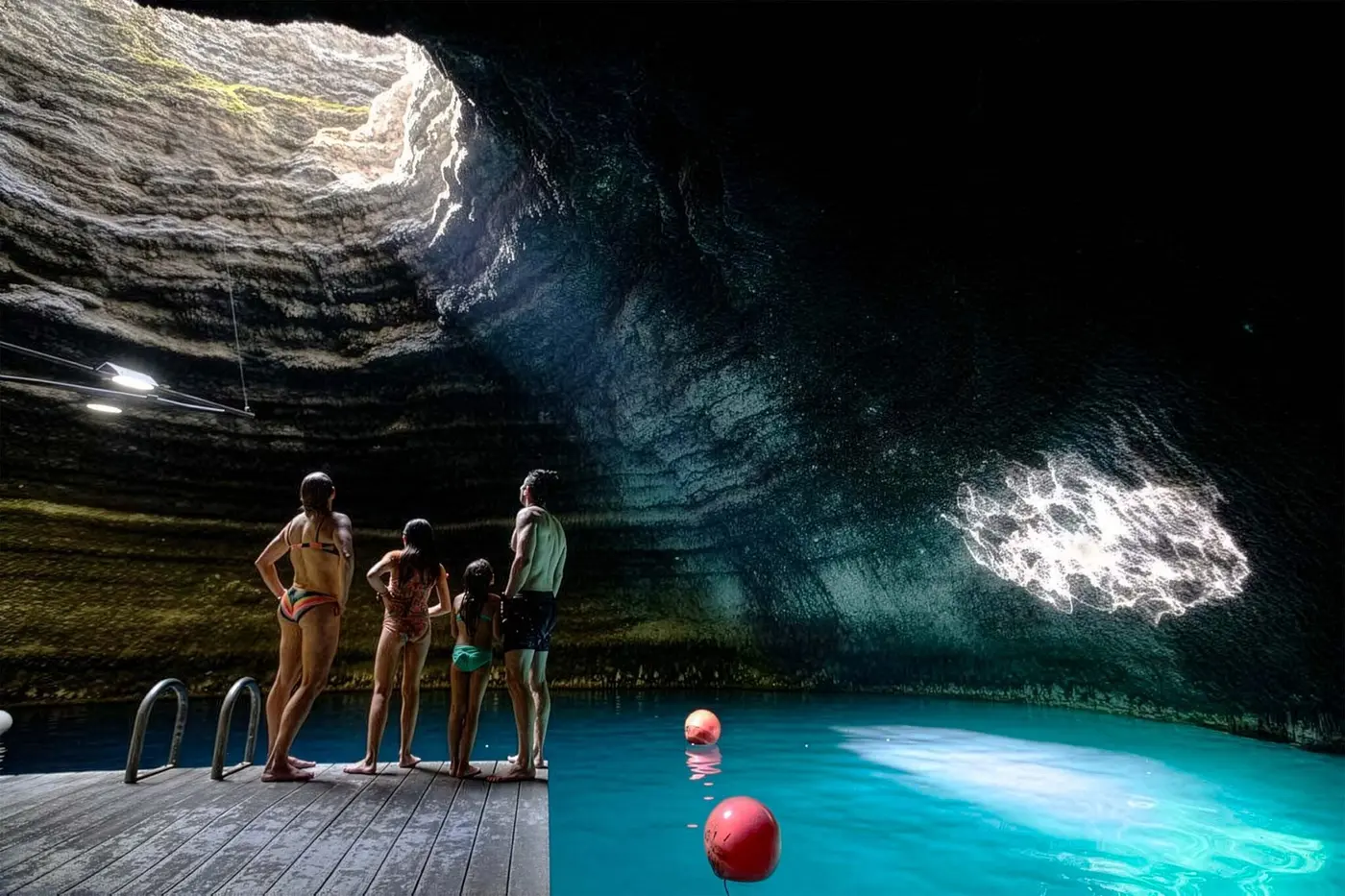
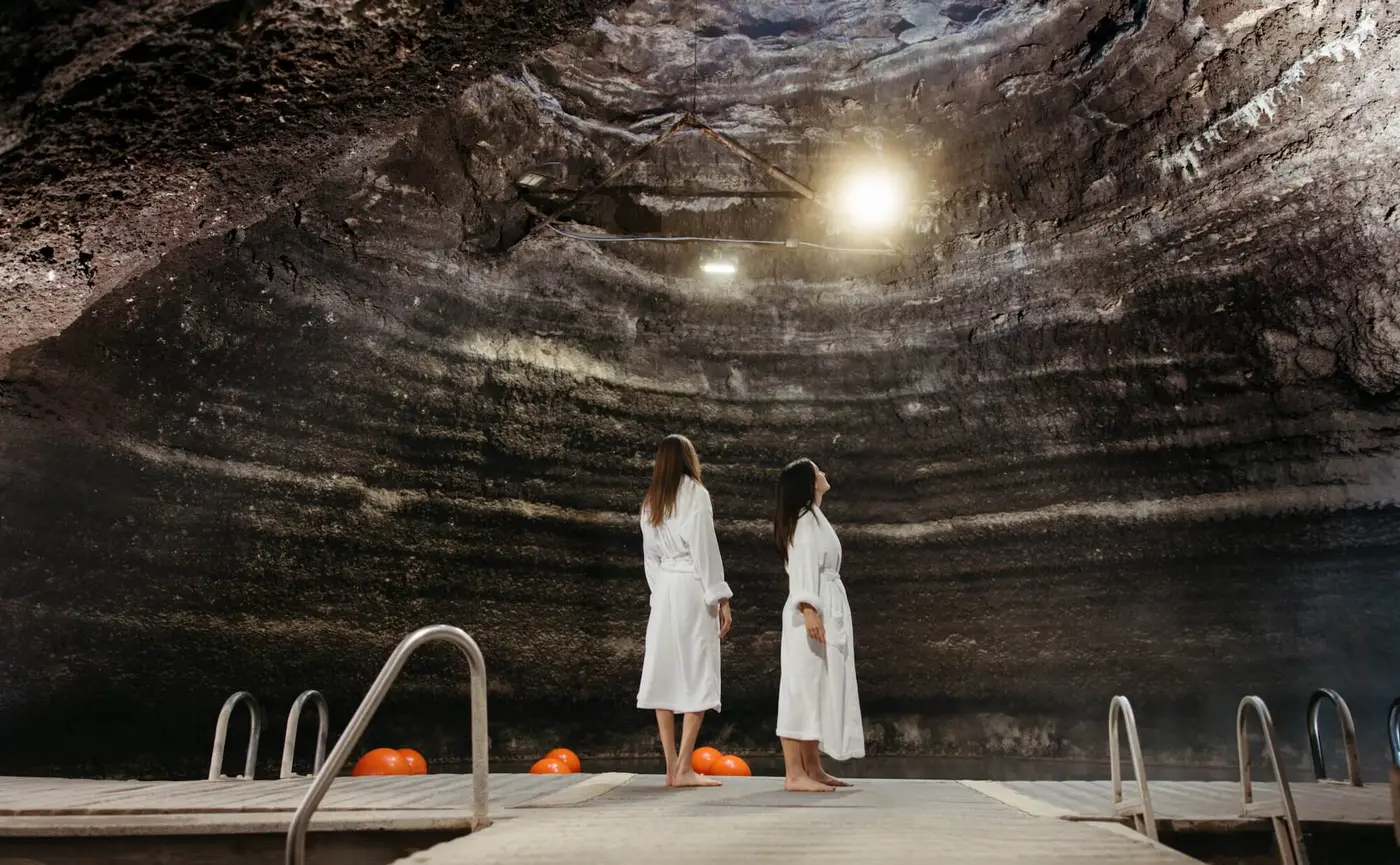
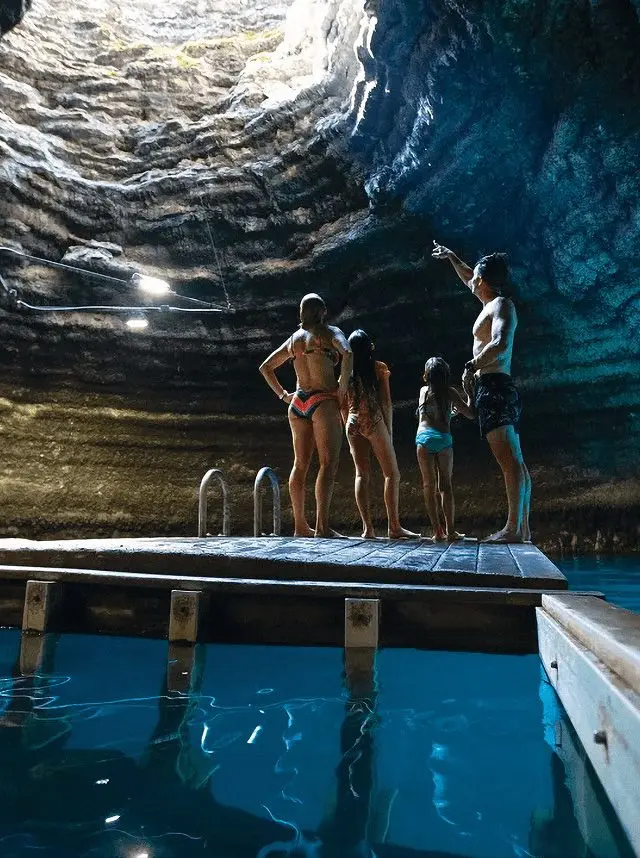
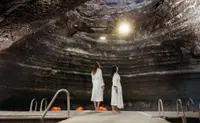
The way in is a tunnel. Visitors enter the Homestead grounds at 700 North Homestead Drive in Midway, park in the main lot west of the Crater, and walk through 110 feet of rock bored from the dome’s north side. The tunnel ends at a floating dock above blue water. Overhead the limestone closes into a beehive 55 feet high, with a small opening at the top for light and fresh air. Steam hangs in the cavern. The operator gives the water as 90 to 96 degrees the year round and about 65 feet deep at its deepest. Nothing lives in it, neither fish nor plants. By the operator’s account it carries calcium from the surrounding limestone, magnesium, bicarbonate, and traces of sodium and potassium.
Inside the dome
Everyone in the water wears a life vest. The operator stocks them from infant to XXXXL. Sessions are booked by the hour, and about 40 minutes of each is spent in the water. A Park Record reporter visited in January 2025 and found about twenty swimmers in red lifejackets floating at the dock. David Simons was giving them the history of the crater, and he started at the beginning: “Over 10,000 years ago, the land around the hot spring was completely flat.”
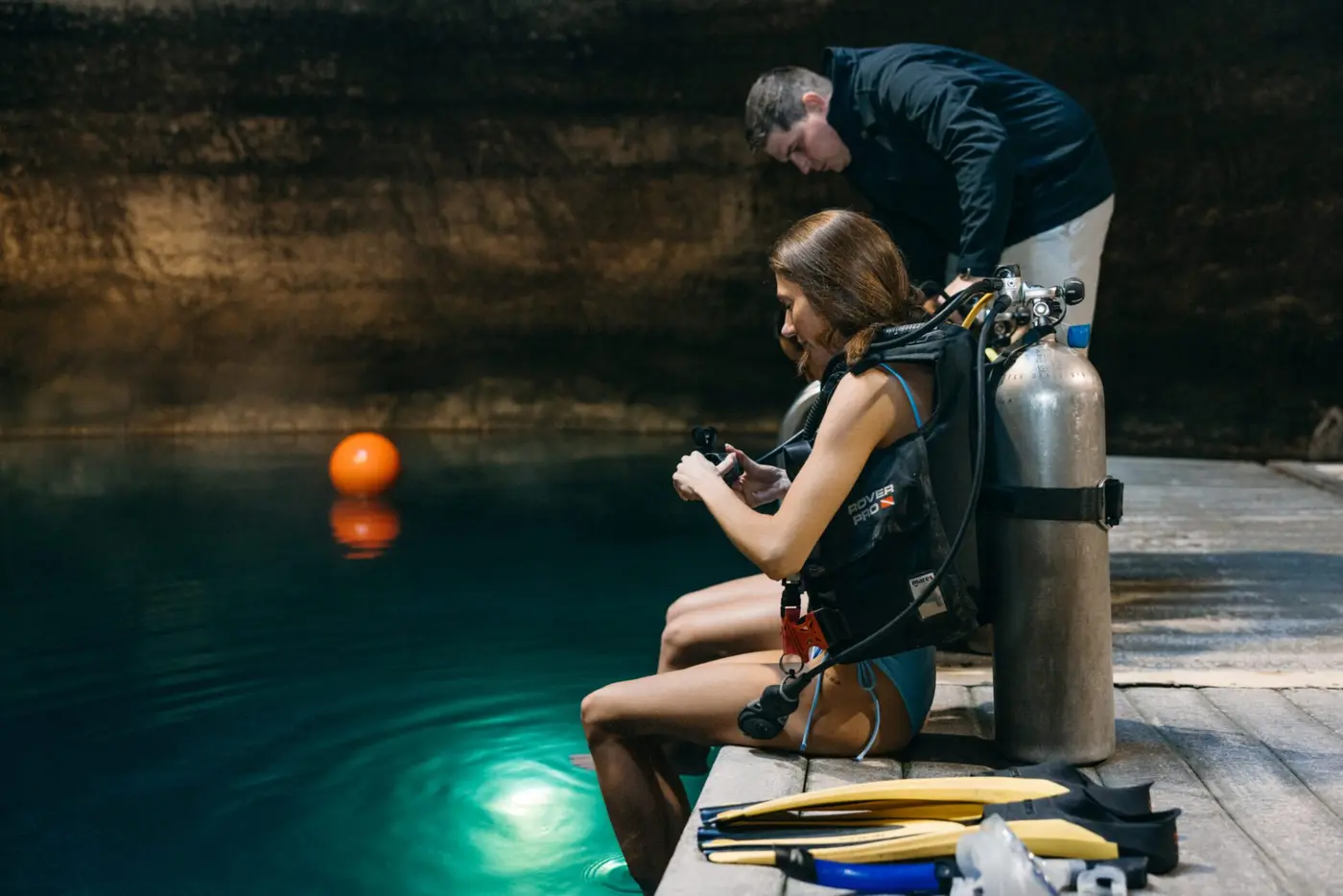
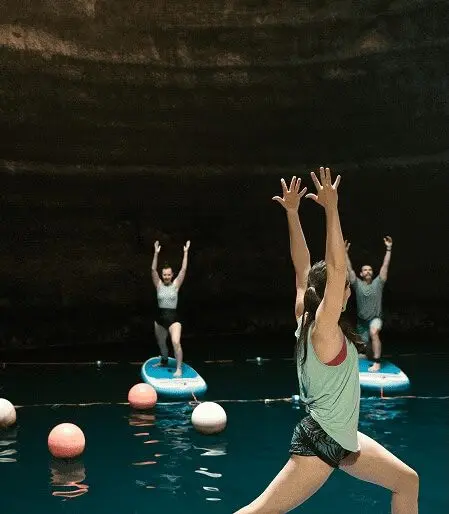
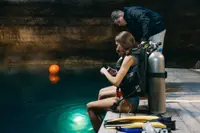
Some guests only soak. Others swim, rent snorkel gear, or stand on paddleboards for yoga sessions booked through Park City Yoga Adventures. Below them the divers work. Certified divers bring a buddy or dive with a staff member. Students come to finish their open-water checkout dives. Anyone ten or older can try a two-hour introductory dive, which does not lead to a certificate. Free-diving is not allowed.
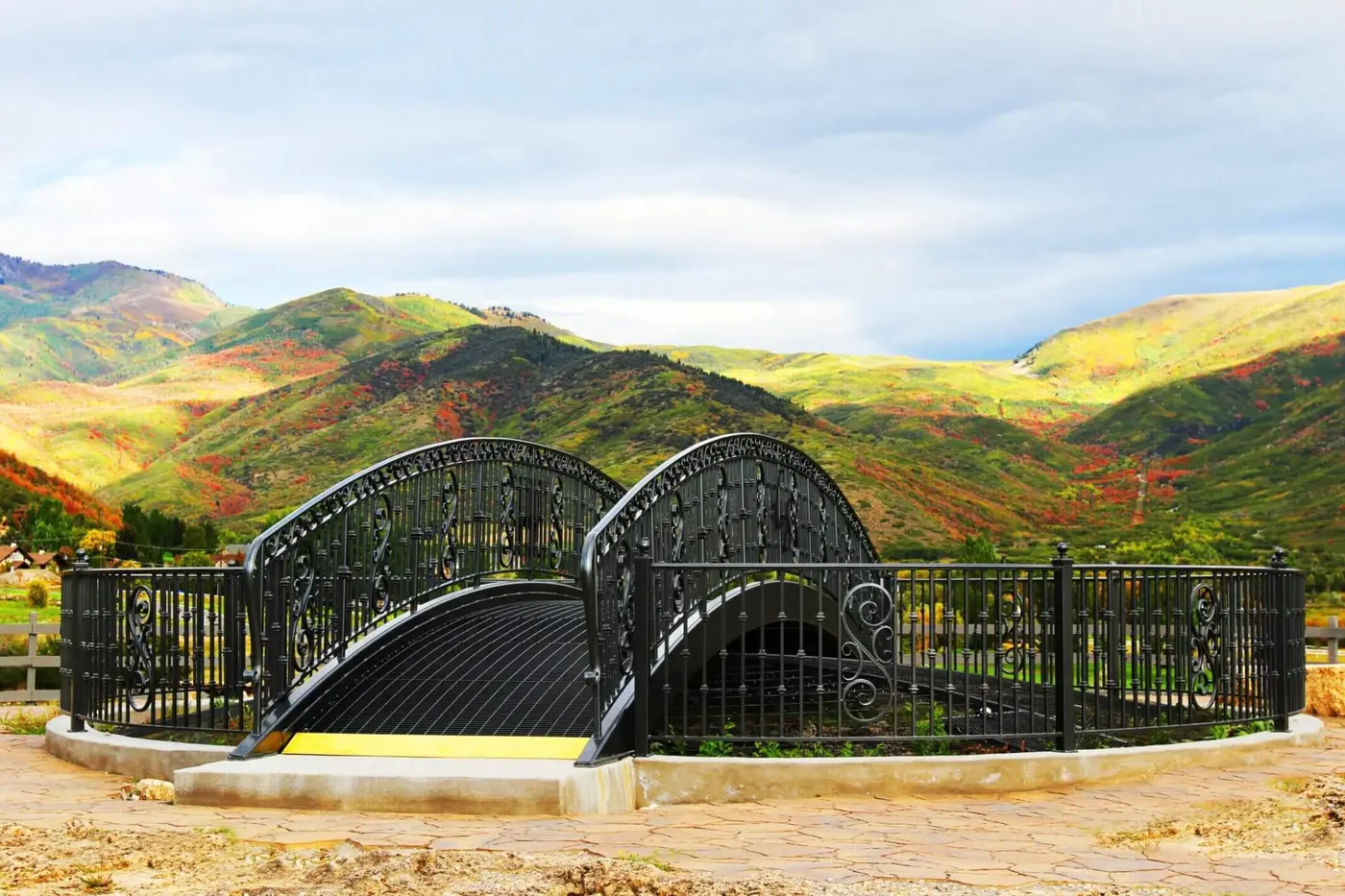
The operator calls the Crater the only warm-water scuba diving destination of its kind. According to the Park Record, winter is its busiest season for divers, because certification is harder to get elsewhere in the cold months. The paper put attendance at nearly 100,000 guests a year. Outside, a stair climbs the dome to an observation deck with views across Heber Valley to the Wasatch Mountains. The operator notes that film crews have used the place, for 127 Hours and The Bachelor among others. The Crater is scheduled to close for renovations in April and May of 2027, ahead of updated infrastructure for that summer.
How the pot grew
The sources describe the dome’s origin in different ways. The Utah Geological Survey classes it among the Midway hot pots, which it describes as rough-rimmed basins of tufa, a porous limestone that settles out of spring water. As the water rises, it gives off carbon dioxide. This changes its chemistry, and calcium carbonate drops out around the spring. Over hundreds of years the tufa builds the mounds and crater-like hollows that give the pots their name. The Survey says the thermal water at Midway probably comes from rain and snowmelt that sink deep into the ground to the north, near Park City, and circulate before returning to the surface.
The operator dates the dome to roughly 10,000 years ago, when snowmelt at the close of the last Ice Age seeped down, met geothermal heat, and rose again carrying dissolved limestone. The same page also says the Crater formed over 12,000 years. In the operator’s telling, the deposits climbed until the structure sealed itself into a beehive. The Park Record gives a third account: an aquifer 2.5 miles underground fed a mineral pool that overflowed again and again, laying down limestone in layers until the dome stood. The operator puts the dome at nearly 400 feet across. When the pool inside opened in 1996, the Deseret News measured it at 81 feet wide.
The big hot pot on the Schneitter farm
Simon and Maria Schneitter came from Switzerland. They had joined the Church of Jesus Christ of Latter-day Saints in their own country, reached Utah in 1863, and settled in 1864 near Midway among other Swiss immigrants. Simon was a watchmaker by trade, but in Midway the couple cleared land and farmed. According to the 1992 National Register nomination for their hotel, one of the largest hot pots in the area stood on their property. The largest of all measured two hundred feet across and one hundred feet high. People came from the surrounding towns to look at the pots and bathe, especially from the mining camp at Park City. The Park Record says the Schneitters soon found the ground poor for crops.
The operator says Simon “discovered” the Crater in 1886 and opened Schneitter’s Hot Pot that year. The nomination is more cautious. It names Simon, Maria, and their 23-year-old son Simon J. as founders, and it quotes a local history’s claim that in 1886 “a two-story brick hotel and swimming pool was started.” The nomination grants that some facilities were probably open then. It judges that the hotel and the full resort were probably not finished until the summer of 1891, when the Wasatch Wave announced the grand opening. A few weeks before that announcement, the paper reported that “S.J. Schneiter” had gone to Salt Lake City to buy furniture “for the fitting out of his bathing resort and summer hotel by the big hot pot.” Business directories did not list Schneitter’s “Hotel and Saloon” until the 1892–93 edition. The nomination concludes that Simon J. was the main force behind the enterprise.
The family drilled into the base of the big pot and piped the water to swimming pools. Guests also had horse racing, music, and food. “A fellow goes into the hot pots and when he comes out, he can eat a house and lot,” one early resort-goer said. By all accounts fried chicken dinners were the favorite. Several hot pot resorts opened around Midway in those years. Only two lasted: Schneitter’s, and Luke’s Hot Pots, founded in 1888 by Andrew Luke and John Busby.
Fannie’s kitchen and the Virginia House
Soon after the hotel was finished, the Schneitters leased it out. The operators included Thomas Monks, William W. Ritter, and Peter Kurellor. Maria died in 1893 and Simon in 1900. Simon J. spent the years from about 1891 to 1907 in the mining towns of Eureka, Utah, and Ouray, Colorado. He married Fannie Manhart Miles in 1903, and around 1907 the couple returned and took over the resort. They ran it until his death in 1938 and hers in 1950, with help from his son Noble J. The operator’s version credits Simon “Jake” Schneitter with running the resort for over 60 years and says his wife Fanny’s home-cooked meals were central to its hospitality.
The family held the property until 1952. About a year after Fannie’s death it was sold to Ferrin W. Whitaker. He renamed the resort The Homestead and called the old hotel the Virginia House. The building is a square, two-story brick house in the Federal style, the only example of that style in the Midway area. It stands on a foundation of local “pot rock” and is topped by a widow’s walk. It was listed on the National Register of Historic Places in 1992. The 1980s brought a golf course and tennis courts. Great Inns of the Rockies bought the resort in 1986, when, according to its general manager Britt Mathwick, it was foundering.
Dynamite in 1996
For years the big pot was mostly left alone. Mathwick told the Deseret News that the owners had considered making a spa of it in the late 1980s, but market studies argued against it. Passers-by climbed stairs to look into its mouth. Jerry Simons, a retired computer-chip designer from Provo and an experienced scuba diver, remembered doing the same. “I remember coming up here as a kid and flipping coins into this thing,” he said.
The Park Record places his proposal in 1995. The resort’s history page says the Simons family remade the Crater that year, and the operator gives 1996 as the year it opened to the public. In 1996 Simons blew open the interior with dynamite and carved it out with a team of professional miners. The water level dropped as they worked. “He made a model of what we pretty much have today,” his son Craig Simons told the Park Record. “We did some preliminary engineering work and measuring, and realized that the shortest distance was on the north side of the dome. So we blasted a tunnel in the side of it.”
Simons put about $250,000 into the project in exchange for a long-term lease. The Crater opened to scuba divers and snorkelers in July 1996. A floating dock held visitors over the clear depths, and one corner of the pool was fitted with hot-tub benches. A dry look cost a dollar. A one-tank dive cost $20, and a 40-minute swim or “therapeutic mineral bath” cost $10. “It’s hard to lose anybody in here,” Simons said at the time.
Craig took over when his father retired, and his son David now gives the talk at the dock. Jerry, Craig, and David are all certified divers and instructors. The family counts four generations of divers, from Jerry and Ella down to Craig’s daughter, who was nearly 13 in 2025. “There are not many activities you can include for generations from 12 to 86,” Craig said.
Notable Events
- 1886The operator says Swiss Pioneer Simon Schneitter 'discovered' the Crater and opened Schneitter's Hot Pot. homesteadmidwayutah.com
- 1886A local history claims a two-story brick hotel and swimming pool was started in 1886; the nomination hedges that some facilities were probably available then, but the hotel and the more fully developed resort were probably not finished until the summer of 1891. npgallery.nps.gov
- 1891The hotel and the more fully developed resort were probably not finished until the summer of 1891, when the local newspaper announced the grand opening of the resort. npgallery.nps.gov
- 1986Simons' crater effort was in partnership with Great Inns of the Rockies, which had owned the resort since 1986. deseret.com
- 1992Virginia House, the resort's Federal-style building, was listed on the National Register of Historic Places in 1992. homesteadmidwayutah.com
- 1995The resort's history page states that in 1995 the Simon family evolved The Crater into the diving and wellness icon it is today. homesteadmidwayutah.com
- 1996A tunnel was dug through the hot pot wall, permitting horizontal access to the warm pool. geology.utah.gov
- 1996The Crater opened to the public in 1996, remaining continuously fed by mineral-rich water from deep in the earth. homesteadmidwayutah.com
- 1996Jerry Simons, a scuba diver, proposed developing the Homestead Crater to the resort owners and, in 1996, blew up the inside with dynamite. parkrecord.com
People
- Britt Mathwick, Homestead general manager who described the crater project as an entrepreneurial venture.
- Jerry Simons, scuba diver who proposed developing the Homestead Crater and in 1996 blew open its interior with dynamite, then carved it out with professional miners (1996).
- Fanny Schneitter, wife of Simon "Jake" Schneitter whose home-cooked meals formed an essential part of the resort's enduring hospitality.
- Simon "Jake" Schneitter, ran the resort for over 60 years.
- Simon Schneitter, Swiss immigrant farmer who discovered the massive geothermal hot spring dubbed a "hot pot" by settlers (1864).
- Maria Schneitter, co-established Schneitter's Hot Pot Resort with Simon Schneitter and their son Simon J (1886).
- Simon J. Schneitter, 23-year-old son who co-established Schneitter's Hot Pot Resort (1886).
- Craig Simons, son of Jerry Simons who took over crater operations when his father retired.
- David Simons, guide who gives visitors a speech on the history of the crater.