
Holesinsky Winery and Vineyard
Buhl, Twin Falls County, Idaho. USDA-certified organic vineyard.
Details

- Where
- 1498 Valley Steppe Drive, Buhl, ID 83316. Directions
- When
- Fri 12pm–8pm Sat 12pm–8pm Sun 12pm–6pm Mon –Thurs by appointment.
- Walk-in or reserve
- Swing by during regular business hours or call and make an appointment—whichever works best with your schedule.
- Phone
- (208) 539-8360
- Website
- holesinsky.com
- Managed by
- winemaker, James Holesinsky.
- Established
- 2001.
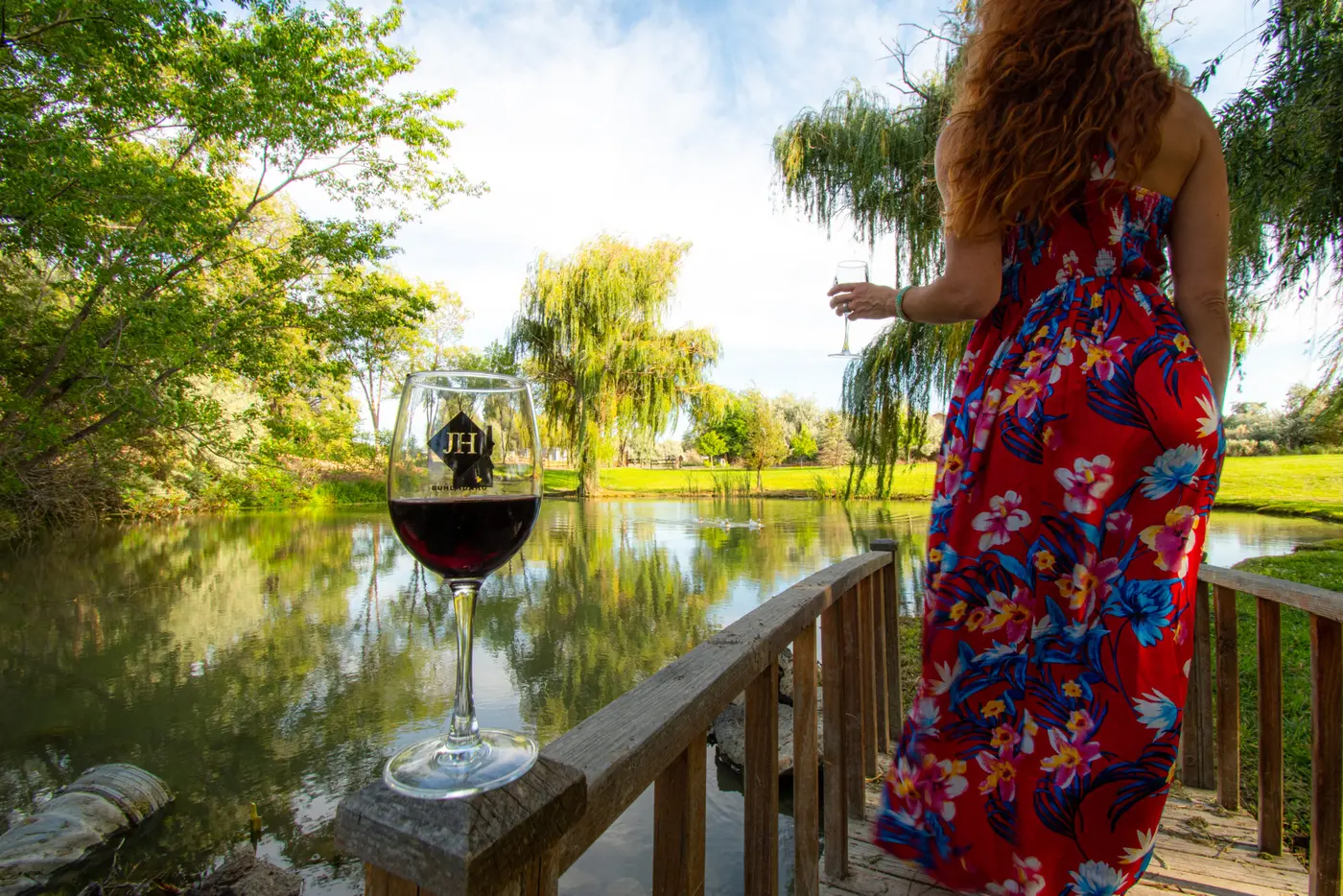
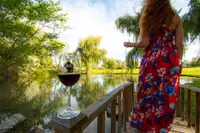
The tasting room of Holesinsky Vineyard + Winery stands about four miles north of Buhl on the rim of the Snake River canyon, along the Thousand Springs Scenic Byway, among trees beside a small lake. A flight is five wines poured an ounce or two at a time. The screen-printed glass they come in goes home with the taster at no charge. Cheese from Evans Farmstead, in Buhl, is set out with the pours, and salami and crackers are for sale. Visit Southern Idaho notes ducks to pet and feed and a dog that lives on the place. The family’s pet duck, Mr. Quackers, has fronted the Facebook campaign for Liquid Quack Sparkling Moscato. Billy Brew, a low-alcohol Chardonnay co-fermented with peaches and sealed with a crown cap, is named for the dog. The winery puts on movie nights and yoga with wine.
The list runs long. Caitlin Holesinsky told Great Northwest Wine in 2022 that there were five wines when she arrived and close to 30 by then. They include rosés, half a dozen sparkling wines, ice wines, and IdaPeach, a Chardonnay-and-peach blend made in white and red versions of about 3,000 cases each. There is also the 2008 Port Hoser, a fortified bottling of Portuguese varieties that spent 12 years in barrel. Asked in 2021 where a newcomer should begin, James Holesinsky said, “Rosé all day.” The rosé is fermented cold and bottled fresh. For the soil he pointed to the estate Syrah. For sentiment he pointed to the Chardonnay: “Because those are the grapes I planted in 2001.” Reds rest six months to a year before release. Under the family name the Holesinskys also make Idawater, Idaho spring water given its sparkle in Charmat tanks, and a vodka distilled from potatoes they grow.
The rows at 3,770 feet
The vineyard lies at 3,770 feet. In 2022 Great Northwest Wine, on its own research, believed it to be the highest commercial vineyard in the Pacific Northwest. “Our slope, the altitude, the soil — it’s just a perfect spot on the canyon rim where the air will dissipate into the low spots and so you’re less prone for frost damage,” James told KMVT in May 2026. Caitlin pointed to the swing between hot days and cool nights: “This is actually kind of considered the holy grail of growing grapes.”
The winery’s own account of that soil begins 600 million years ago with what it calls the 40-mile-wide Beaverhead Asteroid. It continues through 16 million years and seven eruptions of the Yellowstone caldera as the plate slid over the hotspot. It ends 17,000 years ago, when Lake Bonneville overflowed and sent water down the Snake River Canyon at 33 million cubic feet per second, settling, the winery says, in this valley. Rhyolite, basalt, and breccia lie under the vines. Great Northwest Wine reported that the flood left a loam loaded with potassium. The same ground gave the Hagerman Valley its name for watermelon in the early 1900s.
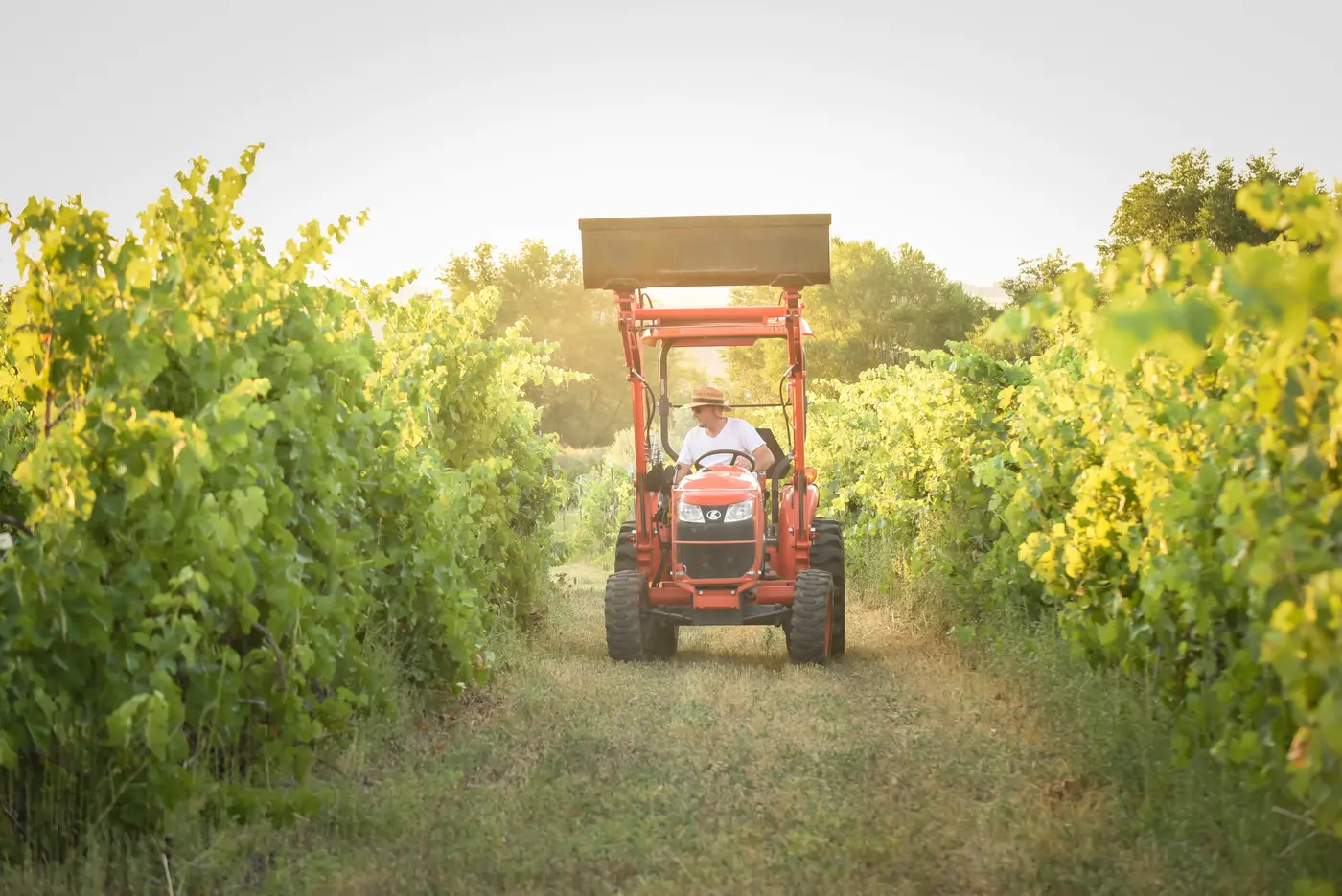
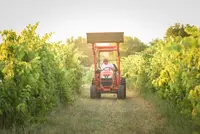
KMVT called the place Idaho’s only USDA-certified organic vineyard. No glyphosates, synthetic fertilizers, weed-killers, or fungicides go on it. Every row is weeded by hand and every cluster picked by hand. Four beehives handle pollination. Pruning, James said, “is kind of like cutting your hair. If you let them just grow out, then the fruit quality goes down.” He worked out his own pruning and trellising because at that elevation, in the high desert, “we couldn’t prune like Walla Walla or California.” He hangs Chardonnay at 12 tons an acre, where Oregon growers run closer to 3. In 2021 most Northwest vineyards came in short after winter damage and the June heat dome. Holesinsky brought in 140 tons.
A dairy above the river
The ground was a dairy first. James’s father, Frank, was the son of immigrants from Czechoslovakia. The Idaho Wine Commission’s 2021 profile calls him a biology teacher, “practically a horticulturist,” and “a dreamer.” Other accounts call him a chemist, or a chemist turned farmer. He bought 80 acres and in the 1970s took up dairying. As a boy James ran the chemical analyses that kept the equipment free of bacteria. “Our business was pretty much liquid chemistry,” he said. The small operation could not keep up with larger dairies and cheese plants. The family sold the cattle and kept working with the cleaning chemicals, and James studied chemistry so they could make their own. He also owns Clear Lakes Products in nearby Filer, which makes disinfectants and soaps for dairies.
Frank had always wanted to plant grapes. The winery’s history adds a loss: the family house, the childhood home of James and his sisters, burned and took heirlooms with it. When Frank began to talk of selling the farm and going back to teaching, James, then a self-described “hippie kid” with some college and no direction, asked for time. “I said give me a year.”
In 2001, at a convenience store, he overheard two men who had 1,000 Chardonnay plants they did not need and were asking to throw them in the store’s dumpster. He offered to buy them. They gave them to him. “Two days later, dad helped me rip up an acre property and I planted my first 1,000 Chardonnay plants,” he told the Idaho Wine Commission. “Was it my dream to be a winemaker? I was just in survival mode.”
Other tellings differ. In 2007 he told Ag Weekly that a garden planted about eight years earlier “started it all,” and that “in 2000, we planted our first 10 acres of vinifera.” Capital Press wrote in 2017 that he finished the UC Davis wine program in 2001 and then came home and planted 7 acres. In 2002 the vineyard took on 3,000 Syrah, 2,000 Merlot, and 200 vines of Port varieties, which Great Northwest Wine names as Sezão, Tinta Cão, and Touriga Nacional. “Everyone thought I was crazy by planting Syrah,” James said. In 2006 came 1,000 Cabernet Sauvignon and 1,000 Riesling, and in 2007 Muscat.
Davis, Benton City, and Glenns Ferry
James was among the first 40 students in the UC Davis extension winemaking program, taking courses online among classmates who held master’s degrees and doctorates. “I was this 21-year-old hippie kid,” he said, “and everyone wanted to know how the hell I got accepted.” Great Northwest Wine names the geneticist Carole Meredith among his instructors. “She told me, ‘Wow, James, you are kind of a kook,’” he recalled. “I was 21 with long hair and played bass in a band.”
According to the winery, the professor Margaret Misser sent him on with a line: “I know someone just as crazy as you that you need to meet.” That was Michael Moore, a French winemaker who helped pioneer the Red Mountain AVA in Washington. The winery says James left Davis after two years and worked under Moore in Benton City, learning lees aging and trellising. “He was kind of a renaissance man,” James said. “I mean, a mad scientist.” Before he could afford a bottling line, James worked days for Roger Jones of Carmela Winery in Glenns Ferry and bottled his own wine there at night.
The winery received organic certification in 2006. Its history says the early wines were “free of sulfates.” James told Great Northwest Wine in 2022, “while I am certified organic, I do add sulfites to my wines.” In those first years, the winery says, organic labels were still a novelty and got the poorer spots on store shelves. That same year his off-dry Riesling took the Albertson’s Choice Award. His Riesling 2005 was named People’s Choice and won silver at the 2006 Idaho Wine Festival. At the festival in Boise on Aug. 24, 2007, the Riesling 2006 was named People’s Choice again. “I thought, they’re never going to give it to me twice but they did,” he said. “It was hilarious and almost embarrassing because everyone was happy for me.” His mother, Barbara, who ran the winery with him and Frank, put it plainly: “I think James was really the laughing stock, like ‘Who does this whippersnapper really think he is?’”
Sanitizer at the drive-through
By 2017 Eric Smallwood, a high school friend of James, was handling sales and events. At that time the tasting room opened by appointment only. That summer the winery sold a bottle called Blackout along the path of the total solar eclipse.
Caitlin, an Alaska native, earned a biomedical science degree from Southern Oregon University in 2015. She met James through a mutual friend on a trip to Idaho, and they were engaged within three months. “It was love at first sight,” she said. She shares the winemaking, works with him in the lab, and handles marketing.
When the pandemic brought a shortage of hand sanitizer, Clear Lakes raised production from about 500 gallons a month to as much as 5,000 gallons a day. The winery set up a drive-through to hand it out, “like a coffee shop,” James said. People picking up sanitizer began picking up wine as well. “It was a very peculiar time in our lives,” he recalled.
Frank Holesinsky did not see the winery’s 20th anniversary in 2021. Great Northwest Wine says he died in early 2020. The Idaho Wine Commission, writing in April 2021, says February of that year. “Dad was just pretty much my biggest fan,” James said. Three Double Platinums at the 2021 Platinum Awards, two of them for Syrah, led to the 2022 Idaho Winery of the Year title from Great Northwest Wine. The family has petitioned for a 1,000 Springs American Viticultural Area. Its centerpiece is a research paper on the Bonneville Flood by James’s sister, and the family means it as a memorial to Frank.
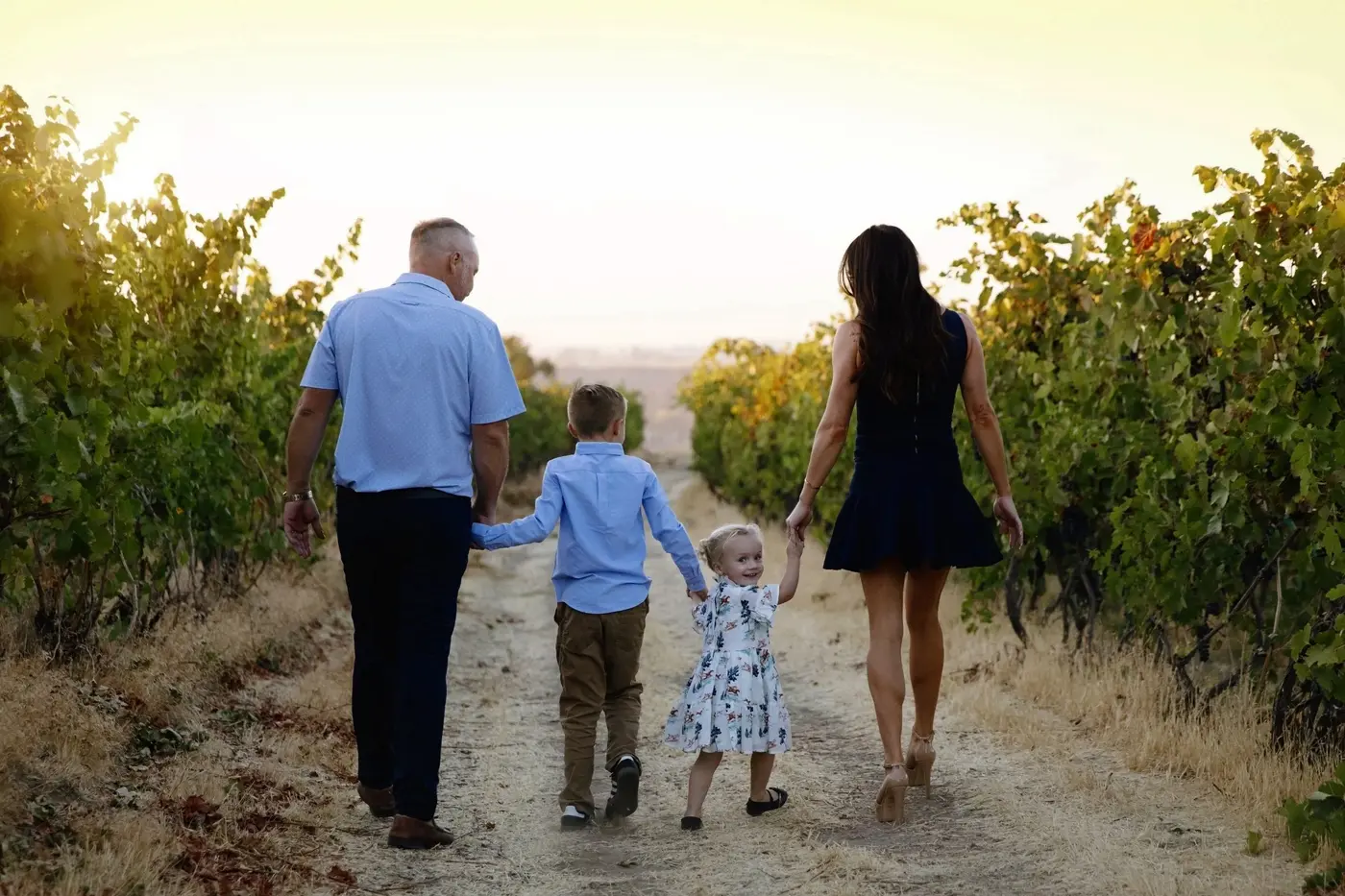
The original holding, about 40 acres by the winery’s account, has grown past 250, with ponds and thousands of trees. Geothermal water irrigates the newer ground. Chenin Blanc and Granché are going in on a nearby slope toward the river beside peach orchards. A 10-acre test plot is planned next to the estate vineyard, where James and Caitlin intend to build a house on the rim with three mountain ranges in view. Their son, Henrik, and daughter, Holland, are growing up on the place. “He already has quite the palate,” Caitlin said of Henrik.
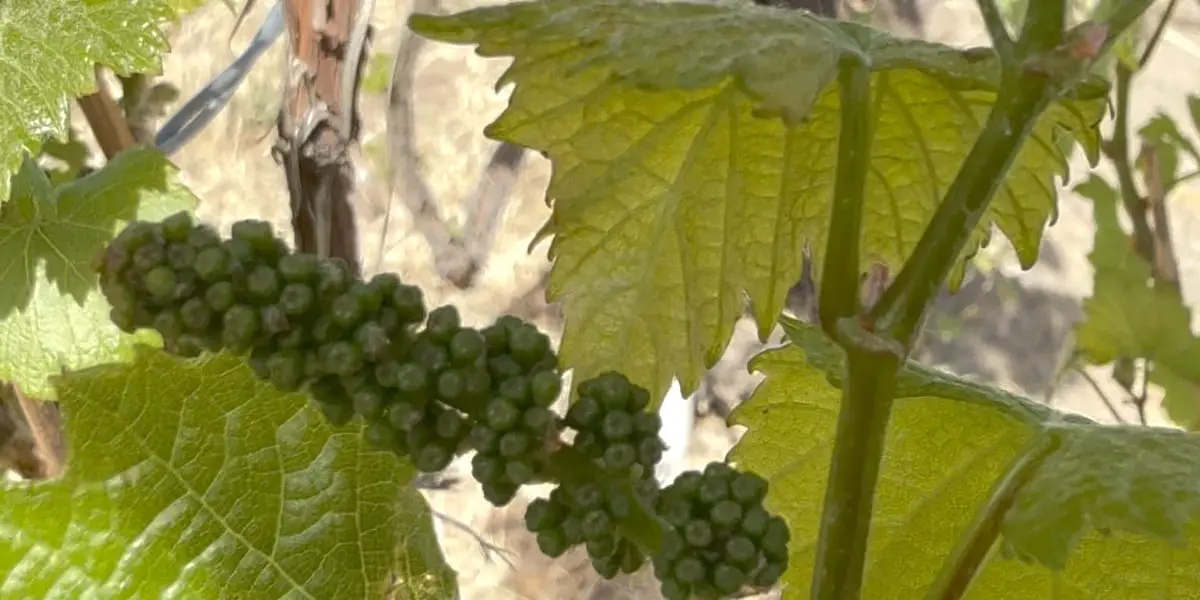
In May 2026 the Chardonnay had already pushed, with the Syrah right behind. The irrigation, shut off all winter, waited on bud break. “You don’t give it its bottle until they’re awake,” James said. “So right now, the vineyard is about to get its bottle.”
Notable Events
- 1970sJames's father tried his hand at dairy farming on the land. blog.idahowines.org
- 1970sThe site began as a family dairy on the Snake River before the vineyard planting. holesinsky.com
- 2000James said they planted their first 10 acres of vinifera. agupdate.com
- 2001The first planting comprised 1,000 Chardonnay grapevines. capitalpress.com
- 2001James completed the UC-Davis wine program and returned to plant 7 acres at the family farm, according to this account. capitalpress.com
- 2002The vineyard added 3,000 Syrah vines, 2,000 Merlot and 200 Port. capitalpress.com
- 2006The vineyard added 1,000 Cabernet Sauvignon and 1,000 Riesling vines. capitalpress.com
- 2006James won the Albertson's Choice Award for his off-dry Riesling. holesinsky.com
- 2006James began producing organic wines, free of sulfates, and received his official Organic Certification. holesinsky.com
- 2022The wines won a trio of Double Platinums at the 2021 Platinum Awards, leading to selection as Great Northwest Wine's 2022 Idaho Winery of the Year. greatnorthwestwine.com
- His Riesling 2006 again took the People's Choice award at the Boise festival described as this year's festival. agupdate.com
People
- Barbara Holesinsky, James's mother and co-owner/operator of the winery.
- Frank Holesinsky, James's father and co-owner/operator of the winery.
- Eric Smallwood, Joined the winery to focus on growing its wine market.
- James Holesinsky, founder and winemaker (born 1978).
- Caitlin Holesinsky, Chemist working with James in the family's winery business.
- Frank, James Holesinsky's father, whose lifelong dream the vineyard honors.
- Jamie Stewart, Winemaker whose long-time friendship gave James encouragement.
- Margaret Misser, UC Davis professor who introduced James to his mentor Michael Moore.
- Meredith, St. Chappel's winemaker and James's UC Davis classmate.
- Michael Moore, French winemaker and founder of the Red Mountain AVA who mentored James after UC Davis.
- Neil Glancey, Winemaker whose long-time friendship gave James encouragement.
- Roger Jones, of Carmela Winery in Glenns Ferry; James worked for him by day and bottled his own wine at night.
Sources
- holesinsky.com
- holesinsky.com/tasting-room
- holesinsky.com/our-land
- idahowines.org/visit/south-central
- visitsouthidaho.com/adventure/holesinsky-winery
- visitidaho.org/things-to-do/wineries-wine-tours/holesinsky-winery-2
- blog.idahowines.org/holesinsky-winery
- kmvt.com/2026/05/08/idahos-only-usda-certified-organic-vineyard-prepares-growing-season
- holesinsky.com/our-history
- greatnorthwestwine.com/2022/04/12/2022-idaho-winery-of-the-year-holesinsky-vineyard-and-winery