Hole N" The Rock
Moab, San Juan County, Utah. Roadside attraction; open all year.
Details

- Where
- 11037 South Highway 191, Moab, UT 11037. Directions
- When
- Open 7 Days A Week (9 am to 5 pm).
- Getting there
- 12 Miles South of Moab Utah on US Highway 191.
- Access
- Open Daily (except Christmas).
- Phone
- (435) 686-2250
- Website
- theholeintherock.com
- Managed by
- Albert and Gladys Christensen.
- Established
- 1940.
- Coordinates
- 38.3907579, -109.4566053.
The name is painted on the cliff in white letters twenty feet tall, readable from US Highway 191 well before the turnoff. Below the letters, on the face of the same rock, is a carved bust of Franklin D. Roosevelt. Below that is the house. The site is in San Juan County, Utah, at an elevation of 5,090 feet. The attraction’s own pages put it twelve miles south of Moab in one place, and 15.3 miles south of Moab and 38.6 miles north of Monticello in another.
Fourteen rooms around pillars
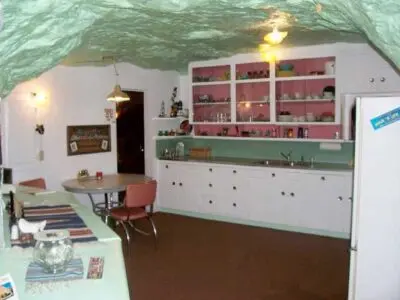
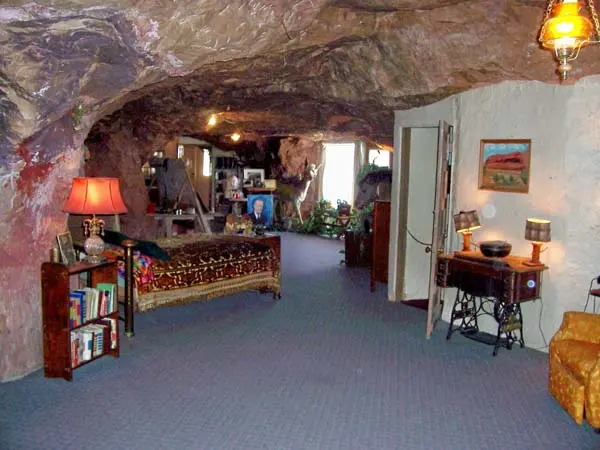
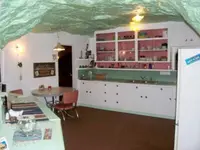
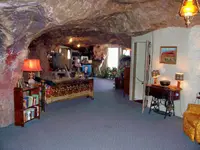
Guided tours of the house run twelve minutes. Inside are 5,000 square feet in fourteen rooms, arranged around huge pillars of the rock and divided by rock archways. Shelves are carved into the walls. A fireplace vents through a 65-foot chimney drilled up through the sandstone, and a deep concrete bathtub is built into the rock. The house has electricity and plumbing. The rooms keep the furniture and belongings the Christensens owned, along with the light fixtures, Gladys Christensen’s doll collection, and many of the tools used to dig the place. In some rooms stand animals that Albert Christensen mounted himself.
His paintings hang throughout. “Albert Christensen loved stone, Jesus and Franklin Roosevelt,” Jim Stiles wrote in the Canyon Country Zephyr, and on the tour “his many renderings of Franklin Roosevelt and Jesus are everywhere, in oils and acrylics and watercolor.” In the same years that he dug out the house, Albert completed a painting, Sermon on the Mount, and the Roosevelt bust on the rock above.
No one lives in the house now. Reported crowds vary by source. A 2017 Country Living story, as cited on Wikipedia, gave about 500 visitors a day. The BYU Daily Universe in 2016 gave 5,000 to 10,000 a month. That year a guide, Conor Sullivan, told the paper, “It’s pretty odd, but people still love it and think it’s fascinating.”
Camels, neon, and a cactus of bowling balls
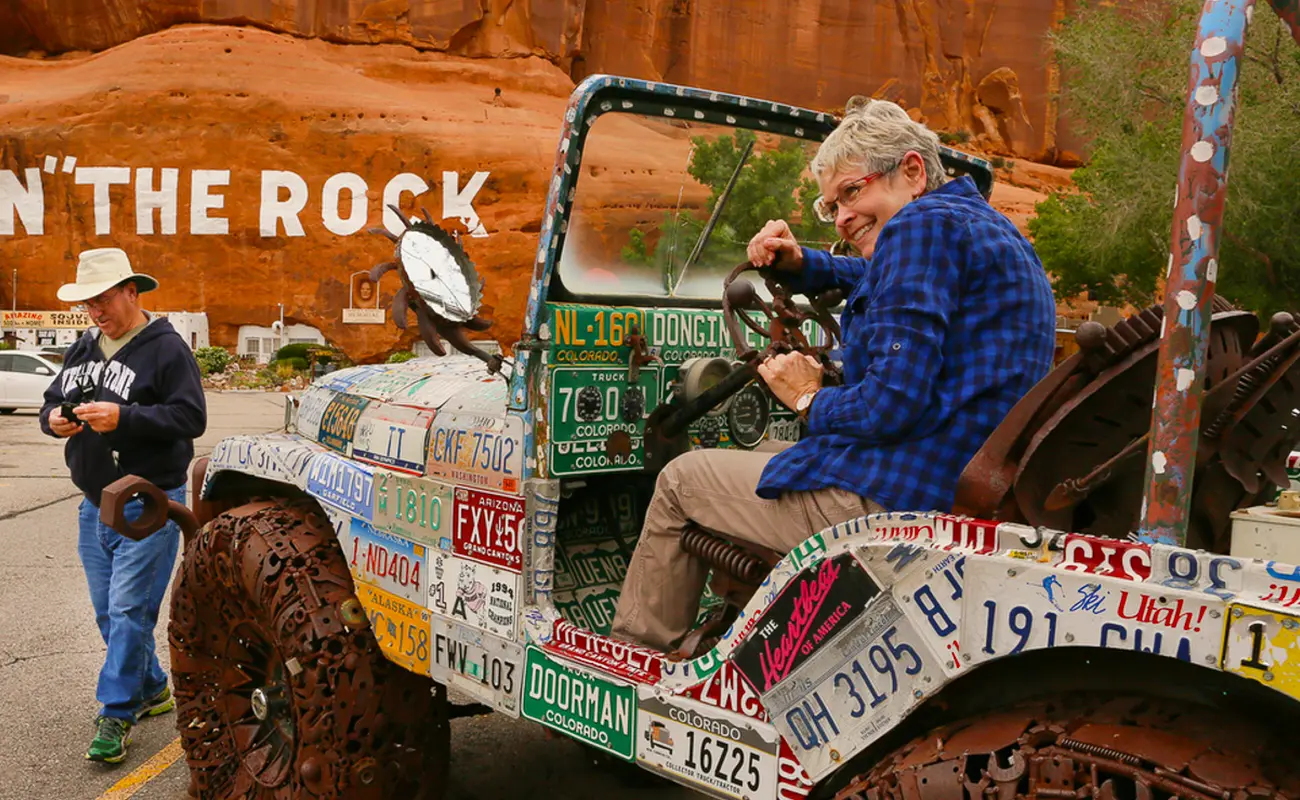
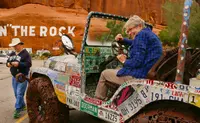
The grounds outside are crowded with antique tools, vintage neon signs, mining equipment, and antique vehicles. There are statues of jeeps and bulls built out of tools, a giant cactus made of bowling balls, an old cage once used to jail criminals, and an aerial tram strung above it all. There are also figures of Big Foot and Mater, and a penny-stretching machine with six designs. Metal and stone sculptures by the Colorado artist Lyle Nichols stand among them. Wikipedia counts eleven. The attraction calls it the largest collection of his work. The General Store sells ice cream cones and drinks. The Trading Post sells locally made Native American pottery, jewelry, and dream catchers, and the shops carry locally made knives. There are picnic areas.
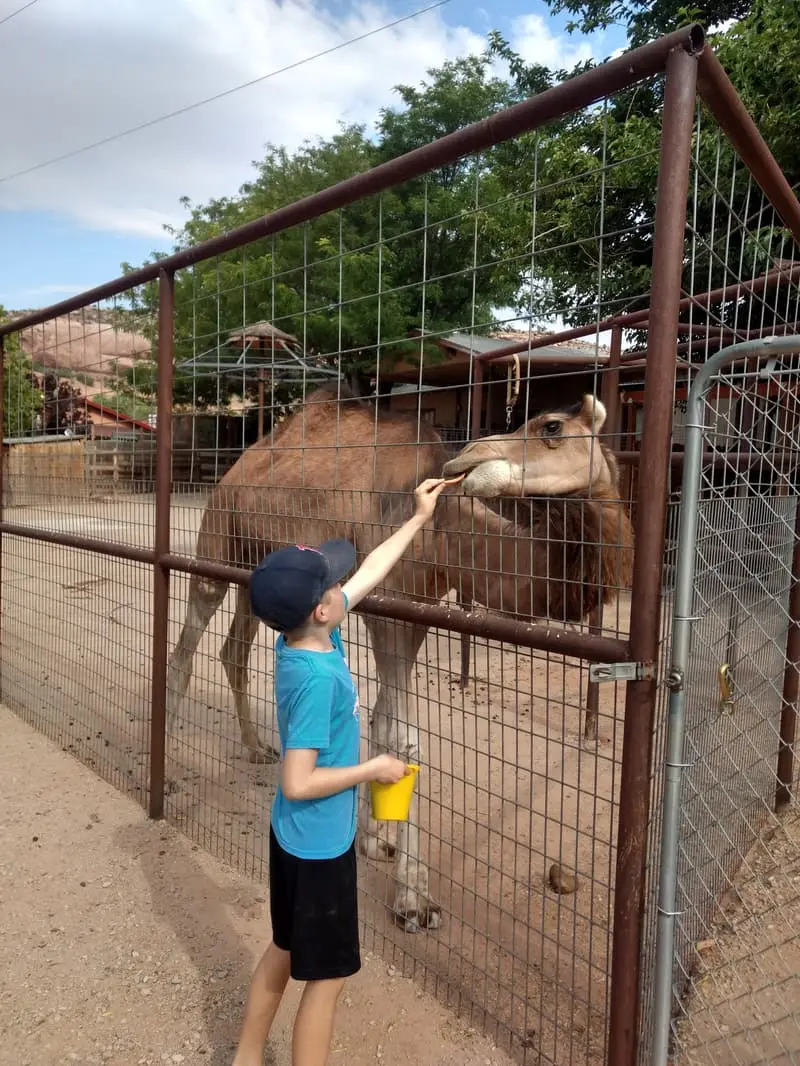
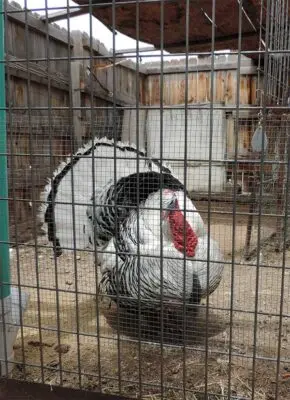
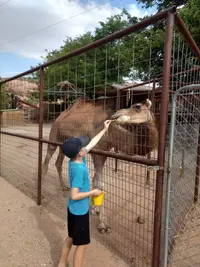
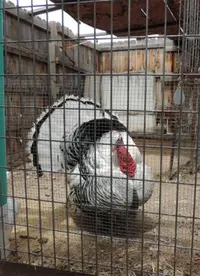
The zoo’s roster depends on who is counting. The attraction’s own page lists Annie the ostrich, Harry the mini-donkey, Bo and Gregory the sheep, Willie and Millie the Angora goats, and Jane Doe the fallow deer. It also lists a Watusi, an albino raccoon, a camel, peacocks, fantail pigeons, pheasants, and exotic turkeys. Its bus-tour page adds a white buffalo. Visit Utah’s list names Cramer the two-humped camel, Zandra the zebra, Wyndell the Vietnamese potbelly pig, and a pair of albino raccoons called Bucky and Noel, along with emus, wallabies, and alpacas. Visitors feed the animals. “When was the last time you fed a camel?” the attraction’s zoo page asks.
A summer room and a king’s name on the wall
Accounts of how the digging began do not agree. Stiles writes that the Christensens moved in the 1930s from Monticello to land the family had bought years before near Cane Springs, 40 miles to the north. Albert’s father had shown him how the softer rock could be blasted and excavated, and had used dynamite and chisels to make a summer room for his boys. The attraction gives the start as a small alcove where the young Christensen boys slept at night. Wikipedia describes an 80-acre homestead from the early twentieth century, where Albert and his brother Leo hollowed a cave in the cliff to give shade and rough lodging to cowboys pushing cattle through.
During the Great Depression, Stiles writes, the family supplemented its meager earnings by bootlegging. When they were caught, “somehow only Albert did hard time.” After his return Albert took up oil painting and sculpture.
West of the main entrance, a sandstone wall carries old inscriptions. Among them is the name of Loren Taylor, longtime publisher of the Moab Times-Independent. Some years before his 2023 article, Stiles was photographing this wall when he found deeply carved letters half hidden behind a thicket of desert holly. He had seen them before, elsewhere. They gave the name and titles of the man Moab knew as Aaron Andrew, or Ahrron Andeew, or “King America/King World.” Stiles places the carving in 1935.
The writer and historian Jen Jackson Quintano later traced the man in the Zephyr. He was Aharon Andrikian, born in 1877 in Malatya, in present-day Turkey. He was a blacksmith who escaped the Armenian genocide into Russia, crossed Siberia to Vladivostok, and landed at Seattle on September 22, 1920. He set up as a shoemaker in Clinton, Massachusetts. In January 1925 he was, in his own term, “reborn” as “the Imperial King of America, and King of All the World.” By May 1933 he was working on a goat ranch at Shiprock, New Mexico, and he left that July with ten goats as pay. Quintano writes that from Shiprock he went north to Cane Springs, cut his name there, and went on to Moab.
Above Moab he carved a bas-relief on a boulder: a man in military dress on horseback, with a map of the northern hemisphere on his Cossack hat. The inscription on that boulder reads “M.C.F. HHAESUSS AMERICA AHARRON ANDEEW KING AMERICA KING WORLD.” Quintano believes “haesus” is the Armenian phonetic spelling of Jesus. She does not know what M.C.F. means. Moab’s leading families expelled him on May 4, 1935. On December 23 of that year, Weber County deputies took him from a dugout in West Weber after he fired on them, and the next day, Christmas Eve, he was committed to the Utah State Hospital. His death was noted there in 1954.
Stiles calls any link between the two men “purely speculative.” Still, he asks whether they met. “Did he and Albert discuss the art of sandstone sculpture?” he writes, and he wonders whether the carving above Moab moved Albert to try bas-relief himself.
The eagle that faced the wrong way
Albert’s largest carving was planned for 1941. Roosevelt had beaten the Republican Wendell Willkie in 1940, and Willkie had then testified in Congress for Roosevelt’s Lend-Lease bill. Albert later wrote that had such a contest happened in any other country, “I am convinced that one of these men would have been assassinated, or perhaps both of them. And that, to me, expresses our American Unity.”
On April 17, 1941, the Times-Independent announced the Unity Monument. Albert Christensen was the sculptor, and the work was paid for by popular subscription. It would show busts of Roosevelt and Willkie surrounded by the American eagle, with the inscription “UNITY With God We Stand All For One One For All.” The final carving was to go on a sandstone wall in an alcove about a mile north of the house, where, the paper said, 100,000 people could gather in the natural amphitheater below. The plan called for likenesses 15 feet wide and an eagle measuring 45 feet from wingtip to wingtip. Albert cleared rock from the cliff face and built a model at one-sixth scale, which was nearly finished by May. People drove the 15 miles from Moab to watch. Eighteen citizens, among them the mayor, the sheriff, and an LDS bishop, wrote to invite Willkie to a dedication tentatively set for May 24, 1941. Stiles found no evidence that he answered.
On August 28, 1941, the paper ran the headline “Unity Monument Passes Into History.” The federal government had said the model stood on public land, and the Department of the Interior had obliterated it. N.F. Waddell of the U.S. Division of Investigations explained that “some of the work was wrong.” “I believe the eagle was facing the wrong way,” he said. He added that his department “has certain rules. We don’t give out much information.”
The diner and Gladys’s letters
The house went on. Stiles dates the digging from the late 1930s and runs it for twelve years. Wikipedia has Albert begin drilling and blasting by hand in 1940, and the family move in in 1952. In all, Albert removed 50,000 cubic feet of sandstone. From 1945 to 1955, part of the cavern served as the Hole N” the Rock Diner. Wikipedia says Albert and Leo opened it. Stiles says it had a reputation “for being a bit on the wild side.” The diner stood in San Juan County, almost 40 miles from Monticello, the county’s nearest town. Moab was much closer, but Grand County had no jurisdiction there. Wikipedia says the diner closed in 1955, when Albert had a heart attack. A gift shop stands in its place now.
Albert died in 1957 with the house unfinished. Gladys kept developing the property. She had the white letters painted on the cliff, opened a gift shop selling rock jewelry she made, and gave tours of her home until her death in 1974. Her son, Hub Davis, owned the place until 2000, when Wyndee and Erik Hansen bought it. They left the house as the Christensens had lived in it, and added gift shops and the zoo. Part of the 2014 film Transformers: Age of Extinction was shot on the grounds. Gladys is buried next to Albert in a small cove in the rock near the house.
Notable Events
- 1930sThe family moved about 40 miles north from Monticello to land it had purchased near Cane Springs. canyoncountryzephyr.com
- 1930sAlbert Christensen began a twelve-year project carving a 5,000-square-foot home from Entrada Sandstone. canyoncountryzephyr.com
- 1935In a passage explicitly called purely speculative, the writer describes an artist carving initials on the sandstone wall adjacent to the museum and shop. canyoncountryzephyr.com
- 1945Part of the man-made cavern operated as a diner. canyoncountryzephyr.com
- 1957Albert died before the home was complete. theholeintherock.com
- 1974Gladys had continued developing the property, opened a gift shop, and gave tours until her death. theholeintherock.com
- The family tried to supplement meager earnings by bootlegging; when caught, somehow only Albert did hard time, according to the paper. canyoncountryzephyr.com
- Albert excavated 50,000 cubic feet of sandstone from the rock. theholeintherock.com
People
- Aharon Andrikian, Drifting artist who left King of the World inscriptions at Hole N' The Rock and above Moab (mid-30s).
- Albert Christensen, builder, excavator, painter, and sculptor (until 1957).
- Loren Taylor, Longtime Moab Times-Independent publisher whose name is recognizable among the rock inscriptions described at the site.
- Franklin D. Roosevelt, subject of Albert Christensen's sculpture on the rock face above the home.
- Gladys Christensen, builder, developer, gift-shop operator, and tour giver (1957 to 1974).
- Conor Sullivan, Hole N' The Rock tour guide.
Sources
- theholeintherock.com
- theholeintherock.com/the-house
- theholeintherock.com/the-petting-zoo
- theholeintherock.com/bus-tours
- theholeintherock.com/map
- en.wikipedia.org/wiki/Hole_N%22_The_Rock
- utahscanyoncountry.com/hole-n-the-rock
- visitutah.com/articles/hole-n-the-rock
- theholeintherock.com/the-house
- universe.byu.edu/2016/06/15/utahs-up-hole-n-rock-homes-draw-attention
- moabmuseum.org/canyon-legacy
- canyoncountryzephyr.com/2023/09/03/albert-christensens-triumph-heartbreak-the-1941-unity-monument-by-jim-stiles-zx78