

Hiram M. Chittenden Locks and Lake Washington Ship Canal
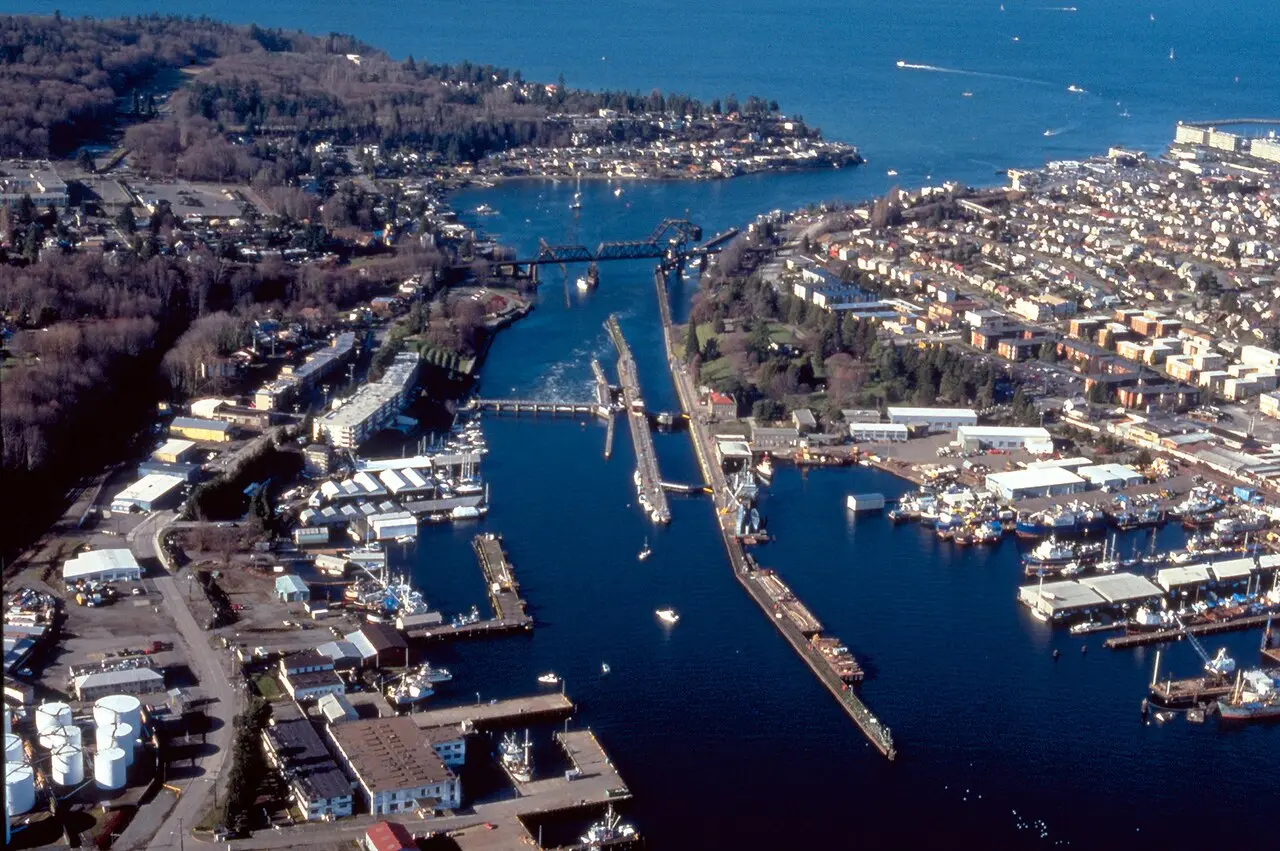
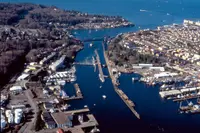
Seattle, King County, Washington. Shipping locks at seaward entry to the Lake Washington Ship Canal.
Details

- Where
- 3015 NW 54th Street Ballard, Seattle, WA 98107. Directions
- When
- Free summer concerts series on the Carl S. English Jr. Botanical Gardens grounds on the weekends, from Memorial Day weekend until Labor Day.
- Season
- Free daily tours begin at 2:00 pm each day the Visitor Center is open (Wednesday - Sunday), May 1 - September 30, and run about one hour.
- Fees
- There are no Day Use Fees charged at this site; Interagency Passes are not sold here.
- Hours
- Visitor Center hours vary by season and personnel capacity; call the visitor center for current hours.
- Access
- The locks are undergoing major and normal annual repairs; check closures for current status.
- Walk-in or reserve
- Free scheduled tours: join anytime, reservations are not required.
- Phone
- 206-783-7059
- Website
- nws.usace.army.mil
- Managed by
- U.S. Army Corps of Engineers.
- Established
- 1917.
At 3015 NW 54th Street in Ballard, a walkway runs across the Lake Washington Ship Canal on top of the locks. To the east lies Salmon Bay, fresh water held at a steady height. To the west is Shilshole Bay of Puget Sound, rising and falling with the tide. The historical marker on the grounds puts the difference between the two at 6 to 25 feet, depending on the tide. The Corps of Engineers master plan gives the lift as 6 to 20 feet. A boat enters a chamber and the miter gates close behind it. The lockmaster in the control tower then opens valves, and water moves through tunnels in the walls until the boat floats level with the far side. The marker calls the arrangement “a boat elevator.” No pumps are used. Gravity moves the water, about 7.5 million gallons of fresh water for an average filling of the large lock.
The pages call these the busiest locks in the nation, passing up to 50,000 vessels a year. Passage is free. Emergency and commercial vessels go first. The U.S. Army Corps of Engineers built the locks and has run them for more than a century, and the grounds are free to enter. The pages also give the attendance two ways: a 2017 resolution of the Washington House counted more than 1.2 million visitors a year, and the Seattle Times in 2023 counted more than 2 million.
Two chambers and a crew
The locks are two chambers, side by side. The large lock measures 825 feet between its upper and lower miter gates and 80 feet wide, and an intermediate gate can divide it in two. The locks’ boater page says it takes vessels up to 760 feet long. The small lock, just south of it, is 150 feet by 30. Its floating mooring bitts ride up and down the walls, which makes it the easier of the two to tie up in. Jet skis, kayaks and every other unpowered craft must use the small lock. Paddleboards are allowed in neither. The boater page warns that a busy summer weekend “can be quite intimidating.”
On a sunny August day in 2023, a Seattle Times writer watched crowds gather while a 120-foot motor yacht slid out of the large lock with a matching SUV on its deck. A group of grade-school boys pushed their bikes across the walkway to the far bank. The largest crew at the locks guides the boats: they shout directions, handle lines and staff the tower. Mike Hand, lock master and a 14-year veteran, has seen boats sink in the chambers and a tug misjudge its beam and get stuck. People fall overboard. Two kayakers were once swept over the spillway and survived. One tug pushing a gravel barge lost throttle control, and the crew worked the lines until the barge struck the gate. “They slowed it just enough that it only made a small dent,” Hand said.
Much of the machinery is old. Under the administration building a circular stair with a brass railing leads down to the original pump motors of 1917, kept now for their historic value. Five stories down, a tunnel carries utility lines beneath the locks. “We’ve got about 55 feet of water over us here,” said David Chapman, the project engineer. Near the small lock, gears the size of a truck tire are greased several times a week. Chapman said he “kind of hate[s] to see them go,” because “there’s something almost romantic about these old mechanical things.”
As the centennial approached, inspectors cut the locks’ safety rating from 4 to 2 on a scale of 5. A 2017 study commissioned by business and community leaders found up to $60 million in needed repairs. By 2023 the Corps had spent or committed more than $65 million, including $18 million for new center gates in the large lock. Each of those hollow gates weighs nearly half a million pounds.
The Corps’ greatest concern is an earthquake that leaves the gates unable to close. Richard Smith, the Corps’ dam safety manager, says Lake Washington could then drop 20 feet in four days. A new crane at the large lock can lower steel bulkheads to stop the outflow.
The repair work continues. The Corps announced that the large lock would close from November 2 to November 20, 2026, for annual maintenance. The small lock was scheduled to close from December 7, 2026, to January 18, 2027, for installation of an Emergency Closure System.
Salmon at the windows
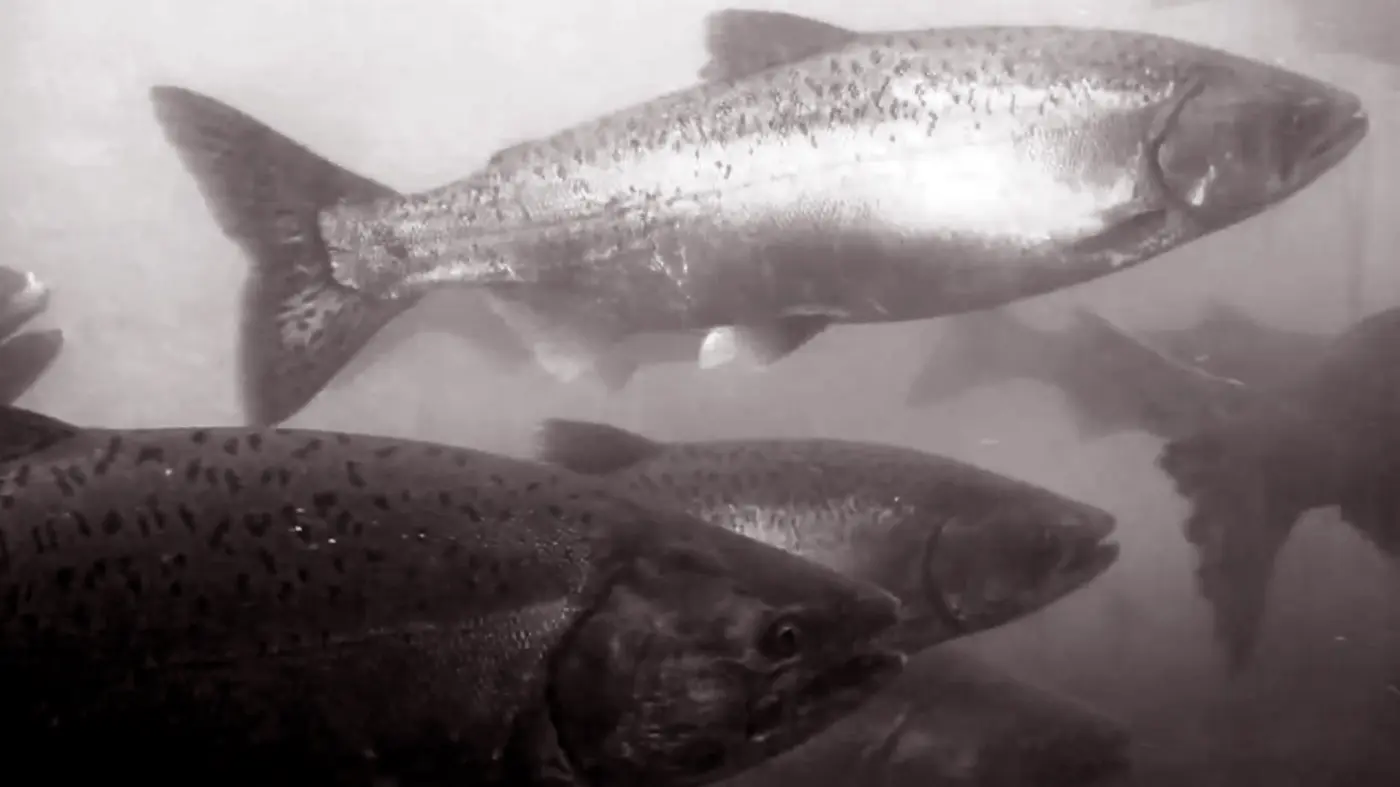
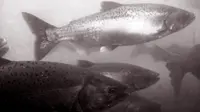
At the south end of the spillway dam, six steel radial gates span 235 feet. Beside them a fish ladder carries salmon around the locks. Indoor windows look into the ladder underwater. The locks’ site gives the season by species:
- Sockeye: best mid-June to mid-July. The runs have fallen sharply, to a recent average under 20,000 a year.
- Chinook: best in August, about 15,000 a year. Visit Ballard narrows the peak to mid to late August.
- Coho: best in September, about 25,000 a year.
- Steelhead: pass from November to May, most often seen from late February to early April.
The site also warns that a visitor may see no salmon at all, even at the peak, because of low tides or hot weather. Seals feed on the salmon below the locks, and herons wait at the edges. The 1970s ladder has no way to keep out seals and sea lions, and some settle inside it to feed.
A fish ladder was built here in 1917. The American Society of Civil Engineers counts it among the first in the United States. Rebuilding began in 1973, and the reconstruction of 1976 added the viewing room. The Salmon Education Center beside it was renovated with public donations.
Young salmon leaving for the sea face other hazards. Since the mid-1990s it had been known that the corroded valves of the large lock, stuck on high speed, were drawing outbound smolts into barnacle-crusted culverts. “It was essentially like a cheese grater,” said Jason Mulvihill-Kuntz of the Lake Washington/Cedar/Sammamish Salmon Recovery Council. These valves are called Stoney gates, after the Irish engineer who invented them, and were first used in the Panama Canal. The Corps replaced them for $13 million. Mike Mahovlich of the Muckleshoot Tribe said the new adjustable valves should be safer, but that it took until 2021 to fix a threat known for more than a quarter century.
Warm water is a growing danger. Temperatures in the canal sometimes pass 70 degrees, and in recent years more than half of the adult sockeye that climbed the ladder died before spawning. The Muckleshoot have taken to catching sockeye at the ladder and carrying them by boat to a hatchery on the Cedar River. “The only way to really fix it is to take them completely out, and that’s not going to happen,” said Rob Purser, fisheries director for the Suquamish Tribe.
Carl English’s garden and the blacksmith shop
North of the locks, the ground rises to a plateau 45 feet high. On it stands the Lockkeeper’s House of 1913, the first permanent building on the reservation. In 1967 it became the residence of the Seattle District Engineer and was renamed for Colonel James B. Cavanaugh. Below it, a terraced bank of dredge spoils steps down toward the water in 5-foot drops. ASCE notes that dredge material was used as fill for the garden.
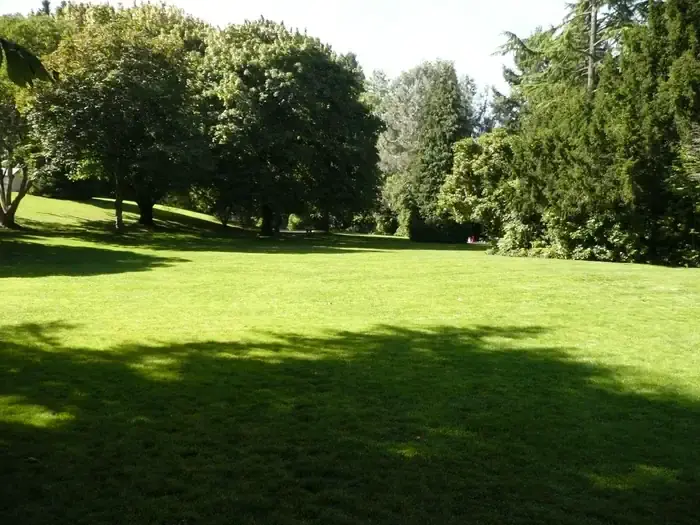
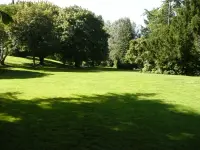
That garden covers about seven acres and holds more than 500 species of trees and plants. Carl S. English, Jr., a horticulturist and botanist, was hired by the Corps in 1931. Over more than forty years he made the ground into a garden in the English estate style. He also helped plant the banks of the Fremont and Montlake Cuts. Along the Fremont Cut, rows of Lombardy poplars run almost unbroken from the Northern Pacific Railway Bridge to the Fremont Drawbridge. The National Register nomination repeats a description of them as “colonnades.”
On weekends from Memorial Day to Labor Day, the garden holds free concerts. Listeners bring picnics onto the lawn. Donations are suggested, and all of them go to volunteer performances, garden upkeep and education programs. The garden is also rented for weddings, and dogs are welcome on a leash.
East of the plateau, the architects Bebb and Gould laid out a cluster of classical concrete buildings around a courtyard that opens onto the locks. The administration building of 1914–15 is the center of the group. The visitor center stands near the east gate, in a building that began as the blacksmith shop where repair parts for the locks were made. The nomination dates the concrete carpenter and blacksmith shops to about 1921. Today its main floor holds a gift shop and a theater that shows short films on request. Exhibits on the locks and on the Corps in the Northwest fill the second floor.
The staff numbers 64, including full-time gardeners and biologists. Rangers lead the tours and answer “Where’s the bathroom?” dozens of times a day. Free tours start at 2:00 pm and run about an hour; Recreation.gov lists them May 1 through September 30. The locks’ own site says weekend tours were canceled for lack of staff.
Sixty-three years from a picnic to a parade
The canal began as a suggestion at a Fourth of July picnic. On July 4, 1854, the pioneer Thomas Mercer proposed the name Lake Union for the fresh lake north of town. Native people had called it “small lake” in Lushootseed for centuries. Mercer and others expected it to become part of a water route between Puget Sound and Lake Washington.
Other routes were tried and dropped. Soil was moved at the north end of Beacon Hill to join Lake Washington directly to Elliott Bay, and a cut from Lake Union to Smith Cove was considered. In 1890 Congress made its first appropriation for the project. On December 15, 1891, a government survey favored the present route from Shilshole Bay. In 1906 Congress authorized a privately financed canal proposed by James A. Moore, with a single timber lock at Salmon Bay.
The same year, the Corps sent Hiram Martin Chittenden to head its Seattle District. He was a West Point graduate and the author of histories of Yellowstone and the western fur trade. He arrived already gravely ill from overwork and lingering typhoid. In December 1906 he recommended a double masonry lock. ASCE credits him with choosing concrete over wood and with insisting on two locks of different sizes. His plan also lowered Lake Washington, which ended the regular flooding of nearby rivers. The state appropriated $250,000 in early 1909. In June 1910 Congress put up $2,275,000, on condition that the other cuts along the route be paid for locally. Chittenden retired that year, paralyzed below the waist. In 1911 King County voters elected him a founding commissioner of the Port of Seattle.
Construction began in September 1911 under Colonel Cavanaugh, with Arthur W. Sargent as assistant engineer in charge. Ground was broken on November 10, 1911. The first concrete went into the forms in February 1913. The mix was one part portland cement, three parts sand and six parts gravel, and the locks were built without piles on a bed of hard clay.
The sources disagree on when the gates first closed and Salmon Bay began to turn from salt water to fresh. The 2017 House resolution gives July 1912. The National Register nomination gives July 12, 1916.
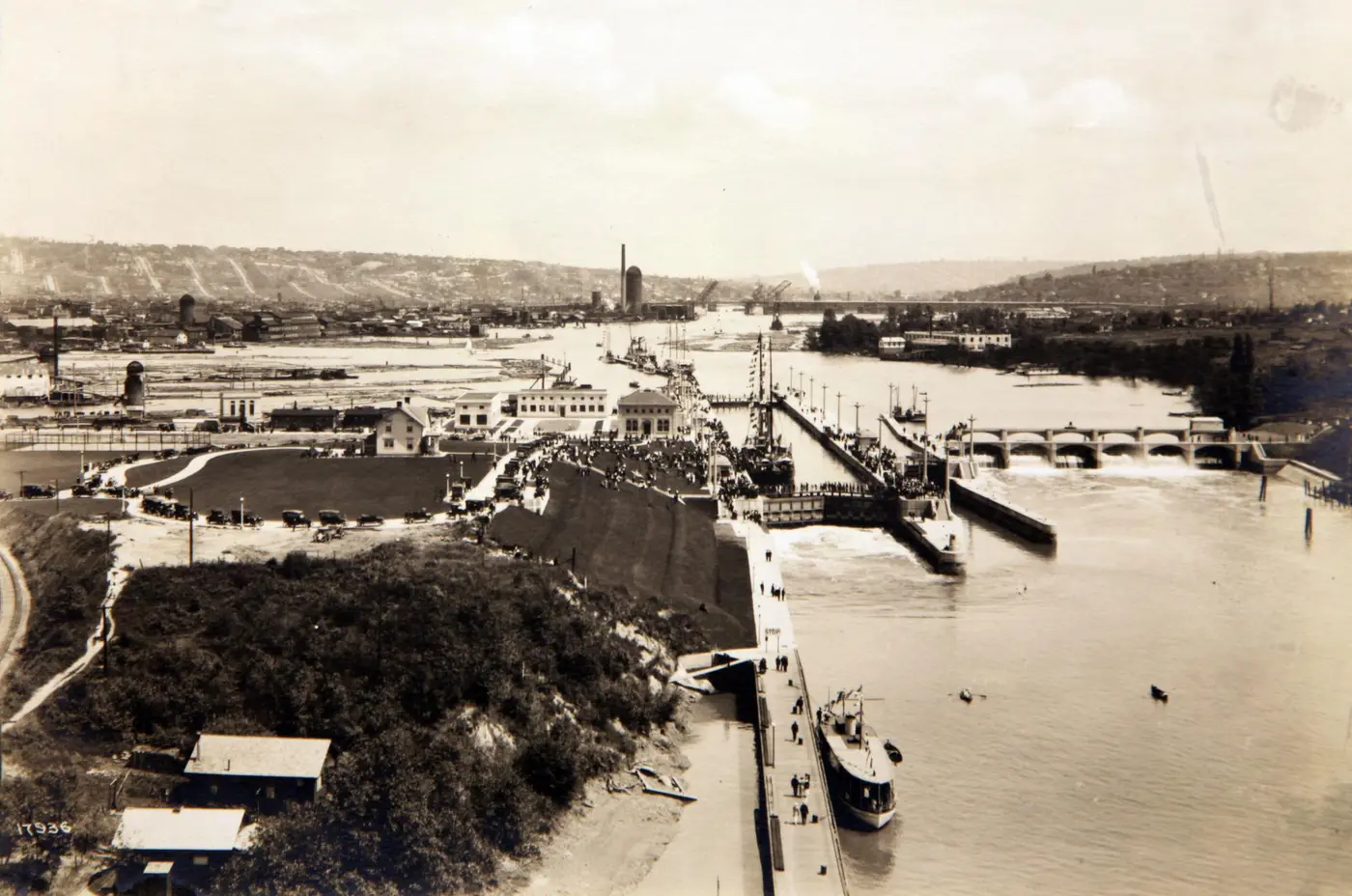
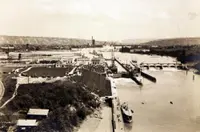
The first boat passed through on August 3, 1916. On August 25, workers cut a gap in the cofferdam at the Montlake Cut. Water fell 37 feet, and 45 million gallons ran from Lake Union into the cut in 56 minutes. That autumn the dam at the east end came out, and over the following months Lake Washington dropped nine feet. Before the canal, coal from inland mines had been handled 11 times on its way to Seattle. Afterward the city’s 4½ miles of harbor grew to 100 miles of piers and wharves.
Dedication waited for the Fremont Bridge, finished in mid-June 1917. On July 4, 1917, the steamer Roosevelt led a parade of more than 200 boats through the locks, and an early Boeing aircraft flew overhead. The marker calls her the USS Roosevelt, flagship of Robert Peary’s 1909 expedition to the North Pole. The nomination names her the flagship of “Commodore Robert E. Perry’s Arctic Expedition of 1907.” The marker adds that the locks were then the largest navigation facility in North America. Chittenden died that autumn, at 58.
The project was declared complete in 1934. The hoped-for Navy base went to Bremerton instead, and by the 1960s pleasure boats outnumbered commercial ones. The North Pacific Fishing Fleet still sails from Fishermen’s Terminal on Salmon Bay and passes through the locks on its way to sea and home again.
The Black River and the namesake
Locally the locks were the Government Locks, or the Ballard Locks. Congress named them for Chittenden in 1956. A 1973 biography by Gordon B. Dodds, drawn from Chittenden’s diaries and papers, quotes him calling the removal of Native Americans “the decree of destiny.”
When the locks’ centennial came in 2017, Michael Herschensohn of the Queen Anne Historical Society called the events a commemoration rather than a celebration. “If we hadn’t had the centennial, there’s an awful lot we wouldn’t have thought about,” he said. Jim Ryan, a retired Corps employee who volunteers at the locks, said: “I personally don’t think he was better or worse than anybody else in the timeframe.”
When the locks opened, Salmon Bay rose a few feet and pushed out the homes, businesses and Native camps along its edge. At the south end of Lake Washington, the Black River had drained the lake toward the Duwamish River. When the lake fell, the river dried up. James Rasmussen, a Duwamish Tribal member, tells the story of an ancestor who lived at the Duwamish village on its bank in the autumn of 1916. “’I look down at my canoe landing, and it’s dry,’” Rasmussen said, repeating his ancestor’s words. “’There are pools of water where there was a river, and salmon are trapped. The mostly white people are bringing gunnysacks to pull up the salmon and they’re having a great old time.’”
Early plans had included a second lock between Lake Washington and Lake Union. It would have held the big lake at its natural level, and the Black River would have kept running. The historian Feliks Banel judged it probably impossible to say whether Chittenden dropped that lock because of his views or because it saved money. Duwamish Tribal chair Cecile Hansen says the canal “erased” the village. An excavation there in 1980 found artifacts and the post marks of at least one large longhouse. The Renton Shopping Center now stands on the site, near the corner of Rainier Avenue and Sunset.
Notable Events
- 1854At an Independence Day celebration Mercer suggested Lake Union as the name of the freshwater lake north of downtown. mynorthwest.com
- 1854At a Fourth of July picnic Mercer cited the advantages of a canal and proposed names for the inland waters. npgallery.nps.gov
- 1854Thomas Mercer was the first to call for joining the lakes and Puget Sound. seattletimes.com
- 1867A Pacific Coast Board of Engineers considered a Puget Sound naval station; a Lake Washington location would require a ship canal. npgallery.nps.gov
- 1890Congress first appropriated funds for the proposed commercial waterway and authorized a route survey. npgallery.nps.gov
- 1891The government survey preferred the present general route from Shilshole Bay for alignment and potential lower cost. npgallery.nps.gov
- 1891David Denny built the first crossing, the Latona Bridge. seattletimes.com
- 1902The streetcar bridge was widened for pedestrians and vehicles. seattletimes.com
- 1906He was sent to lead the district despite grave illness from overwork and lingering typhoid. mynorthwest.com
- 1906Congress authorized a privately financed canal with a single timber lock at Salmon Bay proposed by James A. Moore. npgallery.nps.gov
- 1906Chittenden recommended significant changes in the lock's placement and nature, advocating a double masonry lock. npgallery.nps.gov
- 1907The existing project was based on Chittenden's detailed annual report. npgallery.nps.gov
- 1909The state legislature appropriated $250,000 to excavate between Lake Union and Lake Washington. lawfilesext.leg.wa.gov
- 1910Congress appropriated $2,275,000 for Seattle's ship canal, allowing the project to proceed along Chittenden's plan. historylink.org
- 1910Approval required the other canals along the route to be locally paid for. lawfilesext.leg.wa.gov
- 1910Chittenden retired from the Corps, paralyzed below the waist, six years before completion. mynorthwest.com
- 1911Dredging began after more than 50 years of contention and debate. asce.org
- 1911Work on the locks began with a cofferdam around the Ballard site. historylink.org
- 1911Construction commenced under Colonel James B. Cavanaugh. npgallery.nps.gov
- 1912The locks and ship canal provided a sheltered harbor for the fishing fleet. ballardhistory.org
- 1912The resolution says the gates first closed and turned Salmon Bay from saltwater to freshwater. lawfilesext.leg.wa.gov
- 1913The Lockkeeper's House was the first permanent building completed on the reservation. npgallery.nps.gov
- 1913The first concrete was deposited in the forms. npgallery.nps.gov
- 1913Workers blew up the first cofferdam and admitted Portage Bay water. seattletimes.com
- 1914The reservation's initial multi-purpose public building became its focal point. npgallery.nps.gov
- 1914The operating houses originally controlled the locks and were later functionally superseded by the central Control Tower. npgallery.nps.gov
- 1914The second dam was blown up, after which the north side slumped. seattletimes.com
- 1916With the spillway dam in place, the lock gates closed and Salmon Bay ceased to be a tidal inlet. historylink.org
- 1916The first boat passed through the Ballard Locks. lawfilesext.leg.wa.gov
- 1916The locks opened for business. mynorthwest.com
- 1916Rasmussen's ancestor was at the Black River village when the canal opened, the lake level dropped, and the Black River disappeared. mynorthwest.com
- 1916After the third cofferdam was dynamited the lakes could finally be connected. seattletimes.com
- 1916Workers began letting water out, lowering Lake Washington by 9 feet over the following months. seattletimes.com
- 1917The marker says the locks were North America's largest navigation facility at dedication and USS Roosevelt, flagship of Robert Peary's 1909 North Pole expedition, led the boat parade. hmdb.org
- 1917The newly constructed Ballard and Fremont Bridges were completed. lawfilesext.leg.wa.gov
- 1917The resolution identifies this as the official opening. lawfilesext.leg.wa.gov
- 1917The complete ship canal from Salmon Bay to the Montlake Cut was officially dedicated. mynorthwest.com
- 1917The original fish ladder was constructed at the locks. npgallery.nps.gov
- 1917The cut opened between Lakes Union and Washington near the abandoned improvement association portage. npgallery.nps.gov
- 1919The initially wooden University Bridge opened in response to the canal and deterioration of the Latona Bridge. seattletimes.com
- 1921The concrete carpenter and blacksmith shops appear to have replaced temporary frame structures. npgallery.nps.gov
- 1922The Emergency Dam Hoist House contained emergency dam hoists and the saltwater barrier air compressor. npgallery.nps.gov
- 1925Montlake Bridge followed the other new ship-canal bridges. lawfilesext.leg.wa.gov
- 1931Carl S. English, Jr. was hired by the Army Corps. ballardlocks.org
- 1933The bridge was upgraded to steel and concrete and expanded. seattletimes.com
- 1934The project was declared completed. lawfilesext.leg.wa.gov
- 1940sNew structures, some temporary, were added north and east of the maintenance core. npgallery.nps.gov
- 1950sThe Seattle Garden Club undertook informal subsidiary landscaping along the Fremont Cut banks. npgallery.nps.gov
- 1950A city report discouraged recreational boating facilities and recommended keeping the canal's north side industrial. seattletimes.com
- 1956The locks were officially renamed the Hiram M. Chittenden Locks in his honor; they remained commonly known as the Ballard Locks. historylink.org
- 1960sBy the 1960s pleasure boats outstripped commercial users; the hoped-for Navy base had gone to Bremerton. seattletimes.com
- 1966Interior partitions were revised and one fireplace removed. npgallery.nps.gov
- 1967The house became the official Seattle District Engineer residence and was renamed in honor of Colonel James B. Cavanaugh. npgallery.nps.gov
- 1969The middle-wall Control Tower was intended to centralize control of the locks. npgallery.nps.gov
- 1973Rehabilitation included plans for an underwater viewing room, pedestrian ramps, and rest rooms. npgallery.nps.gov
- 1976Reconstruction improved water flow and fish passage and created an underground visitor viewing window. lawfilesext.leg.wa.gov
- 1990sCorroded valves stuck on high speed sucked outbound smolts into barnacle-encrusted culverts. seattletimes.com
- 2017The date marked the opening's 100th anniversary. qahistory.org
- 2017New maintenance dewatering pumps replaced the old equipment after an original cast iron pipe burst. seattletimes.com
- 2017Business and community leaders commissioned a study identifying up to $60 million in needed repairs. seattletimes.com
- 2021According to Mike Mahovlich, the adjustable-flow valves should be less dangerous to smolts, but addressing the known threat took until 2021. seattletimes.com
People
- Hiram Chittenden, Chief engineer who drove concrete construction and insisted on two differently sized locks.
- Carl S. English, Jr., Horticulturist and botanist who transformed the garden and helped develop canal-cut plantings (Hired in 1931; over 40 years developing the garden).
- Hiram M. Chittenden, Engineer who designed the whole system from Renton to Salmon Bay and re-plumbed King County waterways.
- Robert Peary, Commodore whose North Pole expedition flagship USS Roosevelt led the dedication parade (1909 expedition).
- Cecile Hansen, Duwamish Tribal chair describing how the canal erased the Black River village.
- James Rasmussen, Duwamish Tribal member and cleanup coalition coordinator recounting his ancestor's experience of the canal's effects.
- Jim Ryan, Retired Corps staffer volunteering at the locks and researching Chittenden's engineering papers (Retired in 2007).
- Michael Herschensohn, Queen Anne Historical Society president and member of the locks centennial group.
- Thomas Mercer, Early settler first calling for the joining of lakes and Puget Sound (1854).
- Arthur W, Sargent, Assistant Engineer in charge of construction.
- Arthur W. Sargent, Assistant Engineer in charge of construction (1911-1917).
- Barton S. Alexander, Lieutenant Colonel heading the Pacific Coast Board of Engineers considering a Puget Sound naval station (1867).
- C. A. D. Young, Junior engineer whose concept evidently underlay the Lockkeeper's House plans, not Gould's as once supposed.
- Carl F. Gould, Architect who prepared the Administration Building plans (1873-1939).
- Carl S. English, Groundskeeper who introduced ornamental and specimen plantings with others (1930s and 1940s).
- Charles Herbert Bebb, Architect selected with Gould to lay out and design the concrete accessory-building complex (1856-1942).
- James A. Moore, Proposed a privately financed canal with a single timber lock at Salmon Bay (1906).
- James B. Cavanaugh, Colonel and District Engineer supervising construction (1911-1917).
- Reginald H. Thompson, City Engineer and important advocate of Chittenden's recommendations.
- Richard Ballinger, Secretary of the Interior and former Seattle mayor who interceded for Chittenden's promotion before disability retirement.
- Robert E. Perry, Commodore whose Arctic expedition flagship Roosevelt led the canal dedication parade, as the nomination identifies it (Arctic Expedition of 1907).
- David Chapman, Project engineer for the Corps-operated locks facility.
- Doug Ericksen, State senator who introduced a bill to study breaching the Ballard Locks; the article says he did not really expect it to happen (Died in 2021).
- Jason Bergerson, Locks worker operating the tower (Has worked at the Locks for 13 years).
- Jason Mulvihill-Kuntz, Lake Washington/Cedar/Sammamish Salmon Recovery Council representative discussing repairs and salmon passage.
- Jeff Stander, Locks maintenance chief.
- Mike Hand, Lock master (14-year veteran).
- Mike Mahovlich, Muckleshoot Tribe assistant director for harvest management discussing salmon-safe valves.
- Richard Smith, Corps Seattle District dam safety manager explaining the earthquake threat to the locks.
- Rob Purser, Suquamish Tribe fisheries director advocating reduction of the locks' toll on salmon.
- Stoney, Irish engineer for whom the Stoney gate valves are named; originally used in the Panama Canal (1800s).
- David Denny, Built the first Latona Bridge crossing of the canal corridor (1891).
- John J. McGilvra, Canal booster and Seattle attorney who opposed a proposed park boulevard in favor of trade and commerce.
Sources
- ballardlocks.org
- recreation.gov/ticket/facility/10112103
- facebook.com/ChittendenLocks
- commons.wikimedia.org/wiki/Category:Hiram_M._Chittenden_Locks
- ballardlocks.org/questions.html
- ballardlocks.org/visitor-center-museum.html
- visitballard.com/ballard-locks-botanical-garden
- seattletimes.com/pacific-nw-magazine/how-seattles-locks-and-ship-canal-altered-the-citys-life-and-identity
- seattletimes.com/pacific-nw-magazine/a-deep-dive-into-seattles-busy-beloved-ballard-locks
- asce.org/about-civil-engineering/history-and-heritage/historic-landmarks/lake-washington-ship-canal-and-hiram-m-chittenden-locks
- qahistory.org/articles/hiram-m-chittenden-critical-look-man-built-ballard-locks
- hmdb.org/m.asp?m=86455
- mynorthwest.com/676005/centennial-reveals-complicated-legacy-of-locks-namesake
- ballardlocks.org/carl-s-english-garden.html
- lawfilesext.leg.wa.gov/biennium/2017-18/Pdf/Bills/House%20Resolutions/4638-Hiram%20M.%20Chittenden%20Locks.pdf
- npgallery.nps.gov/GetAsset/fab7a839-8da4-4efe-a4ea-a5405b6aeddf
- ballardhistory.org/mapping-ballard-new/ballard-overview
- historylink.org/file/1444