Himalaya Tourmaline Mine dig
Santa Ysabel, San Diego County, California. Gem and crystal dig; Open year round.
Details
- Where
- Lake Henshaw, 26439 Hwy 76, Santa Ysabel, CA 26439. Directions
- When
- Standing schedule Thursday - Sunday 10am to 3pm; Monday digs by reservation; page marked Currently Closed.
- Fees
- Adult dig $75; youth 13-15 half price ($37.50); children 12 and under free with a paying adult; additional children $20; senior and active military $60.
- Access
- Currently Closed.
- Walk-in or reserve
- Reservations are not necessary; Monday digs available by reservation only.
- Managed by
- Chris Rose.
- Established
- 1898.
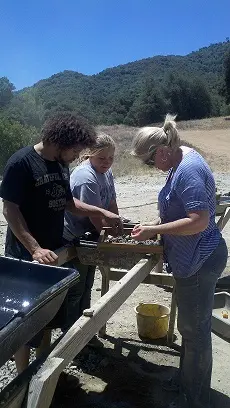
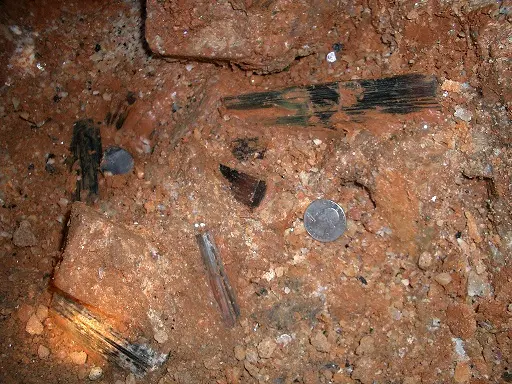
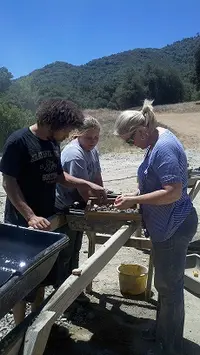
At Lake Henshaw Resort, on Highway 76 near Santa Ysabel in San Diego County, visitors dig and screen through ore brought down from the Himalaya Mine on Mesa Grande. The screens turn up pink and green tourmaline, black tourmaline, quartz crystals, spessartine garnet, lepidolite, clevelandite and other minerals, and the digger keeps all of it. The operators, Chris Rose and Denise Olson, advise bringing a sun hat or rain gear, muddy shoes, perhaps rubber gloves, a toothbrush, a baggie, a small bucket or bin for specimens, and tissue paper to wrap them in. If it rains more than three-quarters of the day, the fee drops by ten dollars.
Screens under the oaks at Lake Henshaw
There are toilets near the digging ground, picnic tables, and, in the operators’ words, “some huge oak trees to sit under.” Rose and Olson keep a display of their own crystals and sell some stones. The Henshaw Grill serves breakfast, lunch and dinner, and a general store carries snacks. The lake has fishing, boat rentals, camping and hiking, and the resort has cabins and RV spaces. The Pacific Crest Trail crosses at Warner Springs, eight miles off, and Mount Palomar stands close by.
The standing schedule is Thursday through Sunday, 10 a.m. to 3 p.m., with Monday digs by reservation. The operators’ page for 2026 marks the dig Currently Closed. It still offers ore by mail: three-gallon buckets of what it calls “ultra-classified tourmaline bearing ore,” about 30 pounds to the sandbag.
Gem Hill and the vein
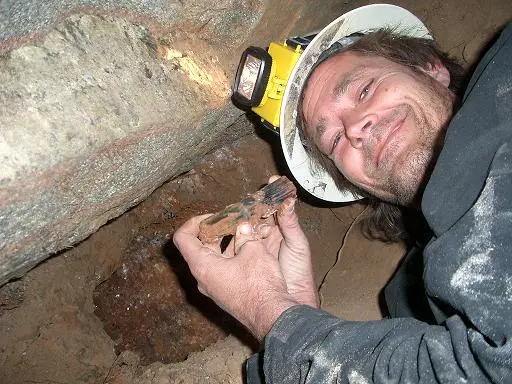
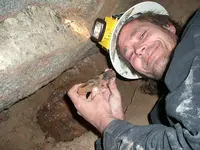
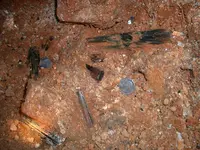
The mine lies on Gem Hill in Mesa Grande, across the valley from Mount Palomar. Rose’s account describes it as an underground five-mile labyrinth of steep passageways, dug, drilled and blasted over the past 100 years. The tourmaline lies in pegmatite, a coarse-grained granitic rock, in veins that run at a 45-degree angle deep into the earth. Several dikes on Mesa Grande carry tourmaline, and the Himalaya works the largest of them.
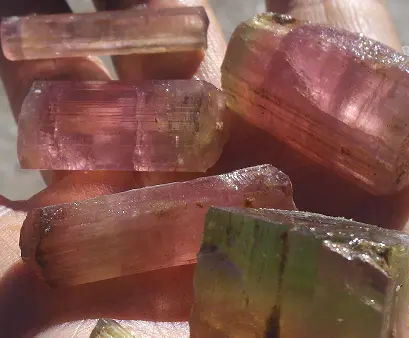
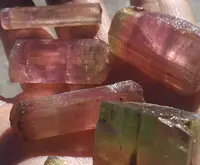
The stone comes in pink, which is rubellite, and in green, bicolor, tricolor and watermelon. Blue indicolite turns up on extremely rare occasions. Rose’s page puts the share of gem-grade crystals at about 5 percent. It also lists quartz, apatite, morganite, calcite, feldspar, stibiotantalite and topaz among the vein’s other minerals.
The sources measure the output in different ways:
- Rose’s page: an estimated 250,000 pounds of tourmaline and specimens. It says the mine led the world in tourmaline for 15 years, and that its 5.5 tons in 1904 were the most tourmaline ever produced in a single year.
- Gemological Institute of America: the greatest producer of gem tourmaline in North America.
- Mark Ivan Jacobson, in a 2021 paper for the New Mexico Mineral Symposium: the most prolific producer of gem elbaite in the United States. He cites George F. Kunz, who wrote in 1905 that “about 6 tons” had been shipped to New York, and Weber, who suggested in 1963 that perhaps 90 tons of elbaite and beryl had come out.
Specimens from the mine are held at the Smithsonian.
Children with crystals, and a tangle of claims
Jacobson reports that the pegmatite may have been known by 1875. Local oral histories tell of children, both Indian and settler, bringing crystals home or trying to trade them away. A specimen in the California State collection in San Francisco shows that by 1896 local adults knew of gem tourmaline from what would later be called the Himalaya vein.
The sources date the discovery differently. The Gemological Institute of America and Rock & Gem place it in 1898, at Mesa Grande about 20 miles southwest of Pala, with bicolored crystals among the finds. Jacobson writes that the discoveries were reported in 1899.
The San Diego History Center says Gail Lewis of San Diego opened the mine in 1898 and later sold it to Tannenbaum. Jacobson gives a longer sequence:
- Lewis claimed the southern end of the vein sometime between 1898 and 1902.
- Charles Orcutt claimed the northern end on November 16, 1899, mined it that year, and publicized his finds.
- A group overstaked Orcutt’s claim and named its holdings the Sancho Pancho Mine. The group was D. L. Hoover, C. E. McGary, and the shoe retailers Frank F. Wright and Frank N. Wright.
- The Sancho Pancho owners optioned the property to Archibald Edward Heighway, Jr., whom the New York Times called the “Cincinnati giant.” Heighway took over in 1901, started mining, reneged on the royalties, overstaked the Sancho Pancho claims, and sold to Lippman Tannenbaum.
- The Hoover group sued Tannenbaum. Just before the case reached court, in December 1903, he paid the Sancho Pancho owners $6,000, and the problem went away.
Photographs held by the San Diego History Center show Vance Angel drilling at the mine about 1901. Another, from about 1905, shows four men near the mine, named as Bill Nelson, Artley, Jim Kinney, and the cook.
Pink stone for the imperial court
The pink stone found its market in China. Accounts agree that the Empress Dowager, Cixi, had a particular fondness for pink tourmaline. Charles Pearson, quoted in Modern Jeweler in 1991, wrote that the gem “was used for carving purposes and to fashion buttons or toggles for jackets worn by the royal court and wealthy individuals.” The Times of San Diego adds snuff bottles and jewelry.
At a 1991 symposium, the Fallbrook miner and dealer Bill Larson described how Tiffany & Co. ran the trade. The imperial court would order a quantity of tourmaline, usually several tons, from J. L. Tannenbaum, a Tiffany gemologist. Tannenbaum would then wire money from a Chinese government account at the Import-Export Bank of New York to hire local ranchers and cowboys to dig it. When the order was filled, the court sent another.
The tonnage varies by source:
- Peter Bancroft: 120 tons of gem-grade tourmaline, valued at $800,000, mined at Mesa Grande alone between 1902 and 1910.
- San Diego Natural History Museum: 120 tons of gem-quality pink tourmaline shipped to China from the county as a whole in the same years.
- San Diego History Center: about 125 tons from the Mesa Grande mines, valued at $800,000, nearly ninety of them from the Himalaya.
The end of the trade is told several ways. Jacobson writes that Tannenbaum’s mining peaked in 1910, then fell off with a sluggish domestic and foreign market and his own financial mismanagement, and that he filed for bankruptcy in April 1913. The San Diego History Center points to 1911, when revolt overthrew the Manchu Dynasty and shut off the main market. Modern Jeweler ties the end of the boom to the Dowager’s death, which it places in 1911. The Times of San Diego gives her death as 1908 and the dynasty’s fall as 1912.
Owners, a caretaker, and a fallen adit
After the bankruptcy, creditors took the property. About 1914 they leased it, Jacobson writes, probably to the George Ah Quin Company. Thomas Ah Quin, Jr., Henry Quin and Fred Rynerson mined there from time to time. By 1922 the Chinese market had recovered enough that the southern California mines could not meet demand. About 1925 the General Electric Company of New York leased the Himalaya and the neighboring San Diego mine to explore for pollucite, the only known ore of cesium. That same year Thomas Ah Quin, Jr. bought the Himalaya properties outright, and Rynerson bought the San Diego mine.
Ed Over and Arthur Montgomery leased the Himalaya in 1935 and found tourmaline, though not enough to pay. Quin died in 1937. His married daughter, Helen Quin Kong, inherited the mine and sold it to Ralph Potter in 1952. A long-term caretaker, Herb Hill, informally let specimen collectors onto the site.
According to Modern Jeweler, Potter tunneled some 500 feet into the west side, found pockets of crystals, and traveled the country selling them until the mine paid. The author John Sinkankas credited him, with the garnet miner Louis Spaulding, for the county’s revival: “It is Potter and Spaulding who once again made gem mining a commercial venture in San Diego.” By 1958 the underground workings were open again. In December 1963 Potter formed Himalaya Gem Mines, Inc., selling shares to eight local collectors and keeping an interest himself. Underground mining went on until the winter rains of 1969 collapsed the adit that led into the workings.
Larson’s arrival is dated two ways. Jacobson writes that in July 1977 Larson, as principal of Pala Properties International, took a ten-year lease and reopened the mine, then bought it in 1988. Modern Jeweler says he bought out Potter’s nine-man syndicate in 1978 and began extending the old tunnels at once. The near-surface rock had weathered, so Larson drove a new, lower adit to reach the pegmatite beneath the shallower tunnels. “As a miner I’m as much on the lookout for fine specimens as fine rough crystals,” he told the magazine. “Both are miracles of nature.” In May 1989 his chief of operations, John McLean, hit a major pocket filled with gem and mineral crystals. Pala Properties worked the mine at a profit until 1997.
In 1998 Chris Rose took possession of the Lohrer Claim, which held the open adit, and Pala Properties sold the two patented claims to the north. The San Diego mine, at the southern end of the dike, remains with Fred Rynerson’s descendants. In 2020, before the pandemic, Rose was working the Himalaya and moving its dump material off the hill, to be sold by the bucket to people who come to dig.
Notable Events
- 1898Gem tourmaline, including bicolored crystals, was discovered at Mesa Grande; this became the Himalaya Mine. gia.edu
- 1898Gail Lewis of San Diego opened the mine, later sold to Tannenbaum. sandiegohistory.org
- 1899Gail Lewis put in his claim on the southern end of the vein sometime between 1898–1902, whereas the northern end was claimed by Charles Orcutt on November 16, 1899. geoinfo.nmt.edu
- 1901Heighway took over the property in 1901, started mining, reneged on the royalty payments, and overstaked the Sancho Pancho claims. geoinfo.nmt.edu
- 1902Mesa Grande mines produced about 125 tons of tourmaline material valued at $800,000, nearly ninety tons from the Himalaya. sandiegohistory.org
- 1902The San Diego Natural History Museum says that between 1902 and 1910, San Diego County supplied imperial China with 120 tons of gem-quality pink tourmaline; the Himalaya Mine became one of the region's major producers. timesofsandiego.com
- 1903Just before the suit went to court, Tannenbaum paid the Sancho Pancho owners $6,000 in December 1903 and the problem went away. geoinfo.nmt.edu
- 1904The Himalaya Mine produced more tourmaline than any other mine in the world for 15 years, including 5.5 tons in 1904, the most tourmaline ever produced in one year. highdesertgemsandminerals.com
- 1910The height of mining activity by Tannenbaum peaked in 1910; mining afterwards decreased radically due to a sluggish domestic and foreign market and financial mismanagement. geoinfo.nmt.edu
- 1911The Chinese people's revolt overthrew the Manchu Dynasty and established a republic, shutting off the major market for tourmaline. sandiegohistory.org
- 1913Tannenbaum filed for bankruptcy in April 1913. geoinfo.nmt.edu
- 1925In 1925, Thomas Ah Quin, Jr. bought the Himalaya mine properties outright, with Fred Rynerson buying the San Diego mine. geoinfo.nmt.edu
- 1952Helen Quin Kong, who inherited the property in 1937, sold it to Ralph Potter in 1952. geoinfo.nmt.edu
- 1963Ralph Potter formed the Himalaya Gem Mines, Inc. to own the patented and unpatented claims; shares were sold to a group of 8 local mineral collectors. geoinfo.nmt.edu
- 1969Underground mining continued until the winter rains of 1969 caused the adit that accessed the underground workings to collapse. geoinfo.nmt.edu
- 1977William "Bill" Larson, as principal for Pala Properties International, obtained a ten year lease and reopened the mine. geoinfo.nmt.edu
- 1978In 1978, Larson bought out a nine-man syndicate formed by Potter that owned the Himalaya and immediately began to extend old tunnels. palagems.com
- 1988In 1988, Larson, as owner of Pala Properties International, purchased the mine. geoinfo.nmt.edu
- 1989In May 1989 the mine's chief of operations, John McLean, hit a major pocket filled with gem and mineral crystals. palagems.com
- 1998In 1998, Chris Rose took possession of the Lohrer Claim, which had the open adit; by 2020 he was working it, with dump material sold as a pay-to-dig tourist activity. geoinfo.nmt.edu
People
- Archibald Edward Heighway, Jr., the "Cincinnati giant"; took an option on the property, mined it, then sold it to Lippman Tannenbaum.
- Charles Orcutt, claimed the northern end of the vein; mined his portion and publicized his discoveries (1899).
- Chris Rose, took possession of the Lohrer Claim and works the mine, selling dump material as a pay-to-dig tourist activity (1998).
- Gail Lewis, Opened the Himalaya mine; later sold it to Tannenbaum (1898).
- Helen Quin Kong, inherited the property from her father Thomas Quin and sold it to Ralph Potter (1937–1952).
- Herb Hill, long term on-site caretaker who informally allowed specimen collectors on the mine site.
- Lippman Tannenbaum, owner whose mining peaked in 1910; filed for bankruptcy in April 1913.
- Ralph Potter, owner; formed the Himalaya Gem Mines, Inc (1952–1963).
- Thomas Ah Quin, Jr., miner, then owner who bought the Himalaya mine properties outright (1925–1937).
- William "Bill" Larson, principal of Pala Properties International; leased, reopened, and later bought the mine (1988–1997).
- John McLean, the mine's chief of operations.
- J. L. Tannenbaum, His company's agent recognized tourmaline at Mesa Grande; later buyer of the Himalaya.
- Empress Dowager Cixi, her fondness for pink tourmaline turned San Diego County into an important source for the Chinese market (died in 1908).
- Vance Angel, shown drilling at the Himalaya Mine (c. 1901).