
Highline Lake State Park
Loma, Mesa County, Colorado. State Park.
Details

- Where
- 1800 11.8 Road, CO 81524 United States, Loma, CO 81524. Directions
- When
- Park: Daily, 5 a.m. to 10 p.m. Visitor Center: Daily, 8 a.m. to 4 p.m.
- Season
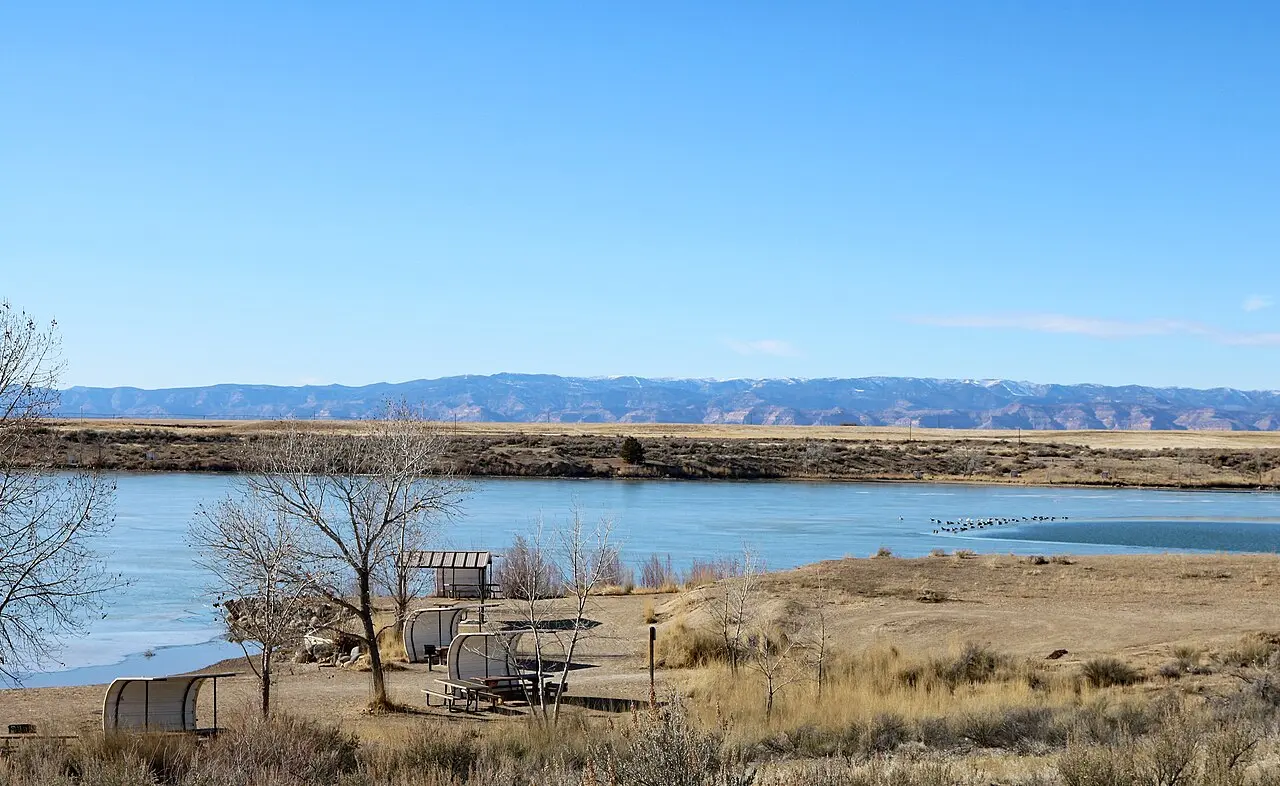
- Highline Lake is open to power boating, jet skiing, water skiing, sailboarding and paddleboarding from March 1 through September 30, weather permitting. The lake is closed annually from October 1 through February 28 to provide a resting location for migratory birds.
- Getting there
- East Entrance Take the Loma exit (Exit 15) from I-70, turning onto Highway 139 north. Travel five miles and turn left on Q Road. At 11 8/10 Road, turn right. Follow 11 8/10 Road north to the Visitor Center.
- Fees
- Daily Vehicle Pass: $10-$15 Individual Daily Pass: $4.
- Access
- Two large projects on the park's west side may bring weekday noise & dust near Sunset Ridge Campground & the Boat Inspection, Decontamination Station. Intermittent road closures, detours may occur with little notice. Learn more.
- Phone
- 970-858-7208
- Managed by
- Colorado Parks and Wildlife.
From October 1 through the last day of February, no motorboat runs on Highline Lake. The water is closed each year to give migrating birds a place to rest, and the waterfowl at times number in the thousands. Watchable Wildlife Kiosks stand on either side of the lake. They are accessible shelters fitted with viewing scopes. More than 200 bird species have been recorded in the park, among them snow geese, white swans, pelicans, blue herons, osprey, bald and golden eagles, sandhill cranes, loons, loggerhead shrikes, Cooper’s hawks, and the vermilion flycatcher, which CPW calls extremely rare in western Colorado. The National Audubon Society has named the park an Important Bird Area. At the north end of the lake are seven waterfowl blinds. Hunting is allowed only Monday through Friday, and only from those blinds.
Two lakes off 11 8/10 Road
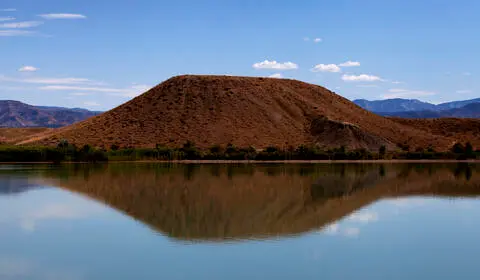
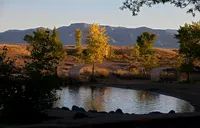
The park covers 738 acres of high desert north of Loma in Mesa County. It is reached by taking Highway 139 north from Interstate 70 and turning onto Q Road and then 11 8/10 Road. The Visitor Center stands at the east entrance. Its store sells firewood, ice, worms, lures, and Powerbait. It also lends life jackets to anyone with identification, and children’s fishing poles and tackle boxes to an adult with a driver’s license. Along the walls are wildlife displays and paintings and carvings of the park’s birds, made and donated by volunteers. Colorado Parks and Wildlife runs the park, which has 56 campsites open year-round and 9.6 miles of trail. The Leave No Trace organization says the park serves nearly 150,000 visitors a year.
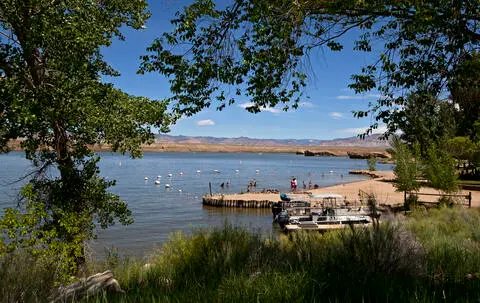
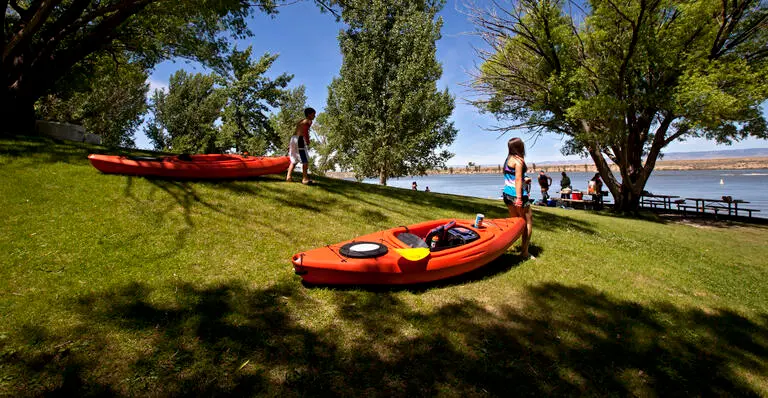
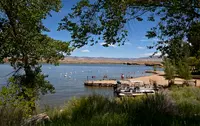
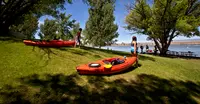
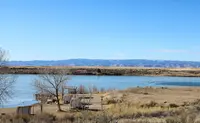
Highline Lake is the larger of the two lakes, at 160 surface acres. It is open to power boats, jet skis, water skiers, sailboards, and paddleboards from March 1 through September 30. On weekends from May through Labor Day it regularly fills to boat capacity, and trailers wait until another boat comes out. The wait can run past four hours. Weekdays and evenings rarely have one. Water skiing has its own rules: every boat travels counter-clockwise, carries an observer, and flies an orange flag. Wednesdays are wakeless, with boats held to about 5 miles an hour, except when July 4 falls on a Wednesday. Paddlers launch from the East Ramp near the Visitor Center and head for the coves and the quieter north end.
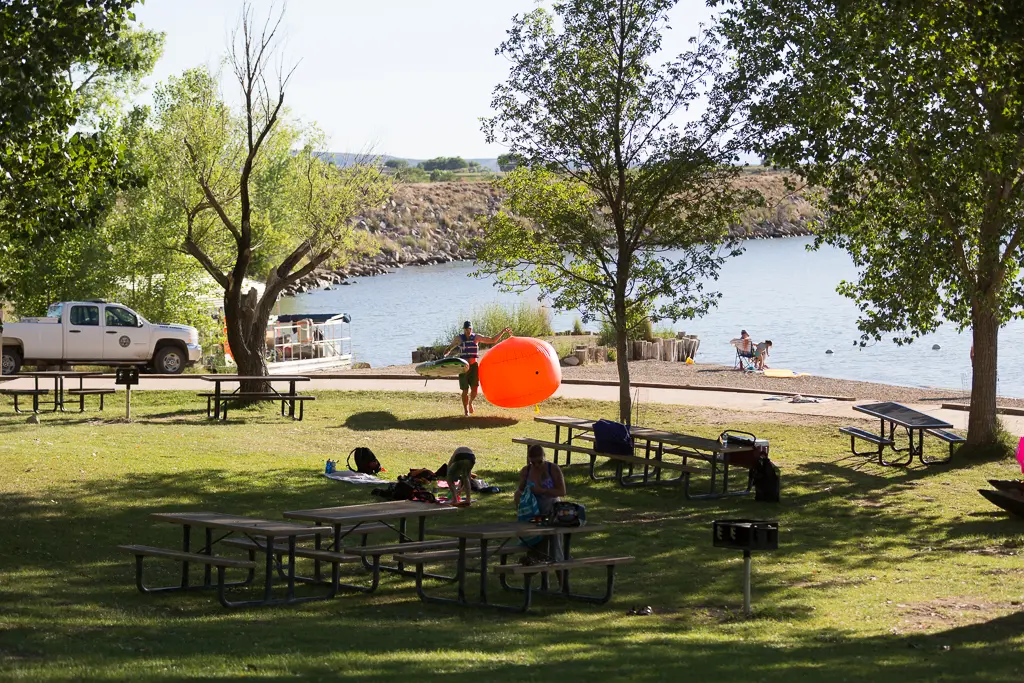
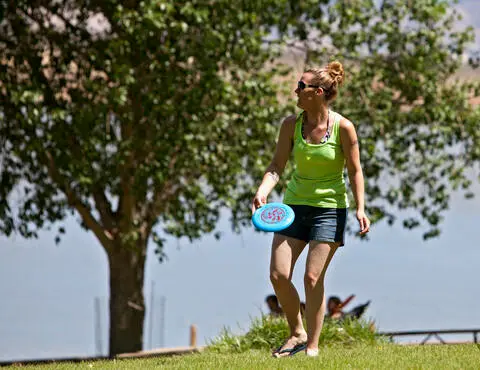
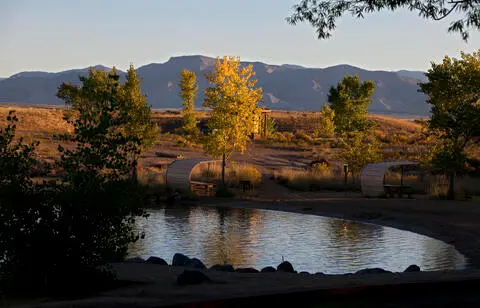
Lakeview Swim Beach is a buoyed area of Highline Lake open from the second weekend in May through the end of September. The water runs from the high 60s to the low 80s. It is the only place in the park where swimming is allowed. The park has 44 family picnic sites with tables and grills. Some sit on grass under mature shade trees. Others are cabanas on sand.
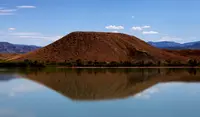
Mack Mesa Lake lies just upslope. It is the smaller and older of the two, open only to paddleboards, kayaks, and small boats with electric motors. No gasoline or diesel engine may be launched there, even with the motor off. It has an accessible fishing pier, is popular with shore anglers, and in cold winters is fished through the ice. Both lakes hold largemouth bass, black crappie, bluegill, channel catfish, and rainbow trout, and both are usually stocked in spring and fall. Largemouth bass are the only fish under special rules: an angler may keep two, and each must be at least 15 inches long.
Sage, cedar, and the Book Cliffs
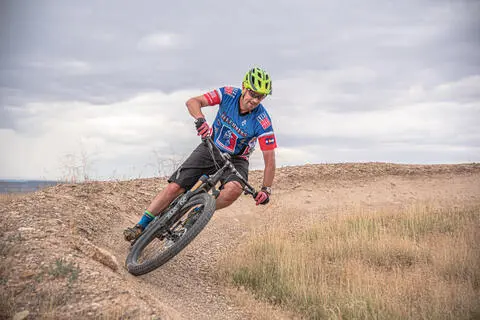
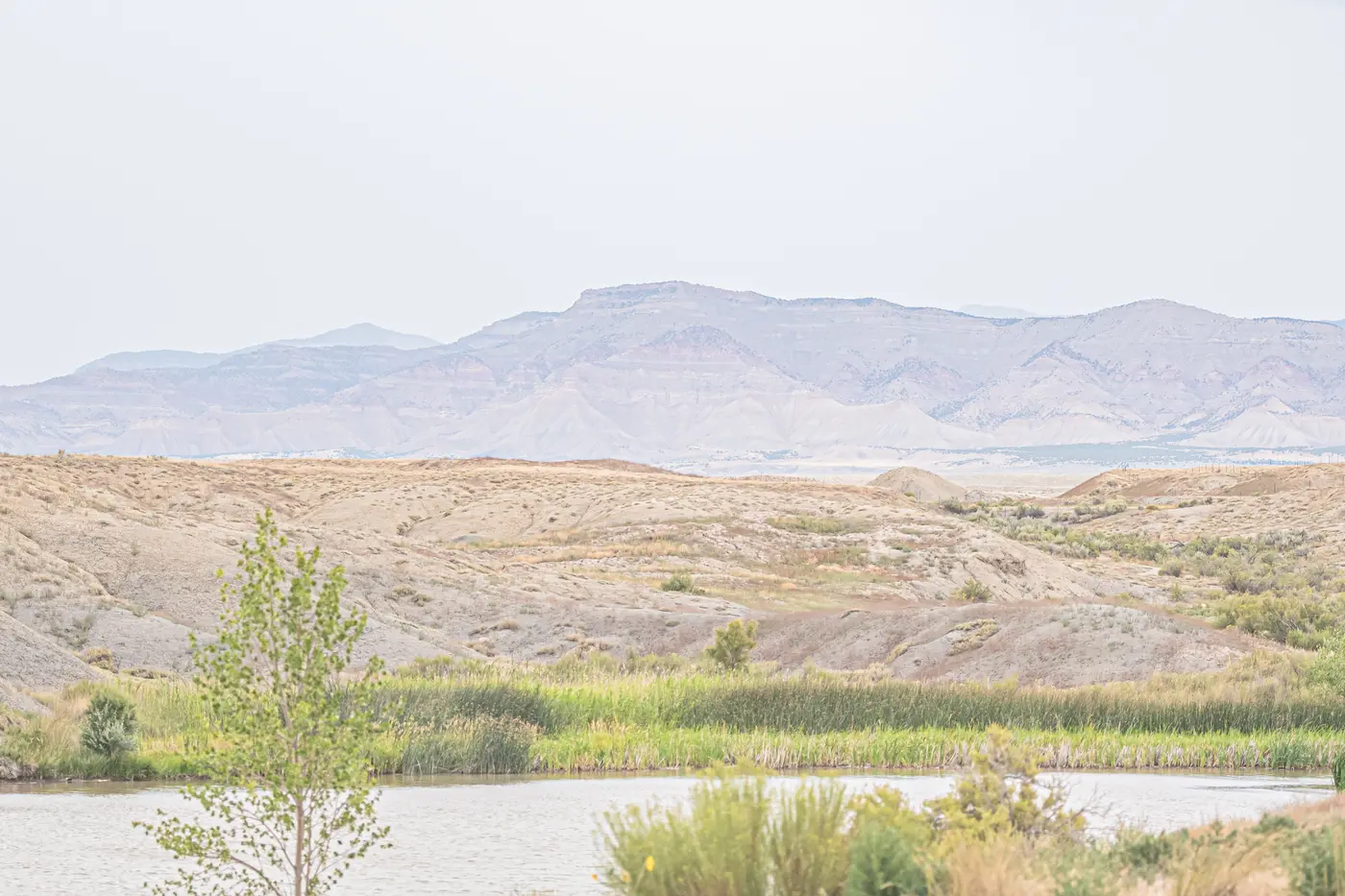
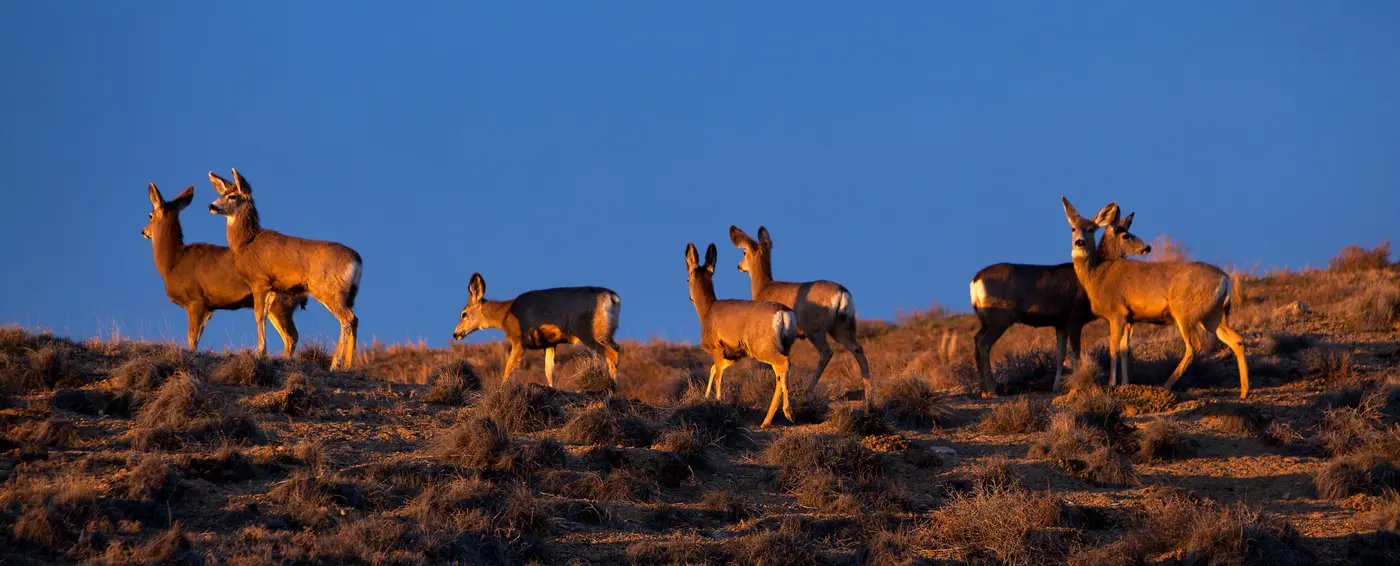
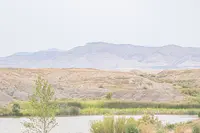
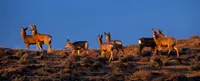
The Highline Lake Trail is the main loop around the water, open to hikers and bikers. CPW lists it at 3.3 miles in one place and 3.5 in another. Shorebirds and mule deer are often seen along it. The Blue Heron Marsh Trail is a 0.6-mile loop through the riparian ground below the dam. It is flat except where it climbs back to the dam crest, and mule deer, raccoons, red foxes, and bobcats are seen there. The Greasewood Flats Loop smells of sage and cedar. The Mack Mesa Loop climbs to one of the highest points in the park. From there the Mack Mesa S Trail runs 0.6 miles of downhill turns, with views of the Colorado National Monument, Grand Mesa, and the Book Cliffs in Colorado and Utah. The East Bluffs Loop is a narrow singletrack with steep sections. Apart from a boat, it is the only way to reach the east-side cabanas and a pebble beach. Most trails are open to horses as well.
The ground between the trails holds mat saltbush, salt-cedar, prickly pear, and cottonwood. Rock squirrels, desert cottontails, prairie dogs, side-blotched and sagebrush lizards, and striped whipsnakes are about by day. Most of the park’s mammals come out only at night. The park says it lacks data on its reptiles and amphibians and asks visitors to log sightings on iNaturalist.
Older remains lie in the park as well. In the early 1900s the Uintah Railway at nearby Mack hauled dinosaur fossils bound for the Smithsonian Institution. Traces of the railway remain inside the park, and its artifacts are to be left where they lie.
The October 2026 calendar lists “Getting Batty,” a talk on Colorado’s bats, for October 10; a Trick or Treat Trail for October 24; and a guided moonlight hike for October 30. Each requires registration.
Water the canal could not use
Both lakes are filled with irrigation water. The Grand Valley Water Users Association diverts the Colorado River into the 55-mile Government Highline Canal to water more than 23,000 acres. Whatever the irrigators do not take spills into the lake. An August 5, 1951 story in The Daily Sentinel of Grand Junction made the case for using it: “Frequently, when there is insufficient demand for the Highline (canal) water, it must be wasted in washes. This is particularly true during and after rains.” The story proposed a small reservoir four miles north and one mile east of Mack, at the northeast edge of Mack Mesa, for warm-water fishing and as a refuge for ducks and other game birds. According to CPW, Grand Valley residents who wanted more water recreation built Mack Mesa Lake in 1952.
That lake drew enough use to start talk of a larger one in the Lower Valley. A February 12, 1966 Sentinel story reported that the Upper Highline Lake Dam had been recommended in the Game, Fish and Parks appropriation to the Colorado General Assembly. The estimated cost was $330,000. The new lake would sit just downstream of Mack Mesa so the two could be used together. It would take canal spill and runoff from an 11-square-mile drainage. Ground was broken May 15, 1966. The plans called for a lake nearly a mile long with 200 surface acres, behind an earth-filled dam 1,480 feet long at the top, 450 feet wide at the base, and 80 feet high. Total cost was projected to exceed $500,000. Planners hoped to have it ready for duck hunting that fall and for warm-water use by spring 1967. The dam stands on a tributary of Mack Wash, and its construction was completed in 1967.
A dam on shale
Water stored behind the dam in May 1967 had to be let out in June. According to a Sentinel story of July 28, 1967, it had seeped through the shale on both abutments. The seepage took away a chunk of road on the west side and cut a cave-like hole beside the right abutment. A $30,000 grouting job to plug the leak also failed. An April 14, 1968 story traced the seepage to sand lenses in the shale that anchored the dam. “As the water goes through the shale it dissolves salt and weakens the abutment,” it said. “If the situation is allowed to continue the entire east abutment of the dam could be pushed out.”
In the spring of 1968 the dam was considered unsafe. The leaks were at 40 to 45 feet, so the lake was held just below that level, and water skiing and fishing went on in the lower water. Repairs needed legislative approval, and then-Sen. Chet Enstrom introduced a bill for a $105,000 supplemental appropriation. In a July 23, 1969 story, state geologist John Rold conceded that the dam site should have been investigated more thoroughly long before the dam was planned and built.
The trouble continued in later decades. A parasite attacked the lake’s trout in 1971. In 1985 the soil layers deep under the west end of the dam settled. In 1989 the state began a long-term monitoring program on the dam. Piezometers, inclinometers, and survey monuments track water pressure and ground movement, and v-notch weirs and toe-drain pipes measure seepage. The State Engineer classifies the structure as a high-hazard dam. In 2014 the lake was lowered so crews could clear the head gate, which lay under 16 feet of sediment. They also hauled trash off the bottom, “motors and anchors all over the place,” as a Sentinel story put it.
The land along the park’s entire western boundary has belonged to the Long family since the early 1940s, when the present owners’ father bought it. The family grazed cattle on it and cut some irrigated hay. In 2021 CPW proposed buying the 174 acres for $775,000 to open public access to the lake from the west. In 2024 the West Entrance was moved to a new road off R Road. In December 2023 the park received the Leave No Trace Gold Standard Site designation, the first state park on Colorado’s Western Slope to earn it. “We owe our success to the dedicated volunteers who worked tirelessly alongside us, including the Friends of Highline Lake, Pomona Elementary, and Orchard Avenue Elementary,” said park ranger Howard Asal.
The mussel and the empty lake
On September 14, 2022, CPW staff found an adult zebra mussel during routine sampling. Highline Lake became the first body of water in Colorado classified as infested. Park staff called the find “sickening.” In March 2023 the state lowered the lake to expose its shorelines and treated it three times with EarthTechQZ, an EPA-registered mollusk-killer. In October 2023 more mussels turned up on buoys. In 2024 all motorized boating was closed for the season, for the first time since the 1960s, while staff applied more of the chemical. The Sentinel’s columnist called the mussels the biggest headache in the lake’s history. CPW finished draining the lake by November 18, 2024, and it sat empty for the first time in more than 60 years. That same year, testing found zebra mussel larvae in the Colorado River upstream, in the reach that feeds the canal. The National Park Service reports that the source of the infestation has not been determined.
Water from the Government Highline Canal began flowing back into the empty basin on March 31, 2025. CPW expected the refill to take 35 days or more. A few days into it, the gauge still read 0 feet, against a full elevation of 65. “It’s great to see water flowing into Highline Lake again,” park manager Alan Martinez said, “and we look forward to welcoming our water recreationists back for the 2025 boating season.” Every boat on a trailer is now inspected before launch and decontaminated with 140-degree water on the way out. Each leaves with a blue receipt showing it was last used on water with a known aquatic nuisance species. CPW samples the lake weekly, and the lake will remain classified as infested until it has five consecutive years with no sign of mussels.
Notable Events
- 1900sIn the early 1900s the Uintah Railway in nearby Mack played a major role transporting dinosaur fossils to the Smithsonian Institution; traces of the railway's history remain in the park and artifacts are to be left in place. cpw.state.co.us
- 1940sThe property bordering the park's entire western boundary has been in the Long family since the early 1940s, when it was purchased by the present owners' father; the family ran cattle and cut limited irrigated hay on it. leg.colorado.gov
- 1951A story of Aug. 5, 1951 explained a proposed Mack Mesa Reservoir four miles north and one mile east of Mack would provide warm water fishing and a refuge for ducks and other game birds, filled by Highline Canal water otherwise wasted. gjsentinel.com
- 1952People in the Grand Valley, seeing the need for more water recreation around the 1950s, built Mack Mesa Lake in 1952. cpw.state.co.us
- 1966Ground-breaking on the Upper Highline Lake Dam took place May 15, 1966; the lake was anticipated ready for duck hunting that fall and warm-water use by spring 1967, nearly a mile long with 200 surface acres behind an earth-filled dam 80 feet high. gjsentinel.com
- 1967Highline Lake State Park was built in 1967 and has been a hub for water activities and wildlife watching in the Grand Valley. cpw.state.co.us
- 1967Water stored in the dam in May 1967 had to be released in June after seeping through the shale on both abutments, giving way a chunk of west-side road and cutting a cave-like hole; a $30,000 grouting project to plug the leak also failed. gjsentinel.com
- 1968The dam was considered unsafe in the spring of 1968; leaks between 40 and 45 feet forced the lake down to just below that level while water skiing and fishing continued. gjsentinel.com
- 1969State geologist John Rold conceded in a July 23, 1969 story that there should have been more geologic investigation of the dam site long before the dam was planned and constructed. gjsentinel.com
- 1971A parasite attacked the lake's trout in 1971. gjsentinel.com
- 1985Continued dam problems in 1985 saw a settling in the soil layers deep under the west end of the dam. gjsentinel.com
- 1989CPW began a long-term monitoring and evaluation program to assess the stability of the dam and to monitor water pressure conditions, seepage flow rates, and ground movement. wje.com
- 2014The lake was lowered to allow maintenance and the removal of years of silt buildup on the head gate, which was buried under 16 feet of sediment. gjsentinel.com
- 2021CPW's Division of Parks and Wildlife asked the Commission to support a fee title acquisition of the Long Family Trusts property adjoining the park, 174 acres for $775,000, to expand public access to the lake from the west side. leg.colorado.gov
- 2022CPW staff found the first adult zebra mussel at Highline Lake on Sept. 14, 2022, during routine invasive species sampling. coloradosun.com
- 2022The discovery of zebra mussels in 2022 was the biggest headache in the lake's history; the lake is being drained to eradicate the infestation and was expected to empty by the year's end. gjsentinel.com
- 2022Zebra mussels were found in Colorado at Highline Lake State Park in September 2022, and the lake is considered infested status by Colorado Parks & Wildlife. nps.gov
- 2023State staff lowered the lake's water level to expose shorelines and treated the lake with EarthTechQZ, an EPA-registered mollusk-killer, three times in March 2023. coloradosun.com
- 2023Highline Lake State Park received Leave No Trace Gold Standard Site designation in December 2023. lnt.org
- 2024The lake sat empty in late 2024 for the first time in over 60 years, after CPW fully drained it as part of the response to the mussel infestation. coloradosun.com
- 2024All motorized boating was closed for the 2024 season, for the first time since the 1960s, while staff applied more EarthTechQZ. coloradosun.com
- 2024The park's West Entrance was moved in 2024 to a new park entrance road reached by turning left onto R Road. cpw.state.co.us
- 2024In 2024 the Colorado River upstream of Highline Lake tested positive for zebra mussels; that section of river feeds into Highline for irrigation purposes, and the source of the infestation has not been determined. nps.gov
- 2025CPW started refilling the lake with spillover from the Government Highline Canal, a process expected to take 35 days or more depending on irrigation use and water supply. coloradosun.com
People
- Alan Martinez, Highline Lake State Park manager.
- Chet Enstrom, then-state senator who introduced in the Colorado legislature a bill asking for a $105,000 supplement appropriation for Highline Lake (1968).
- John Rold, state geologist who conceded there should have been more geologic investigation of the dam site before the dam was planned and constructed (1969).
- John P. Clark, Licensed engineer named with Colorado Parks and Wildlife as the client of the Upper Highline Dam stability and seepage evaluation and mitigation project.
Sources
- cpw.state.co.us/state-parks/highline-lake-state-park
- denvergazette.com/2026/08/09/highline-lake-state-park-a-guide-to-an-oasis-in-the-desert
- coloradosun.com/2025/04/04/highline-lake-colorado-refill-zebra-mussel
- wje.com/projects/detail/upper-highline-dam
- lnt.org/gold-standard-sites/highline-lake-state-park
- nps.gov/cure/learn/nature/mussel_facts.htm
- leg.colorado.gov/sites/default/files/images/highline_lake_sp-long_family_trust.pdf
- gjsentinel.com/news/western_colorado/past-tense-history-of-highline-lake/article_60411f1a-e0ae-11ee-99f5-e3d6a80c1640.html
- kjct8.com/video/2024/01/30/highline-state-park-makes-history