Helldorado Days
Tombstone, Cochise County, Arizona. Celebration.
Details

- Where
- 311 E. Allen Street, Tombstone, AZ 85638. Directions
- When
- Every third Friday, Saturday and Sunday in October.
- Getting there
- Schieffelin Park for vendors and bounce houses; Art Gallery Parking Lot for the food court; Allen Street between 4th and 5th for reenactments, information tents, and the Vigilante Hanging Tree.
- Fees
- Free.
- Hours
- October 16 at 10:00 am to October 18 at 4:00 pm.
- Access
- City special-use permit window October 15, 2026 at 5 PM through October 18, 2026 at 5 PM covers the weekend.
- Phone
- (520) 457-3291
- Website
- tombstonehelldorado.com
- Managed by
- Helldorado, Inc.
- Established
- 1929.
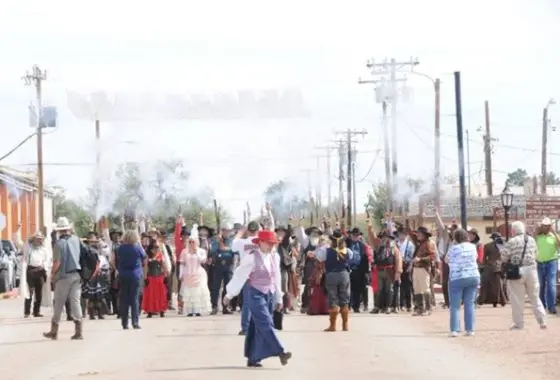
On Allen Street between Fourth and Fifth, Helldorado, Inc. sets up its information tents, its gunfight reenactment shows, and a display called the Vigilante Hanging Tree. The main tent on that block hands out the Helldorado Headstone, the event’s official publication. The celebration falls on the third Friday, Saturday, and Sunday of October. The 2026 edition, which the organizers’ Facebook page bills as the 97th Annual Helldorado Days, runs October 16 through 18. Admission is free.
Three days on Allen Street
The program spreads from Allen Street onto city ground. Vendor booths and bounce houses fill Schieffelin Park, and a food court serves from the Art Gallery parking lot. For 2026 the organizers also invited the Discover Tombstone Market. Street entertainment runs on Allen Street all three days. The 2025 welcome from the board of Helldorado, Inc., printed in The Tombstone News, said “there could be historical depictions or some Western humor, maybe dancers and saloon girls.” Fashion shows are also on the schedule. A shirt is printed each year. The 2026 design is by Jon LeVan, on sale Friday morning while supplies last.
The weekend opens Friday evening with the Helldorado Reunion. The listings disagree on where it is held. The event website and Discover Tombstone place it at the Rose Tree Inn. The organizers’ Facebook page gives Friday, October 16, 2026, at 6 p.m. at the Rose Tree Museum. According to the 2025 welcome, this is where visitors meet the Grand Marshal, “have a crudité or two and spend some time with our Old Timers.”
Sunday belongs to the parade, which steps off at 11 a.m. Each entry passes a judge’s reviewing stand while a few sentences about it are read aloud. The 2026 theme is Celebrating America’s 250th Birthday. The winner of the rifle raffle is announced around the parade. The 2025 welcome also recalled the writer’s first visits to Tombstone, decades earlier, as a tourist with a sister, and the rhyme the two used to say: “the sun is riz, the sun is set, and here we are in Tombstone, yet!”
A borrowed word and a whisker pledge
The parade came first. In 1929 Tombstone marked the 50th anniversary of its founding. Its mines had flooded in 1887. According to The Tombstone Epitaph’s own history, two men named William Kelly, father and son, owned the paper from 1926 to 1930. The younger Kelly was among the first to sense that the town’s future might lie in its history and setting rather than its dormant mines. Larry Noyes, writing in The Tombstone News, quotes William H. Kelly: “My wife and I wanted to do something as an excuse for a big 50th anniversary edition of the Epitaph.” He added: “A simple parade on the anniversary of the O K Corral gunfight sounded like a good idea.” The gunfight had been fought in October 1881. The cover of the first Helldorado program dates the show October 24–27, 1929.
The accounts of who paid for it differ. Kelly wrote that the town council gave his idea a cool reception, and that it took convincing and much of his own money. Noyes reports that he would borrow more than $5,000. “I stood, at one time, to lose not only the Epitaph, but my shirt,” Kelly wrote. The Epitaph’s history says the paper and the city underwrote the cost together. A collection of papers from the first Helldorado at the University of Arizona names another man, Walter H. Cole, as editor of the Epitaph and manager of the Helldorado.
The name came from a book. In Noyes’s telling, Colonel William Breckenridge took his title from an idea of his friend William McLeod Raines, a writer of western stories. Raines had borrowed the word from an 1881 Epitaph article in which a Tombstonian described his newly adopted town. Breckenridge gave Kelly permission to use it. The Epitaph spells the author’s name Billy Breakenridge and calls him a former Cochise County deputy.
On July 29, 1929, 44 townsmen joined the Tombstone Helldorados, the first organizers of the show, and signed a pledge: “We hereby agree to grow some discription of a moustache, beard, or sideburns or a combination of all three to help advertise this show.” Any man who shaved before the show ended owed a fine of $10.00.
Candles in beer bottles
The town expected more than 20,000 people, each to be marked with a rubber stamp and charged 50 cents. The bill promised:
- a 30-member Yuma Indian Band mixing Sousa music and Sioux war bonnets
- the Bell Thazer troupe doing acrobatics on a tower 100 feet off the ground
- the Flying Viera Brothers on a trapeze with no net
- Annie Duncan, “The Tombstone Nightengale,” in two shows daily at the Bird Cage Theater
- wrestling matches, a trick roper, an expert shot, a fiddler, and a rock-drilling contest
The Crystal Palace had served only as a warehouse since the boom days. It was cleaned out and restored as near its old look as possible, down to a working roulette wheel and slot machines. A daily parade was planned to start at Boothill Cemetery, so that the dead seemed to return to town each morning on the old Modoc stagecoach, to be met by masked men.
John P. Clum, founder of the Epitaph, came at 79 and carried a fountain pen in the parade. In the Epitaph’s account, he said he was “armed only with a fountain pen – sometimes the mightiest of weapons.” Breckenridge served as honorary town sheriff for the event. Old timers gathered at the granite monument over Ed Schieffelin’s burial site, joined by Schieffelin’s sister and two nieces. There Breckenridge gave a short eulogy and laid a wreath. Judge Albert Sames closed the ceremony by recognizing those present who had known Schieffelin. Governor John C. Philips came, as did T.E. Walker, an original organizer of the Tombstone district, and Mayor Krebs. A chartered train brought old timers from California.
An American Pathé newsreel from that year shows covered wagons moving through a crowd, one with “Helldorado Bound” on its canvas. Two mules and a cow pull a wagon in harness, and older women walk in costume. Riders overtake a stagecoach and fire pistols in the air. Outside the Crystal Palace Saloon a man is strung up by his neck before a large crowd.
Rain fell heavily on the first day. The municipal light plant failed, and Tombstonians lit the town with tallow candles stuck in the necks of old beer bottles. Over four days only five arrests were made, all for breaking the federal ban on alcohol. Clum later wrote that Tombstone could be held up “as a model bone-dry municipality throughout the period of its four-day Helldorado High Jinks.” First estimates put attendance at about 6,000, though others counted four times that many. Kelly is said to have recalled: “We came out, luckily in the black, but, as I remember now, it was only a few hundred dollars.”
Fifteen years dark
The show ran again in 1930 and 1931. The Epitaph’s history notes that Helldorado drew attention to Tombstone’s place in the Old West but did not stop the town’s decline, as business and political life shifted toward Bisbee. According to Noyes, the Depression and then the Second World War followed, and the celebration lay dormant for 15 years. In 1946 a group of citizens revived it, and it has been held every year since. Merchants from Tombstone and as far away as Tucson bought advertising, among them the Lucky Cuss Restaurant, the Silver Queen Café, Western Cleaners of Tombstone, and Jim’s Richfield Station. The official program of 1970 called Helldorado “a show OF the people and BY the people of Tombstone FOR the people of the world who love the Old West.”
Notable Events
- 1929An American Pathé newsreel shows covered wagons, a Helldorado Bound wagon, costumed women, and a stagecoach in the parade. azmemory.azlibrary.gov
- 1929The cover of the first Helldorado program dates the event October 24-27, 1929. lib.arizona.edu
- 1929Forty-four townsmen joined the Tombstone Helldorados as the first organizers of Helldorado. thetombstonenews.com
- 1930The show continued in 1930 and 1931, raising hopes for its continued success. thetombstonenews.com
- 1946After lying dormant for 15 years, Helldorado was revived by a group of citizens and became annual thereafter. thetombstonenews.com
- 1970The official program described Helldorado as a show of, by, and for people who love the Old West. thetombstonenews.com
People
- Anton Mazzanovich, Correspondent whose letters are among the First Helldorado papers (1929).
- Walter H. Cole, Editor of the Tombstone Epitaph and manager of the Helldorado (1929).
- Colonel William Breckenridge, Author whose book supplied the Helldorado title and who permitted its use (1929).
- John P. Clum, Founder of the Tombstone Epitaph and participant in the first Helldorado parade (1929).
- William H. Kelly, Tombstone Epitaph editor who promoted and financed the first Helldorado (1929).
- William McLeod Raines, Western-story author whose idea led to the Helldorado name.
- Billy Breakenridge, Former Cochise County deputy whose book's title supplied the event's name.
- William Kelly, One of two Epitaph owners named William Kelly, father and son (1926-1930); the younger Kelly saw Tombstone's future in its history and setting (1926-1930).
Sources
- tombstonehelldorado.com
- tombstonehelldorado.com/contact-helldorado
- tombstonehelldorado.com/wp-content/uploads/2026/09/helldorado-parade-entry.pdf
- cityoftombstoneaz.gov/wp-content/uploads/2026/08/EC-Agenda-20260804-signed.pdf
- cityoftombstoneaz.gov
- tombstoneepitaph.com/pages/museum/history.shtml
- lib.arizona.edu/special-collections/collections/papers-relating-first-helldorado-1929-celebrating-50th-anniversary
- tombstonechamber.com/directory/tombstone-helldorado-inc
- thetombstonenews.com/helldorado-then-and-now-a-look-at-its-history-p1374-1.htm
- azmemory.azlibrary.gov/nodes/view/257235