
Hayspur Fish Hatchery
Bellevue, Blaine County, Idaho. Fish hatchery.
Details

- Where
- 71 Hayspur Lane, Bellevue, ID 83313. Directions
- When
- Hatchery is open to walk in visitors from 8 am-4pm seven days a week to look at the fish in designated areas.
- Getting there
- Travel north on State Highway 75 from Twin Falls to U.S. Highway 20, then east on U.S. Highway 20 for about 7 miles, then north into the hatchery entrance and three-fourths of a mile to the hatchery.
- Fees
- There is no charge to visit the hatchery.
- Access
- On-site public campground, Gavers Lagoon Family Fishing Water stocked May through September; free to visit.
- Walk-in or reserve
- Large group guided tours are available during normal business hours.
- Phone
- (208) 788-2847
- Website
- idfg.idaho.gov
- Managed by
- Idaho Fish and Game.
- Established
- Hayspur Hatchery was the first Idaho hatchery and was built in 1907.
The hatchery road turns north off U.S. Highway 20 and runs three-fourths of a mile to Loving Creek. There fifteen covered circular ponds, each 24 feet across, stand on the grounds. Idaho Fish and Game’s own writers have likened them to grain silos and to metal yurts with pitched roofs. Inside each one a single lightbulb hangs over about 500 female and 250 male rainbow trout. Walk-in visitors may look at the fish in designated areas, and there is no charge.
Hayspur lies in the Wood River Valley between Silver Creek and the Big Wood River, about 30 miles south of Sun Valley by the agency’s reckoning. Its 1980–81 annual report fixed the spot more closely: Picabo five miles southeast on Highway 20, Gannett about two and a half miles north, Bellevue 16 miles north. The station draws its water from a covered spring yielding 5.5 cubic feet per second and from three pumped artesian wells giving 2.5 cubic feet per second at 52 degrees. Both supplies are rated Specific Pathogen Free. Loving Creek is fed by springs near the edge of the valley’s confining beds, where ground water rises out of the aquifers beneath the valley floor. A 1977 U.S. Geological Survey bulletin found that most of Silver Creek’s flow rises from springs of this kind.
Gavers Lagoon and the trophy water
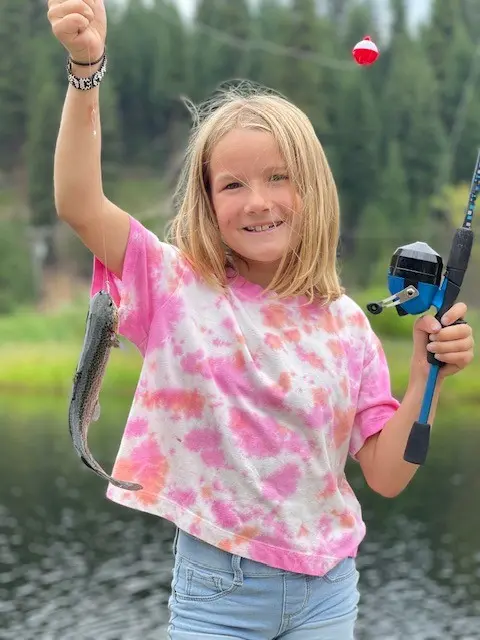
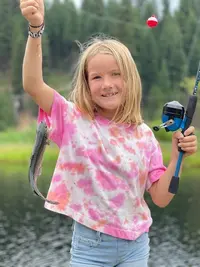
Hatchery staff keep a public campground beside the station and a family fishing water called Gavers Lagoon, stocked with rainbow trout regularly from May through September. The agency recommends it for children and for physically challenged anglers. The limit is six fish, and there are no gear restrictions. Hayspur also maintains a trophy stream fishery, and many visitors camp here and fish Butte Creek, Loving Creek, and Silver Creek, which lies across the highway. Large groups may arrange a guided tour during business hours.
Six hours of light, then eighteen
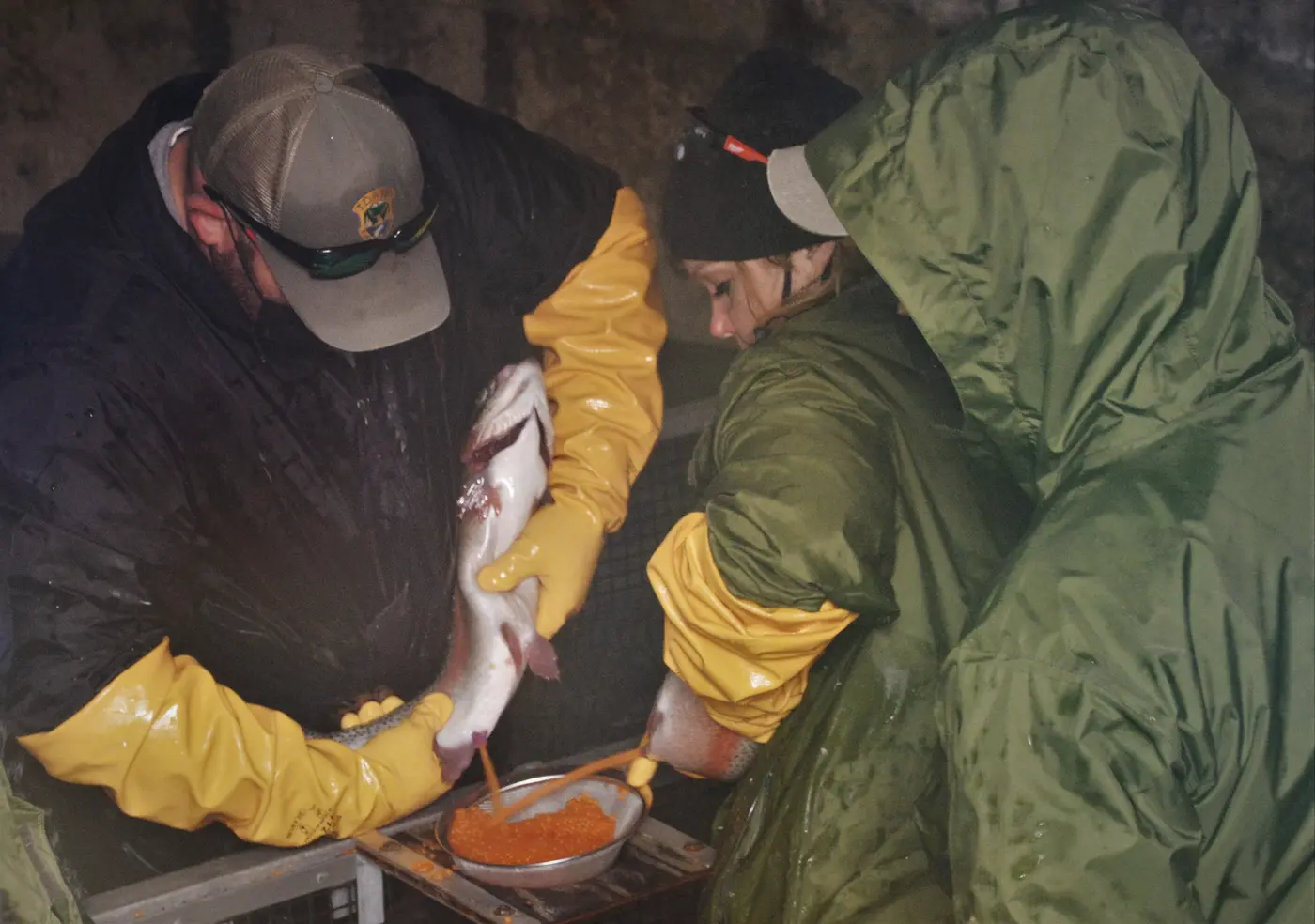
Wild rainbow trout spawn once a year, in spring, when the days lengthen. At Hayspur, biologists set the bulb in each pond to burn anywhere from 6 to 18 hours a day, and the fish spawn on the hatchery’s schedule. Each pond runs a six-month cycle, so one comes ripe while the others wait. “At Hayspur, we are able to get two egg takes per year thanks to strategic light manipulation,” said Tom Lindenmuth, the fish hatchery manager, in a 2022 agency article. His crew typically spawns batches twice a week, and Lindenmuth said Hayspur “can spawn trout and have fertilized eggs out the door in 18 days.” Eggs come from adults aged two, three, and four, and several brood years are kept on the station at once.
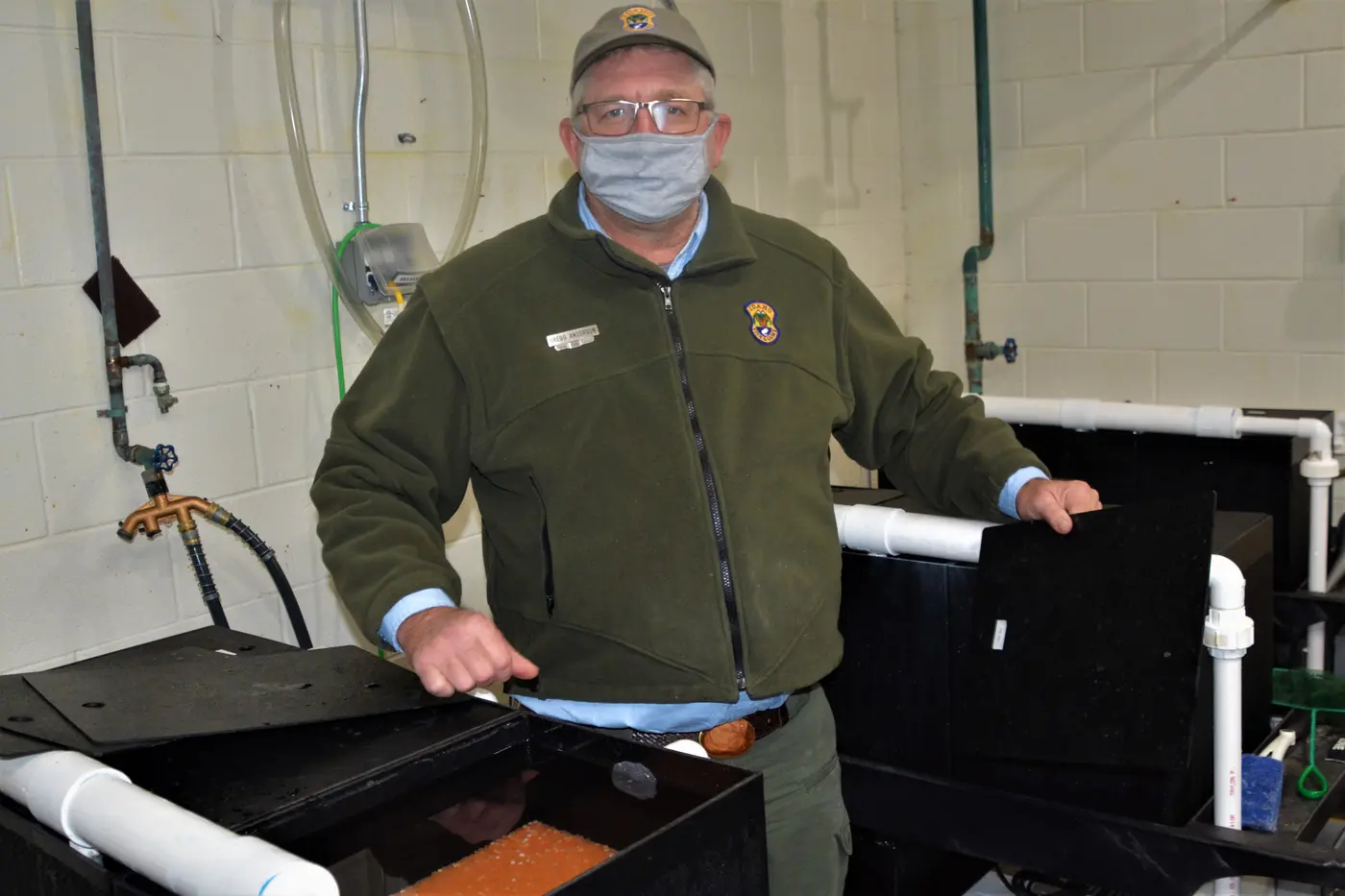
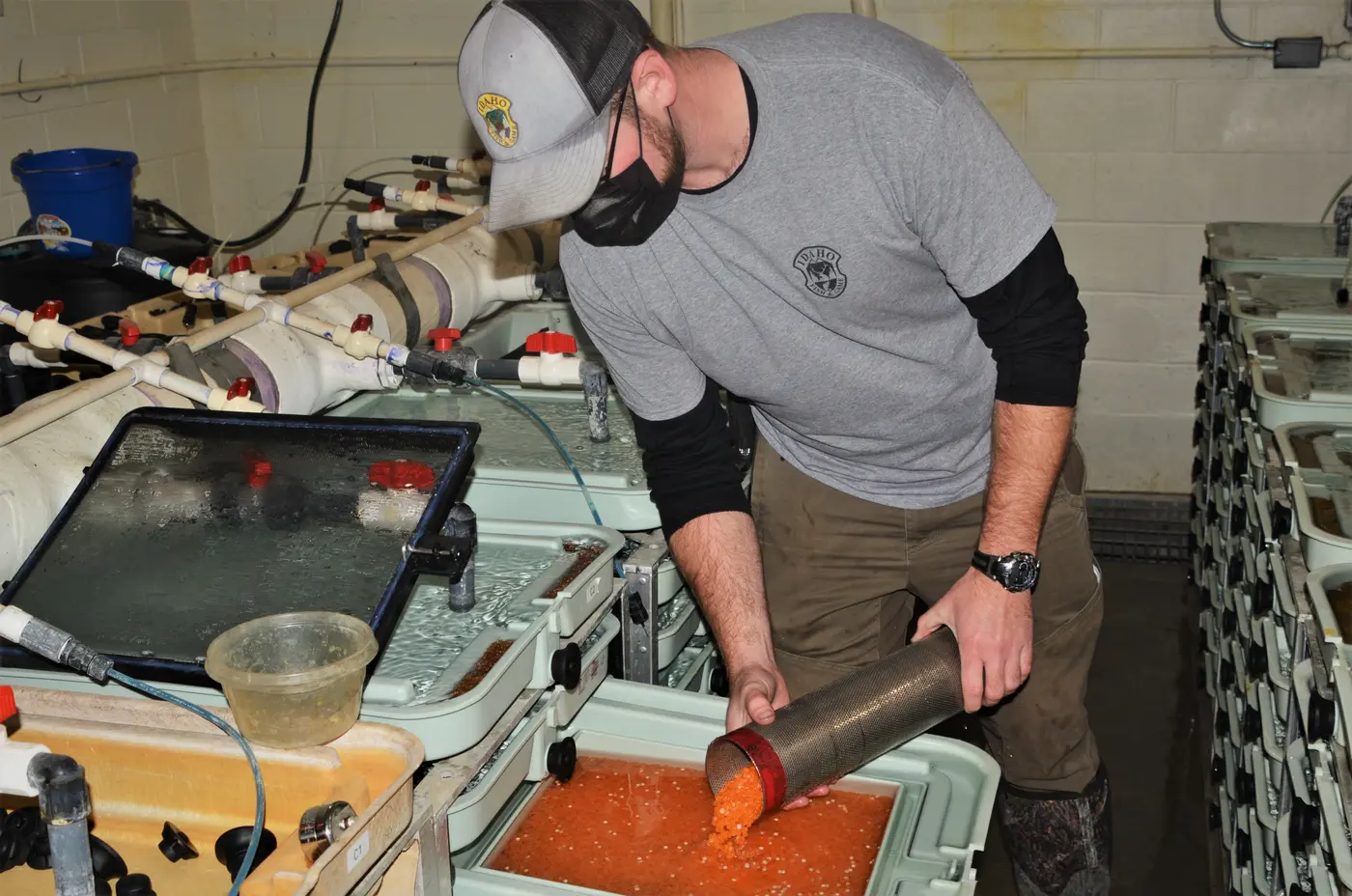
The fertilized eggs go to the incubation building, which holds 18 vertical eight-tray incubator stacks and 10 recirculating incubators. Biologists then seal them in a pressurized canister at 9,500 pounds per square inch for exactly five minutes. The pressure leaves the fish sterile, so stocked trout cannot interbreed with wild ones. “We’ve found that at a certain point after fertilization, and at a certain pressure, we see a 99 percent sterilization success rate,” said Gregg Anderson, who has worked at Hayspur since 2015. The eggs are held until an eye spot shows, then counted and shipped to other state hatcheries to be raised as fingerlings or catchables.
The sources give different totals. The agency’s visit page says Hayspur ships about 5 million eyed eggs a year. The 2022 agency article puts production at 6 to 8 million rainbow trout eggs a year and calls the hatchery the source of over 90 percent of the hatchery-produced rainbow trout eggs supplied in Idaho. The Idaho Mountain Express, in 2021, gave 6 to 7 million. Anderson said demand peaks from March through June, “when the temperatures are still chilly and the ice starts to melt off,” and jumps again from September through late November.
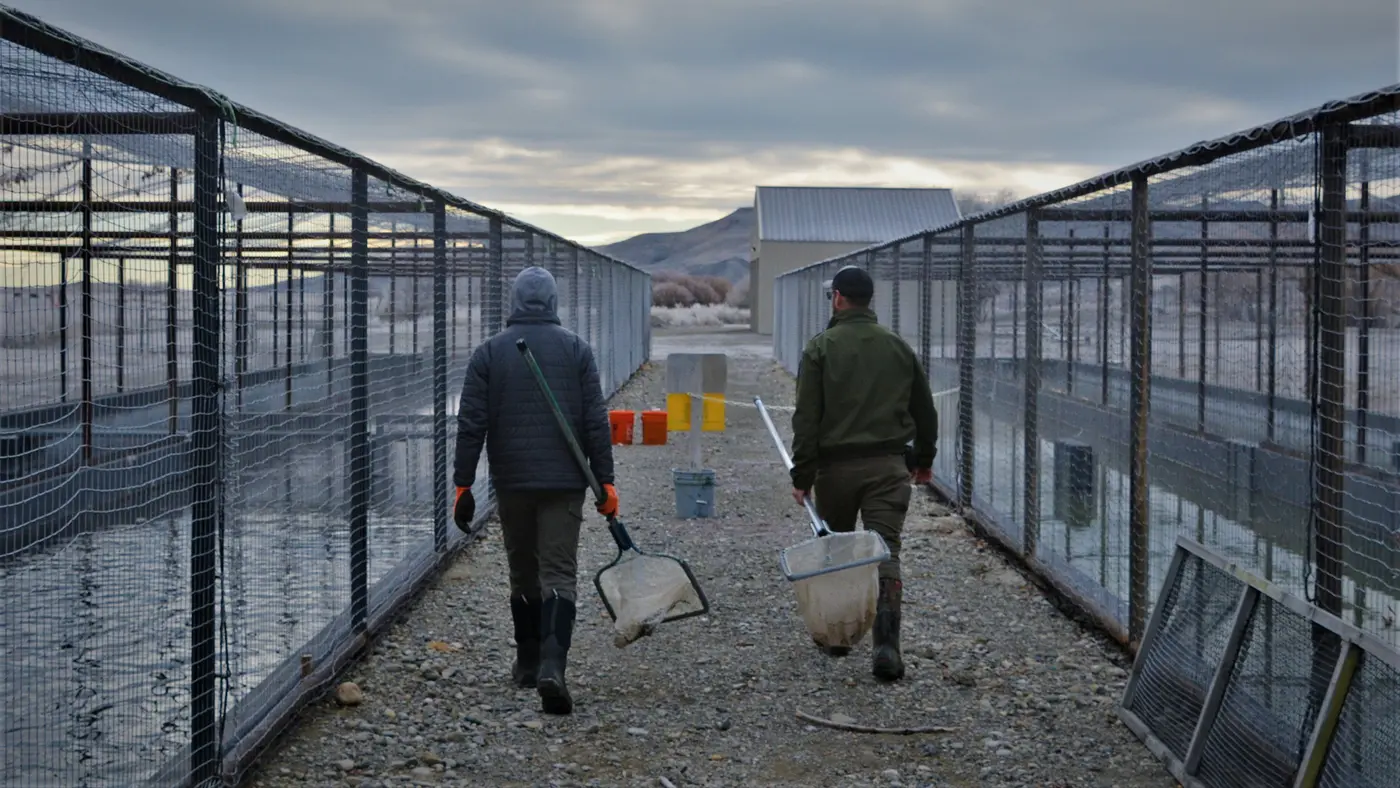
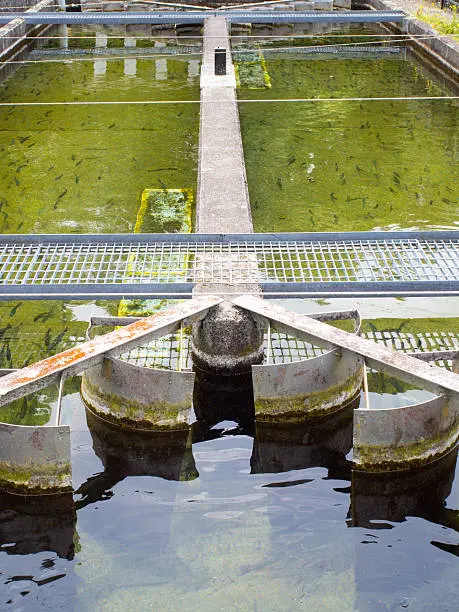
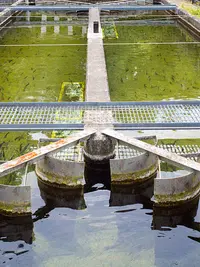
Some fish stay on to grow. The hatchery building holds 20 early rearing vats, and the agency counts four small raceways and four large production raceways; the Mountain Express, describing the grounds in 2021, counted 10. The raceways hold rainbow and brook trout. They are covered with steel wire against herons, pelicans, and mink, and if a feral cat gets into one, every fish in that channel must be culled. In summer, catchable rainbows 10 to 12 inches long go out to area waters, among them the Big Wood River and other fisheries around Ketchum and the Sawtooths.
Super-males in the steel silos
Several of the enclosed silos hold brook trout, sorted by age into first-years, second-years, third-years, and fourth-years. Anderson, Fish and Game’s hatchery manager for the Magic Valley region, told the Mountain Express that brook trout were brought West in the early 1900s and have since taken over high mountain lakes in central and eastern Idaho, crowding out cutthroat and bull trout. “They are an introduced, prolific species from the Eastern Seaboard that did better than they should have,” he said. In 2013 the department set up its YY Male Brook Trout Research Program, which aims to collapse those populations by skewing the ratio of males to females. Hayspur technicians began rearing the fish in 2015.
The method takes two generations. Young brook trout in one silo receive low doses of estradiol, a female sex hormone, which leaves the females unchanged but causes the males to produce eggs. When those males are bred with ordinary XY males, about a quarter of the offspring are YY “super-males,” which look like any other male and sire only sons. At the hatchery, milt and eggs are collected on Tuesdays and the eggs are fertilized in large plastic bags.
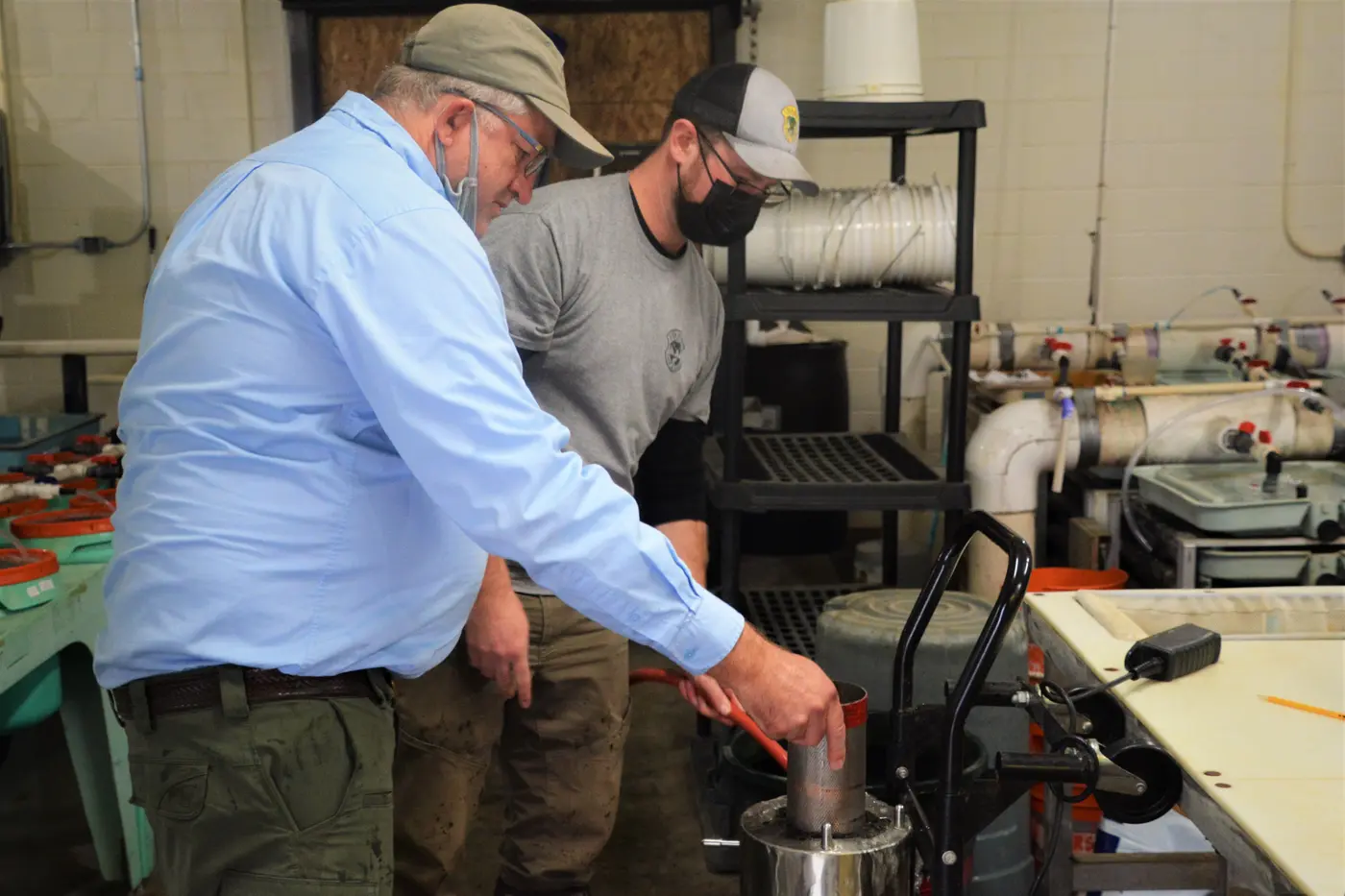
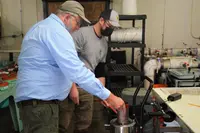
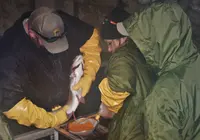
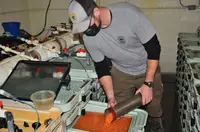
On Tuesday, Oct. 19, 2021, assistant manager Jared Riemenschneider scooped two-year-old super-males out of one silo into a plastic bin. Technicians checked them for vibrant coloration and other signs of fertility, and tossed back the fish that would not be bred. Paula Fanta, a fishery technician, drew ovarian fluid from brook trout eggs with an eyedropper. Batches that showed bacteria were culled, and clean ones went into a cooler to await fertilization. Ordinary XY males hatched at Hayspur are culled. The YY fish are kept as broodstock or flown by helicopter, as 3-inch fingerlings and 10-inch fish, to high mountain lakes from near Cape Horn Mountain north of Stanley to Spencer. By age four the broodstock weigh up to two pounds and are culled for lack of room. “This is a first-in-the-world program,” Anderson said.
Wooden raceways in the creek bed
The agency and Blaine County date the hatchery to 1907. Blaine County calls it the first hatchery operated by Idaho’s Fish and Game Commission. The 1980–81 annual report calls it the oldest in the state but says it “was started in 1906.” It began as wooden raceways built directly into the bed of Loving Creek. Egg collection from broodstock dates to 1910. Between 1915 and 1920, by the county’s account, a man named James McDonald paid for fish eggs at Hayspur and helped carry fingerlings to the mountain lakes nearby. The agency places full hatchery work and stocking in the early 1920s, and the Mountain Express dates the start of trout rearing to the same years.
A year on Loving Creek, 1980–81
The annual report for October 1, 1980, through September 30, 1981, was written by Leland Batchelder, Fish Hatchery Superintendent II, who appears on the staff roll as Bud. Jack Siple was superintendent under him and Chip Corsi was fish culturist, and both lived on the grounds. That year Siple’s residence got a new rug and Corsi’s got an electric furnace in place of a worn-out oil one. In another house the crew removed “a beautiful inefficient fireplace,” built a lava rock wall and floor, and put in a wood stove.
The station then had six large raceways, each 12 by 400 feet, and a lagoon 500 feet long. The brood stock lived in a lagoon of about one acre and had been trained to run into one of the small raceways when they were ready to spawn. The crew took 3,760,252 eggs in the fall of 1980. For five or six years they had set a fist-size rock in the bottom of each incubator tray to rid it of “that deadly bubble,” and the report says it “worked wonders.” On the 1st of October 1981 some 208,000 eggs arrived from the Hot Creek station in California. They were already hatching and were small, and the crew was reluctant to keep them. After culling about 50,000, the rest were doing well, and some might be saved for future brood stock.
The hatchery needed about 21 cubic feet per second, the report says, “but get by on a lot less when we need it most.” Low water brought the usual trouble with nitrogen gas, and irrigation demand for creek water forced some fingerlings out early. About 5,000 visitors came that year, among them scouts, schoolchildren, and a class from CSI. The crew also helped spawn salmon at the Sawtooth Hatchery trap, worked sage grouse and deer check stations, and made a few arrests. In their spare time they fought 200 acres of thistles, spraying by hand and cutting the rest at ground level. On December 18 they hauled 451 brood stock to Magic Reservoir, “mostly nice males, up to about 12 pounds.”
Notable Events
- 1906The Idaho Fish and Game annual report calls the Hayspur Hatchery the oldest in the state and says it was started in that year, a year earlier than the date the agency gives on its visit page. idahodocs.contentdm.oclc.org
- 1907Hayspur Fish Hatchery was constructed on Loving Creek as the first hatchery operated by Idaho's Fish & Game Commission. blainecountyid.gov
- 1910Egg collection from broodstock dates to 1910. idfg.idaho.gov
- 1915James McDonald provided money for fish eggs at Hayspur Hatchery and helped transport fingerlings to local mountain lakes. blainecountyid.gov
- 1920sThe Mountain Express states the hatchery south of Bellevue was established in 1907 and began rearing trout in the early 1920s. mtexpress.com
- 1981Eggs arrived from the Hot Creek California station on the 1st of that month; they were already hatching when received and were small, so the hatchery was reluctant to keep them. idahodocs.contentdm.oclc.org
- 2013The Idaho Department of Fish and Game established its YY Male Brook Trout Research Program in that year to collapse invasive brook trout in alpine lakes in a more sustainable, less invasive manner. mtexpress.com
- 2015Hayspur Hatchery technicians first began rearing YY brook trout in that year, in a programme the agency's manager calls first in the world. mtexpress.com
People
- James McDonald, Provided money for fish eggs at Hayspur Hatchery and helped transport fingerlings to local mountain lakes (1915-1920).
- Chip Corsi, Fish Culturist on the hatchery staff (1980-81).
- Jack Siple, Fish Hatchery Superintendent I on the hatchery staff (1980-81).
- Leland Batchelder, Fish Hatchery Superintendent II who wrote the hatchery's annual report (1980-1981).
- Gregg Anderson, Idaho Fish and Game Hatchery Manager for the Magic Valley region, integral to developing the state's specialized spawning process (since 2015).
- Tom Lindenmuth, Fish Hatchery Manager and member of the Hayspur Hatchery team (since 2015).
- Jared Riemenschneider, assistant manager of the hatchery, shown handling two-year-old super-male brook trout in an enclosed silo.
- Paula Fanta, Hayspur Hatchery fishery technician.
Sources
- idahodocs.contentdm.oclc.org/digital/api/collection/p16293coll7/id/3224/download
- mtexpress.com/news/environment/fish-and-game-looks-to-improve-alpine-fisheries-with-super-male-brook-trout/article_9fd77236-3c24-11ec-a78b-e3609db4ddb3.html
- idwr.idaho.gov/wp-content/uploads/sites/2/publications/wib45-silver-creek-area.pdf
- idfg.idaho.gov/visit/hatchery/hayspur
- idfg.idaho.gov/press/hatch-catch-hayspur-hatchery-near-picabo-idahos-rainbow-trout-capital
- blainecountyid.gov/DocumentCenter/View/13874/Chp-0-Introduction
- idfg.idaho.gov/about/history