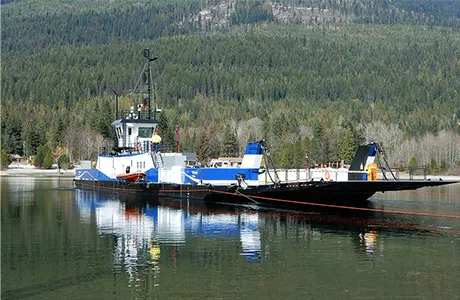

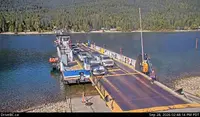

Harrop Cable Ferry
Harrop, British Columbia. Cable ferry in British Columbia, Canada.
Details
- Where
- Harrop, BC. No street address stated. Directions
- When
- 24 hours a day, "on demand".
- Getting there
- On Highway 3A, 24.5 kilometres northeast of Nelson and 8 kilometres west of Balfour.
- Fees
- Free.
- Access
- For safety reasons, ferry service may be cancelled due to weather conditions.
- Phone
- Office 250-229-5650
- Website
- www2.gov.bc.ca
- Managed by
- Western Pacific Marine.
- Established
- 1925.
- Coordinates
- 49.60917, -117.05194.
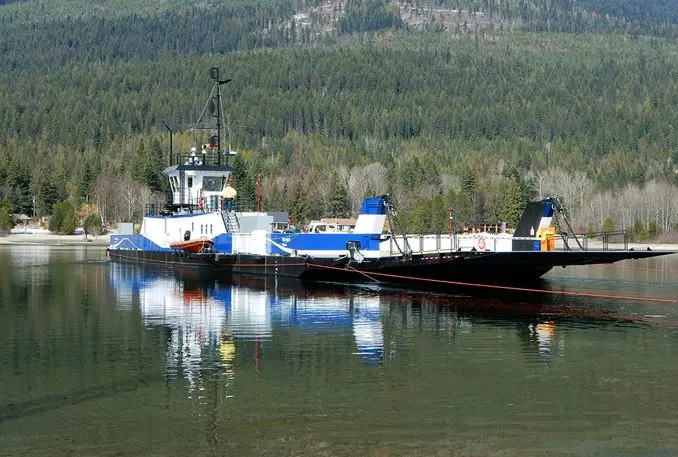
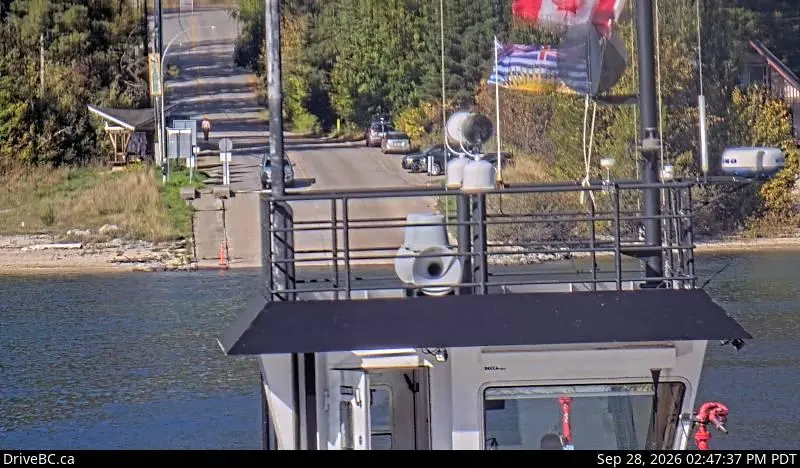
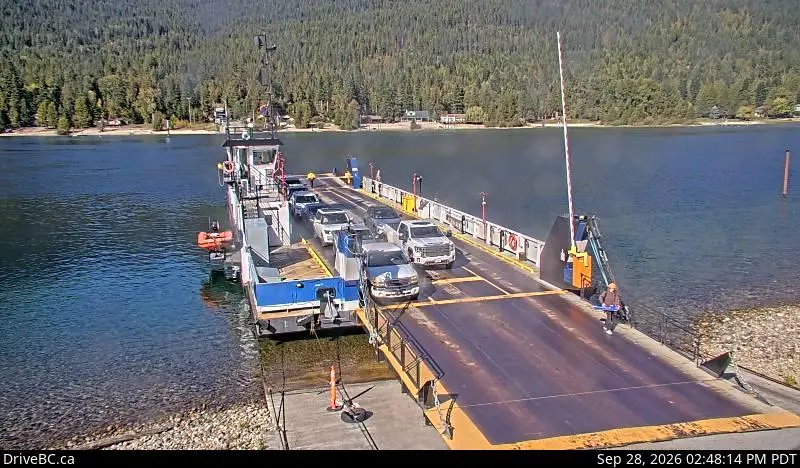
A side road drops from Highway 3A to the north shore of the West Arm of Kootenay Lake, where a steel ferry lies against its ramp with a cable running from it into the water. The far landing at Harrop is 360 metres off by the ferry committee’s measure, and the crossing takes about five minutes. There is no fare and no timetable. The MV Harrop II runs on demand, 24 hours a day, and leaves when traffic arrives. Western Pacific Marine operates it under contract to the provincial Ministry of Transportation. Bad weather can cancel a crossing.
The water here is Harrop Narrows, a name BC Geographical Names adopted on 20 August 1979. The province’s ferry page calls the same water the Kootenay River. Sources differ on the distances. Wikipedia puts the crossing about 27 kilometres northeast of Nelson and 7 west of Balfour. The province gives 24.5 and 8.
Foot passengers and cyclists wait in signed walk-on areas, and bicycles are walked on and off. Horses are led aboard, with a warning that the deck may be slippery. Smoking is not allowed. The operator cautions that the angle between ferry ramp and shore ramp can trouble low-slung cars, fifth wheels, motor homes and long trailers.
The Harrop II was launched in 2019. It was the third of four cable ferries that Waterbridge Steel built with Capilano Maritime Design for the province. A John Deere 4045 diesel of 110 kilowatts drives a hydraulic motor, which turns a dual bullwheel traction winch that hauls the boat along its cable. When the ferry sits at the dock in off-peak hours, batteries supply its power, which keeps the terminal quieter. The boat carries 24 vehicles. Its passenger limit is 48 on the province’s page and 98 in Wikipedia and the committee’s history. In 2018 the vessel before it carried about 290,000 vehicles and 419,000 passengers.
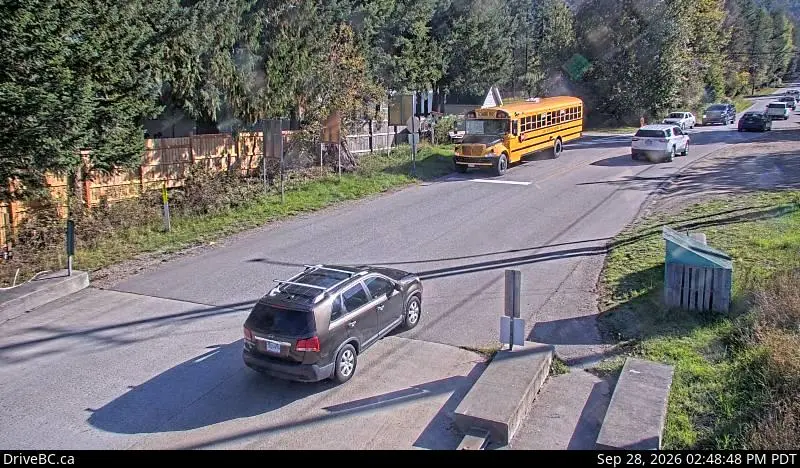
The south shore holds Harrop and Procter, usually written together as Harrop-Procter. The committee cites 2021 census figures of over 600 permanent and 200 seasonal residents, 43 per cent of them over 65. The communities have no school and no medical services. There is one small convenience store with a single gas pump and no diesel. The Canadian Pacific line runs through, and trains carrying dangerous cargo pass at least twice a day. Shift workers commute across to Pacific Regeneration Technologies, a tree nursery with up to 90 staff in busy periods, to the Harrop-Procter Forest Products mill, and to the community forest. The ferry is the only road connection to the highway. The committee calls it “our floating bridge.”
Sawmill Point, McCoy’s Siding, Harrop
Before the ferry, the place went by many names. George Buchanan’s sawmill, the first on the lake, ran from 1889 to 1892, and the name Sawmill Point outlasted it. Walter W. West preempted 160 acres of lakeshore in 1894, and by the late 1890s the point was better known as West’s Landing. In 1895 Andrew McCoy made a similar preemption about 800 metres downstream from the present ferry. Chinese labourers cut cordwood there, and the woodpile became a main fuelling station for steamboats on the West Arm.
The Canadian Pacific opened its Nelson–Procter spur in 1900 and put a siding near McCoy’s land. Land developers called the locality Trafalgar, but most people said McCoy’s Siding, McCoy Station or McCoy’s Point. Sawmill Point, West’s and 13-mile point were also in use for the steamer landing. On the post office application, the authorities rejected Trafalgar and accepted Harrop.
Ernest Harrop was born at Newton Heath, Manchester, in 1862. According to the provincial names file, he came to Moose Jaw at 18 and followed the railway west, taking jobs along the way. He was at Craigellachie when Lord Strathcona drove the last spike. He worked around Revelstoke, arrived at Three Forks in 1899 with his new wife, Bertha Chapman, and moved to the West Arm in 1905. Harrop Post Office opened on 1 January 1907 with him as postmaster, a post Wikipedia says he held until 1930. He kept the store as well. He died at Nelson in September 1950.
An orchard subdivision laid out in 1903 had become a settlement by 1909, with a school and the Harrop general store. Across the water on the north shore, the Fox brothers started the Kootenay Jam Co. in their house in 1908 and moved it to Nelson the next year. A government wharf went in at Hallett’s Landing in 1913, and that landing was renamed Longbeach. The provincial names office adopted it as Long Beach in 1947 and changed it to one word in 1962.
A wooden scow and a 1,700-foot cable
In the early years a log raft pushed by a launch carried people across, mostly with cattle aboard. The first official ferry was a wooden scow built at the Nelson ferry landing. It held four cars, ran along a 520-metre cable, and was driven by a 14-horsepower engine below deck. It went into service in August 1925 under the name Harrop–Longbeach ferry. Wikipedia says Premier John Oliver held the official opening about a week after service began. The committee’s history says the premier presided over the launch that August, and that the ferry ran 12 hours a day carrying residents, workers, mail and farm produce.
The Harrop Co-op packing shed was built the same year and could eventually handle 750 boxes of apples a day. Its upper storey served as the community centre and held the annual fall fair. The committee’s history says the ferry let crops reach processing plants in Nelson and beyond more easily. Longbeach residents crossed the other way for mail, groceries and dances at the packing shed. Crossings outside regular hours carried a toll. To draw outsiders to Harrop and Procter dances, the organizers paid any shortfall so the late runs were free or cheap.
In 1929 the operator died below deck of carbon monoxide poisoning from the gasoline engine. By 1930 the hours had stretched in summer before going back to 7 a.m. to 7 p.m. Sand was dredged from time to time to give the scow clearance at each shore in low water. Dry rot was found in the hull in 1934.
A contract for a new wooden scow was let in 1937, and the boat entered service in 1938. Its engine came from a 1931 Model A Ford. The engine sat on a sponson and turned, through sprockets and chains, a drive shaft with a propeller at each end. In 1939 high winds and waves broke the cable and drove the ferry ashore downstream. Tugs and the CP steamer Nasookin brought it back. In 1941 the engine was moved down into the scow for direct drive.
Steel hulls and the night service
A single-lane steel barge, 70 by 24 feet, took over in June 1947. Western Bridge and Steel Fabricators had built it and launched it in July 1946. Weekday hours went up by one in 1952 and weekend hours by two. The service became simply the Harrop ferry in 1954. In 1955 it ran 19 hours on weekdays and 21 on Saturdays.
In April 1962 a two-lane steel ferry entered service. Allied Shipbuilders had built it in 1961 as Hull #123, and it carried 10 vehicles and 50 passengers. Its 90-foot length made room for logging trucks and heavy machinery. It had long ramps fitted. Until then, crews had dragged a heavy wooden ramp up or down the slipway to follow the water level. Summer service ran 24 hours from 1965. Published documents date year-round 24-hour on-demand service to 1974, but area residents say it began in 1972.
Some men spent their working lives on the crossing. Bunt Ogilvie retired in 1966 after 32 years, Bert Fitchett in 1975 after 40, and Bim Rowley in 1978 after 33. The record also holds deaths. One driver went down the ramp at Harrop before the ferry had arrived. At Longbeach a vehicle ran across the deck and into the lake, and two people drowned.
The next boat came secondhand. Before Nelson’s orange bridge opened in 1959, it had served the Nelson crossing, and afterward it worked between Castlegar and Robson until a road bridge opened there in the early 1990s. It was taken apart and reassembled at Harrop, where the committee dates its arrival to 1993. It carried 21 vehicles and 48 passengers.
Sink or swim
The night service ran without disruption until 2002, by the committee’s account. On February 20 of that year, Premier Gordon Campbell’s government proposed cutting service on every inland ferry and charging tolls. For Harrop the plan was 17 hours a day, with no crossings from 11 p.m. to 6 a.m. Tolls would begin on December 31, 2002, and the ferries would be privatized by 2004. On April 8, Transportation Minister Judith Reid introduced the legislation allowing user fees. “At present, there are severe inequities in the way ferry services are provided across the province,” she said, noting that coastal routes charged fares while inland routes were fully subsidized.
On February 27 the Nelson Daily News headline read “Harrop-Procter ferry draws capacity crowd.” On March 12 it was “Harrop-Procter community says it’s sink or swim as ferry changes loom.” Residents went door to door and counted at least 89 people directly affected by a night closure, among them bakers, nurses, loggers, dairymen and police officers. The newly formed Harrop-Procter Ferry Committee gathered traffic data, costed the inland ferries, and met with the minister and her staff. The cuts were delayed and delayed again. On July 26, 2002, the local MLA, Suffredine, announced that full service would continue. In September the committee proposed a quarter-cent-per-litre tax on fuel to pay for all the inland ferries. On November 24 the premier put user fees off until a transportation strategy was done. On February 12, 2003, Campbell announced that a new 3.5-cent-per-litre gas tax would cover the inland ferries, and that there would be no tolls.
Privatization went ahead across BC in 2004. A labour dispute in 2019 cut service on the Kootenay Lake ferry, but the Harrop and Glade cable ferries kept running. Late in 2024 the BC General Employees’ Union asked the Labour Relations Board to reduce service on both cable ferries. The board’s decision, posted December 27, would have allowed cuts the committee called “unjustified, untenable and deplorable.” On January 5, 2025, the board granted a stay requested by the employer with the committee’s support. Nine days later, at a historians’ gathering in Harrop Hall, someone read aloud from the Nelson Daily News of July 29, 2002.
Special mediator Vince Ready issued his report on June 24, 2025. By October the committee was working on provincial legislation. It wants the law to give the cable ferry the same standing as a highway or bridge, so that it stays toll-free and on demand around the clock and cannot be stopped by a labour action. Its supporters wear buttons that read “Inland Ferries are Floating Highways.”
Notable Events
- 1907A post office was established in Harrop, while Procter had been recognized as a village a few years earlier. hpferry.wordpress.com
- 1938The ferry was replaced in 1938 with a larger, propeller-driven version to accommodate increasing vehicle traffic. hpferry.wordpress.com
- 1947Following the war a single-lane 70 ft steel barge ferry was put in place and operated until 1962. hpferry.wordpress.com
- 1955To meet the growing needs of the communities and businesses the ferry service expanded to operate 19 hours a day and 21 hours on Saturdays. hpferry.wordpress.com
- 1962A 90 ft long vessel with two lanes was put into service for increased car, logging truck, and heavy machinery traffic, carrying up to 10 vehicles. hpferry.wordpress.com
- 1974Published documents date the change to 24-hour on-demand service to 1974; area residents identified it as 1972. That service level has remained. hpferry.wordpress.com
- 1980sThe committee found no written confirmation of labour disputes interrupting the ferry, but recognition of at least one provincial dispute in that decade that may have caused minor ferry service disruption, at a time when the ferry was run directly by provincial government staff. hpferry.wordpress.com
- 1993The cable ferry was replaced again in 1993 with a larger, 21-vehicle capacity vessel. hpferry.wordpress.com
- 2002The committee's history page preserves the Nelson Daily News story saying the community called the coming changes sink or swim, and an earlier February article reporting a capacity crowd at a ferry meeting. hpferry.wordpress.com
- 2002The ministry released new inland ferry schedules taking effect in May, putting the Harrop Ferry on a shortened day with breaks in service and a last sailing out of Harrop just after midnight. hpferry.wordpress.com
- 2002The government would not implement user fees on inland ferry routes until a provincial transportation strategy was completed in the new year, the premier announced at the road builders' annual general meeting. hpferry.wordpress.com
- 2002The implementation of proposed inland ferry service reductions and tolls was pushed back and extended until July 26, 2002, when the local MLA announced that full service levels would be maintained. hpferry.wordpress.com
- 2003The ministry sought a partner to operate the Kootenay Lake, Glade and Harrop ferries on a toll-free basis from the following spring, requiring the proponent to keep existing service levels and offer jobs to all the regular and auxiliary ferry employees. hpferry.wordpress.com
- 2003On February 12, 2003 Premier Campbell announced there would be no tolls on inland ferries; a new 3.5 cents per litre gas tax would cover the need. hpferry.wordpress.com
- 2004In 2004 the privatization of inland ferry services was implemented across BC. hpferry.wordpress.com
- 2019A labour dispute that year led to service disruptions on the Kootenay Lake ferry, however both Harrop and Glade cable ferries were not impacted. hpferry.wordpress.com
- 2019Eighteen years later, in 2019, the cable ferry Harrop II was launched and continues to provide capacity for up to 24 vehicles and 98 passengers. hpferry.wordpress.com
- 2024The union applied to the BC Labour Relations Board to reduce services on both the Harrop and Glade cable ferries, and the results of that hearing were posted at the end of December, a decision the committee calls unjustified, untenable and deplorable. hpferry.wordpress.com
- 2025A late-October committee update reports lots of meetings and work with the primary focus on changes to provincial legislation, following the special mediator's report and recommendations issued in June. hpferry.wordpress.com
- 2025The employer, with the support of the ferry committee, requested a Stay which the BC Labour Relations Board supported in early January; the union then sought a review asking for a different level of service reduction. hpferry.wordpress.com
People
- Bertha Chapman, Ernest Harrop's new wife on the move to Three Forks that brought the family to the Kootenay Lake country (1899).
- Ernest Harrop, First postmaster of Harrop and the man the community, and so its cable ferry, are named after; storekeeper and postmaster on the West Arm for many years (1862 - 1950).
- Vince Ready, Special mediator appointed by the Minister of Labour whose report and recommendations on the ferry dispute were published in June (June 24, 2025).
- Gordon Campbell, Premier of British Columbia elected in 2001 leading the government that proposed inland ferry cuts and tolls and announced the end of tolls the next year.
- Judith Reid, Transportation Minister who introduced the statute amendments giving the province authority to charge user fees for inland ferry services (April 8, 2002).
- Suffredine, Local MLA who told the legislature of the importance of the inland ferries and announced that full service levels would be maintained (2002).
Sources
- www2.gov.bc.ca/gov/content/transportation/passenger-travel/water-travel/inland-ferries/harrop-cable-ferry
- westernpacificmarine.com/routes/harrop-cable
- hpferry.wordpress.com/wp-content/uploads/2025/01/harrop-procter-ferry-and-community-history-jan-2025-jan-12-update.pdf
- apps.gov.bc.ca/pub/bcgnws/names/7710.html
- hpferry.wordpress.com/resources/about/history