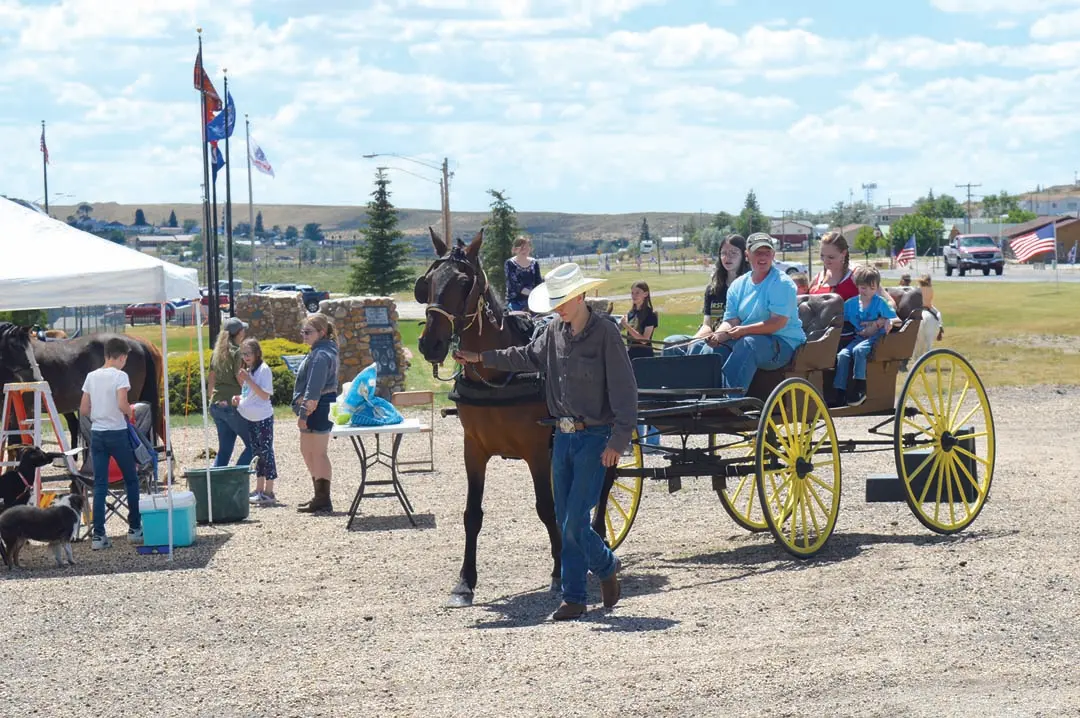



Hanna King Coal Days
Hanna, Carbon County, Wyoming. Annual celebration of coal; July.
Details

- Where
- Listed venues: Recreation Center, 8000 Hwy 72, Town Hall, 301 S Adams Street, Senior Center, 1007 Trona Court, Hanna, WY 82327. Directions
- When
- July 10-11.
- Access
- Recreation Center closure had put the celebration at risk; much of the event took place there and the center has no water available.
- Phone
- 307-325-9424
- Website
- townofhanna.com
The 2026 King Coal Days ran July 10 and 11 in Hanna, a Carbon County town of a little over 800 people. The Carbon County Visitors Council listed its program among the county’s America 250 events that summer: a parade, a pancake breakfast, a community barbecue, bingo, a car show, a craft show, a Glow Run, live music, and tournaments in cornhole, horseshoes, and 3-on-3 basketball. The band was Kaspen Haley and Boxelder Stomp. The Hanna Town Council approved them at its February 10 meeting, the same night it voted $8,120 to host the two days. The Rawlins Daily Times listing named three places in town: the Recreation Center on Highway 72, the Town Hall on South Adams Street, and the Senior Center on Trona Court. The listing also tagged kids’ rides, food vendors, crafts, and a street dance.
Writing in the Carbon County Comet a week later, reporter Mike Armstrong called coal “the lifeblood of this town.” He noted that no official record shows when the celebration started, though it was, and still is, Hanna’s major summer event.
Bingo, a Glow Run, and mud drags
The program shifts a little from year to year. In 2025 the celebration opened at 5 p.m. Friday, July 25, with bingo at the Senior Center, followed by a Glow Run and karaoke. Saturday began with a Color Run and a fireman’s breakfast. Then came the parade, a craft and vendor show, a car show, a petting zoo, and a water-balloon fight, with several food vendors in town and a volleyball tournament added to the basketball and horseshoes. Jennifer Garrett Widdison, Dorn Hetzel, and Vivian Alice Romero-Gonzales were listed as hosts.
Ten years earlier, King Coal Days marked Hanna’s 125th birthday at the Hanna Rec Center. A flyer described in the Rawlins Daily Times laid out three days:
- Friday: a barbecue at 5 p.m., then a battle of the bands and a Texas Hold ‘em tournament.
- Saturday: a 5K, a breakfast, a second battle of the bands, and the parade. A craft fair and farmers market ran through midday, with pony rides, a petting zoo, a hypnotist at 11:30, carnival rides in the afternoon, and dinner at 4. Three-on-three basketball followed, and a street dance ran from 7 to 11 p.m.
- Sunday: breakfast at 7 a.m., men’s horseshoes, then co-ed horseshoes, and mud drags at 1 p.m.
A recreation center without water
The Rec Center that held the 2015 birthday also put the celebration in danger. In July 2025 the Comet reported concern that King Coal Days would disappear with the center’s closure, since much of the event had taken place there. That could no longer happen, because the building had no water. Mayor Charlie George and the Town Council then reformed the Hanna Parks and Recreation Board, and its members took on reviving King Coal Days as their most important task.
By February 2026 the board was applying to the Carbon County School District #2 Recreation Board for money for King Coal Days and the town’s New Year’s celebration. At the same council meeting, Dorn Hetzel presented his idea for a nonprofit that would reopen the center’s gym, locker rooms, and weight room and fund them, once he had state approval. The building dates from the town’s last boom. Work on the 31,000-square-foot recreation center began April 6, 1983.
Chimney Springs and the No. 1 Mine
“’Coal is King,’ proclaims a yearly celebration in Hanna,” local historian Nancy Anderson wrote in 2014 for WyoHistory.org. North of town stands a dragline, Arch Mineral Corporation’s Page model 742, which uncovered coal and reclaimed pits from 1977 to 2005. Its main engine house is about 25 feet high. Of the dozen or so such machines once working the strip mines of the Hanna Basin, it is the only survivor, and it is now silent.
The town was first called Chimney Springs. The Alliance for Historic Wyoming says Mark Hanna, a prominent Ohio politician, toured the new coal fields in 1888 and pushed for mines there. Anderson describes him as a Cleveland coal and shipping magnate who had convinced the Union Pacific that the railroad’s future lay in its coal fields. In the winter of 1889 workmen began opening Union Pacific mines at Chimney Springs, which was soon renamed in his honor. The seams ran 15 to 30 feet thick, and company officials hastily brought the No. 1 Mine into production.
Hanna was the first planned town the Union Pacific Coal Company built. It had rows of identical houses, with privies and coalhouses in the alleys. One Town sat on a treeless flood plain by No. 1 Mine, and Two Town and Three Town followed as more mines opened. Japanese families settled near No. 2 Mine, where there was room for large gardens. Elmo, a Finnish village incorporated in 1917, lay a mile east, beyond the company’s reach, and its saloons flourished. The Finns’ meeting hall had stood in Carbon, the railroad’s first coal camp about ten miles south. It was hauled intact to Hanna by hand. Stories differ on whether the Finns literally carried it or rolled it on logs. “Everyone was always welcome at the Finn Hall,” said Gert Salo Milliken, daughter of a Finnish miner.
On the morning of June 30, 1903, about 10:30, coal gas in the No. 1 Mine caught fire. The explosion trapped about 200 men underground. Forty-six escaped because they happened to be near an air shaft. Within thirty minutes the Carbon County Commissioners had hired a special train to bring every physician from Rawlins. The blast had thrown timbers hundreds of feet from the mine opening. About 45 mules and horses were trapped in the stable inside the entrance, and the burning stables at entry No. 17 ignited the coal vein. By July 3, rescuers, including about thirty firefighters from Rock Springs, had given up hope of finding anyone alive. The newspapers said the Fourth of July was “scarcely noticed.” The Rawlins Republican reported it was “pitiful to see the women and children weeping and wailing about the mouth of the mine, begging for a word about their loved ones.” In all, 169 miners died, and it remains Wyoming’s deadliest mine disaster. One newspaper counted about 600 children left fatherless. The company sent clothes and train cars full of coffins. Anderson writes that it “was condemned for refusing to compensate survivors beyond a meager amount for burial expenses.”
The mine exploded again on March 28, 1908. With 228 men lost across the two disasters, Hanna became, in Anderson’s phrase, a town of widows. In 1932 a memorial was placed on a hill overlooking where the No. 1 Mine had been. It stands there still, on a dirt road off County Road 72. In 1957 Mike Leon, editor of Wyoming magazine, wrote of the town: “Its atmosphere is different … They have united over barriers that divide men elsewhere, have drawn together in a shared, prideful tradition … and in a common sorrow.”
Diesel, the boom, and the last crew
Hanna kept other holidays before King Coal Days. In 1906, as Hanna historian Muriel Kitching told it, a United Mine Workers organizer got off a Union Pacific train outside town limits. He hiked a quarter mile to the top of Spion Kop Hill, which British miners had named after a Boer War battle, and signed up willing miners there. The company recognized the union in 1907 and accepted the eight-hour day that same year. Hanna celebrated that victory every April 1, a holiday second only to Labor Day. A photograph of the 1920 Labor Day parade is held by the Wyoming State Archives.
The Union Pacific’s Hanna mines closed in February 1954, because diesel was replacing coal as the railroad’s fuel. Ruth Boam’s father had worked the mines for fifty years, and four men of her family died in 1908. She recalled: “What fools we were. When the first diesel locomotives came through town, there we were by the tracks and cheering our heads off. We never thought for a moment what it meant for us.” Catherine Fenimore remembered that “a big number moved away—house and all.”
Strip mining brought the town back. Between 1970 and 1980 Hanna grew from 460 people to 2,294. Then Powder River Basin coal undercut the Hanna field. The final issue of the Hanna Herald, published January 23, 1985, ran an editorial titled “The Boom Was Great But….” By 2010 the population was 841. In August 2001 part of Hanna’s last crew of underground miners was photographed at the filled-in entrance to the RAG Shoshone Mine, beneath a sign that reads, “You are Expected Home Tonight. Please Be Careful.”
Notable Events
- 1889During the winter of 1889 workmen began opening Union Pacific mines at Chimney Springs, soon renamed Hanna in honor of Mark A. Hanna. wyohistory.org
- 1903In total 169 miners lost their lives in the Hanna No. 1 mine, Wyoming's deadliest mine disaster. ahcwyo.org
- 1908The tragedies of June 30, 1903, and March 28, 1908 cost 228 fathers, brothers, sons, uncles and friends; Hanna became a town of widows. wyohistory.org
- 1932A memorial was placed to honor those lost in the mine explosions; it remains on a hill overlooking where mine No. 1 was. historicwyoming.org
- 1954From its inception in 1890 until closing in 1954, the Union Pacific Coal Company opened six Hanna mines. wyohistory.org
- 2015King Coal Days returned to Hanna celebrating the town's 125th birthday at the Hanna Rec Center. wyomingnews.com
- 2025There were concerns the 2025 celebration could be the last King Coal Days. carboncountycomet.com
- 2025Mayor Charlie George and the Town Council reformed the board, whose members took on reviving King Coal Days as their most important task. carboncountycomet.com
People
- Nancy Anderson, local historian, author of 'A Brief History of Hanna, Wyoming' on WyoHistory.org.
- Charlie George, mayor who reformed the Hanna Parks and Recreation Board to revive King Coal Days.
- Eugene McAuliffe, Union Pacific Coal Company president.
- Gert Salo Milliken, daughter of a Finnish miner, quoted on the Finn Hall.
- Mark A. Hanna, Cleveland, Ohio-based coal and shipping magnate in whose honor Hanna was named (1889).
- Muriel Kitching, Hanna historian.
Sources
- wyomingcarboncounty.com/blog/276-carbon-county-joins-the-nation-in-celebrating-america-251
- carboncountycomet.com/king-coal-days-draws-families-and-fun
- carboncountycomet.com/king-coal-days-fired-comeback
- bulletin.townofhanna.com
- townofhanna.com
- facebook.com/events/1368073797619726
- wyomingcarboncounty.com/events/annual-events
- wyohistory.org/encyclopedia/brief-history-hanna-wyoming
- marketplace.rawlinstimes.com/places/view/5871/king_coal_days_july_10_11_2026_.html
- minutes.townofhanna.com/uploads/minutes/2026/February%2010th,%202026%20Regular%20Meeting%20Minutes.pdf
- wyomingnews.com/rawlinstimes/news/king-coal-days-set-for-this-weekend/article_d3e33fa5-92af-5ae1-9205-adac8c6fb4c5.html
- carboncountycomet.com/king-coal-days-make-comeback
- historicwyoming.org/profiles/hanna
- ahcwyo.org/2022/06/27/hanna-wyomings-1903-frightful-disaster