Hampton Butte Petrified Wood Site
Crook County, Oregon. BLM public collection site for petrified wood.
Details
- Where
- Crook County, OR. No street address stated. Directions
- Fees
- Collecting petrified wood is free up to 25 pounds per day, plus one piece, but no more than 250 pounds per year; a permit is needed for amounts over these limits.
- Access
- All rocks collected are for personal, non-commercial use only; many areas are surrounded by private property and must be respected at all times when using public collection areas.
- Phone
- 541-416-6700
- Managed by
- Bureau of Land Management.
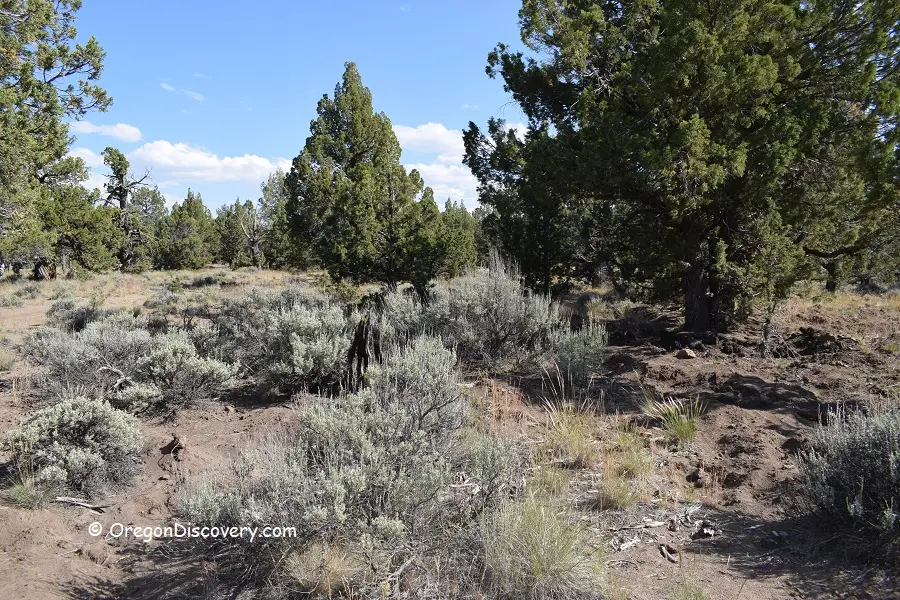
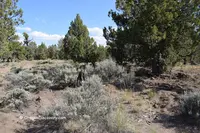
The road out from Bend follows Highway 20 east about 50 miles, turns north on Van Lake Road between mileposts 52 and 53, and runs 10.7 miles to Price-Twelve Mile Road. About 2.3 miles along that road the collecting ground begins, and it lines both sides for the next three-tenths of a mile. Dirt tracks lead off to the left into a juniper forest. The Oregon Discovery guide puts the site at 120 acres and 4,800 feet, about 23 miles northeast of Brothers. It recommends a high-clearance four-wheel-drive vehicle and names May through October as the best months.
The Bureau of Land Management holds the ground. It is one of the Crook County collecting areas on the Central Oregon Rockhounding Map. Public land lies to the north and east, and private property lies to the west and south. Primitive camping is allowed throughout the public BLM land, and visitors pack out their own trash.
Green wood under the junipers
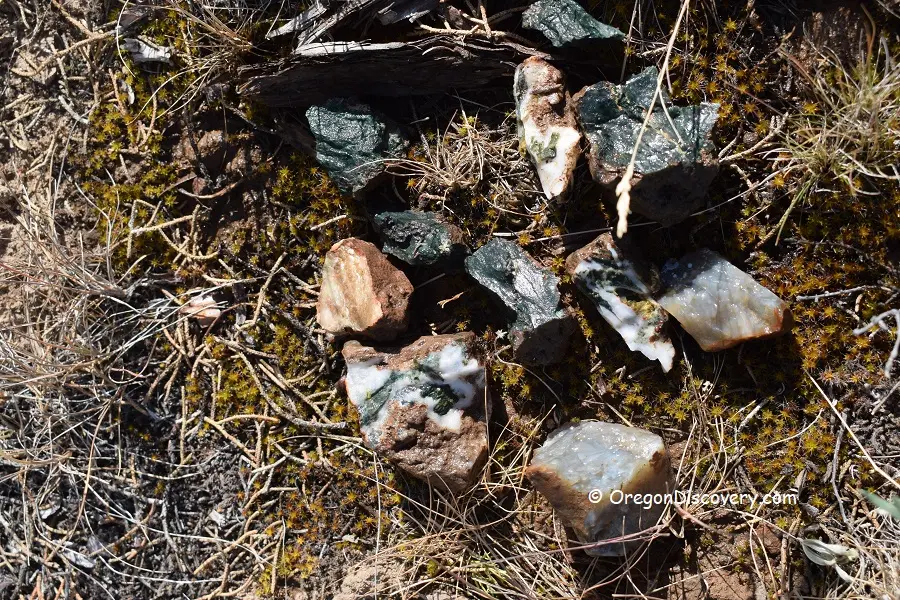
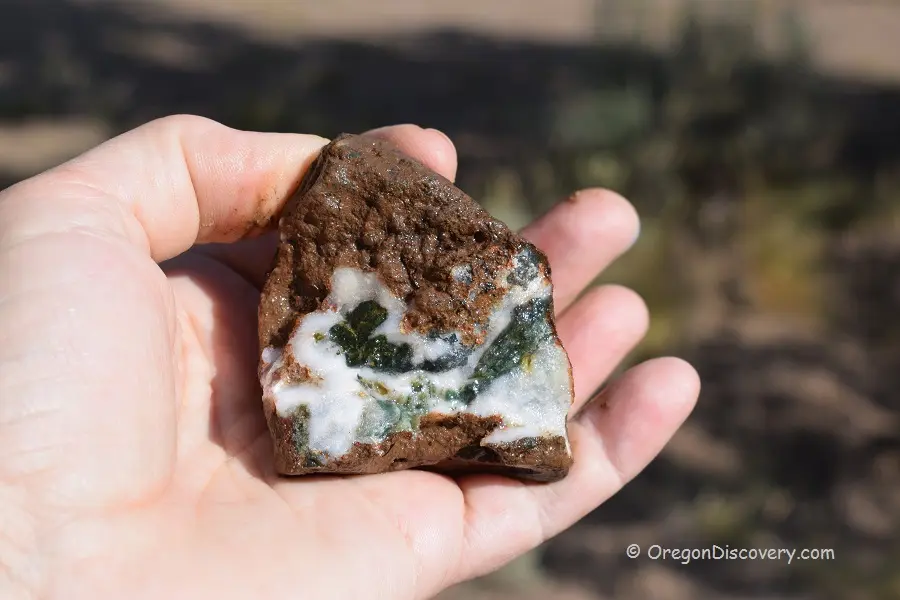
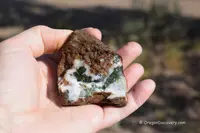
The material is petrified wood. The Forest Service’s account of central Oregon says the local woods run from white to black, with browns the most common. An occasional specimen is colorfully agatized and takes an excellent polish, and some localities offer green wood, which the account calls highly prized. Oregon Discovery lists white, gray, black and yellow at Hampton Butte and says the most prized pieces range from turquoise to dark green. George Mustoe, in a 2016 paper on the origin of petrified-wood color, names Hampton Butte as one of two localities well known for bright-colored silicified wood, red and green, from the Eocene Clarno Formation.
The cause of the green is stated with hedges. Oregon Discovery says such colors are likely caused by chromium or copper, and that at Hampton Butte the green is often attributed to copper and iron oxidation. Mustoe measured trace metals in 35 samples from elsewhere. He found iron the most important colorant, producing a range of hues depending on its abundance and oxidation state, and chromium the dominant colorant in bright green fossil wood from Arizona and Zimbabwe.
According to Oregon Discovery, the wood here is mostly jasperized and opalized, with agatized pieces turning up now and then. Limb casts, agate and jasper are also found. Rockhounds have worked the ground for many years, yet tumbler-sized pieces still lie on the surface. Larger ones call for digging one to two feet down with a shovel or pick. The soil is relatively soft, and diggers are asked to keep away from trees and their roots. Much of the material is porous and will not polish. The Forest Service’s test for petrified wood is the grain of the annual growth rings, clearest from an end, where the rings show as circles. Carrie Gordon, an Ochoco National Forest geologist, told The Bulletin in 2008: “I’ve actually found some of my best pieces just walking around in the spring on the slopes in the forest and on BLM land. You can do surface collecting anywhere.”
Twenty-five pounds and one piece
Petrified wood is free to take up to 25 pounds a day, plus one piece, and no more than 250 pounds a year. Larger amounts need a permit. BLM forbids two or more people from pooling their quotas to take out a piece heavier than 250 pounds. Everything collected is for personal use and may not be sold. Gordon said rockhounds may use shovels but no mechanized digging equipment, and may not blast. “This is not for the commercial operator that wants to work the product and sell it,” she said. “We’re talking about recreation, going out with the family for personal collection.” BLM’s guide adds its own rules: dig no deeper than four feet, fill every hole, and leave gates as found. Petrified wood cannot be held under a mining claim, the guide notes, though people sometimes stake such claims by mistake.
The collecting areas were first mapped in the 1960s, when local chambers of commerce kept up a few of the sites. In 2004 the Forest Service, BLM and the Prineville-Crook County Chamber of Commerce revised the map. They added GPS coordinates, a briefing on local geologic history and a “rockhound’s code of ethics.” In 2008 the chamber’s executive director, Brandi Hereford, said it gave out hundreds of copies a year. “They’re very specific,” she said. “’I’m here to rockhound, where’s the map?’”
Mudflows of the Clarno
The Forest Service’s account of the wood’s origin starts about 50 million years ago. Then a chain of volcanoes in eastern Oregon began erupting in a tropical climate that supported lush woodlands. Ash on the steep volcanic slopes mixed with tropical rain into mudflows that swept across the country, entombing plants and animals. The buried trees and wood debris became much of the petrified wood collected in central Oregon today. Later the Cascades rose high enough to block the Pacific storms and turned the region to high desert. About 4.9 million years ago, southeast of Hampton, molten volcanic glass flowed out at Glass Buttes.
Lewis A. McArthur’s Oregon Geographic Names (1952) describes Hampton Butte as a group of dissected hills lying partly in Crook County. Its summit, at 6,333 feet, is apparently in Deschutes County. The book cites Dr. I. C. Russell’s account in USGS Bulletin 252. Russell held the butte to be the product of explosive eruptions that discharged acid lavas and probably furnished most of the material for the tuff sheets covering much of the surrounding country.
Joe Hampton’s valley
W. P. Vandevert of Bend told McArthur in 1926 that the butte was named for one Joe Hampton, who moved into Hampton Valley in the ‘70s from near Eugene. A post office opened in the valley in 1911. A. S. Fogg, its first postmaster, suggested naming it for the butte, and it became Hampton.
Notable Events
- 1911Hampton post office was established and named for the butte at the suggestion of A. S. Fogg, the first postmaster. en.wikisource.org
- 1960sRockhounding areas were first mapped in the 1960s, when a few of the sites were maintained by local chambers of commerce. bendbulletin.com
People
- Joe Hampton, Namesake of Hampton Butte; settled in Hampton Valley from near Eugene (moved into Hampton Valley in the '70s).
Sources
- fs.usda.gov/r06/ochoco/natural-resources/rocks-minerals
- bendbulletin.com/2020/09/18/dig-for-history-in-the-ochoco-national-forest
- blm.gov/sites/default/files/docs/2024-07/orwa-rock-collect-guide.pdf
- en.wikisource.org/wiki/Oregon_Geographic_Names_(1952)/H
- academia.edu/78478491/Origin_of_Petrified_Wood_Color
- bendbulletin.com/2008/06/02/for-rock-enthusiasts-were-a-bit-of-a-mecca