Green Ridge Lookout
Sisters, Deschutes County, Oregon. Fire lookout rental; Mid-April - Mid-June.
Details

- Where
- Sisters, Deschutes County, OR. No street address stated. Directions
- When
- check-in 3:00 p.m., check-out 11:00 a.m.
- Getting there
- From Sisters, travel 5.5 miles west on U.S. Highway 20 to Forest Road 11 at Indian Ford Campground. Turn right on Forest Road 11 and travel approximately 10 miles to the end of pavement at the junction with Forest Road 1150. Take the left fork of Forest Road 1150, to the junction with Forest Road 1154. Turn left on Forest Road 1154 and continue to Forest Road 1140.
- Fees
- $40 per night per group, with a maximum of four occupants.
- Access
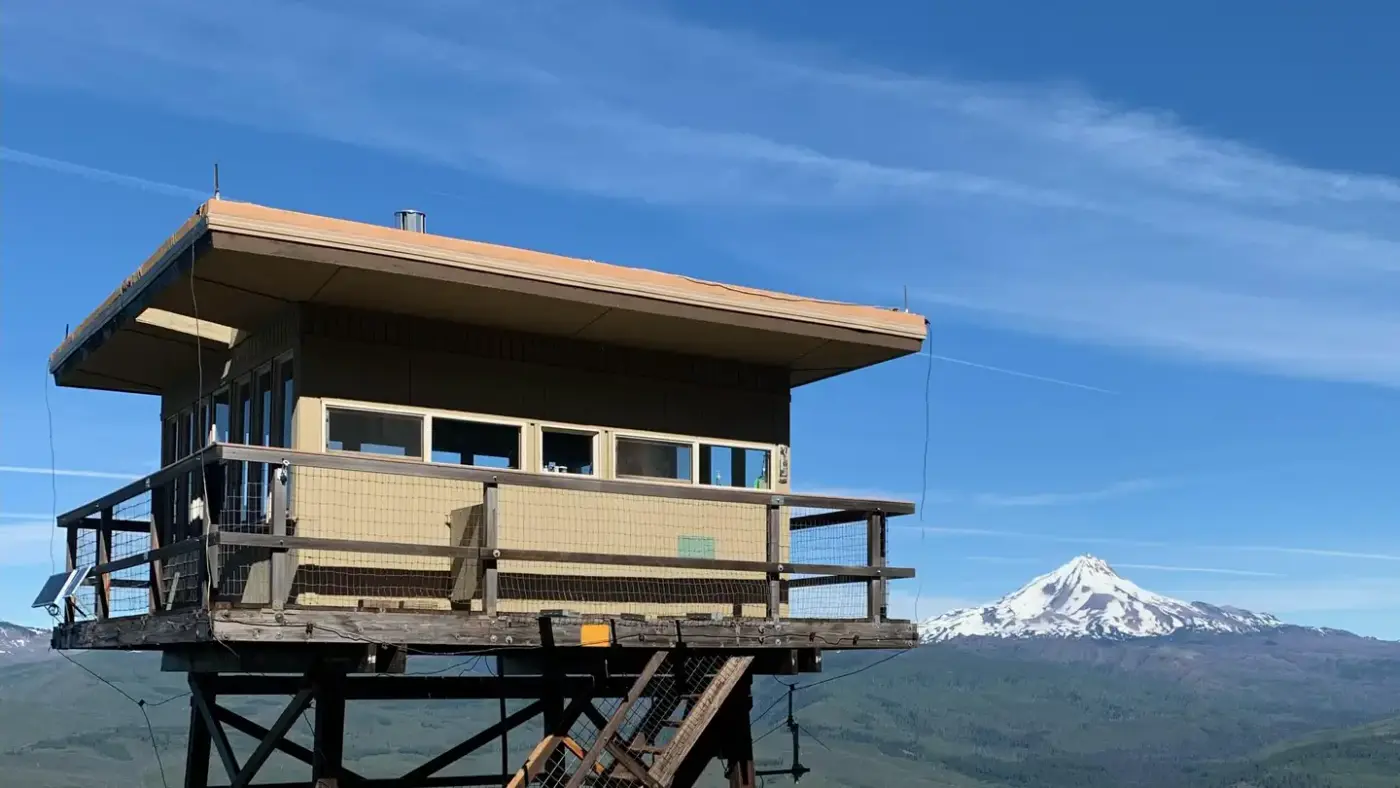
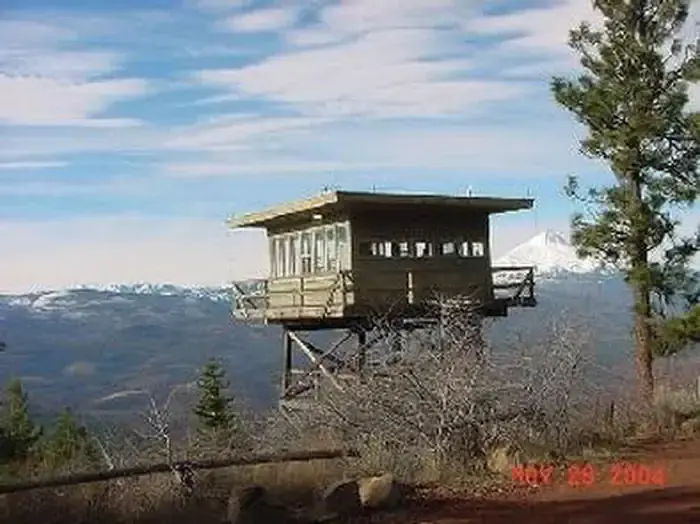
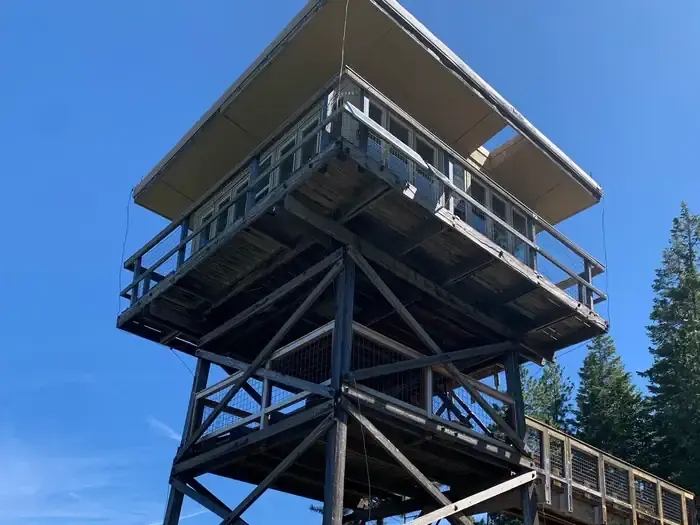
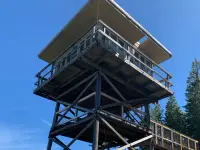
- First lookout a Standard L-5 10x10 finished in 1934, classified as an emergency station; the current 15' x 15' R-6 flattop with catwalk on a 21' timber tower was constructed in 1961.
- Walk-in or reserve
- the combination code is provided in the reservation reminder email sent out several days ahead of the reservation.
- Phone
- (541) 549-7700
- Website
- recreation.gov
- Managed by
- Deschutes National Forest.
- Established
- 1961.
- Coordinates
- 44.533810, -121.608636.
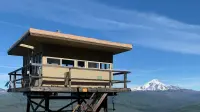
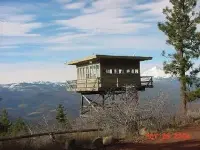
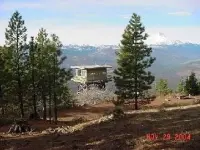
From the parking area on Green Ridge a short boardwalk runs out to a wooden deck, twenty feet by twenty and railed. One flight of steps climbs from it to the catwalk around the cab. The cab is a single room fifteen feet square on a timber tower. The National Historic Lookout Register gives the tower as 21 feet tall, and Recreation.gov calls it 20. Inside are a futon, a table and two chairs, a propane refrigerator, a propane wall heater, an overhead light, and a propane stove and oven. The Forest Service counts three burners on the stove and Recreation.gov counts four. Up to four people may stay the night, and there is one futon.
The Deschutes National Forest rents the lookout from early May through June and again from mid-September to mid-November. Guests carry up nearly everything they need: food, sleeping bags and pads, towels, cookware, dish soap, matches, toilet paper, and garbage bags. They also bring all the water for drinking, cooking, and washing, because the site has none. A vault toilet and a picnic table stand outside. Pets stay outdoors. Cell service is minimal at the lookout and extremely limited in the country around it.
The way in leaves Sisters 5.5 miles west on U.S. Highway 20, turns onto Forest Road 11 at Indian Ford Campground, and runs about ten miles to the end of pavement. From there a chain of forest roads, 1150, 1154, and 1140, leads to a very sharp right onto spur road 600. The Forest Service describes a locked gate, unsigned, at spur road 650, and entry is by combination. Early and late in the season the road may require a high-clearance four-wheel-drive vehicle. When snow holds it shut in spring, the opening is put off and reservations are refunded.
Jefferson and the Metolius basin
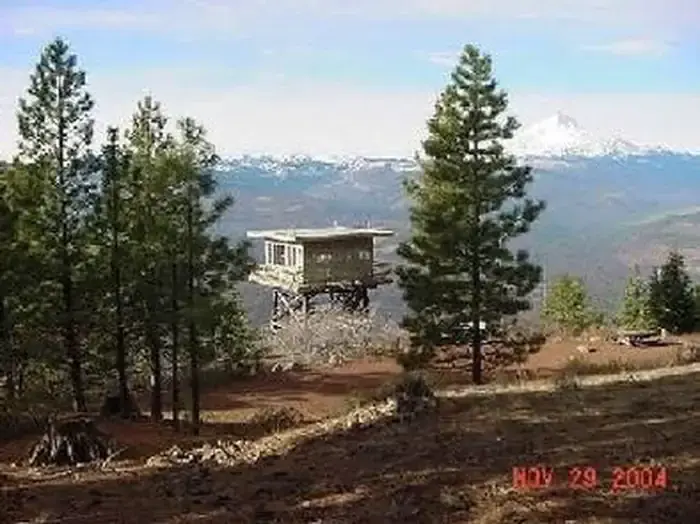
The register calls Green Ridge a “side hill” site, set on the flank of the ridge and looking into the Metolius River drainage and toward Mount Jefferson. It puts the elevation at 4,659 feet. A 2001 report in The Nugget of Sisters gave a 4,600-foot perch with a 180-degree view over the Metolius Basin. Jefferson is the most prominent peak in sight. It is a stratovolcano of 10,497 feet, the second highest mountain in Oregon. Forests of Douglas-fir, cedar, and ponderosa pine run out from the ridge. The Forest Service suggests setting a camera on a tripod for sunrise and sunset.
The river below rises at Metolius Springs at the base of Black Butte, a 6,436-foot cinder cone, and flows north, clear and cold, through coniferous forest and volcanic country. Its waters hold rainbow trout, whitefish, bull trout, and kokanee salmon for fly-fishermen. Day hikes follow the river and climb to the top of Black Butte, and Lake Billy Chinook, about ten miles off, has boating and fishing. Just below the ridge is Wizard Falls Fish Hatchery, which by the Forest Service’s account feeds the eagles every morning. Osprey frequent the area as well, and the agency advises keeping binoculars at hand.
Three dates for the tower
The sources do not agree on when the lookout was built. The register says the first lookout on Green Ridge was a Standard L-5, ten feet by ten, finished in 1934 and classified as an emergency station. It dates the present R-6 flattop with catwalk to 1961. The Nugget’s 2001 report said the one-room lookout was originally built in 1933 and rebuilt in 1954. Recreation.gov, and The Nugget in 2021, say only that it was built in the 1960s. Green Ridge entered the National Historic Lookout Register on December 1, 1998, as US 287, OR 32, on the nomination of Marilyn Anderson.
Volunteers in the cab
In summer the cab is not rented, and Forest Service volunteers keep the fire watch. Conrad Weiler wrote up the 2001 season in The Nugget that September. The lookout had operated from July 1 to Labor Day, 9 a.m. to 5 p.m., with 16 volunteers, mostly from Central Oregon. They met in June to schedule the summer’s days, practice radio etiquette, train on the fire equipment, and sign federal volunteer papers. Most took a single day on duty, and some took several. The room then held a single bed, a propane refrigerator, and a stove, with a picnic table and an outside shower beneath the structure.
Bob Naidis of Bend, the group’s radio expert, had done the work for five years. “I wanted to do it,” he said. “It’s very quiet and peaceful and I like it.” He made a 100-mile round trip each day. He kept a cell phone and a Forest Service radio “to keep in touch with the Forest Service and Central Oregon Dispatch (Prineville) which coordinates fire and rescue activities in Central Oregon.” June and Bob Hill, Ron Roach, Sue and Harry Sprang, and Alwyn Stockley were counted among the old-timers. Sue Sprang regretted the Labor Day closing. “The lookout is very important to folks living in Camp Sherman as their area can be seen from Green Ridge,” she said. Part of Camp Sherman cannot be seen from the Black Butte lookout because of where its tower stands. Rental fees went to upkeep, and the structure was receiving attention that year.
By 2015 the roster had grown to 36, some serving a week at a time and others one day a week. Sandy Sharp was among the one-day volunteers. Before joining the Forest Service she had lived in a lighthouse on Lake Superior as a National Park Service interpreter, telling visitors about early navigation. She retired after more than 19 years with the Forest Service, the last 12 as a “front-liner” greeting visitors at the Sisters District office, and went to Green Ridge. A photograph from that summer shows her explaining fire-finding to Reuben Anderson and his son, Truman. “It’s such a beautiful trip I hardly notice the miles,” she said of the 50-mile drive, “no matter if I’m coming or going, I’m so looking forward to my day in the lookout.”
Smoke below the ridge
Bob Larson came to Green Ridge new in 2001, sixty years after his first lookout job. “I worked in the Siskiyous in 1941 as a fire lookout. This was a two-and-a-half month stint with mules bringing in food and equipment,” he said. “My first day at Green Ridge I was one of the stations calling in the Bald Peter fire this summer. It started as a small smoke and then really took off.”
The Eyerly Fire burned across the ridge country in 2002. The Bridge 99 Fire followed in 2014, during one of Sharp’s nights in the cab, when several small fires flared up after dark and cost her sleep. Then she reasoned with herself, “They’re not going let me get cooked up here...,” and settled in for a peaceful night. In August 2020 the lightning-caused Green Ridge fire burned 4,338 acres twelve miles north-northwest of Sisters. Its smoke drove people from town to the coast and farther.
In 2021 the Forest Service proposed a large-scale restoration of Green Ridge. The agency said years of clear-cutting, heavy logging, and fire suppression had left the forest overly dense, a risk to the stands that shelter the federally protected northern spotted owl. “A lot of it was previously either high-grade logged, where some of the largest, most fire-resistant trees were logged, or it was clear-cut and then replanted in pretty dense plantations,” said Sisters District Ranger Ian Reid. The Blue Mountains Biodiversity Project called the plan the “Green Ridge Timber Sale” and argued that thinning the understory would degrade habitat for owls, deer, and other species. The Forest Service wildlife biologist John DeLuca stated the agency’s aim: “The intention is to maintain the canopy cover for spotted owls to persist in those stands for purposes of dispersal.”
Notable Events
- 1933The Nugget states that the lookout was originally built in 1933. nuggetnews.com
- 1934The first lookout on Green Ridge, a Standard L-5 10x10, was finished in 1934 and was classified as an emergency station. web.archive.org
- 1954The Nugget states that the lookout was rebuilt in 1954. nuggetnews.com
- 1960sThe Nugget's restoration report describes the lookout as built in the 1960s. nuggetnews.com
- 1961The current 15' x 15' R-6 flattop with catwalk on a 21' timber tower was constructed in 1961 and is regularly staffed by volunteers. web.archive.org
- 1998Green Ridge Lookout was entered in the National Historic Lookout Register as US 287, OR 32, nominated by Marilyn Anderson. web.archive.org
People
- Alwyn Stockley, Longstanding lookout volunteer.
- Bill Miller, Lookout volunteer.
- Bob Hill, Longstanding lookout volunteer.
- Bob Larson, New volunteer who wanted to try lookout work again.
- Bob Naidis, Volunteer from Bend, doing lookout work for five years at the time of the report.
- Carol Pettit, Lookout volunteer.
- Donna Carter, Lookout volunteer.
- Elaine Wellman, Lookout volunteer.
- Harry Sprang, Longstanding lookout volunteer.
- Jack Walker, Lookout volunteer.
- June Hill, Longstanding lookout volunteer.
- Monique Allori, Lookout volunteer.
- Richard Wellman, Lookout volunteer.
- Ron Roach, Longstanding lookout volunteer.
- Sue Sprang, Longstanding lookout volunteer.
- Wayne Carter, Lookout volunteer.
- Reuben Anderson, Visitor receiving fire-finding instruction from volunteer Sandy Sharp.
- Sandy Sharp, Volunteer fire lookout on Green Ridge; explains fire-finding techniques to visitors.
- Truman, Reuben Anderson's son, receiving fire-finding instruction from volunteer Sandy Sharp.
- Marilyn Anderson, Nominated Green Ridge Lookout to the National Historic Lookout Register (December 1, 1998).
Sources
- recreation.gov/api/camps/campgrounds/234477
- recreation.gov/camping/campgrounds/234477
- nuggetnews.com/story/2001/09/25/news/green-ridge-closes-for-season/7528.html
- nuggetnews.com/story/2015/09/08/news/usfs-retiree-mans-lookout-tower/25254.html
- nuggetnews.com/story/2021/11/02/news/spotted-owls-in-focus-on-green-ridge/32551.html
- fs.usda.gov/r06/deschutes/recreation/green-ridge-lookout
- web.archive.org/web/20250118093950/http://nhlr.org/lookouts/us/or/green-ridge-lookout