.jpg)
Grandma Prisbrey's Bottle Village
Simi Valley, Ventura County, California.
Details

- Where
- 4595 Cochran St, Simi Valley, CA 93063. Directions
- When
- Tours available by appointment.
- Walk-in or reserve
- Tours available by appointment.
- Phone
- 744-226-5006
- Website
- bottlevillage.org
- Managed by
- Preserve Bottle Village (501(c)3 non-profit since 1979).
- Established
- 1956.
- Coordinates
- 34.2792333, -118.7046528.
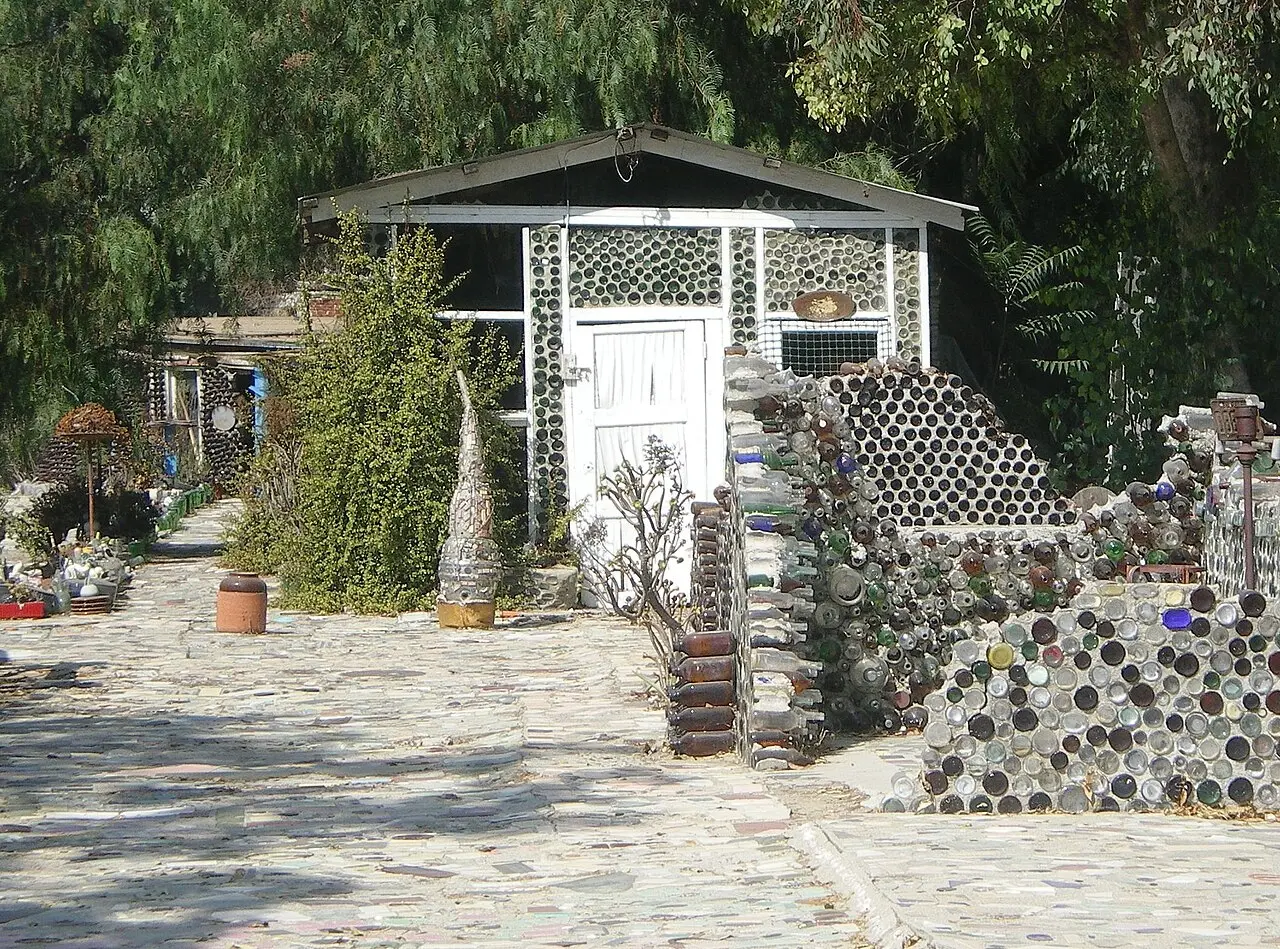
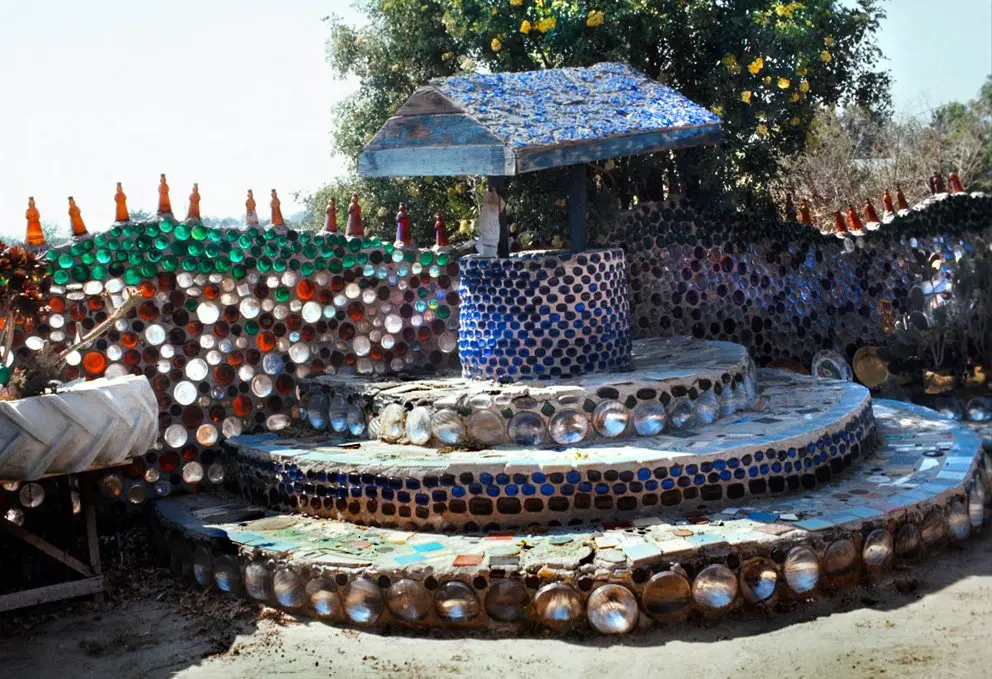
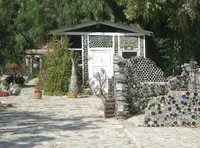
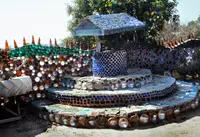
Historical plaques stand at the entrance of 4595 Cochran Street in Simi Valley, on a lot 50 feet wide and 250 feet deep. From the street a visitor can see a well made of bottles and car headlights. Tressa Prisbrey put that well on the cover of one of her own brochures. Behind it, running north, are mosaic walks, shrines, wishing wells, a leaning tower of bottles, and the one-room houses she built from what she hauled out of the town dump, beginning in 1956 when she was 60. The place is a City of Simi Valley Landmark, Ventura County Landmark No. 52, and California State Historical Landmark No. 939. It was listed on the National Register of Historic Places in 1996, and in 2025 the National Trust for Historic Preservation named it an Affiliate Member of its Historic Artists’ Homes and Studios program.
The village has been closed to the general public since 1984. Preserve Bottle Village is an all-volunteer nonprofit, a handful of people. It owns the site and opens it for tours by appointment, monthly by the group’s own account. The rules posted for its 2019 public tours ask each visitor to sign a liability waiver and to wear soft-soled shoes on the fragile mosaic walks. Hard or pointed heels, sandals, and flip-flops are not allowed. Bottles that once stood in the walls are stored around the grounds, and there is broken glass. The remaining original structures cannot be entered under any circumstance. The volunteers say that keeping an outdoor museum means a lot of sweeping, raking, and weeding.
The neighborhood has filled in around the village. The 1996 National Register nomination places the lot in the Kadota Fig District, which was first cut into one-acre lots in the late 1920s. In Prisbrey’s day, walnut groves stood across Cochran Street, fig orchards lay to the east, and a turkey farm sat next door on the west. By the mid-1980s, houses and a senior apartment complex had taken their places. State Route 118 runs a block away. In 1960 it was the only east-west highway through Simi Valley.
Bottles, headlights, and “the ladies”
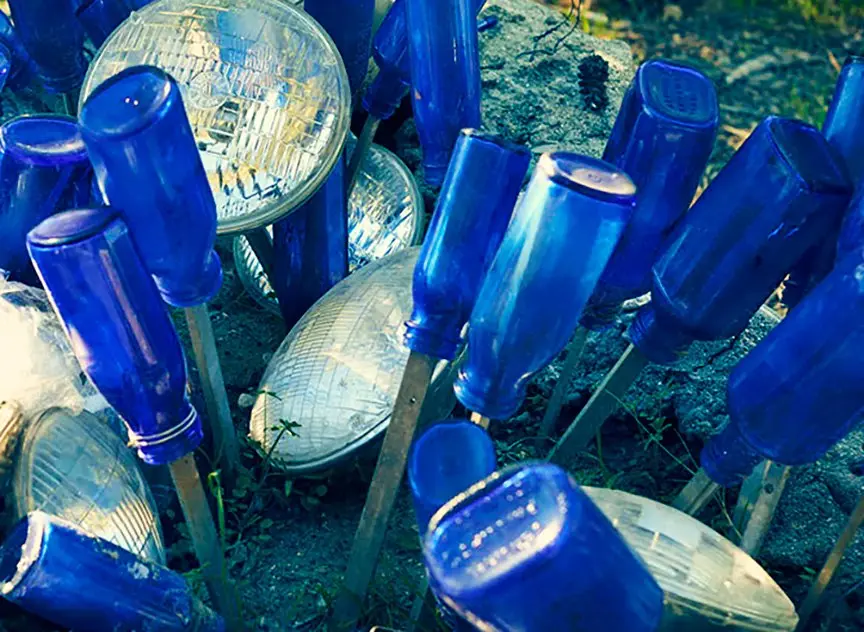
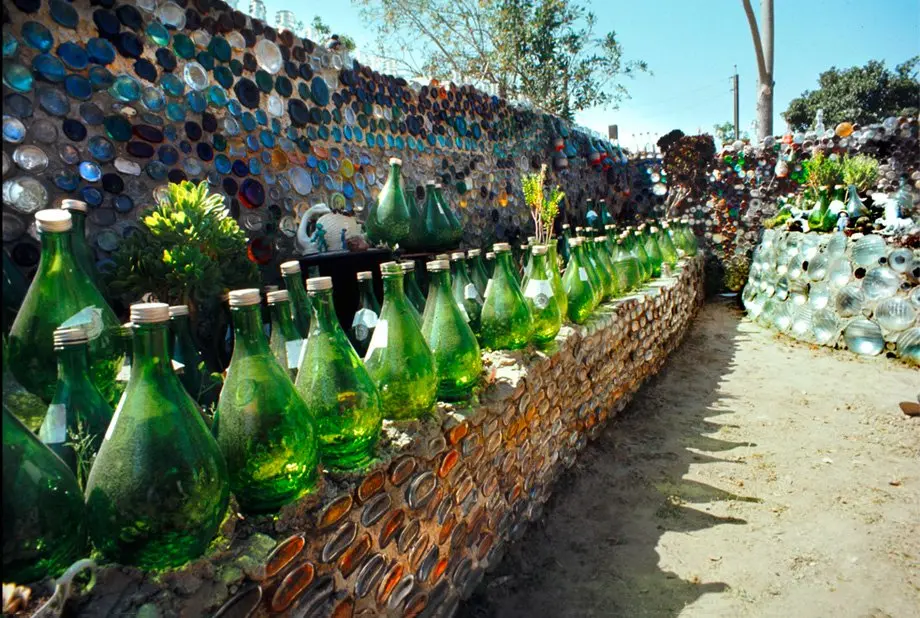
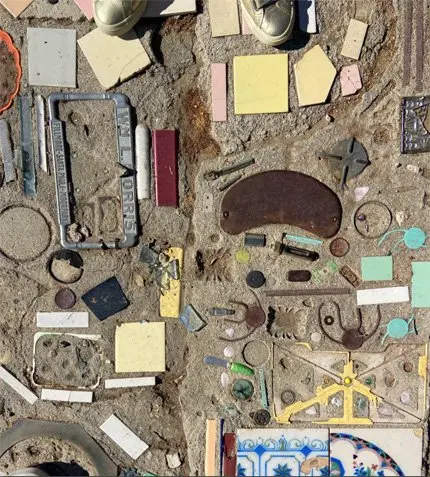
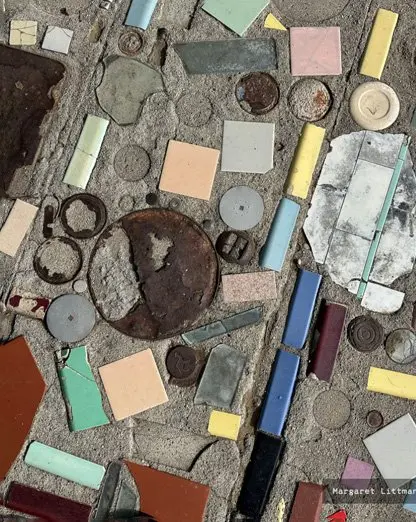
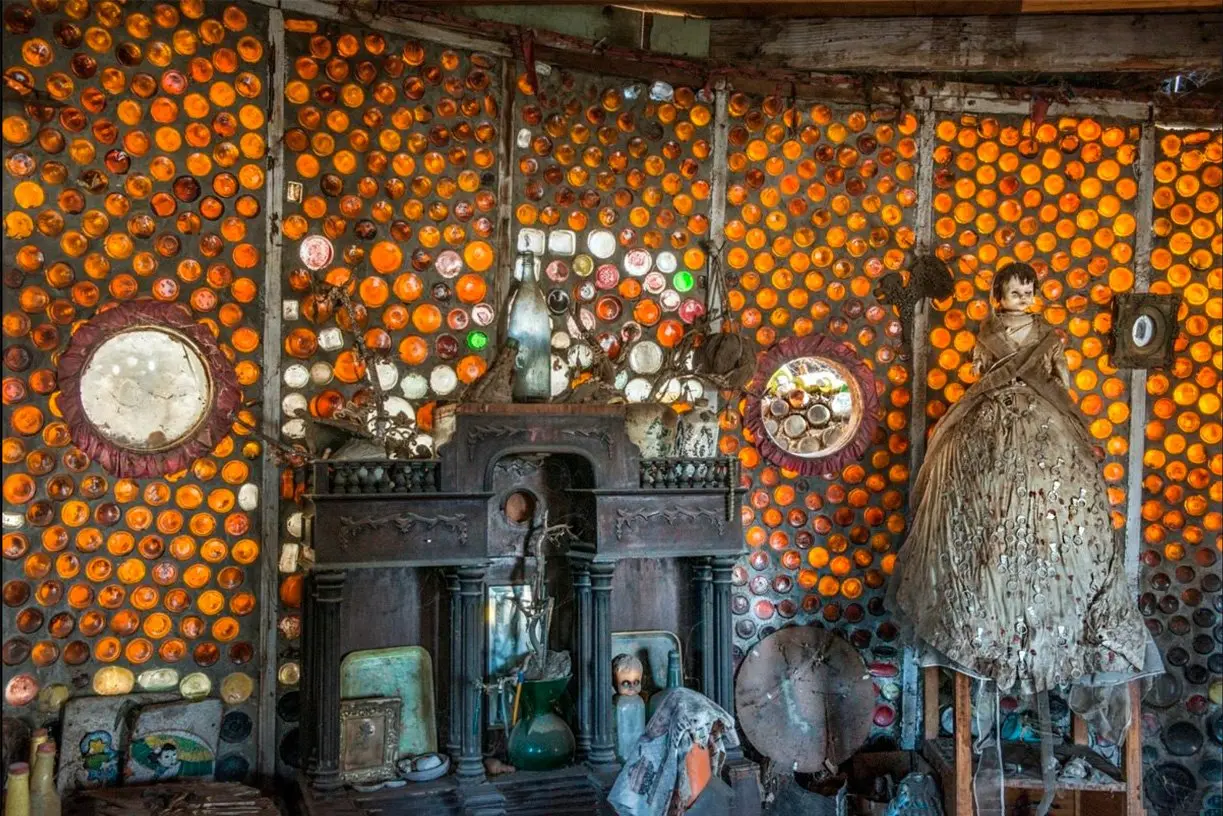
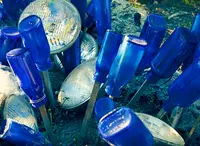
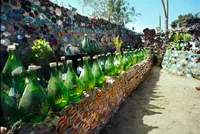
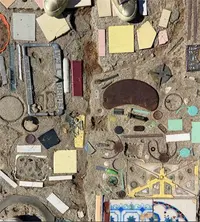
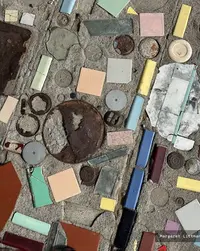
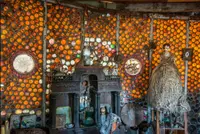
The walls are whole bottles laid on their sides in mortar. Prisbrey used amber and green beer bottles, clear bottles often painted inside, and cobalt-blue Milk of Magnesia bottles. She sometimes set the blue ones in bright white cement for contrast. Her usual mortar was three parts sand to one part gray cement, and she laid only a few courses a day so it could cure. In any one wall the bottle ends all point out or all point in, never both. In the Round House she put larger bottles low and smaller ones of matching color above. The early houses stand on bottle walls alone. The later ones have 2x4 framing filled in with bottles, and some have round footprints. Roofs are mostly corrugated metal. She covered the ceilings with salvaged fabrics stitched together. She set the floors with broken tile, scissors, license plates, cups, cigarette lighters, marbles, sunglasses, and toy guns. Car headlamps serve as planters beside most doorways. The National Register form notes the sunlight that floods through the bottle walls, particularly at dusk.
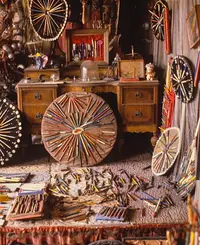
Each house had a theme, usually its contents. Her collections included lipstick cases, pine cones, horseshoes, shells, toothbrushes, golf tees, shot glasses, more than 200 hand-painted gourds, and over 600 dolls. The dolls lived in the Doll House, where she changed their outfits and called them “the ladies.” The Round House held a round bed. The Shell House was the only one with plumbing. Outside are the Dolls’ Head Shrine, the Shrine to All Faiths, a fence of television tubes, a pyramid, and a cactus garden. There are also stepping stones shaped as hearts, diamonds, and spades, filled with objects such as scissors, after a trip she made to Las Vegas. In 1982 the Dolls’ Head Shrine appeared on the cover of Wall of Voodoo’s single “Mexican Radio.”
The count of buildings depends on who is counting. The preservation group lists 16 one-room structures, and Prisbrey’s booklet records 15 of the 16 done by 1960. The National Register form says she made seventeen. The state landmark guidebook gives the village today as 13 buildings and 20 sculptures.
A wall against the turkey farm
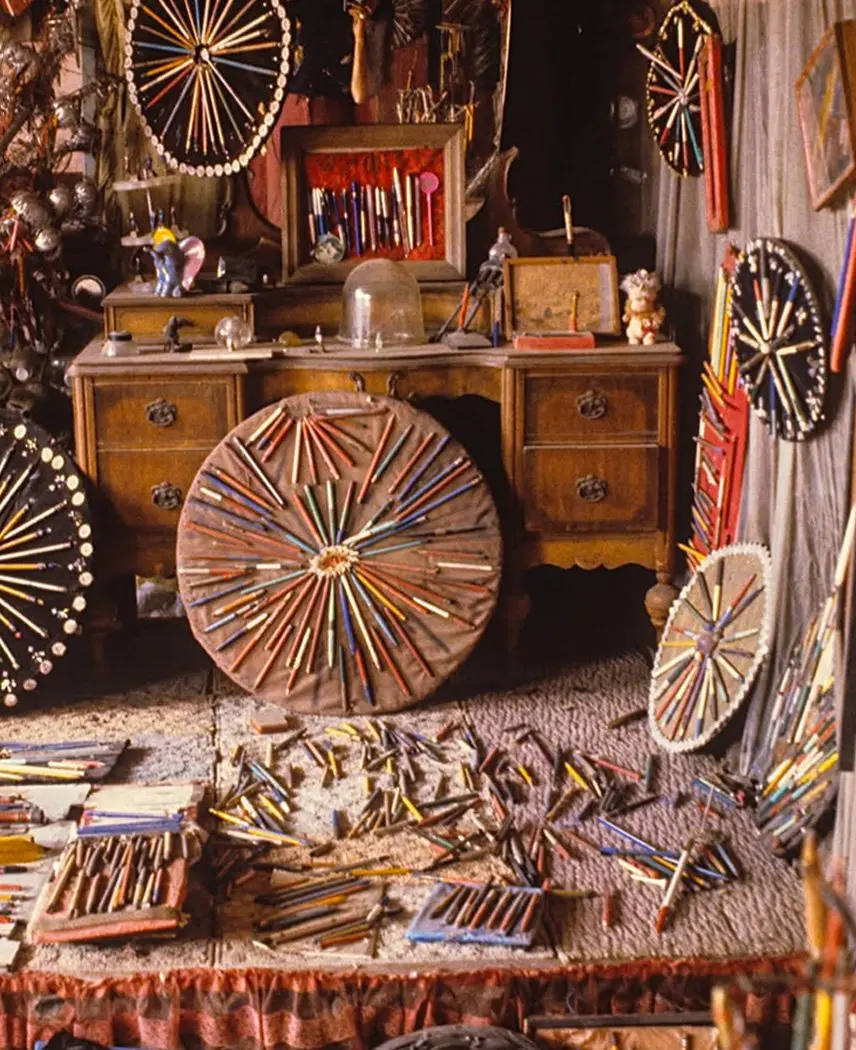
Prisbrey was born Tressa Luella Schaefer in Easton, Minnesota, in 1896 according to Wikipedia and the SPACES archive. Philadelphia’s Magic Gardens gives 1898. She was the youngest of eight, and her family homesteaded in Minot, North Dakota. At 15 she married her elder sister’s former husband, Theodore Grinolds, who was 52. They had seven children, and he died in 1931. A brief turn in North Dakota politics started her first collection, autographed campaign pencils. During World War II she assembled parts for Boeing in Seattle and learned welding and riveting.
She reached Simi Valley by 1946 or 1947 and worked at the Tapo Citrus packing house. In the late 1940s she built herself a house of cement block. She sold it to pay for ulcer surgery and used the rest to buy the lot on Cochran Street. In 1955 she and her second husband, Albert Prisbrey, settled there in a trailer. She “took the wheels off the trailer and hid them” to prevent any “further meandering about the country.”
Accounts of why she began differ. She told visitors she needed a house for her pencils:
“I went to get cement blocks to build this house for my pencils and, my God, they were so expensive, so I went over to the dump, and I thought, ‘I’m going to make it out of bottles…’”
Philadelphia’s Magic Gardens says she first wanted a wall to hide the turkey farm. Her own writing, quoted by the historian Elizabeth Driscoll Smith, gives another reason: “I got to thinking about various things I could do to our one-third acre which could make it pay.” In 1956 she began the Bottle Wall, a retaining wall along the east side of the lot. She followed it with the First Pencil House, later called the Shot House when it held shot glasses.
The first bottles came from her husband’s “bad habit.” After that she combed the landfill daily, driving a Studebaker pickup in a large sunhat and, Smith writes, without a license. Soda bottles usually went back for the two-cent deposit, so she found mostly Milk of Magnesia and liquor bottles. Her sons helped with some roofs and heavy work, and Smith names her son Frank and her grandsons. She laid the walls, mixed the mortar, wired the buildings for electricity, and invented the designs herself.
A quarter at the gate
People stopped to watch. “I liked it, and so did other people who rubbered in to see what I was doing, and stayed around to give me ideas on how to do it,” she wrote. In 1959 the county granted her an outdoor advertising permit. Her sign offered tours at ten cents for children and a quarter for adults. She began charging after repeated thefts, as more visitors came once the Automobile Club of Southern California listed the village. Prices later rose to a dollar for adults, 50 cents for teens, and 25 cents for children.
The name came from her grandchildren. Tourists heard them call her Grandma and did the same, and she put “Grandma’s Bottle Village” on her signs and on a yellow brochure first printed in 1960. She sold it for a dollar and often signed it with a quotation: “Anyone can do anything with a million dollars—look at Disney. But it takes more than money to make something out of nothing, and look at the fun I have doing it.” She served lemonade and fresh cookies, and photographs show her in a frilled half-apron. Her tours ran from jokes about North Dakota to the deaths in her family. They often ended in the Meditation Room, where she played the piano and sang risqué songs from the 1920s.
Visitors offered to buy pieces out of the walls. Many wanted a brown plaque of Queen Victoria pried from the Rumpus Room floor. “Many people want me to dig it out and sell it to them, but I like it where it is,” she wrote. “And I don’t think I am being a bit disrespectful to Her Majesty, either.” Her brochure quotes a neighbor who took visiting parents from Indiana to Knott’s Berry Farm, Marineland, and Disneyland: “The only thing my dad talked about was the Bottle Village.” On February 2, 1972, the local paper pictured Mrs. Clyde Locke, 80, of Memphis, holding the brochure under the headline “I’ll be Back.” The architectural historian Esther McCoy came in July 1974 and left with two copies. She wrote that Prisbrey’s work recalled Goethe’s description of folk art: “like a word of God spoken this instant.”
The Headlight Garden and the Shell House
Six of Prisbrey’s seven children died before she did. The Heart-shaped Shrine is for her daughter Velma, who died at 35 or 36. Prisbrey built the Shell House in two days after learning that a son ill with cancer would return to her care. After he died she filled it with seashells. She made the Headlight Garden for a daughter who loved flowers and had been diagnosed with cancer, with car headlights standing in for roses. Wikipedia says the daughter liked to sit by the garden in silence each morning. Prisbrey told how, on the day her daughter died, the roses “died” too. Her own advice was short: “If you’re feeling bad, find something to do and do it!”
In 1972 she sold the property and moved to Oregon to care for her son Hubert. After he died in 1974 she came back. The new owner, a local realtor, let her live rent-free in her trailer as caretaker and guide. Philadelphia’s Magic Gardens tells it as a sale after the deaths of her second husband, a daughter, and three sons, and a return after the death of a fourth. She went on adding sculptures and planters until 1981.
Northridge and the federal money
In 1979 the Preserve Bottle Village Committee formed to buy and restore the site. Prisbrey was in her early 80s and had suffered small strokes. That year the folk-art specialist Don Howlett found theft losses, deteriorating roofs, water damage, cracking and leaning walls, and poor wiring. A $5,000 National Endowment for the Arts grant, dated 1980 by the preservation group and 1981 in the National Register form, paid for a 15-by-6-foot bottle mural in the Simi Valley Library. Prisbrey designed it, and her assistant Jeff Wack, a co-founder of the committee, completed it. The state landmark designation came in 1981. In 1982 city officials ordered the village closed for building code and safety problems. That same year Prisbrey moved to San Francisco to live with her daughter, Othea “Babe” Krieger.
The property was gift-deeded to the committee in July 1986. In 1987 the committee won a permit to run the village as a public museum, with one year to finish structural and seismic work, and it could not raise the money. By 1990 it had lost its tax exemption through an administrative oversight and paid back taxes, narrowly saving the site from auction. Engineers drew seismic plans in 1991 meant to “preserve [the buildings] as historic ruins.” Prisbrey had died in October 1988, of complications of a stroke, in a San Francisco convalescent hospital. The preservation group gives her age as 92 and the Simi Valley Acorn as 88. She is buried in Oakwood Memorial Park in Chatsworth.
The Northridge earthquake struck on January 17, 1994, at magnitude 6.7. The preservation group puts its center about 18 miles away, and Wikipedia says eight. Five structures and one object collapsed, seven structures were seriously damaged, and the collections lay “commingled with the fallen walls and exposed to the elements.” The Federal Emergency Management Agency paid $18,900 for an engineering report. Bud Goldstone, the structural engineer known for his work on Watts Towers, judged the bottle walls repairable. In 1996 the agency approved disaster aid, which made Bottle Village one of only two arts sites, with Watts Towers, to receive quake funds. Wikipedia puts the grant at $455,000.
In January 1997 Rep. Elton Gallegly moved to block it. He and former Councilwoman Sandi Webb opposed the grant, and Gallegly called it a waste of taxpayers’ money. According to the SPACES archive, opponents objected to federal money for constructions made of “garbage.” The agency’s director, James Lee Witt, ruled the site ineligible because it had not been open to the general public since 1984. All funding was rescinded in March 1997. The late artist Joanne Johnson, a docent and later board president, wrote that the “crumbling Bottle Village is an ironic paradox – built from castoffs, now cast aside.”
In 2018 a volunteer, Drew Kennedy, restored Prisbrey’s pencil collages, unseen since the early 1990s. She had made them on cookie sheets, acrylic, or whatever else she could find. That fall they hung in the Los Angeles Public Library’s Central Branch, in an exhibit that also showed typewriters collected by Tom Hanks. “I think she’d be surprised and delighted to see her collages on display in the library,” said Tanya Ward Goodman, a volunteer with the group.
Notable Events
- 1955The Prisbreys bought the one-third-acre property where Bottle Village would be built. npgallery.nps.gov
- 1956Tressa began the Bottle Wall, a retaining wall along the east side of the property, and shortly after built her first structure, the First Pencil House, also called the Shot House, to store her commemorative pencils. bottlevillage.org
- 1959Prisbrey received a county outdoor advertising display permit. journalpanorama.org
- 1960Prisbrey's booklet documented that the bulk of the work, including 15 of 16 structures, was complete by 1960. npgallery.nps.gov
- 1972Prisbrey sold the property and moved to Portland, Oregon. npgallery.nps.gov
- 1974Prisbrey returned as Bottle Village's caretaker. npgallery.nps.gov
- 1979Preserve Bottle Village has been a 501(c)(3) nonprofit since 1979. bottlevillage.org
- 1980Tressa received a National Endowment for the Arts grant to design and supervise a bottle mural in the new Simi Valley Library; the work and supervision under her were completed by artist Jeff Wack. bottlevillage.org
- 1981Bottle Village was officially designated a California State Historical Landmark. bottlevillage.org
- 1981Prisbrey's artistry was recognized with a $5,000 NEA grant to build a 15-by-6-foot bottle wall in the Simi Valley main library. npgallery.nps.gov
- 1982City officials ordered Bottle Village closed to the public due to building code and safety issues. bottlevillage.org
- 1982Because of poor health, Prisbrey moved to San Francisco to live with her daughter. npgallery.nps.gov
- 1984The landmark record gives a registration date of 07/21/1984 for this Twentieth Century Folk Art Environments thematic site. californiahistoricallandmarks.com
- 1986The property was gift-deeded to Preserve Bottle Village and a landmark dedication ceremony was held, unveiling historic markers; that year the committee also began working with architects on a plan to reopen the site in a limited way. bottlevillage.org
- 1987After addressing numerous conditions PBVC received a Special Use Permit to operate Bottle Village as a public museum on residential land, with only one year allowed to complete significant structural and seismic work. bottlevillage.org
- 1988Tressa 'Grandma' Prisbrey died. npgallery.nps.gov
- 1990Facing serious financial strain, the group lost tax-exempt status through administrative oversight and had to pay back property taxes, narrowly saving the site from auction. bottlevillage.org
- 1994The Northridge earthquake, centred about 18 miles from Bottle Village, collapsed five structures and one object completely, seriously damaged seven structures and partially damaged one more, scattering the collections among the fallen walls. bottlevillage.org
- 1996FEMA approved disaster assistance for the quake repairs, making Bottle Village one of only two arts sites besides Watts Towers to receive FEMA quake funds. bottlevillage.org
- 1996The art environment was added to the National Register of Historic Places. phillymagicgardens.org
- 1997Under mounting political pressure, FEMA froze then rescinded all Bottle Village funding in March 1997, invoking regulations that limited assistance to facilities with established budgets and clear, regular public use; without seismic work the village could not regain its permit to operate. bottlevillage.org
People
- Bud Goldstone, structural engineer hired after the Northridge earthquake, noted for his work on Watts Towers, who judged the bottle walls repairable.
- Don Howlett, folk-art specialist who made the condition assessment finding the Village generally stable but with theft losses, deteriorating roofs and framing, water damage, cracking and leaning walls and poor wiring (1979).
- Elton Gallegly, congressman who moved to block the federal disaster money for the village (January 1997).
- Harry Kobzeff, landscape architect on the Preserve Bottle Village master plan.
- Jeff Wack, artist, co-founder of the Preserve Bottle Village Committee and assistant to Prisbrey, who completed the library mural work and supervision under her (1980).
- Othea “Babe” Krieger, Prisbrey's daughter, in whose San Francisco home she lived after leaving the Village (1982).
- Raymond Girvigian, architect who worked with Preserve Bottle Village on the master plan drawn up to reopen the site in a limited way (1986).
- Velma, Prisbrey's daughter, memorialized by the Heart-shaped Shrine (died at 35/36).
- Tressa “Grandma” Prisbrey, Creator and builder of Bottle Village (1956 to 1981).
- Albert Prisbrey, Tressa Prisbrey's second husband (1954).
- Tanya Ward Goodman, volunteer who works to preserve Bottle Village and its collections, and source for the account that the village was created to store Prisbrey's pencil collages and dolls.
Sources
- bottlevillage.org
- bottlevillage.org/bottle-village
- californiahistoricallandmarks.com/landmarks/chl-939.9
- spacesarchives.org/explore/search-the-online-collection/grandma-prisbreys-bottle-village
- simivalleyacorn.com/articles/sharpen-your-respect-for-bottle-village
- bottlevillage.weebly.com
- npgallery.nps.gov/GetAsset/042b000e-ec72-4381-a357-523e99911b84
- library.csuci.edu/collections/bottle
- journalpanorama.org/article/tressa-prisbrey
- phillymagicgardens.org/about-philadelphias-magic-gardens/visit-from-home/art-environments/art-environment-creators/tressa-prisbreys-bottle-village