

Grand Coulee Dam Visitor Center
Coulee Dam, Grant County, Washington. Visitor center.
Details

- Where
- Grand Coulee Dam Visitor Center, WA-155, Coulee Dam, WA 99116. Directions
- When
- Public tours every Friday, Saturday and Sunday May 22-Oct. 31, 2026, about one hour, first-come first-served, at 9 a.m., 10 a.m., 11 a.m., 1 p.m., 2 p.m. and 3 p.m. Pacific Time; free; limited availability; can be canceled without notice.
- Season
- Closed on Thanksgiving, Christmas, and New Year's Day.
- Getting there
- 90 miles west of Spokane, Washington on State Highway 155.
- Fees
- Free.
- Hours
- Open daily 8:30 a.m.-5 p.m. Pacific Time; closed Thanksgiving, Christmas, and New Year's Day.
- Access
- All tour participants pass through a metal detector before beginning the tour; cameras allowed but camera cases must remain in vehicles; no onsite storage for personal belongings.
- Walk-in or reserve
- None; tickets are not required to watch the light show.
- Phone
- 509-633-9265
- Website
- usbr.gov
- Managed by
- Bureau of Reclamation.
- Established
- Late 1970s.
- Coordinates
- 47.95483000000000, -118.98992000000000.
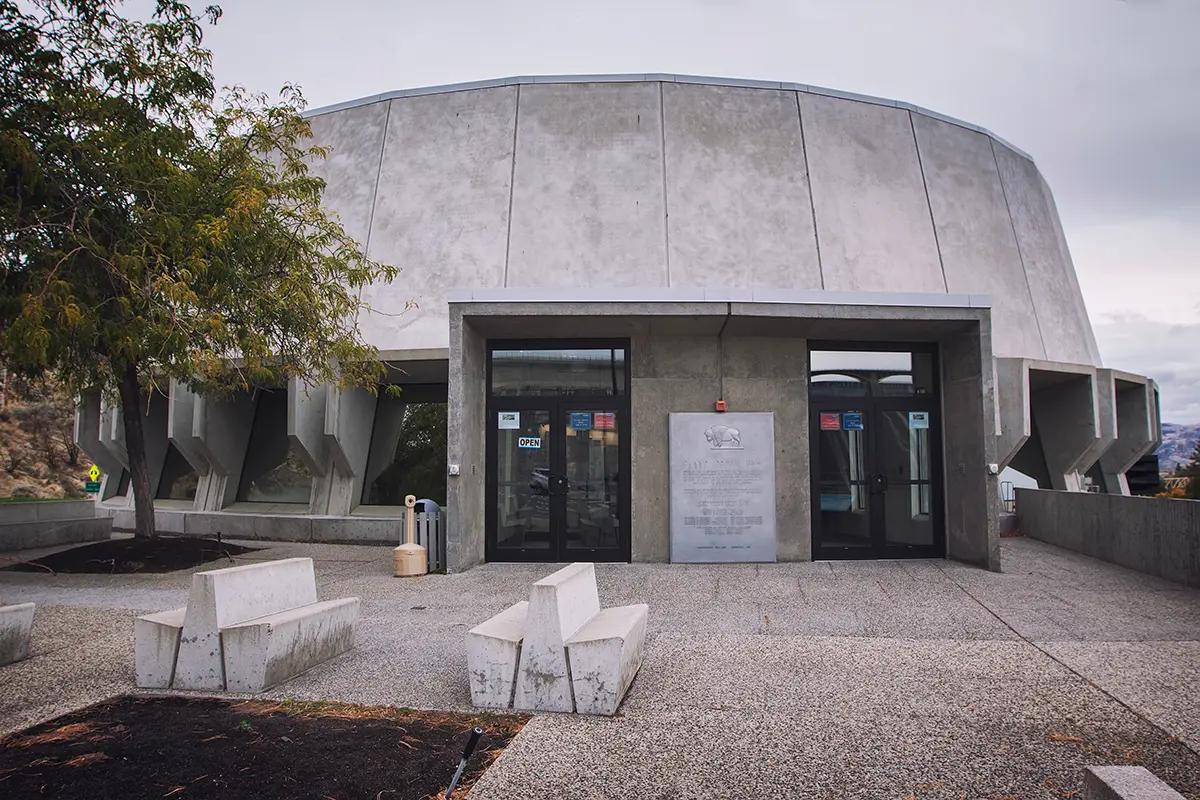
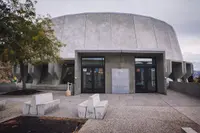
A six-foot concrete tablet with raised metal lettering stands between the entrance doors of the Grand Coulee Dam Visitor Center. “Begun in time of adversity,” it reads, “it stood in war as a sentinel of strength safeguarding the nation.” Below that are the names of the people who carried the work through. There are two presidents, Franklin D. Roosevelt and Harry S. Truman, and three secretaries of the interior. There are four commissioners of reclamation, each with his chief engineer, and three regional directors. Last comes the construction engineer, Alvin F. Darland, and the years of construction, 1933–1950. A marker to Franklin Delano Roosevelt stands beside it.
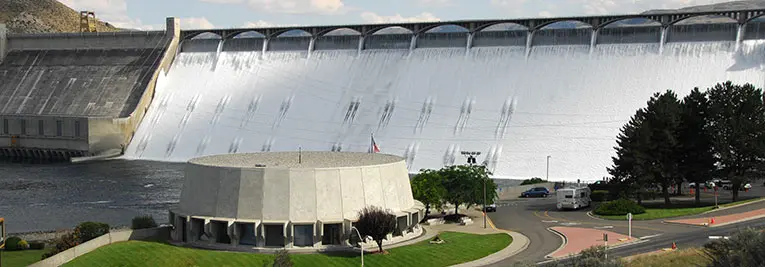
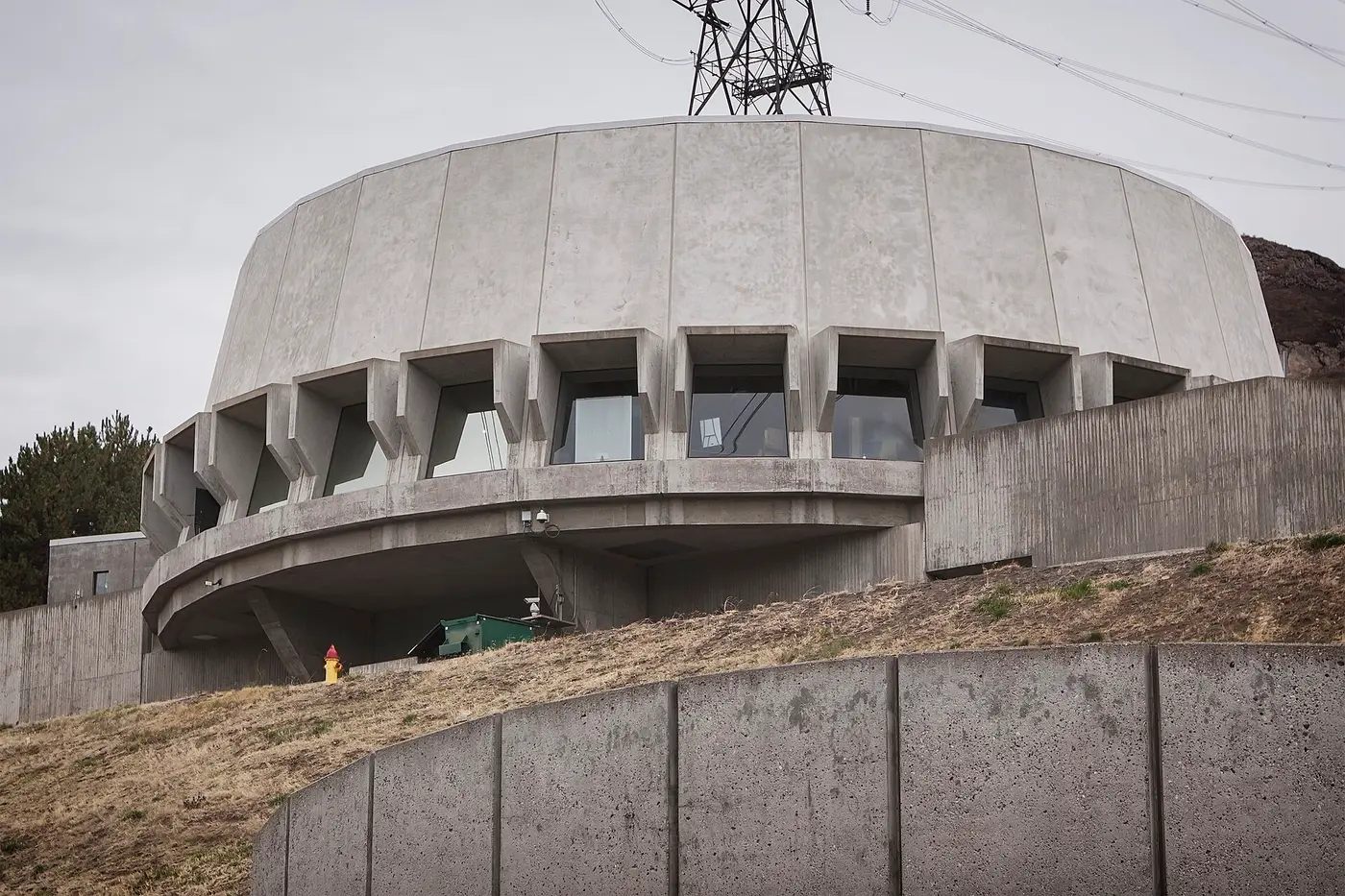
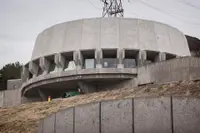
The building that holds the tablet is a cylinder at the base of the dam on State Highway 155, about 90 miles west of Spokane. The dam above it is 550 feet tall. The Grant County tourism office describes it as rising from a 500-foot-wide polished granite base to a 30-foot crest that carries a paved two-lane road. With the third powerhouse included, the county puts its length at almost a mile.
Six exhibits inside the rotor
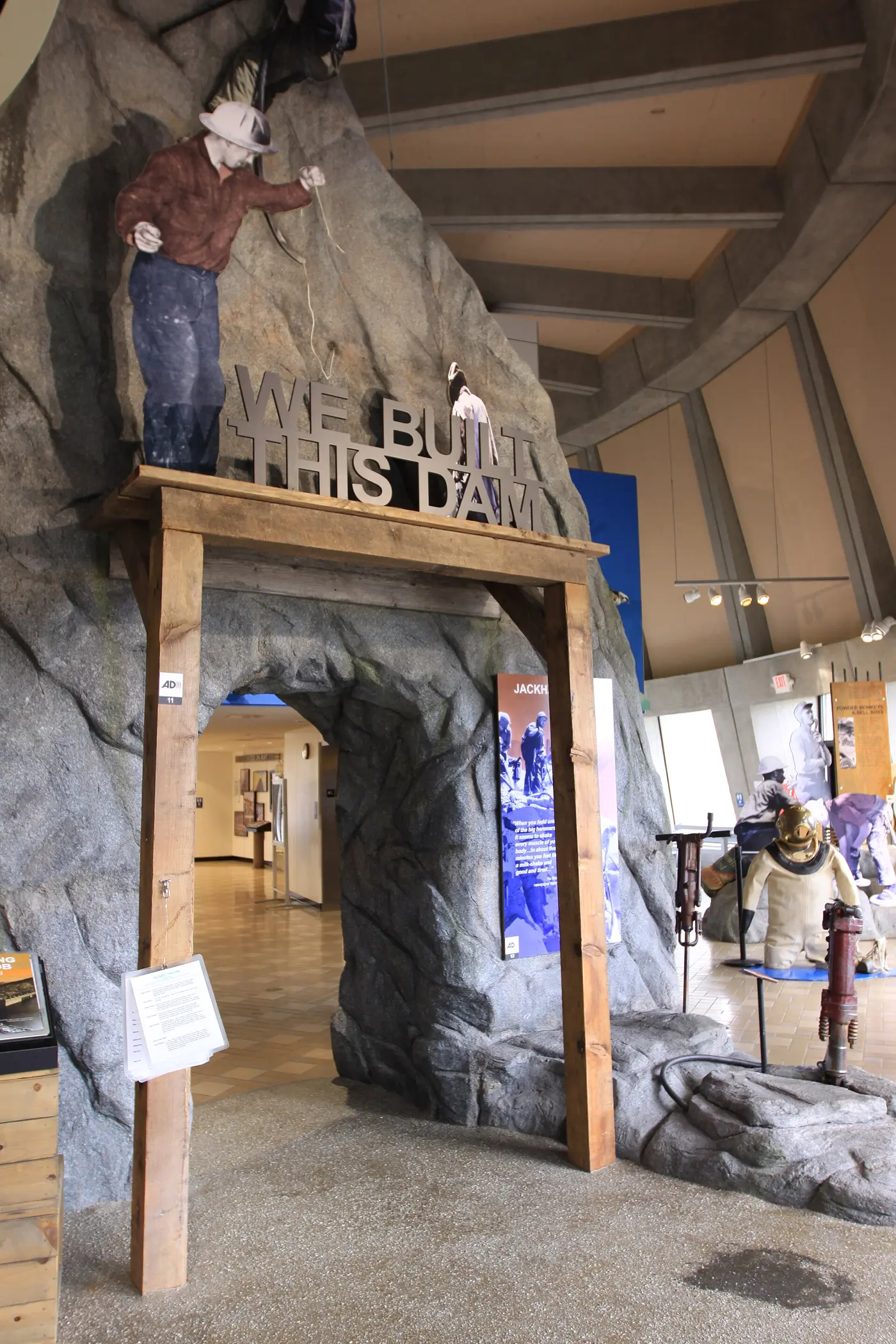
The Bureau of Reclamation runs the center, and admission is free. The National Park Service lists a staff member on hand, picnic tables, and a scenic view and photo spot among its amenities. The building was retrofitted in 2004 for seismic, life-safety, and accessibility standards. It has an auditorium and hands-on exhibits. The Bureau’s visit page also lists a film, Grand Coulee Dam: A Man-Made Marvel, and a printed Knowledge Scavenger Hunt.
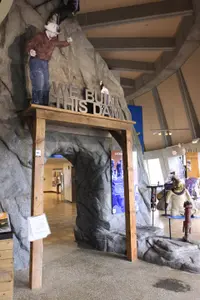
The present exhibits went in during 2006. Formations, Inc., of Portland, Oregon, designed, built, and installed them. Reclamation’s exhibits page names them:
- The Power of Water
- We Built this Dam: Oral History
- Our Stories: The Tribal Viewpoint
- three scrapbooks: “Memorable Moments,” “Getting Started” for 1933 to 1938, and “Finishing the Job” for 1938 to 1950
According to the center’s brochure, “We Built This Dam” plays audio excerpts from interviews “with people who were actually there.” The brochure also says “Our Stories” centers on interviews with six members of the Colville Tribe: “What seemed a grand accomplishment to some was considered a destructive intrusion by many tribal members.” The National Scenic Byway Foundation places the dam on the Colville Indian Reservation.
The same brochure lists other hands-on pieces:
- a virtual-reality fly-through of the dam
- an operating jackhammer
- a game called “Balancing Act,” in which a visitor sets the dam’s operations among flood control, power, irrigation, fish flows, and recreation, then sees “the benefits and consequences” of the choice
Reclamation’s exhibits page notes that some hands-on exhibits may be temporarily unavailable.
Outside, the grounds hold caches for the D3 Geocaching Challenge, which Grand Coulee shares with Chief Joseph and Rocky Reach dams. The three Grand Coulee caches carry these names:
- “Don’t BUST the Balloon...a Point-of-a-View”
- “A Means to Reclaim the Land”
- “Dam, A Clock & What a View”
A finder who answers the questions correctly at the visitor center gets a stamp in a D3 passport and a prize. All three dams’ stamps earn a commemorative patch. In April 2013 the National Hydropower Association gave the program its Outstanding Stewards of America’s Waters Award for public education.
Lasers on the spillway
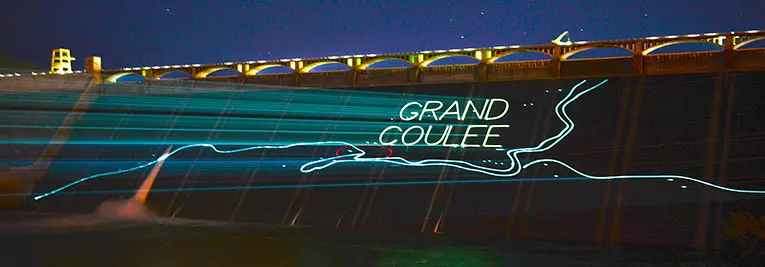
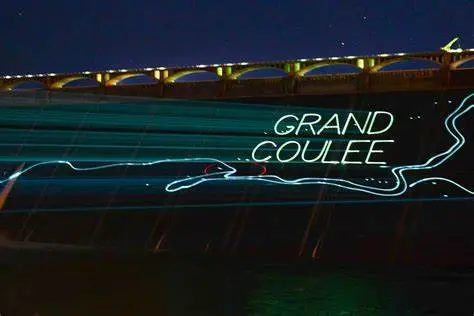
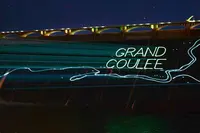
On summer nights the dam itself becomes a screen. “One River, Many Voices” is a laser show of about 30 minutes, projected across the face of the dam. The show can be seen and heard from the visitors’ arrival center, where there are viewing bleachers. No tickets are required.
The Grant County tourism office describes the show this way: the Columbia River narrates how and why the dam was built while lasers move across the whole span and over the spillway, ending with a patriotic finish. The 2026 season opened Friday, May 22. Shows began at 10 p.m. through July 31, at 9:30 from August 1, and at 8:30 through September. The 2026 show ended September 30, and Reclamation says it will resume in May 2027.
The first laser show was commissioned for 1989, the centennial of Washington’s statehood. The Star, the Grand Coulee newspaper, ran a 2011 photograph of that show: beams from the visitor center draw a map of Washington on the dam and mark the dam’s place on it. The original equipment was replaced in 2013, and “One River, Many Voices” premiered in 2014. The old show returned for a single night on July 4, 2025.
An older display of colored floodlights has also come back. A fire had ruined its control panel decades earlier. On December 31, 2024, Reclamation relit it, and the dam shone blue, green, red, and amber on New Year’s Eve for the first time in 24 years. A Star photograph shows a family at the base watching the face shift from blue to white to orange to red. The lights then ran nightly from 5 to 7 p.m. until March 6.
A bus ride over the crest
Guided tours visit the John W. Keys III Pump-Generating Plant. They leave from a tour building on the east side of the river. From the visitor center the route runs northwest on Highway 155, then across the Grand Coulee Bridge, onto Roosevelt Way through a gate, and half a mile down Marina Way. The Bureau of Reclamation began the bridge in late 1934. It is a 950-foot cantilever steel truss, built to carry heavy equipment across the Columbia during construction and then to serve as the permanent highway.
Each visitor passes through a metal detector. Cameras are allowed, but camera cases must stay in the car. Purses, bags, backpacks, and packages are not allowed, and there is no place to store them. Visitors ride a bus to the plant. The tour, about an hour long, ends with a bus ride along the top of the dam. In 2026 the tours run first-come, first-served on Fridays, Saturdays, and Sundays from May 22 through October 31, at six times a day.
Frozen concrete and a folk song
The Washington Trust for Historic Preservation’s Revisiting Washington tour says the visitor center was once called the United States Government West Conservation Point. That account notes it “affords a splendid view of the slowly rising dam.”
The rising began with core drilling in the late summer of 1933. Groundbreaking ceremonies were held July 16 of that year. On July 13, 1934, the contract for a low dam went to the Mason-Walsh-Atkinson-Kier Company, or MWAK. The Revisiting Washington account spells the last name Kerr and says work began that October. In June 1935 the plan changed to a high dam. Concrete placement began that fall. As winter set in, several pours froze and had to be blasted out and replaced. According to the National Park Service, nearly 11,000 men worked more than 27 million hours on the river diversion, excavation, and concrete, and 45 of them died.
On May 12, 1938, Reclamation accepted the finished foundation from MWAK. Consolidated Builders Inc. of Oakland took the contract to raise the dam to its full height. On May 21, 1939, one bucket of concrete marked 60 percent of the 10,500,000 cubic yards the dam proper required. The sources disagree on when power came. Revisiting Washington gives March 22, 1941, for the first generators. The Park Service says the first generator went into service October 4, 1941.
That year, Woody Guthrie wrote “The Song of the Grand Coulee Dam” under contract with the Bonneville Power Administration:
“Biggest thing built by the hand of a Man… Power that sings, boys, turbines that whine. Waters back up the Canadian Line.”
Reclamation accepted the dam on January 1, 1942. Its power went into aluminum for wartime planes and ships. The Park Service says water pumped from the dam first reached Columbia Basin lands in 1948. The Spokesman-Review gives 1951.
Breuer’s commission
The visitor center came out of a later expansion. Reclamation began looking for a third powerplant site in 1952, but the project stalled for more than a decade. In 1967 Commissioner Floyd Dominy appointed a Board of Artistic Consultants, and he later recalled its findings:
“I was delighted, but not too surprised, when the board came back from a survey trip to assert that many of our dams were things of sculptured beauty. But they added that some appurtenant structures and surroundings left something to be desired.”
That September, Reclamation staff visited Marcel Breuer’s Manhattan office to negotiate a contract. A week later Tician Papachristou, an architect on Breuer’s staff, wrote: “Mr. Breuer has asked me to convey to you again his strong personal interest in this commission.” The scope of the work named “visitors’ facilities.” Reclamation accepted Breuer’s design for the Third Power Plant and Forebay Dam in February 1968, with Hamilton P. Smith as partner in charge. Breuer described the plant’s concrete as having “dimensions truly Egyptian.”
The first generating unit in the Third Powerplant started in August 1975. Three years later, according to the preservation group Docomomo US, the cylindrical visitor center opened on the opposite side of the river. Breuer’s archive at Syracuse gives its completion as 1978. The archive also says Reclamation asked Breuer to redesign the older parts of the dam, a commission that was never carried out.
The plant, which Reclamation now calls the Nathaniel “Nat” Washington Power Plant, brought its last generator online in 1980. Grand Coulee then became the largest hydropower complex in the United States, at 6,809 megawatts. According to Docomomo, Breuer’s failing health kept him from visiting the finished project, and he died in 1981.
Notable Events
- 1933The entrance inscription dates dam construction to 1933-1950. hmdb.org
- 1933Groundbreaking ceremonies took place on July 16, 1933, just days before funds were approved for Bonneville Dam downstream. nps.gov
- 1933Work on the Coulee Dam site began with core-drilling. revisitwa.org
- 1934ASCE gives the completion date as 1934-1941. asce.org
- 1934The contract for a low dam, awarded on July 13, 1934, went to the Mason-Walsh-Atkinson-Kier Company (MWAK). nps.gov
- 1938Reclamation received the completed foundation from MWAK, and a new contract was issued to Consolidated Builders Inc. (CBI) of Oakland, Calif., to complete the dam to its full height of 550 feet and build the Left Powerhouse. nps.gov
- 1938The first unit was finished; the foundation or ‘lower dam’ was then in place. revisitwa.org
- 1939A bucket of concrete marked completion of 60 percent of the 10,500,000 cubic yards needed to complete the dam proper. revisitwa.org
- 1941The first generators began producing Grand Coulee power. revisitwa.org
- 1942Grand Coulee took eight years to build, employed thousands of men during the Great Depression, and was completed in 1942. nps.gov
- 1942The concrete gravity dam was completed in 1942 and supplied power needed for aluminum for World War II planes and ships. spokesman.com
- 1948Water pumped from Grand Coulee began reaching Columbia Basin lands in 1948 and today irrigates about 670,000 acres. nps.gov
- 1950sIn the 1950s, the American Society of Civil Engineers listed Grand Coulee as one of the seven civil engineering wonders of the United States. nps.gov
- 1951Water pumped from Grand Coulee began reaching Columbia Basin lands. spokesman.com
- 1952Operation of the first two plants had barely become routine when Reclamation began exploring possible sites for another plant; implementation was delayed for more than a decade by political and economic issues. docomomo-us.org
- 1960sReclamation sought to reduce spilling water, Northwest power demand grew, and continental power grids were interconnected. docomomo-us.org
- 1967Preliminary site work began months before Reclamation contacted Breuer. docomomo-us.org
- 1967Construction began on the Third Power Plant designed by Marcel Breuer in his ‘Brutalist’ style. spokesman.com
- 1968The Bureau of Reclamation accepted Breuer's proposal for the design of the Grand Coulee Third Power Plant and Forebay Dam in February of 1968. breuer.syr.edu
- 1970Vinnell-Dravo-Lockheed-Mannix won the prime construction contract. docomomo-us.org
- 1970sThe visitor center was built as part of the dam's Nathaniel ‘Nat’ Washington Power Plant expansion. usbr.gov
- 1972Central Pre-Mix Concrete Company began producing the prestressed, precast roof tees at its Spokane facility. docomomo-us.org
- 1974The Third Powerplant opened. docomomo-us.org
- 1978Breuer designed a visitor center for the dam, completed in 1978. breuer.syr.edu
- 1980When the final generator came online at the Nathaniel Washington Power Plant in 1980, Grand Coulee Dam became the largest hydropower generating complex in the United States with a generating capacity of more than 6,809 megawatts. iafi.org
- 1989The original light show was commissioned to launch in celebration of the centennial anniversary of Washington's statehood. grandcoulee.com
- 2004The center was retrofitted in 2004 for seismic, life-safety, and accessibility standards. nps.gov
- 2006The new exhibits were designed, manufactured, and installed by Formations, Inc., of Portland, Oregon. nps.gov
- 2012The visitor center would reopen Friday after its temporary Oct. 1 move to the John W. Keys III Pump Generating Plant during stringing of new 500 kilovolt overhead lines. grandcoulee.com
- 2013The original laser equipment was replaced in 2013. nps.gov
- 2014A new laser light show, "One River, Many Voices," premiered in 2014. nps.gov
- 2022The "One River, Many Voices" laser light show and the John W. Keys III Pump-Generating Plant public tours resumed May 28, 2022. iafi.org
- 2024The Bureau of Reclamation relaunched its old light show on the face of Grand Coulee Dam. grandcoulee.com
People
- Hamilton Smith, Breuer's partner on the Grand Coulee Third Power Plant and Forebay Dam design (1972-1975).
- Floyd Dominy, Reclamation Commissioner who enlisted the Board of Artistic Consultants.
- Hamilton P. Smith, Breuer's partner in charge of the Grand Coulee expansion design.
- Harold Arthur, Denver USBR Office representative shown discussing the architectural design of the Third Powerplant and surrounding area.
- Kenneth Brooks, Spokane architect shown discussing the architectural design of the Third Powerplant and surrounding area.
- Marcel Breuer, Architect who designed the visitor center to resemble a generator rotor.
- Otis Peterson, Assistant to the Commissioner-Information shown discussing the architectural design of the Third Powerplant and surrounding area.
- Paul Weidlinger, Structural consultant for the Grand Coulee expansion design.
- Thomas Hayes, Associate architect for the Grand Coulee expansion design.
- Tician Papachristou, Architect on Breuer's staff who wrote to Reclamation after commission negotiations.
- Lynne Brougher, Grand Coulee Dam Public Affairs Officer explaining the temporary visitor-center relocation.
- Alvin F. Darland, Construction Engineer commemorated on the entrance tablet.
- Elwood Mead, Commissioner of Reclamation commemorated on the entrance tablet.
- Frank A. Banks, Regional Director and Supervising Engineer commemorated on the entrance tablet.
- Franklin D. Roosevelt, President commemorated on the dam-construction tablet at the visitor center (1933-1945).
- Harold L. Ickes, Secretary of the Interior commemorated on the entrance tablet.
- Harold T. Nelson, Regional Director commemorated on the entrance tablet.
- Harry S. Truman, President commemorated on the dam-construction tablet at the visitor center (1945-1953).
- Harry W. Bashore, Commissioner of Reclamation commemorated on the entrance tablet.
- John O. Page, Commissioner of Reclamation commemorated on the entrance tablet.
- Julius A. Krug, Secretary of the Interior commemorated on the entrance tablet.
- Leslie N. McClellan, Chief Engineer commemorated on the entrance tablet.
- Michael W. Straus, Commissioner of Reclamation commemorated on the entrance tablet.
- Oscar L. Chapman, Secretary of the Interior commemorated on the entrance tablet.
- Raymond F. Walter, Chief Engineer commemorated on the entrance tablet.
- Robert J. Newell, Regional Director commemorated on the entrance tablet.
- Sinclair O. Harper, Chief Engineer commemorated on the entrance tablet.
- Walker R. Young, Chief Engineer commemorated on the entrance tablet.
- John W. Keys III, namesake of the John W. Keys III Pump-Generating Plant, whose public tours run from the dam.
- Nathaniel "Nat" Washington, namesake of the dam's Nathaniel "Nat" Washington Power Plant, the expansion the visitor center was built with.
- Woody Guthrie, Folk singer who wrote ‘The Song of the Grand Coulee Dam’ under contract with the Bonneville Power Administration (1941).
Sources
- usbr.gov/pn/grandcoulee/visit/index.html
- usbr.gov/pn/grandcoulee/visit/gcvc.html
- usbr.gov/pn/grandcoulee/visit/laser.html
- usbr.gov/pn/grandcoulee/visit/tour.html
- usbr.gov/pn/grandcoulee/visit/exhibits/index.html
- usbr.gov/pn/grandcoulee/visit/geocache.html
- usbr.gov/pn/grandcoulee/visit/docs/20260311_GC_Visitor_Center_Hours_508.pdf
- nps.gov/places/grand-coulee-dam-visitor-center.htm
- recreation.gov/recreationalAreaDetails.do?contractCode=NRSO&recAreaId=1889
- grantcountywa.gov/1453/10873/Grand-Coulee-Dam-Visitor-Center-Laser-Light-Show
- columbiabasinherald.com/news/2024/may/21/grand-coulee-dam-laser-light-show-resumes-this-weekend
- hmdb.org/m.asp?m=129615
- revisitwa.org/waypoint/grand-coulee-dam
- spokesman.com/guides/grand-coulee-ice-age-brutalism/stop-43
- breuer.syr.edu/browse/projects-by-name/list/project-name/67736
- docomomo-us.org/news/powerhouse-marcel-breuer-at-grand-coulee
- grandcoulee.com/story/2012/10/03/news/grand-coulee-dam-visitor-center-operations-move/1249.html
- grandcoulee.com/story/2012/11/21/news/newsbriefs/1454.html
- grandcoulee.com/story/2025/07/02/community/special-showing-planned-for-older-light-show/18538.html
- grandcoulee.com/story/2025/01/08/news/grand-coulee-dam-lights-up-on-new-years-eve-for-the-first-time-in-24-years/18047.html
- npshistory.com/publications/laro/brochures/vc-exhib.pdf
- nps.gov/articles/washington-grand-coulee-dam.htm
- asce.org/about-civil-engineering/history-and-heritage/historic-landmarks/grand-coulee-dam
- iafi.org/grand-coulee-dam-visitor-center
- nsbfoundation.com/nb/coulee-corridor-scenic-byway