
Grand Canyon Railway
Williams, Coconino County, Arizona. Heritage railroad; Departing Daily from Williams, AZ.
Details

- Where
- 233 N. Grand Canyon Blvd., Williams, AZ 86046. Directions
- When
- Daily 9:30 a.m. Mountain Time (8:30 a.m. November/December); returns 5:45 p.m. (4:45 p.m. November/December).
- Getting there
- Departs from the Williams Depot.
- Fees
- $39.00 – Pumpkin Included!
- Hours
- Nightly at 5:30 p.m. and 7:30 p.m (Arizona Mountain Standard Time).
- Access
- Scooters may not be more than 26 inches wide and 50 inches long. The lift mechanism on the train also has a maximum total weight of 500 lb. allowed.
- Walk-in or reserve
- Space is limited on each departure, and weekends are expected to sell out. Booking early is highly recommended.
- Phone
- 1-800-843-8724
- Website
- thetrain.com
- Managed by
- Xanterra Travel Collection.
- Established
- 1901.
- Coordinates
- 35.252417, -112.191220.
The Williams Depot was built by the Atchison, Topeka and Santa Fe Railroad in 1908. It now holds the ticket counter, a retail shop and a coffee house for the Grand Canyon Railway. Before the 9:30 a.m. departure, cowboy characters stage a Wild West Shootout. Passengers board about fifteen minutes ahead of time, and every seat is assigned. Williams lies off Interstate 40, 32 miles west of Flagstaff, at about 7,000 feet among ponderosa pine. Route 66 serves as its main street, two blocks south of the depot.
The morning train to the South Rim
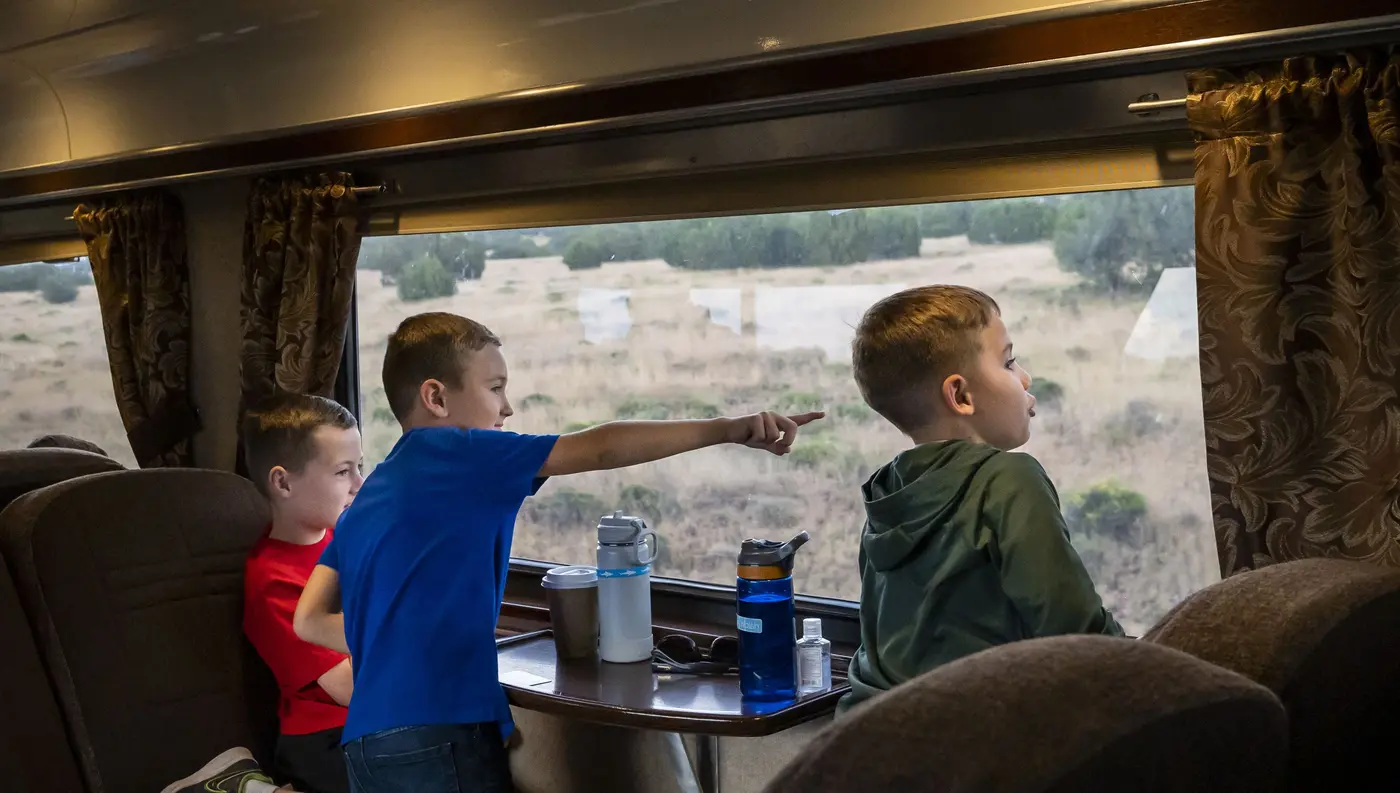
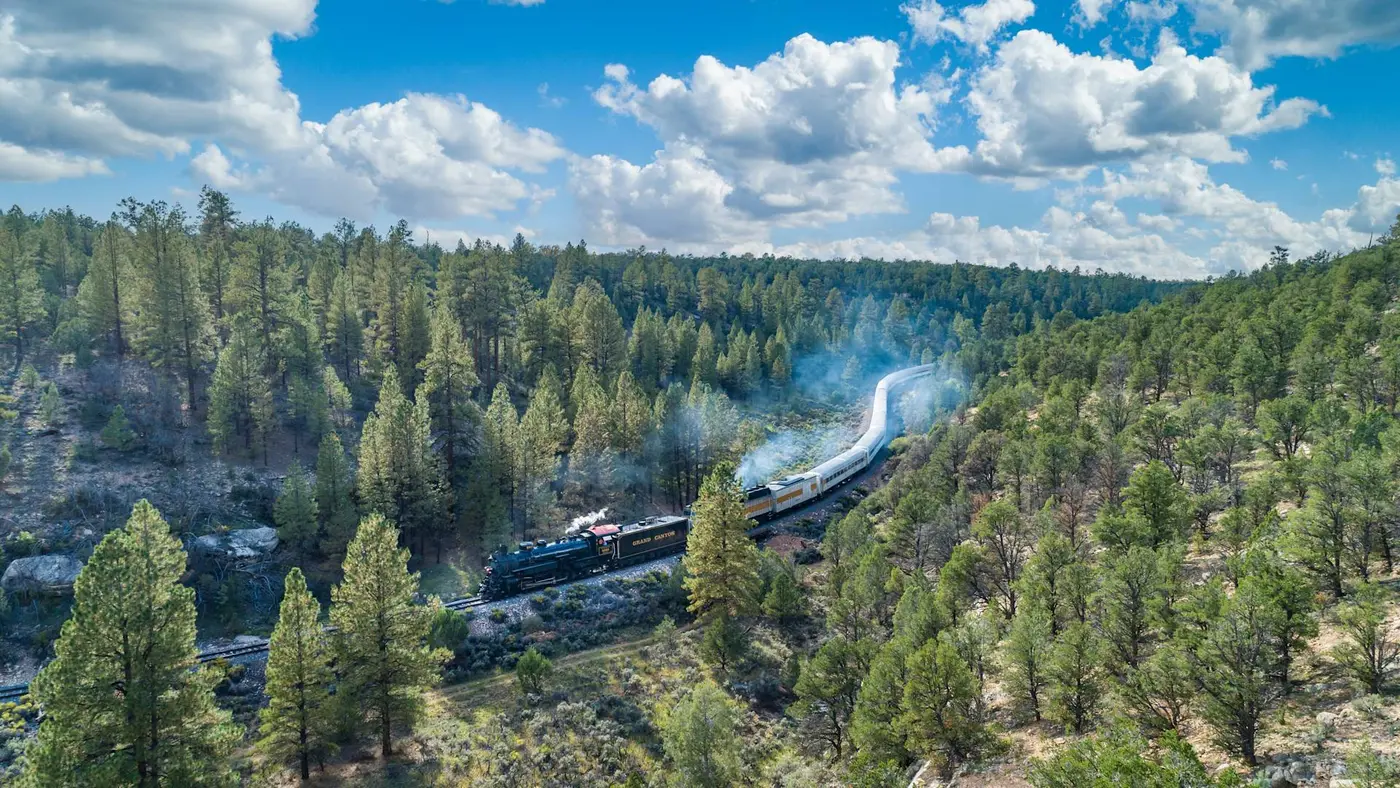
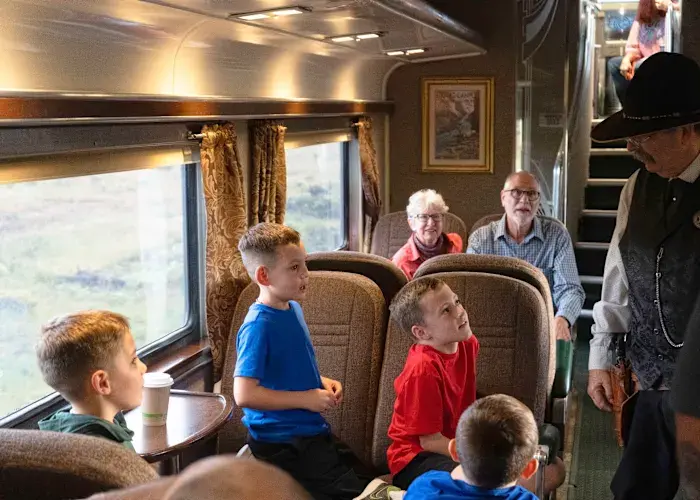
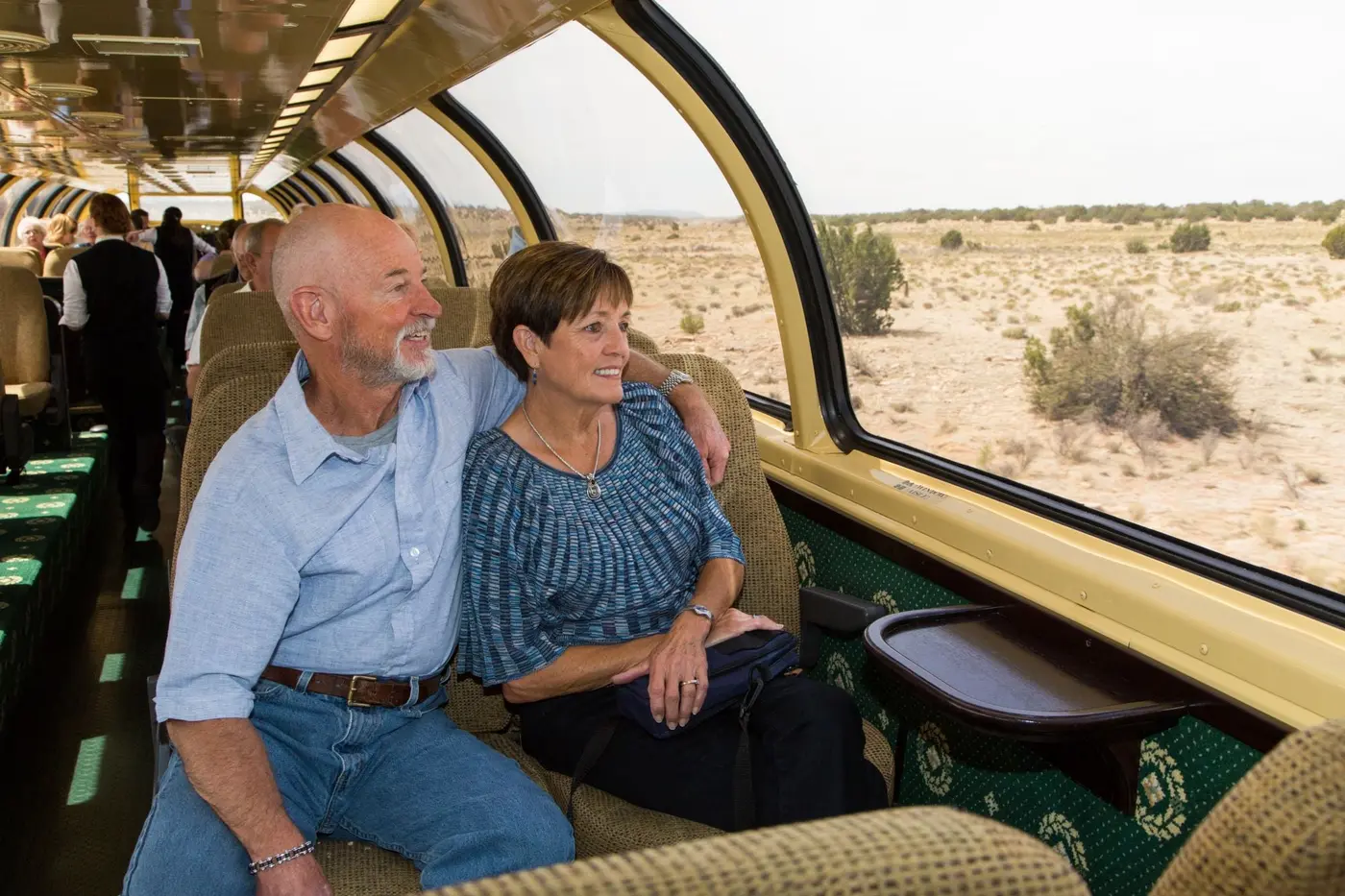
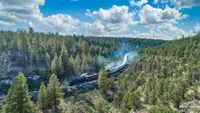
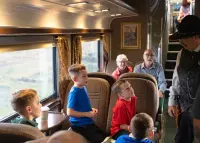
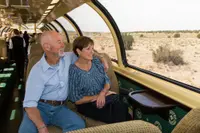
The run north covers 65 miles in two hours and fifteen minutes. The railway describes the country outside the window changing “from high desert to prairie, prairie to pine.” Western musicians play in the vintage cars, and bandits work the aisles. In August 2026 a pair of travelers posting as @welcometoarizona reported that their train was “robbed” by outlaws on the way back to Williams.
The train reaches the Grand Canyon Depot at 11:45 a.m. It stops in the Historic Village, where the paved Rim Trail runs about 13 miles along the South Rim between the South Kaibab Trailhead and Hermits Rest. Passengers have a little over three hours at the rim. The train leaves at 3:30 p.m. and is back in Williams at 5:45 p.m. In November and December the whole schedule moves an hour earlier. The railway runs every day of the year except Christmas.
There are six classes of service. Coach and First Class are the cars with wheelchair lifts and space to park a wheelchair. Passengers in the Observation Dome and Luxury Dome climb stairs to their seats. Pullman Class runs from March through October.
Jovan works as a Passenger Service Attendant. He was born in Atlanta and raised in Tucson, and the railway says his interest in trains began with his grandfather and with locomotives passing his childhood window. In 2021 he served hot cocoa as a Polar Express Chef Character. Now he tends bar and passes along facts about the line. “There’s consistency, and no consistency at the same time... it never gets mundane,” he says. He calls northern Arizona the “Goldilocks zone.”
The Grand Canyon Railway Hotel stands next to the depot. It has 298 rooms, an indoor pool, the Fred Harvey Restaurant and Spenser’s Pub. A 124-site RV park adjoins the depot, and a pet resort is about 0.4 miles away. Xanterra Travel Collection runs the railway and hotel.
Pumpkins in October, the North Pole in winter
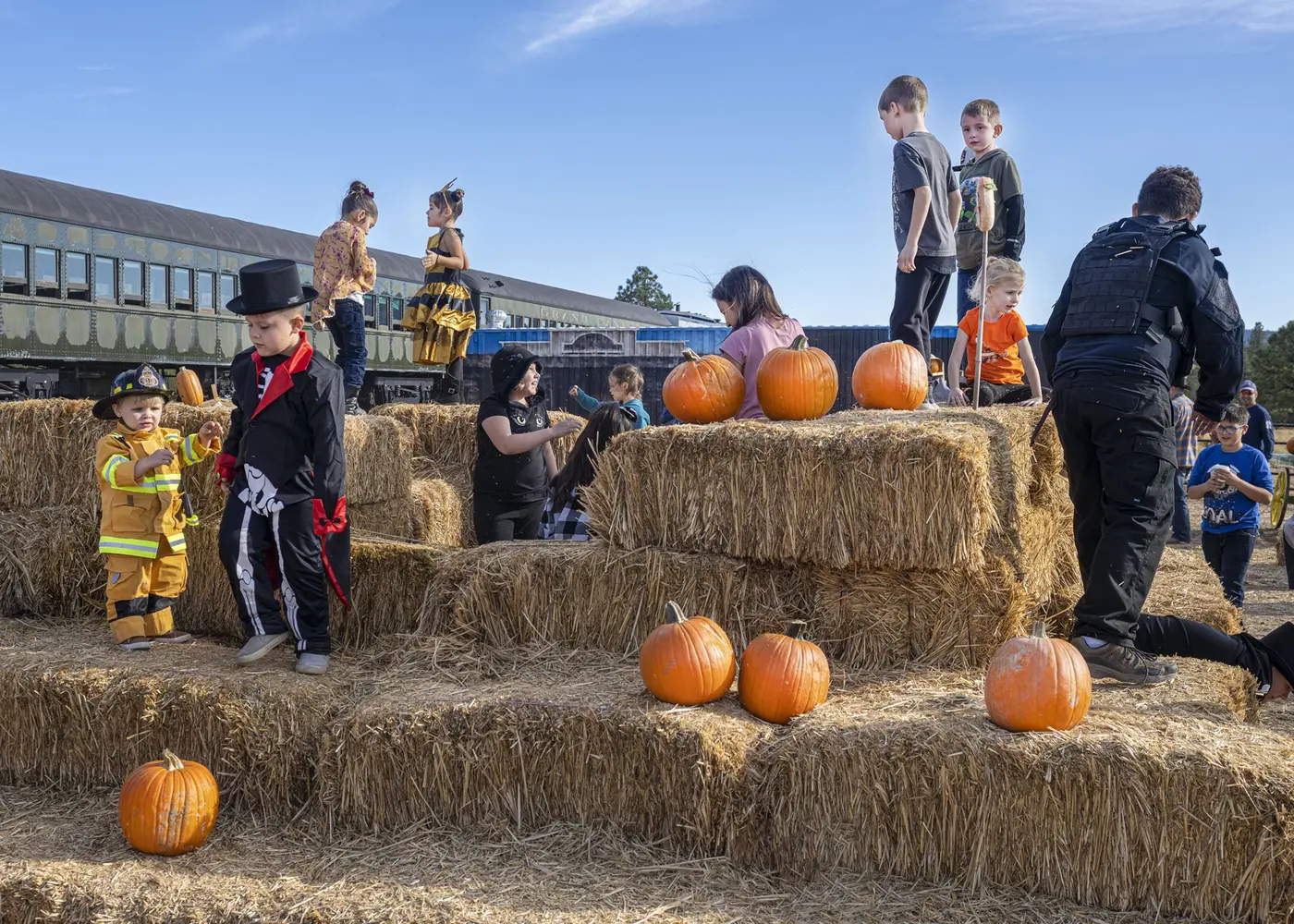
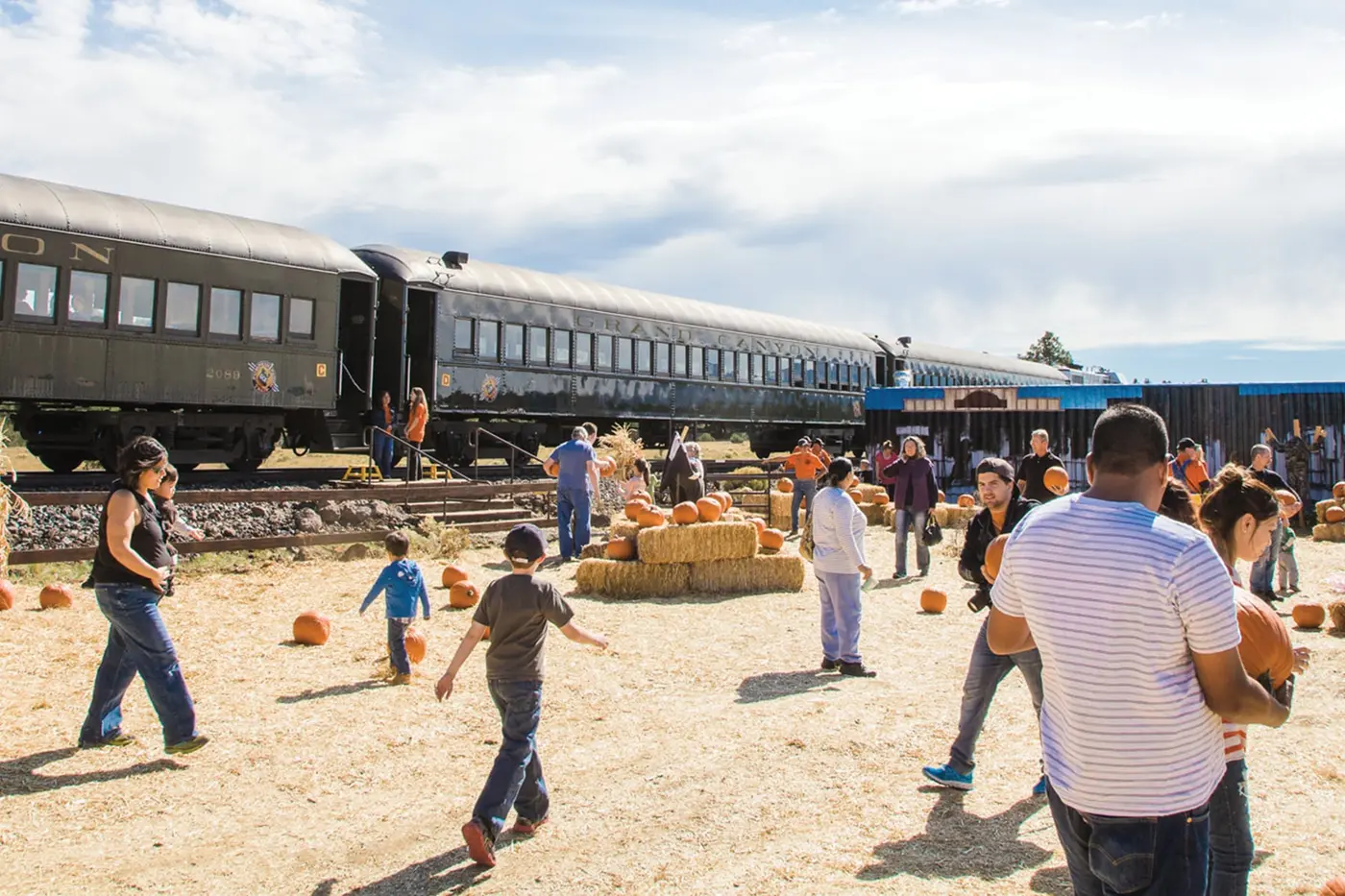
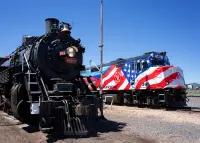
In October 2026 the railway brought back its Pumpkin Patch Train. It is a short ride from the Williams Depot to a patch that can be reached only by rail, and each ticketed guest picks one pumpkin to take home. Haunted Train Cars are offered to those who want them. Back at the depot there is a Harvest Maze. A Phoenix family-travel account also listed food and a beer garden. Costumes are encouraged. For the first weekend the railway scheduled its 1950s-era ALCO FPA-4 diesel, No. 6793, at the head of the train.
From early November through late December, the Polar Express leaves Williams nightly at 5:30 and 7:30 p.m. for “the North Pole.” The round trip takes about 90 minutes. Passengers are served hot chocolate and chocolate chip cookies while the Chris Van Allsburg story is read. By the railway’s count, the train has run every winter for 25 years.
Two engines and a tank of vegetable oil
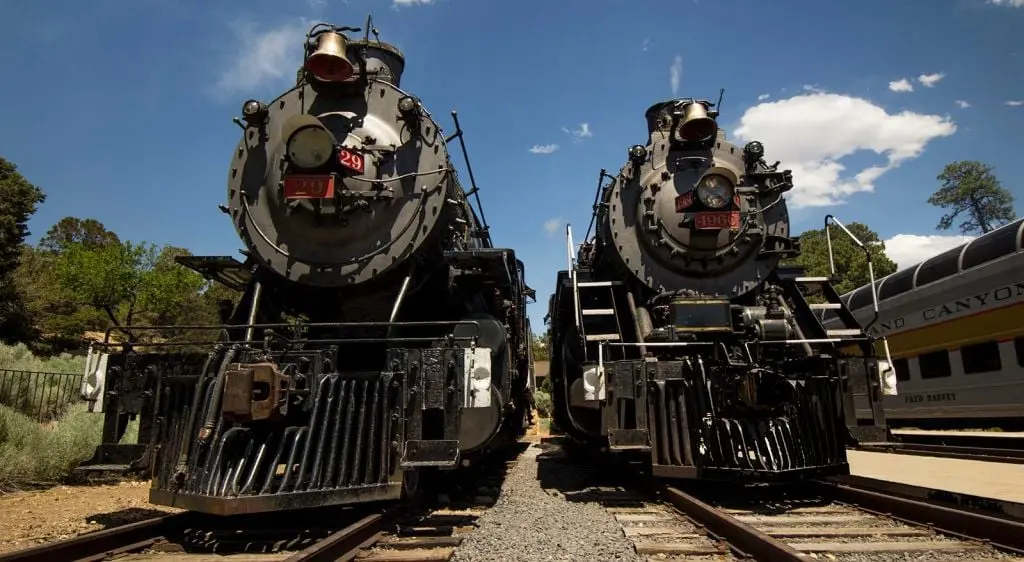
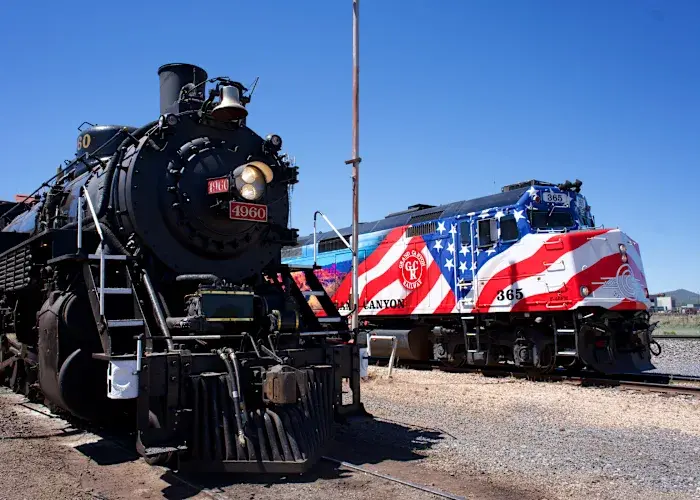
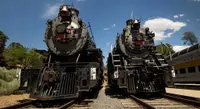
Most days a diesel pulls the train. On select days from March through October, one of two restored steam locomotives takes the 9:30 a.m. departure instead.
No. 29 was built in 1906 by the American Locomotive Company. It hauled iron ore on the Lake Superior & Ishpeming Railroad in Michigan’s Upper Peninsula. When it retired in 1960 it was sold to the Marquette & Huron Mountain Railroad, which never used it. Grand Canyon Railway bought it in 1989. No. 29 ran to the canyon from 1990 to 1995 and again from 2004 to 2008. It then stood as a display piece, first on the Williams platform and later in front of the Grand Canyon Depot.
In 2016, for the National Park Service centennial, the railway returned No. 29 to service. It pulled its first round trip in eight years on August 24, 2016. Later that week it ran with No. 4960 in the first steam double-header to the canyon since 2012. That restoration won the 2017 Arizona Governor’s Award for Outstanding Historical and Cultural Preservation. In August 2026 No. 29 was back in testing. On September 1 it made what the railway called its first unofficial trip to the South Rim since 2019.
No. 4960 came out of the Baldwin Locomotive Works in Philadelphia in 1923 and hauled freight across the Midwest for the Chicago, Burlington & Quincy. After retiring in 1960 it pulled excursion, museum and circus trains in Wisconsin and nearby states. It was put on static display in the early 1970s. Grand Canyon Railway bought it in 1989. In 1996 the railway restored it at a cost of more than $1.5 million and 80,000 man-hours, converting it from coal to diesel fuel. That same year it made its first run on the canyon line.
The railway ran steam regularly from Memorial Day to Labor Day until 2008, when it stopped for environmental reasons. In 2009 it converted No. 4960 to burn recycled waste vegetable oil. Since then No. 4960 has handled the railway’s steam excursions. Its 103rd birthday run was August 15, 2026. The railway also reports that it was the first tourist railroad in the United States to earn ISO 14001 certification for its environmental management system. The last steam run of 2026 was set for October 14.
Ore, a mayor, and the Santa Fe
The Santa Fe and Grand Canyon Railroad Company was incorporated in 1897. It planned to carry ore from the Anita mines north of Williams, but the mining traffic did not last, and the line came to depend on tourists. William Owen “Buckey” O’Neill, mayor of Prescott, spent nearly five years lobbying for the money to build it. The Atchison, Topeka & Santa Fe took over the project and finished the track in 1901.
On September 17, 1901, the first train carried passengers to the South Rim. Before the railroad, the trip to the rim was a long stagecoach ride. The train met the Santa Fe main line at Williams, which gave tourists a direct route from Chicago and Los Angeles.
The railroad then built at both ends of the line. El Tovar Hotel went up beyond the canyon depot in 1905. The Williams Depot and the Fray Marcos Hotel followed in 1908. The company timeline names Francis W. Wilson as the hotel’s architect, and another source credits him with the Grand Canyon Depot. The Fray Marcos opened with 22 guest rooms, and its second floor held quarters for ten Harvey Girls, the staff of restaurateur Fred Harvey. The Grand Canyon Depot was built in 1909 and 1910. Between 1905 and 1954 the Santa Fe paid for many of the buildings still standing in the canyon village, often working with the Fred Harvey Company and federal agencies.
The canyon around the tracks changed status over the same years. It had been made a forest preserve in 1893, and Congress made it a national park on February 26, 1919. A good road reached the park in 1920. Diesel locomotives arrived on the line in 1940, and the last steam train of that era ran in 1953. In 1954 the Santa Fe closed the Fray Marcos to the public, though the depot kept serving trains.
Cars and airplanes took the remaining passengers. Accounts of the final run differ. One source records Train No. 14 leaving the Grand Canyon Depot on June 30, 1968, with a diesel, one baggage car, one coach and three people aboard. The company timeline puts the last regularly scheduled train in July 1968, also with three passengers. Freight continued for a few more years. The Grand Canyon Depot closed in 1969, and the Santa Fe ended all rail service to the canyon in 1972. In 1988 its maintenance crews and field engineer left the Williams station for good.
Eighty-eight years to the day
On January 10, 1989, Max and Thelma Biegert announced plans to rebuild the line and restore the Fray Marcos Hotel and the Williams Depot. On September 17, 1989, exactly 88 years after the first train, they brought steam back to Grand Canyon National Park. Governor Rose Mofford rode as guest of honor, and the Williams Depot reopened the same day.
The work continued over the next decade:
- 1990: Two steam locomotives, built in 1906 and 1910, were reconditioned at 8,000 to 10,000 hours each. The Grand Canyon Depot reopened to trains in July.
- 1993: The railway carried more than 105,000 passengers a year, which kept about 40,000 cars off the South Rim.
- 1995: The present hotel opened, built to resemble the Fray Marcos. Daily passenger service began, and vintage diesels returned to the line.
The National Register of Historic Places listing is dated two ways. The company timeline gives 1999. The National Park Service record gives August 23, 2000, under reference number 00000319.
On September 19, 2026, the railway marked its 125th anniversary with a steam double-header to the canyon. The railway posted video of the two engines passing Willaha.
Notable Events
- 1893The Grand Canyon is first established as a forest preserve by presidential proclamation. thetrain.com
- 1897Santa Fe and Grand Canyon Railroad Company was incorporated. nrrhof.org
- 1901A Santa Fe spur line's first steam-powered train arrived at the South Rim. nps.gov
- 1901Atchison, Topeka & Santa Fe took over and completed the track to the Grand Canyon. nrrhof.org
- 1905Santa Fe funded and built many preserved village structures, often with Fred Harvey Company and federal agencies. grcahistory.org
- 1908The hotel designed by architect Francis W. Wilson was built with 22 guestrooms and 10 employee quarters for the Harvey Girls on the second floor. thetrain.com
- 1909The railway's northern terminus depot was constructed. thetrain.com
- 1919Grand Canyon National Park is established by an act of Congress on February 26. thetrain.com
- 1925The Santa Fe Railway completes a two-story addition to the Fray Marcos Hotel of 21 rooms. thetrain.com
- 1940Diesel locomotives begin traveling the Grand Canyon line. thetrain.com
- 1953Last steam train travels the route; more economical diesel locomotives replace the classic steam locomotives. thetrain.com
- 1954Retired by the Santa Fe, the Fray Marcos Hotel closed to the public while the depot continued servicing mainline and Williams-Grand Canyon trains. thetrain.com
- 1968Passenger service ended and the railroad cut back to freight only. grcahistory.org
- 1968Automobile and airplane competition led to cessation of passenger service and disuse of the line. nrrhof.org
- 1968Train No. 14, a diesel locomotive with one baggage car and one coach car, left Grand Canyon Depot with just three people aboard. thetrain.com
- 1969Grand Canyon Depot closes nearly a year after the discontinuation of passenger service. thetrain.com
- 1972Santa Fe discontinued all rail service to the Grand Canyon. grcahistory.org
- 1984On December 30th, Williams' downtown business district achieves listing on the National Register of Historic Places. thetrain.com
- 1988Santa Fe maintenance crews and the field engineer abandon the Williams train station facility for good. thetrain.com
- 1989Santa Fe tracks revived with formation of Grand Canyon Railway. grcahistory.org
- 1989Max and Thelma Biegert reopened the railway exactly 88 years after the first passenger train. nrrhof.org
- 1990Two vintage 1906 and 1910 steam locomotives are reconditioned, each requiring 8,000 to 10,000 hours; the Grand Canyon Depot re-opens to Grand Canyon Railway trains in July. thetrain.com
- 1993Grand Canyon Railway carries more than 105,000 passengers per year, reducing automobile traffic to the South Rim by approximately 40,000 cars. thetrain.com
- 1995The modern-day hotel built to resemble the historic Fray Marcos Hotel opens; the Railway begins daily passenger service and re-introduces vintage diesel locomotives. thetrain.com
- 1996Steam locomotive No. 4960 makes its first run on the Grand Canyon line after a full restoration costing more than $1.5 million and 80,000 man-hours. thetrain.com
- 1999Grand Canyon Railway placed on the National Register of Historic Places, as the company timeline records it. thetrain.com
- 2000The NPS supplementary listing record dates the National Register listing of Grand Canyon Railway to 8/23/2000, under NRIS Reference Number 00000319. npgallery.nps.gov
People
- Max Biegert, restored the railway and depots and reinstated train service with his wife Thelma (Sept. 17, 1989).
- Rose Mofford, Governor and guest of honor when the reopened train departed.
- Thelma Biegert, restored the railway and depots and reinstated train service with her husband Max (Sept. 17, 1989).
- William Owen "Buckey" O'Neill, mayor of Prescott who lobbied nearly five years to secure the funding for the Railway.
- Francis W. Wilson, Architect of the Grand Canyon Depot.
- Fred Harvey, Restaurateur whose employees brought higher dining and service standards to the region (1835-1901).
Sources
- thetrain.com
- thetrain.com/the-train/schedule-route
- thetrain.com/plan/faq
- nrrhof.org/max-thelma-biegert
- grcahistory.org/sites/south-rim/grand-canyon-railway-depot
- nps.gov/grca/learn/historyculture/historic-village.htm
- thetrain.com/the-train/train-depots
- thetrain.com/the-train/history
- thetrain.com/press-kit/backgrounder
- npgallery.nps.gov/GetAsset/64254ac4-fb05-4d29-88d5-5f4a63f5be7c