Graham Cabin
Idaho City, Elmore County, Idaho. Former Forest Service Guard Station; Beginning of July - End of September.
Details

- Where
- Idaho City, Elmore County, ID. No street address stated. Directions
- Getting there
- Graham Cabin is 53 miles northeast of Idaho City. From Idaho City, take Highway 21 for 18 miles to Crooked River-Little Owl Road #384. Turn left and stay on Road #384 for 4 miles to Pikes Fork Road #312. Turn right and stay on Road #312 for 26 miles. There are only 2 major road intersections on Road #312; just keep bearing right and follow the directional signs.
- Fees
- Overnight Use: $35 per night (6 people max).
- Access
- The road is extremely rocky and rutted and has steep sections; you also have to ford the river. Only high clearance 4-wheel drive vehicles are recommended. Plan on a minimum 3-hour trip from Idaho City to the cabin.
- Phone
- (208) 392-3700
- Managed by
- Boise National Forest.
- Coordinates
- 43.9541, -115.2733.
Two rooms by the airstrip
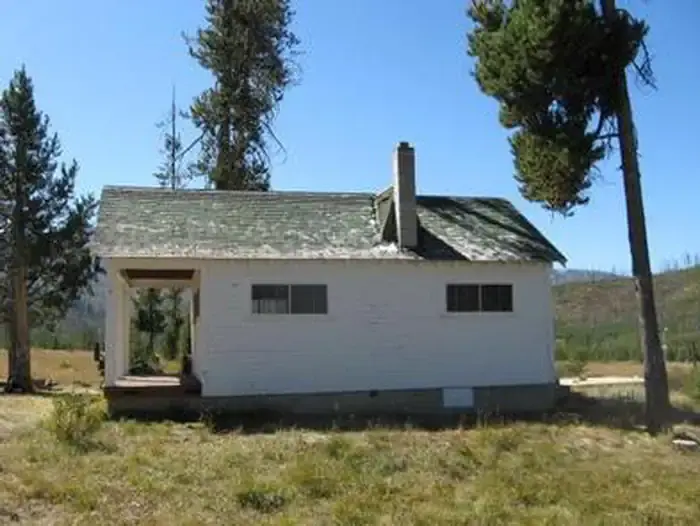
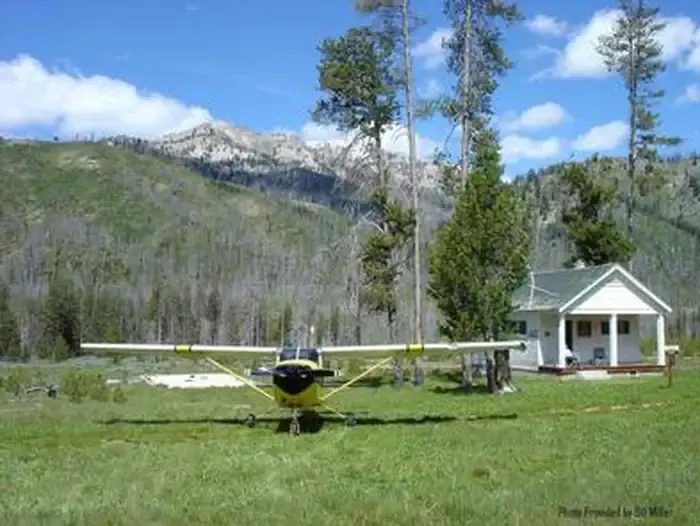
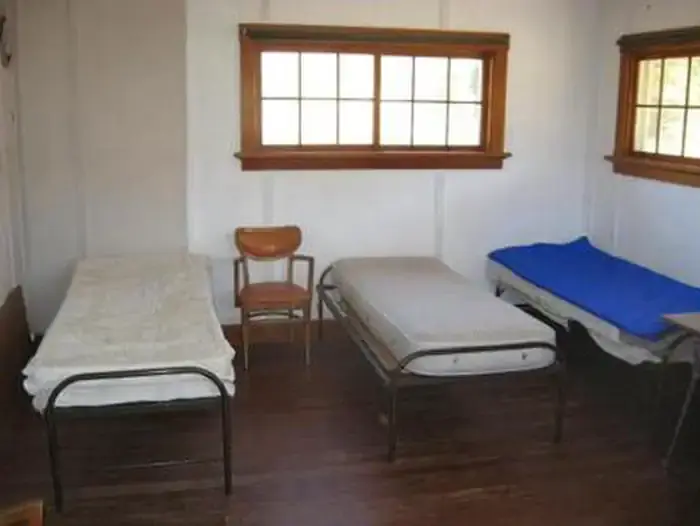
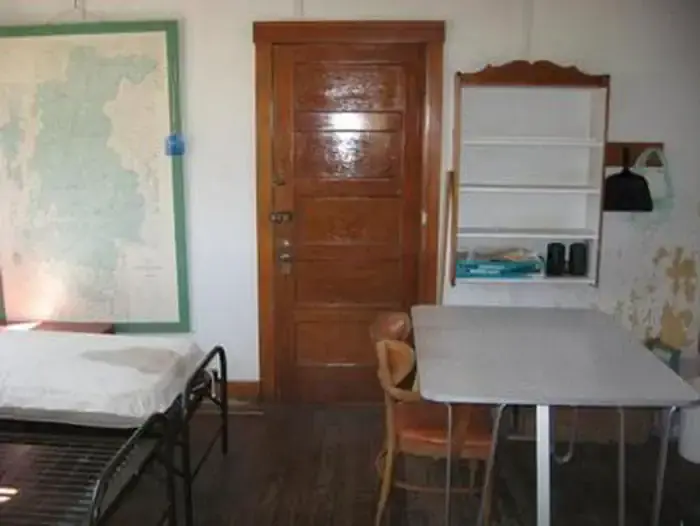
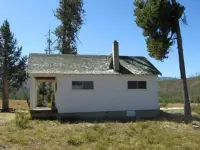
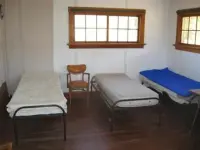
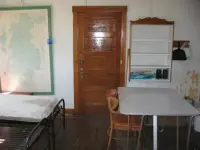
Graham Cabin stands in an open grassy flat on the North Fork Boise River, beside the Sawtooth Wilderness. The Forest Service gives its elevation as 5,720 feet. It is a rustic cabin of two rooms with a front porch. Inside are a table with chairs and five twin beds, although the cabin is permitted for six people. The kitchen has a wood stove for cooking and heat, and guests gather their own firewood. An outhouse with a vault toilet stands behind the cabin, and a picnic table and campfire ring stand outside. There is no electricity and no drinking water, so guests bring their own water or a filter. They also bring bedding, lights, cookware, utensils, matches and first-aid supplies. The provisions kept in the cabin are for emergencies only. No one staffs the place. The Boise National Forest rents it through Recreation.gov for $35 a night and emails the door combination to guests before they arrive.
The furnishings were different in 2014. That year Roger Phillips of the Idaho Statesman, writing for the Associated Press, quoted the Forest Service’s description. It listed two sets of bunk beds and a table in the front room, a bunk bed and a table in the kitchen, and a sink with running but non-potable water. Because the site was hard to reach and could freeze early, that water ran only from July 15 to Sept. 1. Phillips gave the elevation at Graham as about 5,600 feet.
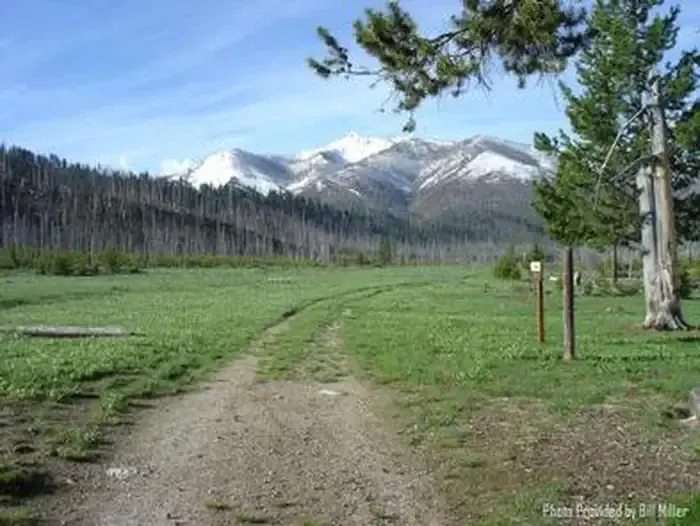
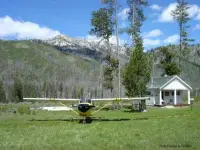
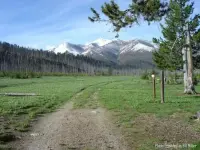
The airstrip lies just across from the cabin. It is generally free of snow from late May until the beginning of October, and Phillips wrote that summer landings usually come in the mornings and late afternoons. Peaks of the Sawtooth Range surround the flat, dotted with evergreens. The ground still shows signs of an old forest fire. In Phillips’s account it was “coming back nicely,” with lush willows and young trees in the riparian strip along the river. The Forest Service lists elk, deer, mountain goats, wolves, coyotes, cougars, bobcats and bears, along with the occasional wolverine, whose numbers are growing in the Sawtooth Wilderness. Bears are seen now and then, and guests are asked to keep trash and food away from the outside of the cabin.
Several trails start within 2 miles of the door, among them the Horse Heaven Trail. The Forest Service says they are in varying states of maintenance but tend to be in good condition for at least the first 2 miles. Phillips called the maintenance sporadic and the country open enough for off-trail hiking. A hiker can follow the river all the way to its headwaters in the Sawtooth Wilderness. There are trout in the North Fork and good fishing in nearby Johnson Creek. Big game hunters come in season, and livestock are permitted at the cabin.
Road 312 and the ford
The cabin is 53 miles northeast of Idaho City and, by Phillips’s count, about 90 miles from Boise. From Idaho City the route follows State Highway 21 for 18 miles, then takes Forest Service Road 384 past the Edna Creek Campground. After 4 miles it joins Road 312, the Pikes Fork Road, for about 26 more. The Forest Service describes Road 312 as extremely rocky and rutted, with steep sections. It recommends only high-clearance four-wheel-drive vehicles and allows a minimum of three hours from Idaho City.
Phillips rode the road in July 2014 and set down its course. It climbs above 8,000 feet twice. About 6 miles from Graham Bridge it tops out near 8,300 feet on a ridge between two basins, with jagged peaks behind. It then drops about 3,000 vertical feet in a few miles, on a narrow grade of tight switchbacks with few turnouts and large loose gravel that makes steering and braking tricky on a big motorcycle. Near the river the road flattens and smooths. At Graham Bridge a small campground sits beside a washed-out bridge whose gap is too wide to cross. To reach the cabin, and the Johnson Creek campground at the road’s end, vehicles ford the North Fork. In late July 2014 the river ran deep and swift enough to make the crossing hard on a motorcycle, though most full-sized ATVs managed it. Riders on horseback can take the last 10 miles of Road 312 or the 6-mile Horse Heaven Trail from Road 327, just beyond Deer Park.
The cabin’s season runs from the beginning of July to the end of September. The Forest Service notes that snow on Road 312 can affect early-July reservations and that high-elevation snow generally confines vehicle access to the weeks from mid-July to the beginning of October. Phillips found light frost in the mornings in late July and warned that snow could reach the summit as early as September. In late September 2026 the Forest Service page for the cabin carried the notice “Site Closed,” and the forest’s alerts that month included a road and trail closure for the Crooked Fire area.
Matt Graham’s silver camp
The University of Idaho Library’s Civilian Conservation Corps in Idaho collection lists the Graham Guard Station among its extant structures and dates it to 1934. Phillips described the building as “an historic Forest Service building.”
The name Graham is older than the guard station. A reference paper of the Idaho State Historical Society, “Silver Mountain Mines,” tells of a town of Graham in the North Boise district. Prospectors had known for twenty years or so of large, unpromising veins on Silver Mountain. Late in 1885 Matthew Graham, a well-known miner from Atlanta, 16 miles to the southeast, examined some dull red outcrops there. Graham had spent years promoting Atlanta mines in New York and London, and in New York his close resemblance to William Marcy Tweed was still remarked on long after Tweed’s death in prison. Graham’s assays bore out his hopes, and only deep December snow held back a rush. An Atlanta correspondent wrote on December 30, 1885, that “The tin horn gamblers will be there to work the greenies.” On January 2, 1886, the Statesman judged that “the new discovery will eclipse any of the older quartz discoveries in Idaho.”
Early in 1886 two shifts drove a tunnel some 240 feet to strike the vein about 200 feet below the surface. On that showing Graham brought London capitalists into his Idaho Gold and Silver Mining Company, Ltd. By the fall of 1887 a $15,000 road reached the camp, and a 500-foot tunnel and a 112-foot inclined shaft had been run into the lode. The company began building a 20-stamp mill and employed about 150 men. Miners earned $4 a day and carpenters and stonemasons $7, wages the paper calls unusually high, set by the trouble of drawing skilled labor so far out. Fifty or sixty men worked through the hard winter of 1888.
That summer the boom reached its height. The town counted “six saloons, one store, five boarding houses, one restaurant, two blacksmith shops, a jail, a Justice of the Peace and Deputy Sheriff, one butcher shop, two faro games, three livery stables, a fine hall, 300 men, forty-one ladies, and the controlling vote of Boise county.” Assault, battery and larceny moved the mine superintendent, George M. Parsons, to build the jail, “a strong affair of logs, nails, planks, and iron,” since Justice James D. Agnew would be sending “quite a number of guests.” By August 12 the mill was finished at a cost of $350,000. A mile-long tramway carried ore down to it, and telephones linked mine and mill.
What the camp lacked, the paper says, was ore the mill could treat. After a few trial runs the mill shut down, and Graham left for London to raise more money. While he was on his way, an attachment for unpaid debts put the county sheriff in charge of the mine on November 23, 1888. That winter, in the paper’s words, “only the watchman had anything to do.” On June 10, 1889, three English mining engineers, “Very much pleased with the mines,” recommended the 6,000-foot tunnel Graham wanted to drive. No further London capital came.
The company’s property was sold in three sheriff’s sales: at Graham on August 31, at Rocky Bar on September 10, and at Idaho City on November 16. The mill brought $9,500. The tramway, the buildings and the thirteen mines, which a year earlier had been thought the most valuable silver properties in Idaho, brought $500.
Notable Events
- 1885Matthew Graham's careful examination of some dull red outcrops on Silver Mountain created interest in the district late in 1885. idahodocs.contentdm.oclc.org
- 1886Exploration of the most promising Silver Mountain lode began, with two shifts driving a tunnel to reach the vein. idahodocs.contentdm.oclc.org
- 1887With London capital backing Matt Graham's Idaho Gold and Silver Mining Company, a road to the camp and exploratory mine workings were completed. idahodocs.contentdm.oclc.org
- 1888By August 12, the mill was completed and a mile-long tramway began hauling ore from the mines to the mill; telephones connected the mine and mill. idahodocs.contentdm.oclc.org
- 1888In the summer of 1888, the Silver Mountain boom reached its height at the new town of Graham. idahodocs.contentdm.oclc.org
- 1888The mill shut down after a few trial runs, and Matt Graham spent the winter in London seeking more British capital to develop ore bodies. idahodocs.contentdm.oclc.org
- 1888An attachment for unpaid debts led the county sheriff to take over administration of the mine on November 23, 1888. idahodocs.contentdm.oclc.org
- 1889Three English mining engineers examined the property and recommended Graham's proposed tunnel, but further London capital was not forthcoming. idahodocs.contentdm.oclc.org
- The first of three sheriff's sales of the Idaho Gold and Silver Mining Company's property took place at Graham to satisfy unpaid creditors' claims. idahodocs.contentdm.oclc.org
People
- George M. Parsons, mine superintendent.
- James D. Agnew, Justice in the mining town of Graham who sent offenders to its jail; not identified as a guard-station builder or employee.
- Matthew Graham, A well-known Atlanta miner whose examination of Silver Mountain outcrops started the district; he set out to develop Silver Mountain.