
Government Mineral Springs Guard Station
Carson, Skamania County, Washington. Recreation Rental.
Details

- Where
- 2455 HWY 141 TROUT LAKE, Carson, WA 98650. Directions
- When
- Check in: 2:00 p.m.; Check-out: 12:00 p.m.; Quiet hours are 10:00 p.m. until 6:00 a.m.
- Season
- From approximately April 15 to November 1, the cabin is usually accessible by vehicle; during the winter season, the cabin is a half-mile trek by skis, snowshoes, or snowmobiles from the parking area.
- Getting there
- From Carson, Washington go north on Wind River Highway/Forest Road 30 for about 15 miles to the intersection with Forest Road 3065 just past the Fish Hatchery. Turn left on Road 3065 and continue for about one mile to the cabin.
- Fees
- $100 per night (up to 9 people).
- Access
- No potable water at the cabin; bring plenty for drinking, cooking and washing. A stream within 300 feet of the Guard Station may be used as a water source; the water must be treated or boiled before drinking. Vault toilet on site. No smoking, no pets, no additional camping on site.
- Walk-in or reserve
- Reservations can be made online at recreation.gov or by calling 1-877-444-6777. There is a two night minimum on the weekends (Friday and Saturday). The maximum length stay is seven consecutive nights.
- Phone
- (509) 395-3402
- Managed by
- Gifford Pinchot National Forest (Mt. Adams Ranger District).
- Established
- 1937.
- Coordinates
- 45.88119, -121.993146.
The cabin at the end of Road 3065
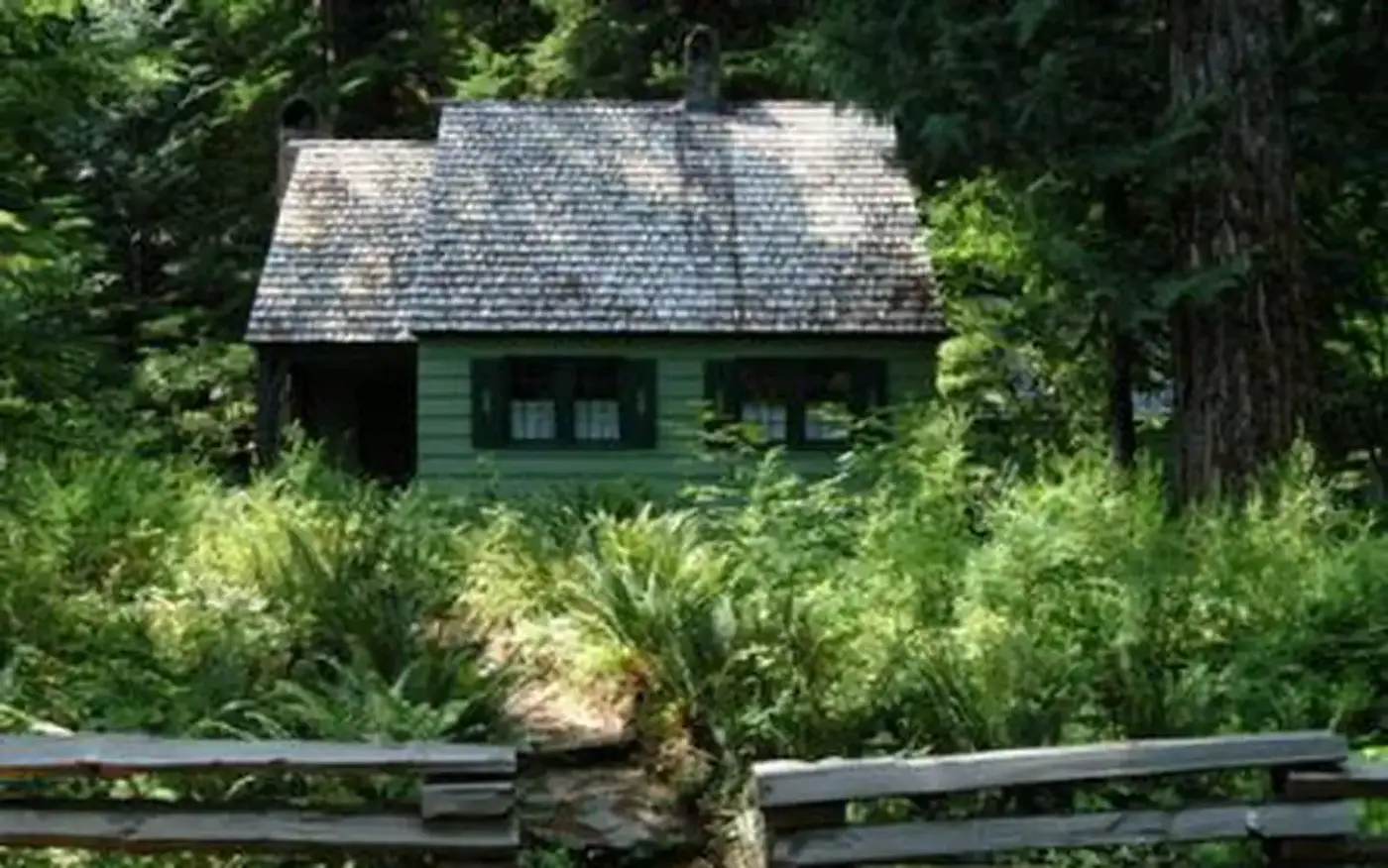
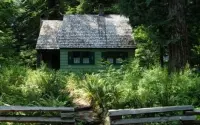
Forest Road 3065 leaves the Wind River Highway just past the Carson National Fish Hatchery and runs about a mile to its end. There a two-story cabin stands in a grove of old-growth conifers. Its paint is light green and its trim dark green, and its shutters have tree shapes cut through them. It has a covered front porch. This is the Government Mineral Springs Guard Station, built in 1937 on the Mt. Adams Ranger District of the Gifford Pinchot National Forest, in Skamania County. It is now rented by the night to parties of up to nine.
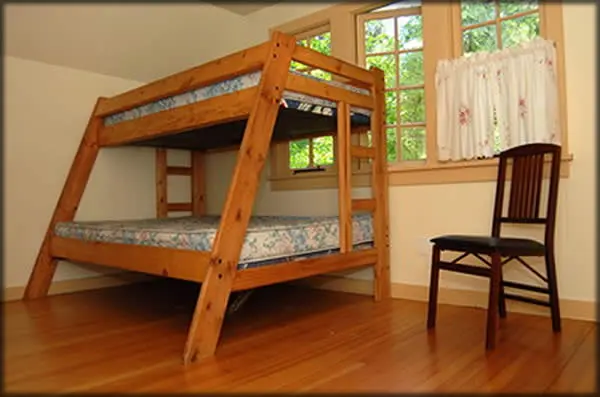
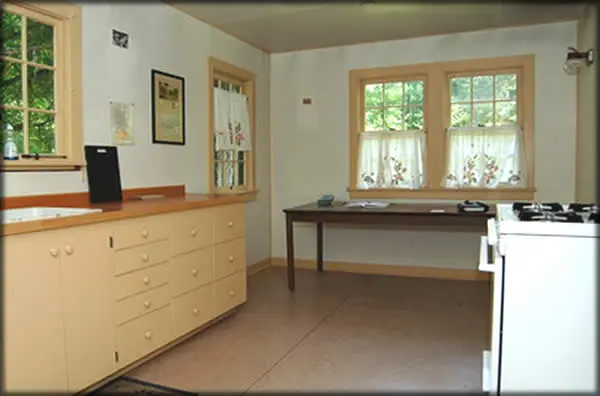
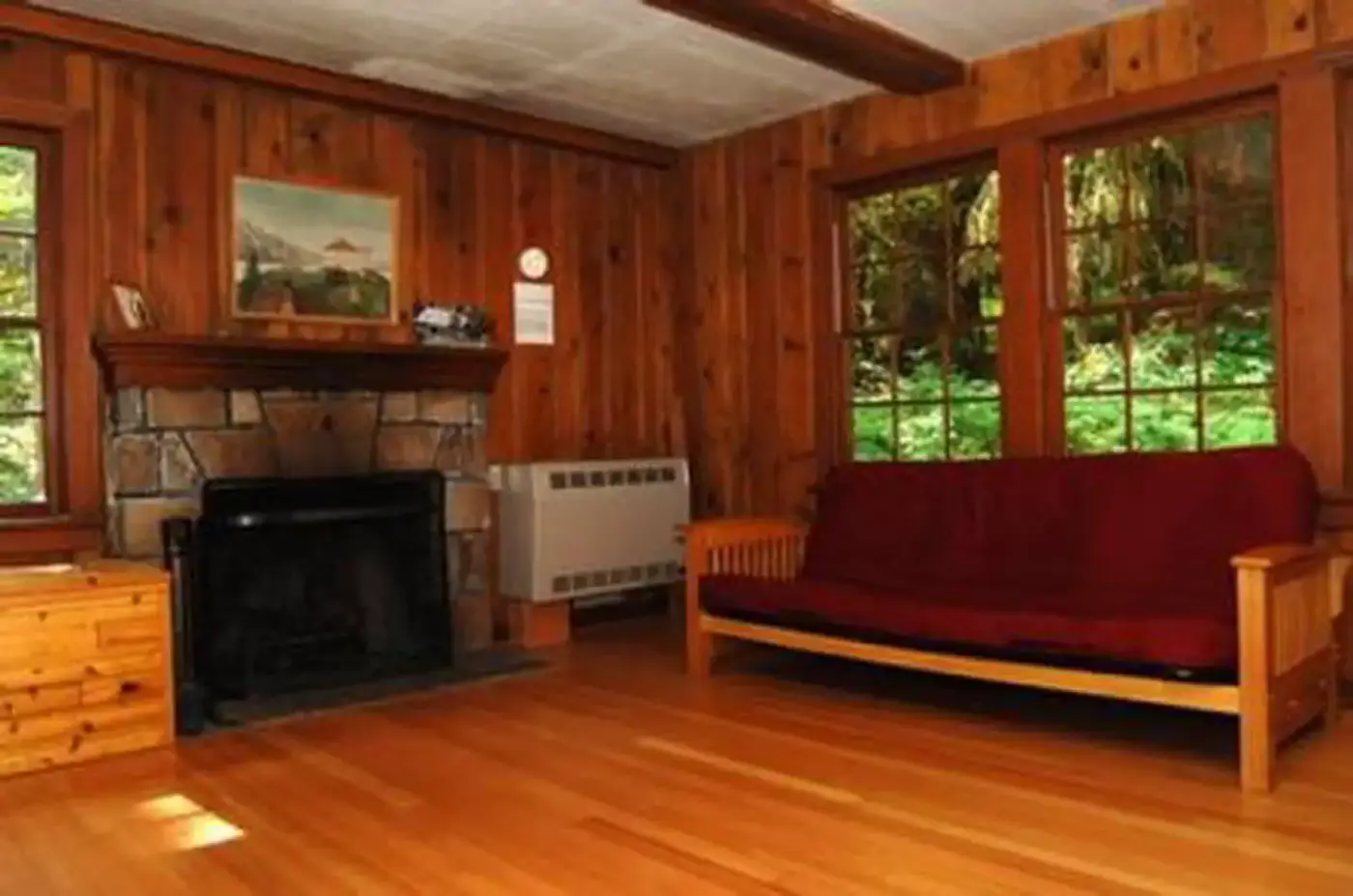
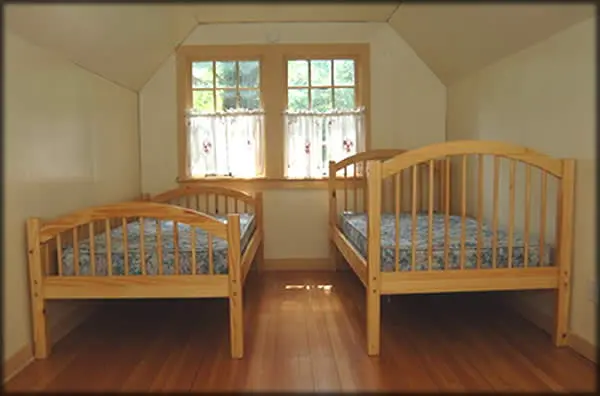
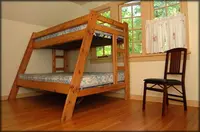
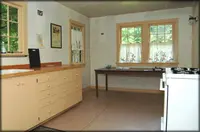
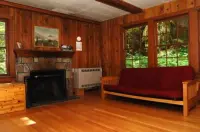
Guests let themselves in with a key from a lock box. Downstairs are a large kitchen with a propane stove, a dining room, and a living room with a fireplace and two futons that fold down into double beds. Upstairs, one bedroom holds two single beds and the other a bunk bed that sleeps three. Propane runs the heater, the lights, and the cook stove. The Forest Service supplies firewood, pots, pans, dishes, and utensils. Guests bring their own bedding, towels, matches, and toilet paper.
There is no potable water. A stream within 300 feet can be used, but its water must be treated or boiled before drinking. Melted snow will do for washing but is not safe to drink. A vault toilet is on site.
From about April 15 to November 1 a car can usually reach the door. When snow covers the road, the cabin is a half-mile trip on skis, snowshoes, or snowmobile from the Sno-Park. The Forest Service does not plow the road to the Sno-Park itself. In heavy snowfall, Recreation.gov warns, guests may not be able to reach it or could be stranded.
Trapper Creek and Falls Creek Falls
The Trapper Creek Wilderness lies next to the guard station and covers 6,050 acres. Its steep lower slopes carry cascading streams and waterfalls, and huckleberry fields grow higher up near Observation Peak. The Big Hollow Fire affected the wilderness in 2020. Black-tailed deer, Roosevelt elk, and black bear are commonly seen. Cougar, bobcat, and pine marten turn up occasionally. Spotted owls, barred owls, pileated woodpeckers, and goshawks live in the treetops.
Anglers fish the Wind River for spring chinook and Soda Peaks Lake, inside the wilderness, for brown and brook trout. A short drive from the cabin is the Falls Creek Falls Trail, a 3.5-mile round trip open year round. It follows a forested creek, crosses a suspension bridge, and traverses a side slope with views of the creek and its rock formations. At the end, lower Falls Creek Falls drops in three tiers nearly 250 feet into a pool below the viewpoint.
Iron Mike and the dance pavilion
Campers were coming to the springs early in the twentieth century and made informal camping grounds near where the guard station now stands. In 1910 S.D. Fox and the Star Brewing Company of Portland began a 50-room hotel at the soda springs near Trapper Creek. The place eventually became known as Government Mineral Springs. The resort had bath houses, the Iron Mike Bubbling Springs, a dance pavilion, a store, an ice cream parlor, goldfish ponds, and flower gardens. Its early advertisements claimed the mineral water could cure gallstones, rheumatism, diabetes, and anemia, along with disorders of the stomach, liver, kidneys, skin, and nerves.
The hotel burned to the ground. The Forest Service dates the fire to 1935. Pete Paladeni, who served in CCC Company 944 from 1934 to 1937, placed it on New Year’s Eve at the end of ‘34. He recalled that his crew cut down the burning cedar tops and contained the fire, and he remembered it as their first fire.
Company 944 and the first guard
Paladeni’s company was based at Camp Hemlock, near the community of Stabler, about ten miles north of the Columbia River. It was erected in May 1933 as the first CCC camp in Washington, and it housed a 200-man company until 1942.
Camping at the springs continued after the hotel was gone. In 1937 and 1938 the Corps expanded and developed the public campground. Lynn Hazen, at Hemlock in 1937 and 1938, recalled gathering local stones, hauling them by truck, mixing mortar, and building fireplaces at the campground. Pat Sutherland, at Hemlock in 1939 and 1940, had camped at Government Mineral Springs with his father before he joined.
Company 944 enrollees built the guard station in 1937 so the Forest Service could administer the campground and other local recreation. Alfred Albert was the first guard stationed there. He, his wife, and their two children lived in the cabin during the summers of 1937 and 1938.
The cabin outlasted the camp that built it. When the CCC disbanded at the start of the Second World War, Camp Hemlock passed to the Selective Service Commission and housed a small contingent of conscientious objectors. By the 1950s the site had been developed for a new ranger station and an expanded Wind River Tree Nursery, and scarcely a trace of the camp remained on the surface.
Rick McClure, Heritage Program Manager for the Gifford Pinchot National Forest, organized Passport in Time volunteer projects to stabilize, restore, and rehabilitate historic properties, including this guard station. By 2005 it was in the forest’s historic cabin rental program. That year the White Salmon Enterprise reported that public demand for overnight use was high and that converting the cabins to public use had been a successful effort at preservation.
The station was entered on the National Register of Historic Places on December 26, 2017. The listing names the United States Forest Service Architects Group and the Civilian Conservation Corps as its architects, and it cites the building’s significance in architecture, conservation, and recreation. The nightly fee, $100 in 2025, goes directly to the maintenance and preservation of the building.
Notable Events
- 1910S.D. Fox and the Star Brewing Company of Portland began a 50-room hotel at the soda springs, which became known as Government Mineral Springs. fs.usda.gov
- 1935Pete Paladeni recalled the hotel catching fire and his crew cutting burning cedar tops and containing the fire; he remembered it as their first fire on New Year's Eve. fs.usda.gov
- 1935The Government Mineral Springs hotel burned to the ground. fs.usda.gov
- 1937The Civilian Conservation Corps significantly expanded and developed the public campground. fs.usda.gov
- 1937Company 944 CCC enrollees from Camp Hemlock near Stabler built the guard station. fs.usda.gov
- 2017The Government Mineral Springs Guard Station, at the end of FS Road 3065 off the Wind River Highway on the Mt. Adams Ranger District, Gifford Pinchot NF, Skamania County, was listed on December 26, 2017, reference SG100001939. nps.gov
People
- Lynn Hazen, CCC oral-history narrator who recalled gathering local stones, hauling them by truck, mixing mortar and building fireplaces at Government Mineral Springs Campground.
- Pat Sutherland, CCC oral-history narrator who recalled camping at Government Mineral Springs with his father before joining Camp Hemlock.
- Pete Paladeni, CCC oral-history narrator who recalled helping fight the Government Mineral Springs hotel fire (1934-1937 (Company 944 service)).
- Alfred Albert, First guard stationed in the cabin; lived there with his wife and two children during summers (1937 and 1938).
- S.D. Fox, With the Star Brewing Company of Portland, began construction of the resort hotel at the soda springs (1910).
- Rick McClure, Gifford Pinchot National Forest Heritage Program Manager who organized Passport in Time preservation projects including Government Mineral Springs Guard Station.
Sources
- fs.usda.gov/r06/giffordpinchot/recreation/recreation-rental-gov-mineral-springs-cabin
- recreation.gov/camping/campgrounds/234091
- fs.usda.gov/media/150953
- sandmountain.org/about
- nps.gov/subjects/nationalregister/upload/weekly-list-2017-national-register-of-historic-places.pdf
- npgallery.nps.gov/NRHP/AssetDetail/b140f952-cb84-47d5-b804-6f40d1273e4c
- columbiagorgenews.com/archive/work-done-on-old-guard-station/article_5e453965-9bbf-570e-bc08-143c441b78c4.html