
Goldwell Open Air Museum
Beatty, Nye County, Nevada. Open air museum.
Details

- Where
- 1 Golden St, Beatty, NV. Directions
- When
- Museum open 24 hours, 7 days a week; Visitor Center and Gift Shop Monday - Saturday 10 a.m. to 4 p.m. (days and hours for the Visitor Center are approximate).
- Getting there
- Approximately 5 miles west of Beatty off State Highway 374, the road that leads to Death Valley; Beatty is 115 miles north of Las Vegas on Highway 95; parking on site; free self-guided tour brochure.
- Fees
- Free admission; donations accepted.
- Access
- Private property with a great variety of permanent artworks on display for everyone to enjoy and see.
- Website
- goldwellmuseum.org
- Managed by
- Goldwell Open Air Museum, a 501(c)(3).
- Established
- 1984.
Ghosts below Rhyolite
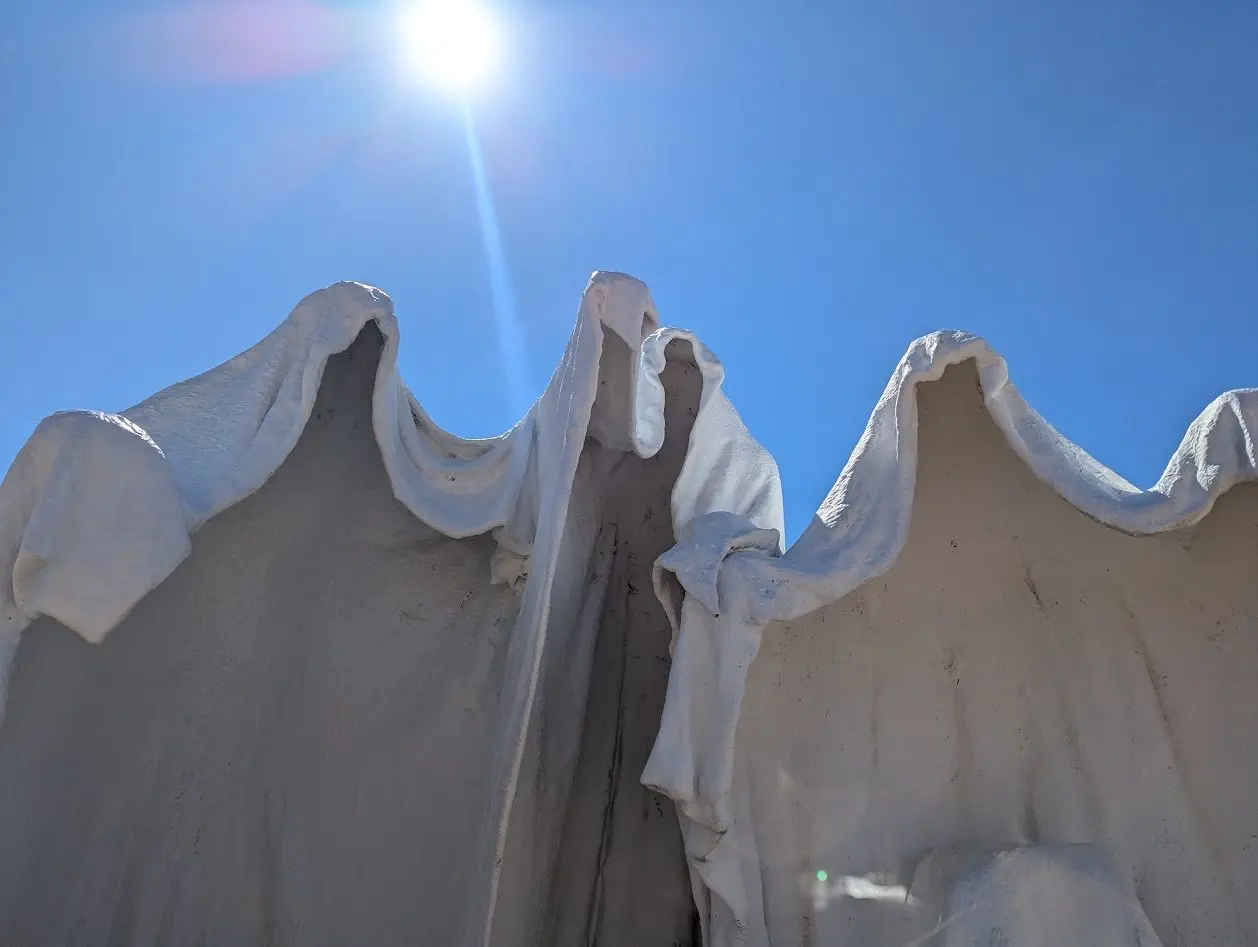
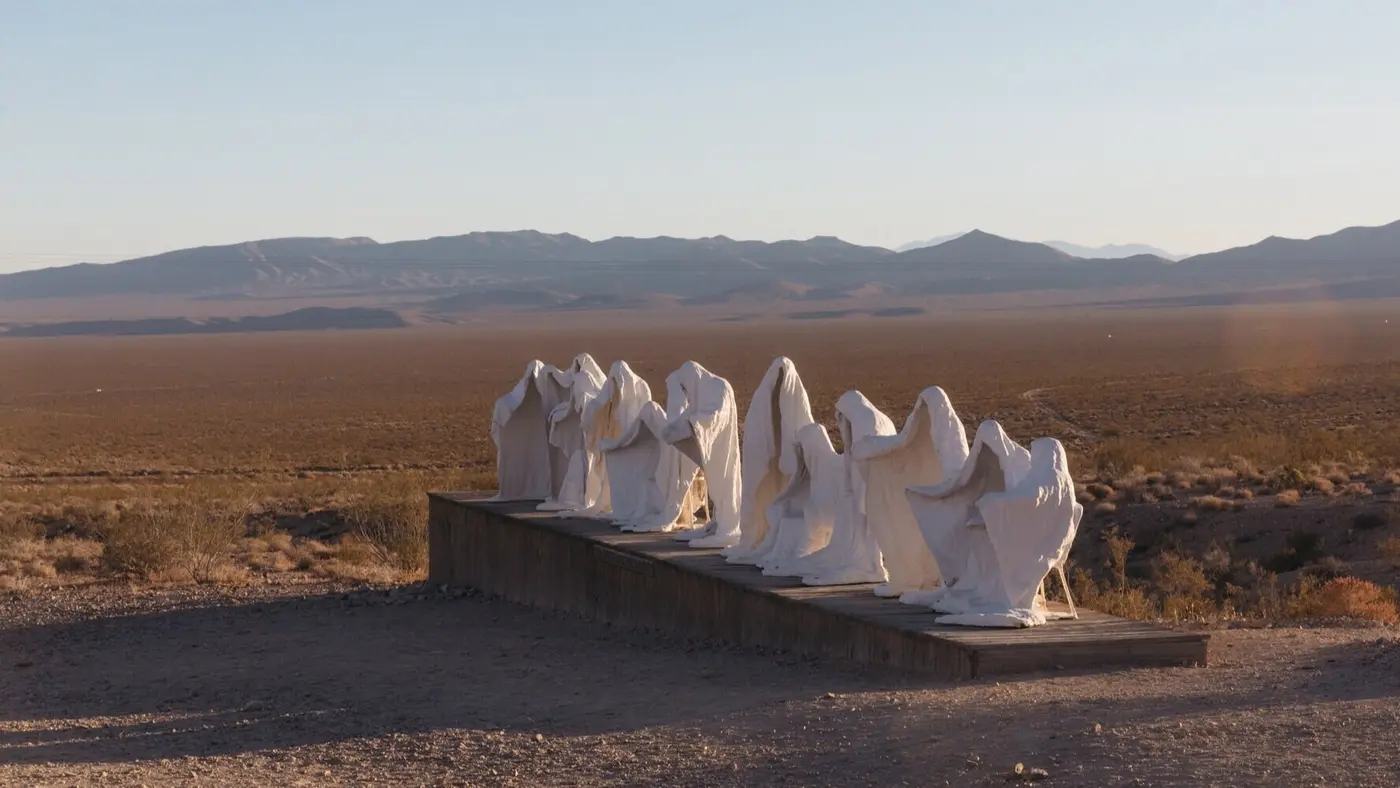
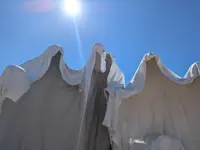
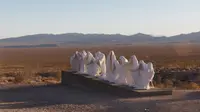
Below the ghost town of Rhyolite, a row of hollow, life-size figures sits in the poses of Leonardo da Vinci’s The Last Supper, with the Amargosa Valley spread out behind them. Each figure is a shroud: cloth stiffened with plaster and sealed in fiberglass, with no body inside. Visitors climb in. In an essay for the museum’s 2004 film, William L. Fox called crouching inside “one of the twelve figures to have their picture taken” “a favorite stunt pulled by tourists.” He added that doing it can leave you feeling “as if you’ve assumed a position in history,” with the gold mines off to your right.
This is the Goldwell Open Air Museum. It is a private, nonprofit sculpture ground in Nye County, about five miles west of Beatty off State Highway 374, the road to Death Valley, according to the museum’s directions. The museum also places itself within walking distance of Rhyolite and 4 miles from the eastern entrance of Death Valley National Park. Beatty is 115 miles north of Las Vegas on Highway 95.
The rest of the grounds are spread across open desert. The museum lists what a visitor will meet:
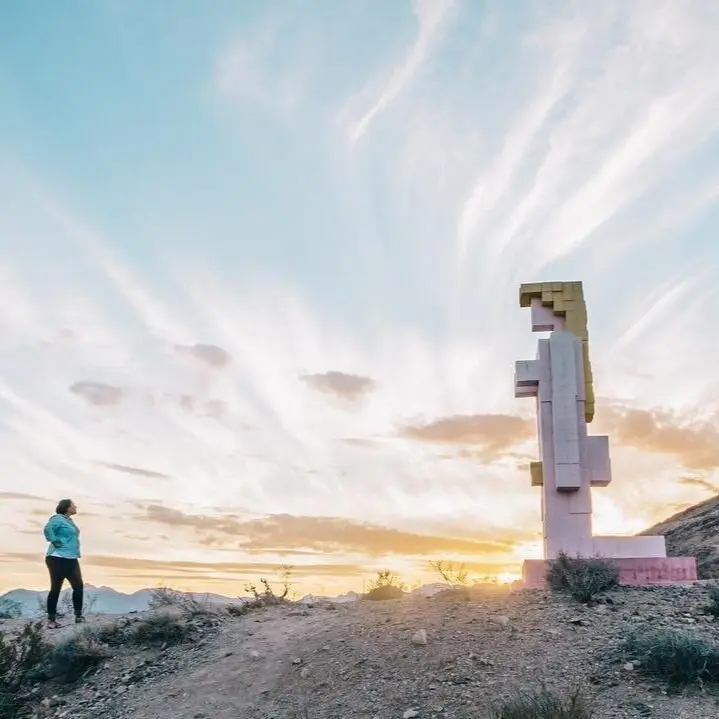
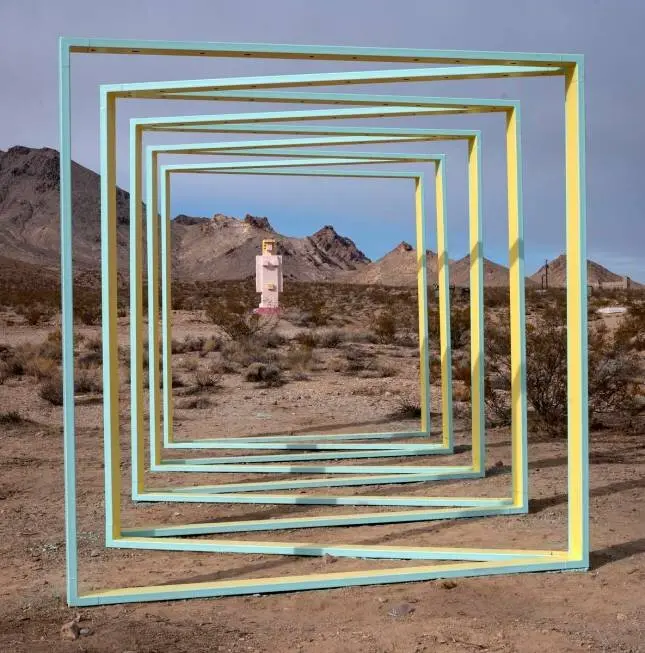
- Lady Desert: Venus of Nevada by Dr. Hugo Heyrman (1992), “a 25-foot high pink woman made of cinder blocks.” The Las Vegas Review-Journal likened her to “a voluptuous set of giant Lego bricks.” To Fox she seemed to be directing attention toward Las Vegas.
- Tribute to Shorty Harris by Fred Bervoets (1994), “a 24-foot high steel prospector accompanied by a penguin.”
- Icara by Dre Peeters (1992), a carved female Icarus “reaching for the sun from high atop a wooden pillar.”
- A ghostly figure holding a bicycle, described by Nevada Magazine.
- Sit Here! by Sofie Siegmann, a couch of mosaic and concrete.
The museum’s list also mentions “a blossoming tangle of gleaming chrome car parts.” That is Szukalski’s Desert Flower of 1989, which the museum’s own biography of the artist says was destroyed in a windstorm in 2007.
Szukalski’s Ghost Rider and Serving Ghost date from 1984. Newer pieces by American artists stand among the Belgian ones:
- Eames Demetrios’s Rhyolite’s District of Shadows (2006)
- Cierra Pedro’s 1000 in 1 Cranes (2016)
- Emily Budd’s Memorial for Queer Rhyolite (2020)
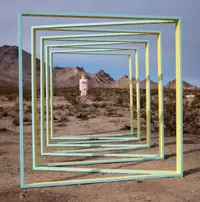
- Amanda Phingbodhipakkiya’s Portone (2021)
- Antwane Lee’s Ancestral Totem (2021)
- Javier Sanchez’s The First Design (2021)
- Michelle Graves’s Keep Going (2023)
- Irina and Stanislav Schminke’s Dip Town (2024)
A Medicine Wheel is also on the grounds.
The grounds never close and cost nothing. Donations are taken, and a self-guided tour brochure is available. A small visitor center and gift shop keep daytime hours. In summer the center usually closes by 2 p.m. because of the heat.
Suzanne Hackett-Morgan, a Las Vegas artist, is executive director. The board president is Michelle Graves, maker of Keep Going. A Travel Nevada grant recently paid for Goldwell-branded directional signs, installed by Eric Stanford and Co., to help visitors find the place. For Beatty Days on October 31, the museum’s site announces an afternoon on the grounds: walking tours, a ribbon-cutting for its newest permanent piece, an author reading on the couch itself, and sunset at the Ancestral Totem.
Burlap and plaster in a hot September
The figures came first, in 1984. Charles Albert Szukalski was a Belgian sculptor, born April 4, 1945, in Furth im Wald, Poland, by the museum’s account, and known in Europe as the sculptor of “ghosts” and a “situation maker.” Fox describes him as “a lanky, dark-haired Belgian sculptor with a striking resemblance to the late rock star Jim Morrison.” He meant to work inside Death Valley National Park but ran into restrictions there, Fox writes, and turned to Rhyolite instead. The museum says he was drawn to the Mojave partly for its resemblance to the deserts of the Middle East. For him, the museum adds, “America” and “The West” stood for “a place of ultimate freedom.”
He had made the piece once before, in Belgium. The museum dates the first version to 1974, with a caption placing it at Kapellen; Fox says it was executed in West Flanders.
The Rhyolite version was built on living people. According to the museum’s history, Szukalski wrapped models in fabric soaked in wet plaster and posed them as Leonardo had. When the plaster set, each model slipped out, leaving the rigid shell. Fox tells it more plainly: Szukalski talked his friends into posing, draped them in wet burlap, and coated it with plaster. “It was September, a month when temperatures in Rhyolite routinely remain well over a hundred even when the sun goes down, and no one caught pneumonia.” The fiberglass came afterward, to make the figures weatherproof. Szukalski unveiled the work in late October 1984.
It was meant to last two years, the museum says. Nevada Magazine reports that the tableau first stood high above Rhyolite on a wooden frame, lit at night by a neon light bar. The museum says it was first installed by the ghost town’s train station. Both sources agree it was later moved. In the magazine’s telling, vandals destroyed three of the original figures. Szukalski responded by buying 7.8 acres at the base of Rhyolite and inviting other Belgian artists to share it. The Pahrump Valley Times gives the park as 15 acres.
The town above had its own arc. Fox writes that Rhyolite was founded in 1904, after a gold-bearing quartz vein turned up in the red hills, and reached 8,000 residents. The financial panic of 1910 cut it to less than a tenth of that, and its stone and concrete buildings outlasted the wooden camps elsewhere in Nevada. In the late 1980s the Barrick Mining Corporation terraced the nearby hills “to resemble Aztec temples.” That mine ran until 2000.
Belgians, then a survey team from Las Vegas
Three more Belgian artists followed in the early 1990s and added six pieces between them. The museum’s history describes them as major figures in European art “who chose to create in relative obscurity in the Nevada desert.” Heyrman’s Venus and Peeters’s Icara date from 1992 and Bervoets’s prospector from 1994. With Szukalski’s two works of 1984, the museum counts these as “the original 5 sculptures of Goldwell.”
In 1994, Charles Morgan and Suzanne Hackett were surveying Southern Nevada’s outdoor sculpture for the national “Save Outdoor Sculpture!” project, sponsored by the Nevada Arts Council, the Smithsonian Institution, and the National Institute for the Conservation of Cultural Property. The survey brought them to Szukalski. In 1996 they mounted an exhibition about the site at the Contemporary Arts Collective in Las Vegas and built the museum’s first website.
Szukalski died in January 2000. The museum gives the date as January 25 and the place as Antwerp. Fox writes that he died of throat cancer and was buried in a cemetery in Belgium. The property and artworks passed to his business partner, who lives in Amargosa Valley. By March 2000 an agreement set up a 501(c)(3) to receive them, and the federal tax exemption came in April 2001.
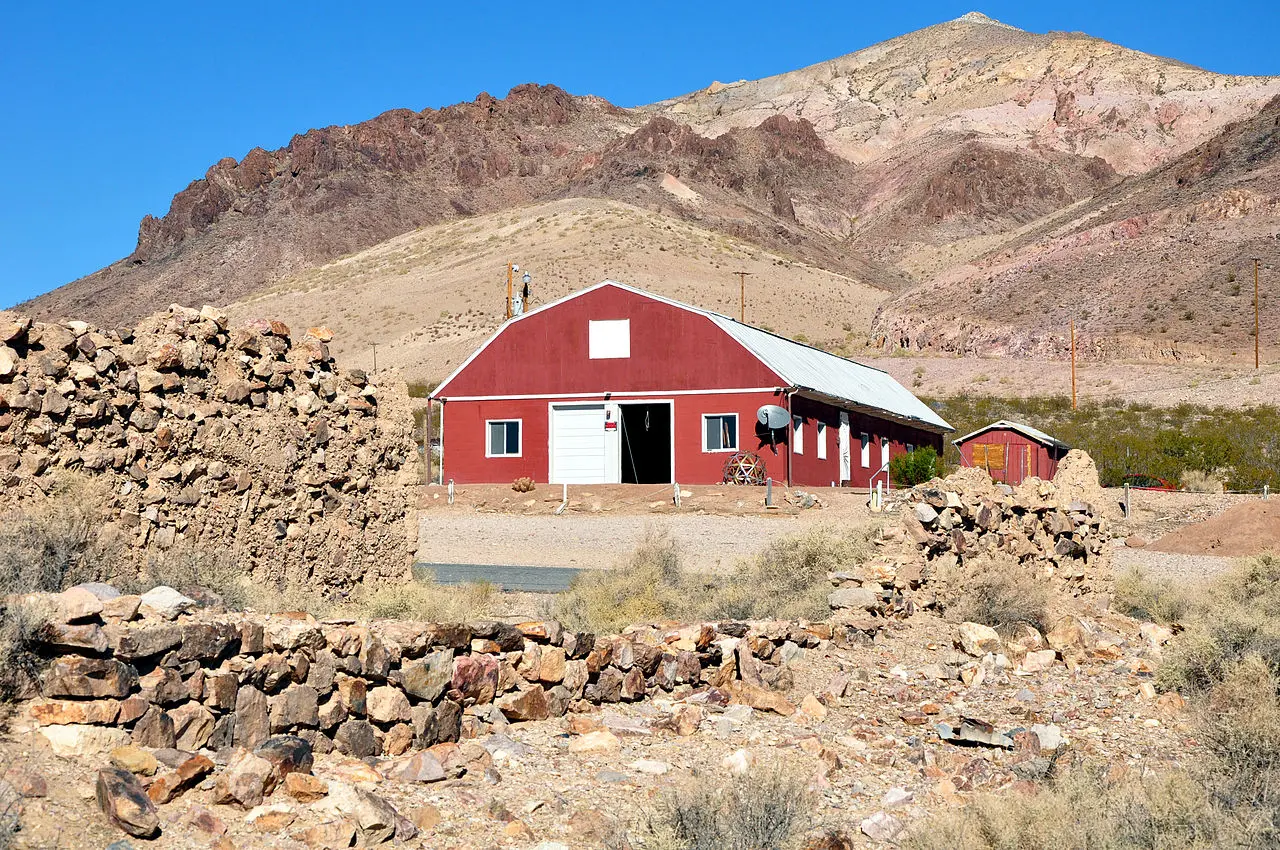
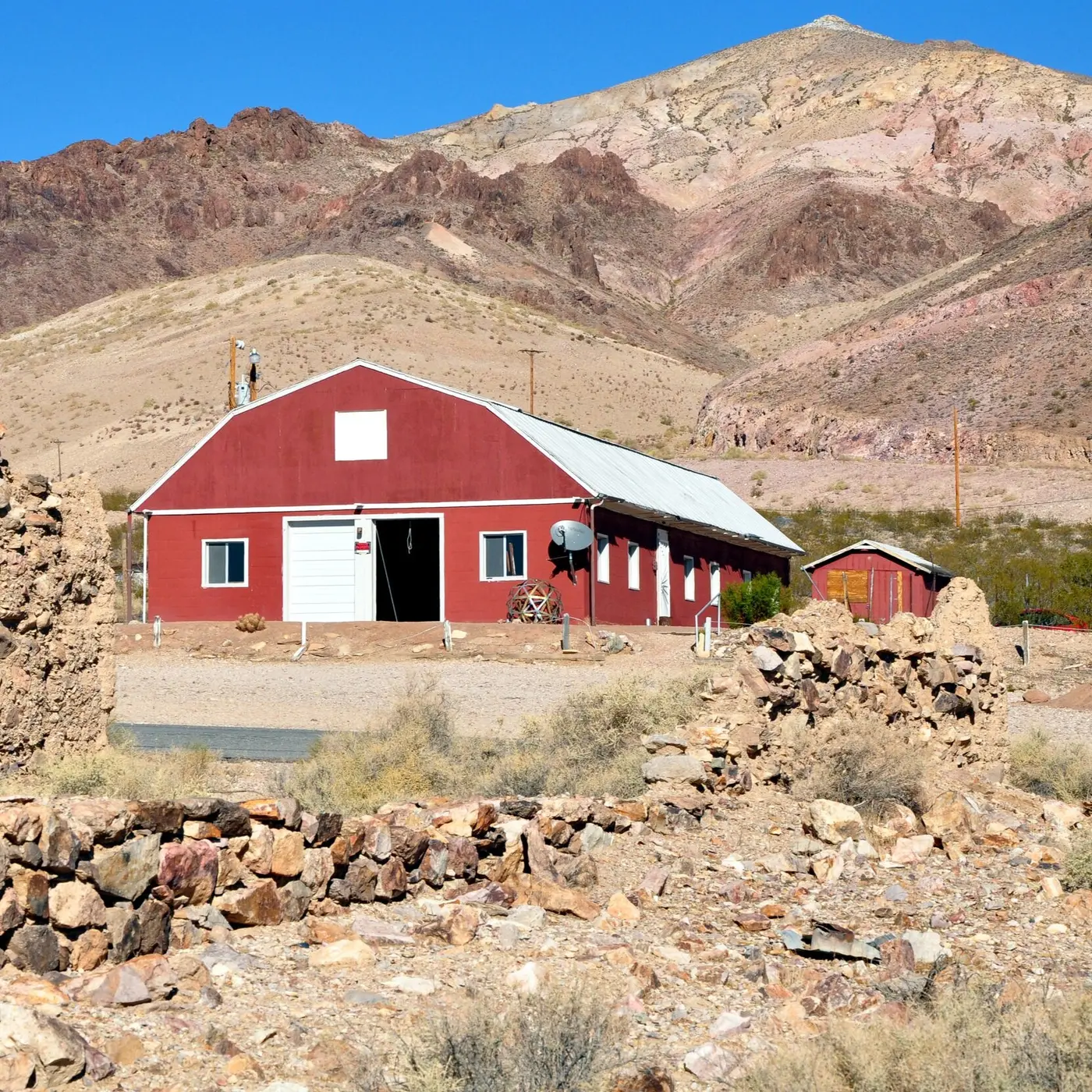
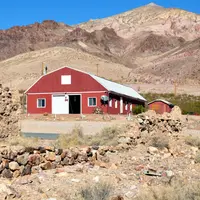
From 2006 to 2014, Goldwell ran an artist residency and workspace in the nearby Red Barn Art Center. The museum says it will bring the residency back.
The collection grew slowly and stayed still until June 2011. That month, David Berg and a team of volunteers raised a 21-foot steel-pipe sculpture with three crutch-shaped arms that turn in the wind. The Review-Journal reported it was the first new work in four years and only the third ever added, and the first that moved. Berg called it Politician’s Compass. “It moves in the slightest breeze, with elements that point in any given direction at any given time,” he said. “And after vast amounts of movement and energy, absolutely nothing is accomplished.”
Hackett-Morgan had worried the steel arms might hurt someone. The fix was to mount them out of reach; “You’d have to be Yao Ming” to worry, she said. She pictured visitors watching it from the porch or from Sit Here!: “It will be like Death Valley TV.” She also recalled that no signs named the pieces, as Szukalski intended. “Albert wanted it to be peculiar and mysterious,” she said. Berg noted that cellphones generally don’t work there. “It leaves the viewer and the landscape pretty much to themselves,” he said.
For the 40th anniversary, October 18–20, 2024, a parade ran from the Rhyolite Depot to the visitor center. Debbie Baker rode as Miss Rhyolite, and Lt. Gov. Stavros Anthony gave opening remarks. Kyle Bissantz and the UNLV Percussion Ensemble played “Ghost Town Miners” by former resident-artist Nolan Stolz, and the Red Barn sold food and screened “Death Valley Project.”
A column of mine tailings
The inaugural Bullfrog Biennial, curated by Sierra Slentz, opened at Goldwell in October 2019. For it, Emily Budd raised a column of packed desert sand and mine tailings from the area. Budd is a sculptor who teaches at the University of Nevada, Las Vegas. The museum’s collection list dates her piece to 2020.
Her column remembers Stonewall Park. In the mid-1980s, Budd writes, a small group led by Fred Schoonmaker and Alfred Parkinson tried to buy Rhyolite and found a queer town there, a safe place during the AIDS epidemic. They met protest from the surrounding area and could not raise the money. Budd found the story in the Stonewall Park Collection at UNLV’s Special Collections. There she also found a regional newspaper condemning the attempt beside a headline about a nearby atomic test.
The column is held together only with water. As it wears down, it will bury a small aluminum marker cast inside it, which reads: “here lie dreams of Stonewall Park, a safe and peaceful place.”
Notable Events
- 1984Szukalski unveiled his sculpture in late October 1984. goldwellmuseum.org
- 1990sSix additional pieces by three other major Belgian artists were added to the site, created in relative obscurity in the Nevada desert near Death Valley. goldwellmuseum.org
- 1994Charles Morgan and Suzanne Hackett first became involved with Szukalski while surveying Southern Nevada outdoor sculpture for the national Save Outdoor Sculpture! project. goldwellmuseum.org
- 1996The founders organized an exhibition about the site at the Contemporary Arts Collective in Las Vegas and established the Museum's first website. goldwellmuseum.org
- 2000Szukalski died in January 2000; by March 2000 an agreement established a 501(c)3 organization to receive the property and ownership of the artworks. goldwellmuseum.org
- 2001The Museum received its federal tax exemption in April 2001, becoming eligible for grants and individual contributions. goldwellmuseum.org
- 2004Goldwell made the documentary Death Valley Project, A Film by Goldwell. goldwellmuseum.org
- 2007Desert Flower, which Szukalski had placed at the site in 1989, was destroyed in a windstorm. goldwellmuseum.org
- 2019The public work was originally installed for the inaugural Bullfrog Biennial at Goldwell. goldwellmuseum.org
People
- Charles Albert Szukalski, Belgian sculptor whose The Last Supper became the genesis piece of the Goldwell Open Air Museum (1945-2000).
- Albert Szukalski, Belgian artist of the Last Supper sculpture (1945-2000).
- Charles Morgan, co-founder of the museum.
- Suzanne Hackett-Morgan, Goldwell executive director and Las Vegas artist.
- Sierra Slentz, Curator of the Bullfrog Biennial (2019).
- Suzanne Hackett, co-founder of the museum.
- Amanda Phingbodhipakkiya, sculptor of Portone (2021).
- Antwane Lee, sculptor of Ancestral Totem (2021).
- Cierra Pedro, sculptor of 1000 in 1 Cranes (2016).
- Dr. Hugo Heyrman, sculptor of Lady Desert: Venus of Nevada (1992).
- Dre Peeters, sculptor of Icara (1992).
- Eames Demetrios, sculptor of Rhyolite's District of Shadows (2006).
- Emily Budd, Artist of Memorial for Queer Rhyolite, installed at Goldwell's inaugural Bullfrog Biennial (October 2019).
- Fred Bervoets, sculptor of Tribute to Shorty Harris (1994).
- Irina & Stanislav Schminke, sculptors of Dip Town (2024).
- Javier Sanchez, sculptor of The First Design (2021).
- Michelle Graves, sculptor of Keep Going (2023).
- David Berg, Southern Nevada artist whose sculpture was Goldwell's first kinetic addition.
- Sofie Siegmann, sculptor of Sit Here!, a colorful couch.
Sources
- goldwellmuseum.org
- goldwellmuseum.org/plan-your-visit
- goldwellmuseum.org/history
- goldwellmuseum.org/whoweare-mission
- goldwellmuseum.org/permanent-collection
- goldwellmuseum.org/charles-albert-szukalski
- travelnevada.com/nevada-magazine/only-in-your-state-goldwell-open-air-museum
- pvtimes.com/news/goldwell-open-air-museum-anniversary-offering-a-weekend-full-of-activities-136477