

Gifford-Inchelium Ferry
Inchelium, Stevens County, Washington. Vehicle and passenger ferry; April 1 - September 30 (Summer Hours).
Details

- Where
- 267 Gifford Ferry Road, Inchelium, WA 99138. Directions
- When
- first run at 6:30 am (from the Inchelium side) and last run at 9:45 pm (from the Gifford side).
- Fees
- The fare to ride is free.
- Access
- The Ferry closes for 1 week in April during Spring break for maintenance. It will also close if the water levels go below 1229' above sea level. It will resume when the water levels permit.
- Managed by
- Colville Tribes.
- Coordinates
- 48.27812, -118.14500.
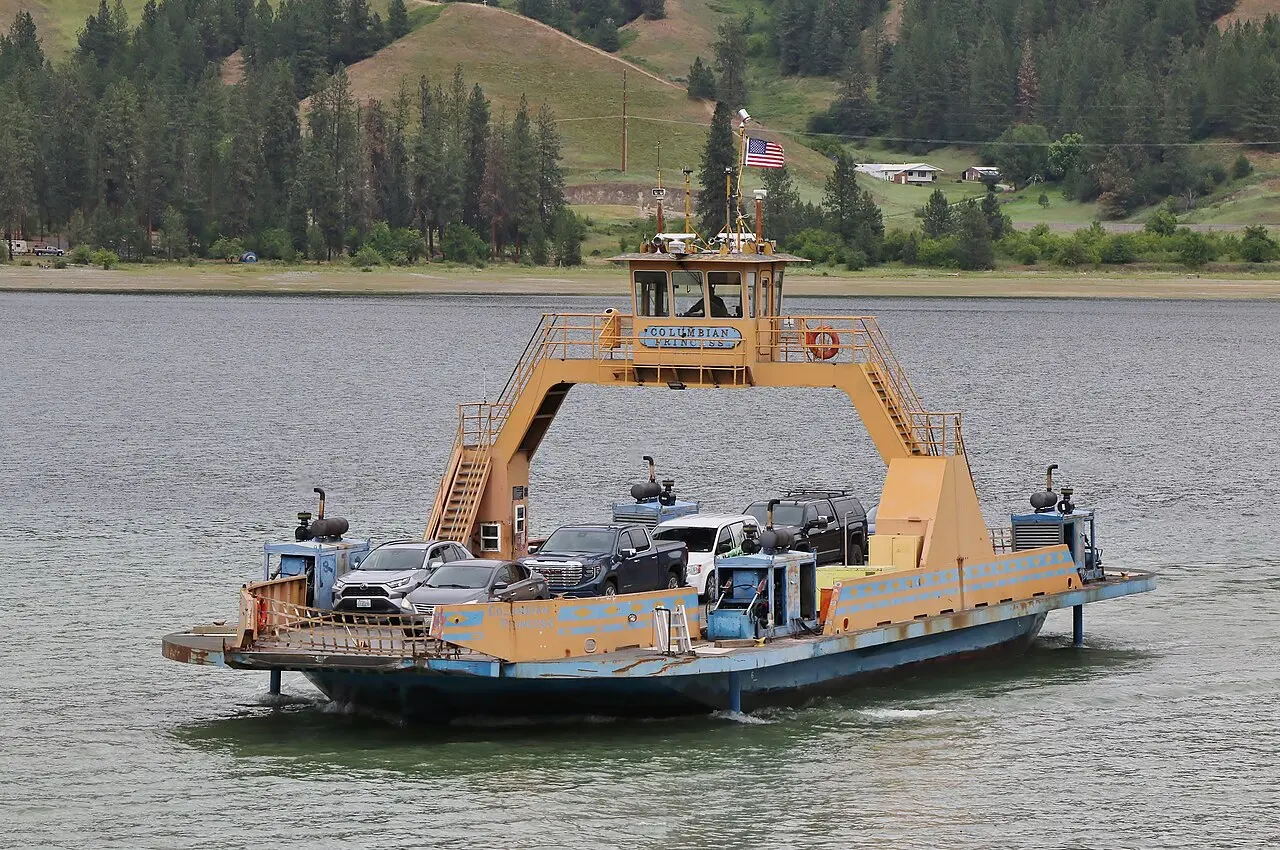
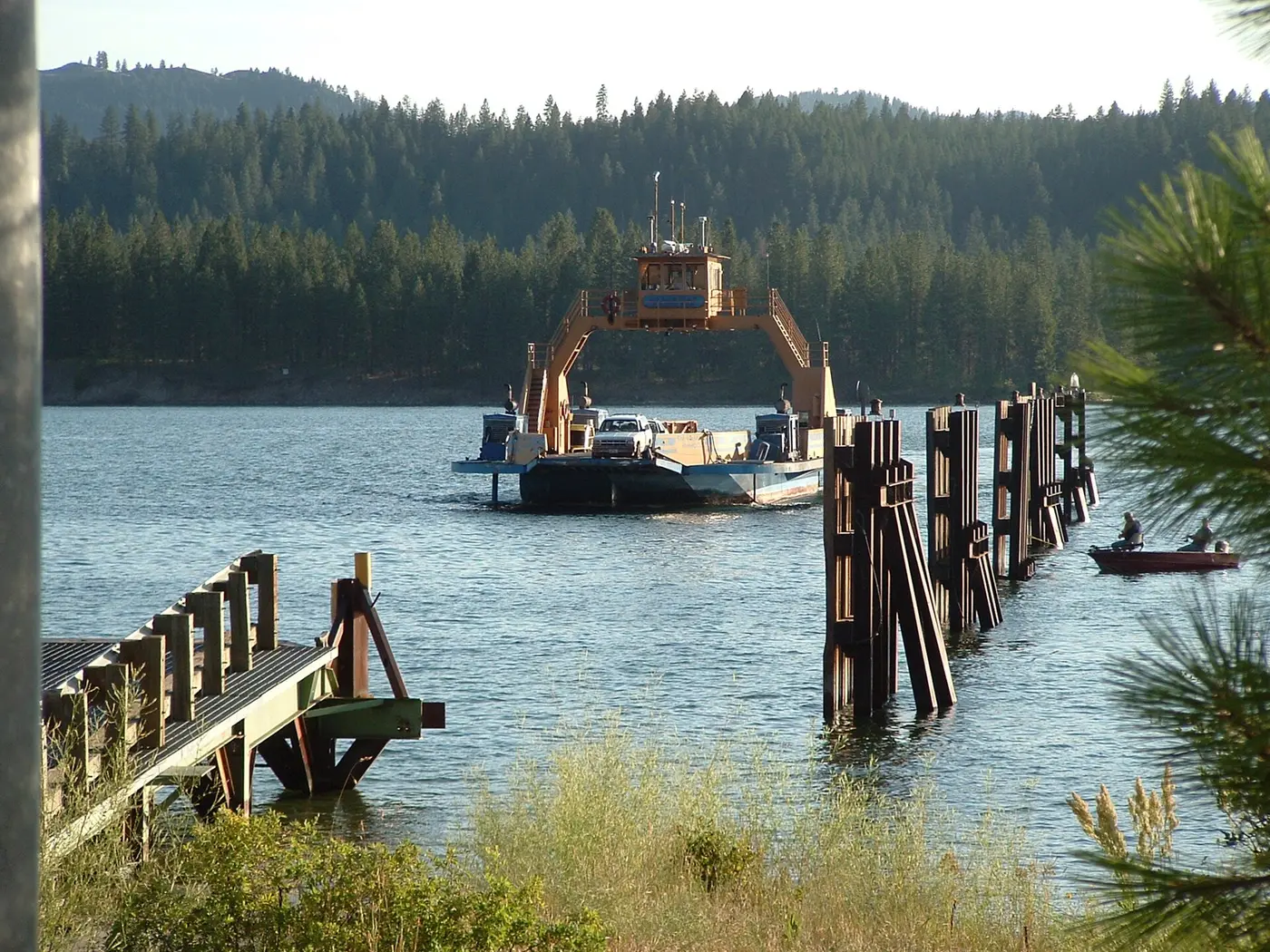
The boat leaves the Inchelium shore on the hour and the half hour and starts back from Gifford at a quarter past and a quarter to, seven days a week. It is an open deck with a hydraulic ramp at each end and room for sixteen vehicles up to 15 feet 7 inches tall. It carries cars, trucks, motorcycles, and now and then a person on foot, with a weight limit of 40 tons. No fare is collected. A 2021 Avista piece noted that there are no lounges and no espresso, and that on a warm summer day swallows dive for insects over the smooth water as the boat rumbles across. HistoryLink gives the crossing as six minutes; Avista calls it about ten.
Six minutes on Lake Roosevelt
The run is known locally as the Gif. On the west bank is Inchelium, on the Colville Reservation in Ferry County. On the east is Gifford, a small town on State Route 25 north of Hunters in Stevens County. The ferry links the reservation road to that highway, and it is the only crossing between the Kettle Falls bridges upstream and the Keller Ferry downstream. The Colville Confederated Tribes operate it on behalf of the Bureau of Indian Affairs, under a Public Law 93-638 contract. Christine Whitney manages it as Inchelium Ferry/Transit Program Manager, and the same office runs shuttle routes from Inchelium to Nespelem and to Colville.
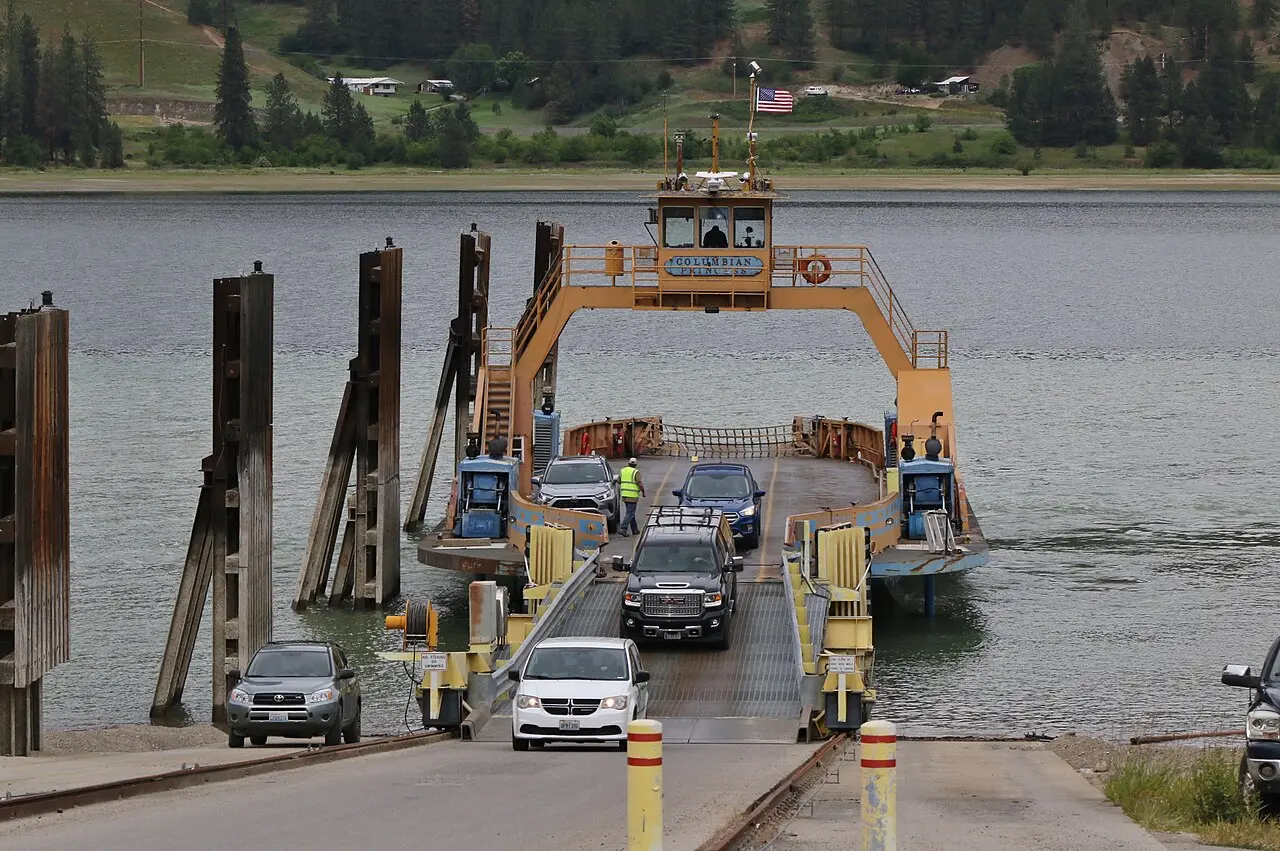
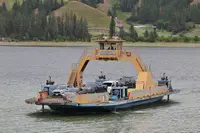
The vessel is the Columbian Princess. The Federal Highway Administration and Avista both write her name as Columbia Princess. A 1981 trade report describes four General Motors 4-71 diesels, one in each corner, each driving an outdrive unit with a 36-inch propeller that can turn 360 degrees. All four are controlled from a central pilothouse and usually run in pairs. HistoryLink described the wheelhouse in 2006 as sitting on legs that straddle the car deck, with no shelter for foot passengers. When the water is low, the boat simply noses up onto the shore like a landing craft to load and unload. The ferry closes for a week each April, during spring break, for maintenance. It also stops whenever the lake drops below 1,229 feet above sea level and resumes when the water allows. The FHWA counted an average of 227 cars a day, and a round trip of about thirty minutes. A photograph made on June 1, 2026, shows the Princess at the eastern dock.
A cable ferry and a drowned town
Inchelium was first called Buffalo and later Troy. Government surveyors gave it its present name, their spelling of the San Poil name En-char-lay-um or En-ch’lay-um. The name is said to mean “where big water meets little water” or “a meeting place among three waters,” and it refers to Hall and Stranger creeks joining the Columbia nearby.
In 1896 Congress opened the reservation to mineral development by non-Indians, and traffic across the river from the direction of Colville increased. A ferry began running between Gifford and Inchelium in 1898. The Washington Trust’s Revisiting Washington guide says it was a cable ferry. Avista suggests the site was chosen because it offered a short, somewhat protected reach across what was then the free-flowing Columbia.
HistoryLink dates the next change to 1939 and 1940, when Lake Roosevelt rose behind Grand Coulee Dam and inundated both Inchelium and Gifford. The old Inchelium townsite went under 135 feet of water. Its people moved a few miles away to the benchland and kept the name, and the ferry moved its landings to match. The service stayed in private hands until 1974, when the business closed as unprofitable. Avista recalls it simply as closed “for a while in the early 1970s.” Travelers had to drive 30 miles to the Keller Ferry instead. The Colville Confederated Tribes and the BIA asked Congress for money for a permanent ferry, and in the meantime the BIA hired a tug and barge to move autos across the lake.
A hull on wheels through the wheat
Fisherman’s Boat Shop in Everett completed the Columbian Princess in 1981 on a $1.7 million BIA contract. The FHWA page gives a much larger figure, saying the ferry cost $28 million when purchased by the tribe.
The 120-foot, 42-foot-wide boat then had to reach a lake with no sea outlet. Maritime Reporter said she went under her own power through the Strait of Juan de Fuca and down the coast to the mouth of the Columbia. HistoryLink says the hull was towed. Both accounts agree that she climbed the Columbia through the locks of five dams.
The two accounts differ on what happened next:
- Maritime Reporter says the ramps, propulsion units, and superstructure were removed at Burbank, near Pasco. The hull was then towed to Lower Monumental Dam on the Snake River, where the 170-ton hull was lifted from the water onto heavy moving trucks.
- HistoryLink says she was put on wheels at Pasco in July and trucked 108 miles to Lincoln in Lincoln County, at four to six miles an hour.
On the road, the convoy crossed four highway bridges and 54 culverts. Five miles of road were widened and four bridges reinforced ahead of it. A crew went in front taking down traffic signs and another put them back after the boat passed. The state Department of Transportation called it the widest load ever moved on Washington highways. The fields along the way were dusted with ash from Mount St. Helens, and HistoryLink described the hull as “an odd image in a sea of ripening wheat.”
The trade press expected the boat to carry logging and mining trucks along with summer vacation traffic. Daily service began in 1982. In 1994 the tribe took over operation from the family that had held the BIA contract. In 2002 a new $1.6 million dock was finished, paid for with $940,000 in Ferry Boat Discretionary funds plus Indian Reservation Roads money. The FHWA reported that $530,000 of the tribe’s annual maintenance funding went to the ferry.
Water levels and a bridge on paper
The run depends on the level of the lake. On April 13, 2001, a Spokesman-Review headline described what a closure meant: a 120-mile detour for some. In April 2017 the ferry was scheduled to stop after the Army Corps of Engineers began drawing down Lake Roosevelt to make room for spring runoff. The tribe argued that many people depended on the boat to reach work, school, and medical care, especially after a winter that had damaged area roads. The Corps agreed to hold the lake at or above 1,232 feet, and the ferry kept running that season.
The tribe has also proposed replacing the ferry with a bridge across the lake. It asked for $120,000 for a feasibility study of a project estimated at $44 million. On April 11, 2024, Roland Springer of the Bureau of Reclamation told the Colville Business Council that his agency’s specialists were working with the Washington State Department of Transportation on a possible replacement. He said the work would move to a phase of exploring feasibility and funding, and that Jordan Rank, a Reclamation supervisory project manager, could keep the council updated as often as needed.
Notable Events
- 1896Congress opened the reservation to mineral development by non-Indians, increasing traffic across the river from Colville. historylink.org
- 1898A ferry began operating across the Columbia River between Gifford and Inchelium. historylink.org
- 1939Lake Roosevelt inundated Inchelium and Gifford. A new Inchelium grew on higher ground and the ferry shifted its landings. historylink.org
- 1970sThe Gifford ferry closed for a period in the early 1970s. myavista.com
- 1974The private ferry enterprise closed as unprofitable, compelling travelers to use Keller Ferry. historylink.org
- 1981Fisherman's Boat Shop completed Columbian Princess under a Bureau of Indian Affairs contract. historylink.org
- 1981The new ferry traveled by water and 108 miles overland to reach Lake Roosevelt. magazines.marinelink.com
- 1982The Columbia Princess began carrying travelers daily across the lake. myavista.com
- 1994The tribe took over operation from the family that held the BIA contract. historylink.org
- 2002A $1.6 million dock project, supported by Ferry Boat Discretionary and IRR funding, was completed. fhwa.dot.gov
- 2017The U.S. Army Corps of Engineers agreed to hold Lake Roosevelt at or above 1,232 feet so the ferry could remain in service. spokesman.com
People
- Christine Whitney, Inchelium Ferry/Transit Program Manager.
- Jordan Rank, BOR Supervisory Project Manager identified as able to keep the CBC updated on possible ferry replacement.
- Roland Springer, Bureau of Reclamation manager updating the council on possible Inchelium Ferry replacement work with WSDOT.
Sources
- colvilletribes.com/transit-inchelium-ferry
- wsdot.wa.gov/travel/washington-state-ferries/ferries-terminals/other-ferry-systems
- facebook.com/ColvilleConfederatedTribes
- instagram.com/colvilleconfederatedtribes
- fhwa.dot.gov/tribal/tribalprgm/govts/colville.htm
- myavista.com/connect/articles/2021/08/local-treasures-with-pia-the-gifford-ferry
- spokesman.com/stories/2017/apr/25/agreement-will-keep-inchelium-gifford-ferry-runnin
- revisitwa.org/waypoint/inchelium
- magazines.marinelink.com/Magazines/MaritimeReporter/19810915/content/two-vessels-trucked-204950