.jpg)
Garnet Hill Rockhound Area
Ely, White Pine County, Nevada. Public recreation area.
Details

- Where
- Garnet Hill, Ely, NV 89301. Directions
- Getting there
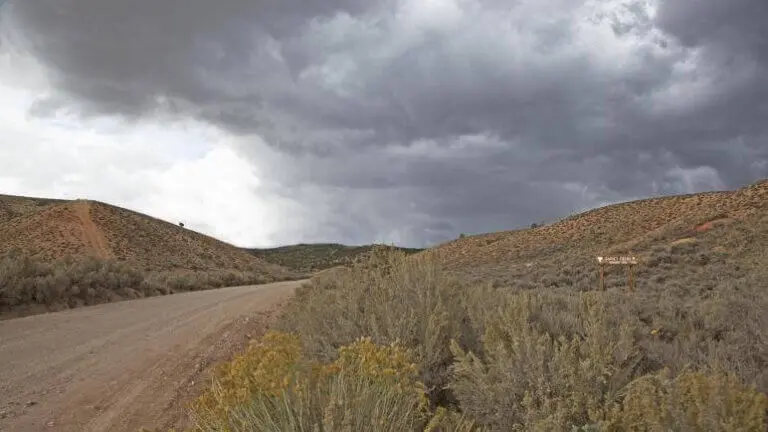
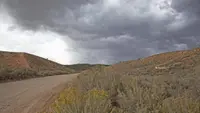
- In White Pine County along Highway 50 on a well-maintained dirt road; a 'Garnet Hill' BLM marker on the right-hand side of the road guides you to the recreation and rockhound area.
- Fees
- Open to the public at no charge.
- Access
- Limited camping space for tents and smaller RVs, a group campfire area, a wheelchair accessible restroom, and five picnic tables near the top of Garnet Hill.
- Phone
- (775) 289-1800
- Website
- blm.gov
- Managed by
- Bureau of Land Management, Ely District.
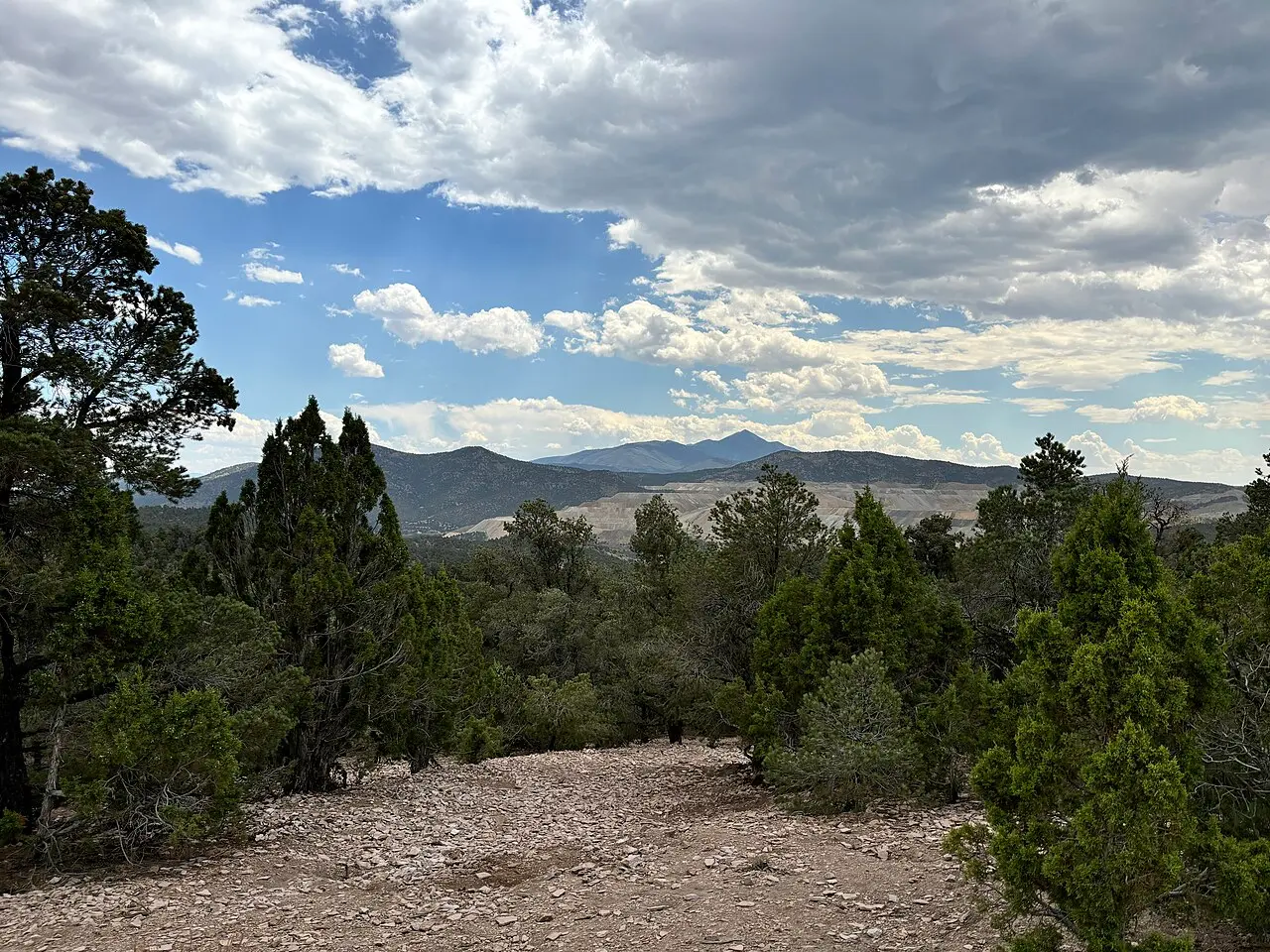
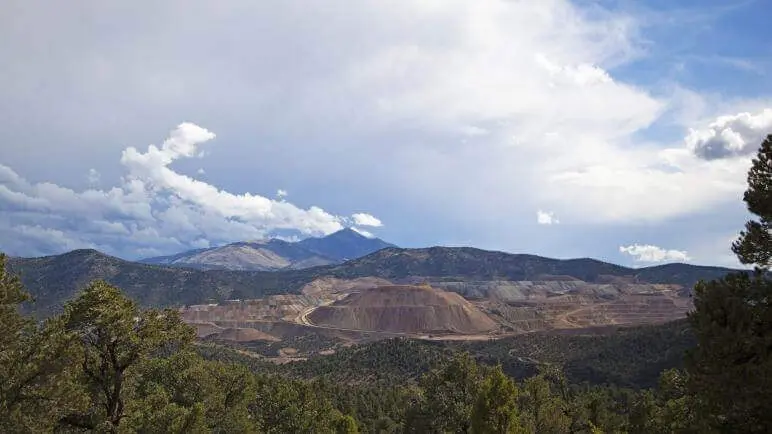
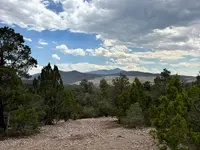
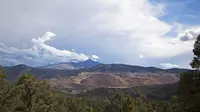
From the parking area near the top of Garnet Hill, a visitor can see the excavations of the open pit copper mines near Ruth and, in the words of a 1995 Bureau of Land Management fact sheet, the “multi-colored waste rock dumps” of the Robinson Mining District. The ground underfoot is pink to gray rhyolite. It is heaped in places with mounds of broken cobbles left by collectors who came before. In that rock, and in the gravel washed down from it, are garnets. The Ely District of the BLM manages the site, and it is the only designated rockhounding area in that district. Collecting is free.
The road off Highway 50
The way in leaves U.S. Highway 50 west of Ely. The BLM directs drivers to a point a quarter mile north of the Ruth turnoff, where a graded access road turns off to the right. A “Garnet Hill” BLM marker stands on that side of the highway. The 1995 fact sheet puts the junction about 6.4 miles west of the traffic signal at the U.S. 93 and U.S. 50 junction in town. From there the road runs 3.1 miles to the parking area. It is winding and somewhat steep, and the BLM rates it suitable for sedans. A page prepared for a 2025 cave symposium in Ely gives the drive from town as about ten minutes.
By air the area lies between 3½ and 5½ miles northwest of central Ely, according to the 1995 sheet. The BLM gives the elevation as 7,000 feet. The symposium page gives 7,400.
The sources count the furniture differently. The BLM lists four picnic sites with grills, a group barbecue area, an accessible restroom, and two informal areas for tents or small campers. It does not recommend RVs or large trailers, and it notes that no water is available. Travel Nevada and the 1995 fact sheet count five tables near the top of the hill. The Ely tourism office and the Nevada Outback Gems site count three tables around the road loop.
Dark stones in the gullies
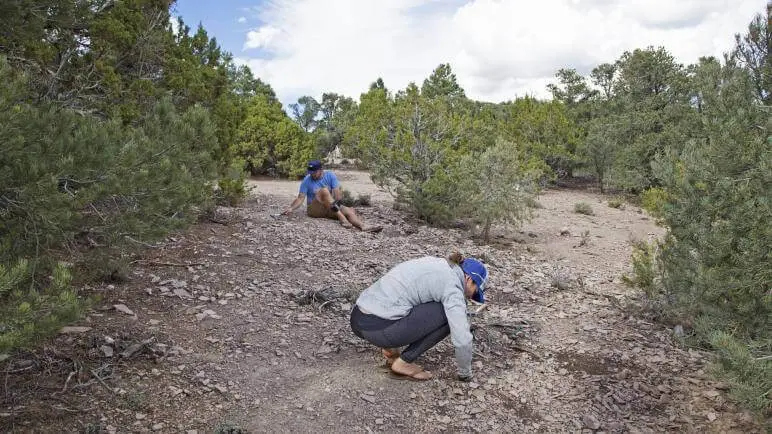
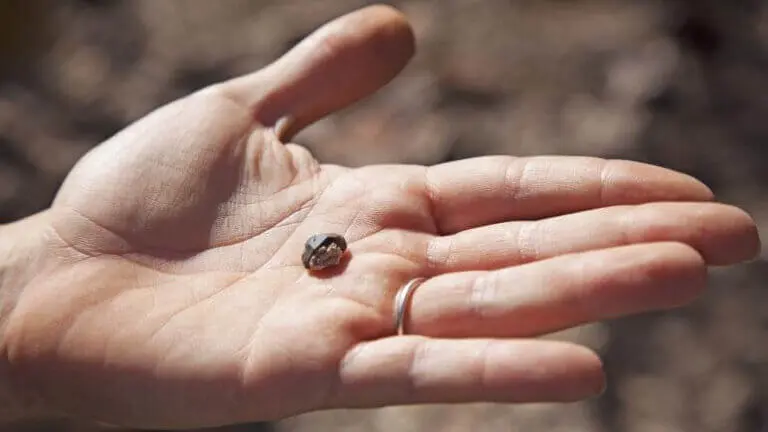
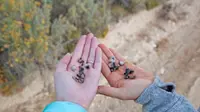
The garnets usually sit as single crystals in small cavities in the rhyolite. Over time they weather loose and wash downhill. Because they are heavier than the surrounding rock, they collect in low spots and small drainages, “somewhat like placer gold in a stream,” as the symposium page puts it. Its advice is to “keep your eyes open for dark red dots in the dirt and rubble.” Nevada Outback Gems notes that the stones’ very dark color contrasts strongly with the local rock and soil. Of the two ways to hunt, this one takes the least work.
Travel Nevada says the best time to search is after a rainstorm or snowmelt, when it is not uncommon to find stones sitting just above the soil. The 1995 fact sheet sends searchers beyond the hill itself, to the canyons south of it and to either side of the former community of Lane. It also suggests a shortcut. Rather than drive to the top, a collector can park at the large pullout on U.S. 50, 5 miles from Ely or 1.1 miles from the Ruth junction, and walk up the adjacent drainage, “usually rewarded by finding garnets.”
Locals quoted by Travel Nevada point to the southwest corner of the hill for the best stones. The fact sheet names a more specific spot: the southwest summit of the rhyolite ridge running southwest from Garnet Hill, at 7,339 feet, which “has been reported to contain better quality gemstones.”
Hammer, chisel, and the old pits
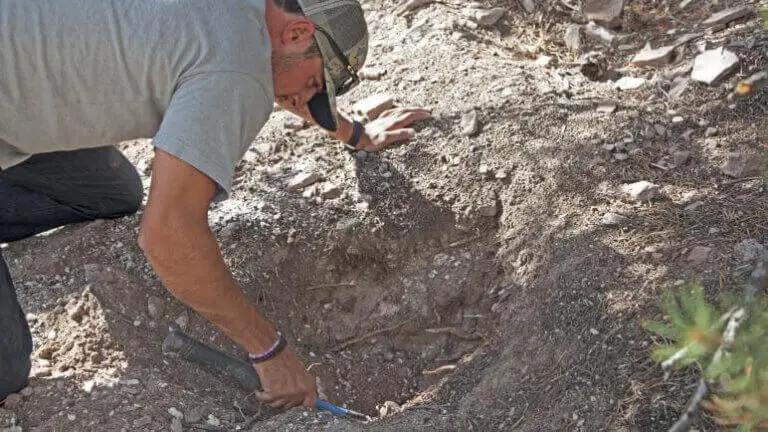
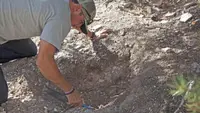
The other method is to break the rock open. The 1995 sheet calls it “more arduous, but sometimes more rewarding,” and judges it popular, “as evidenced by the mounds of rock cobbles.” Nevada Outback Gems calls it the best way to find the finest specimens, with the stones still attached to the mother rock. It requires sharp chisels and heavy crack hammers to open the hard, unweathered rhyolite. The writer of that site, a prospector who signs himself Chris, recalled: “When I dug here, I felt the distinct flavor of what it must have been like to break rock in the old time prisons.”
The cavities that hold garnets are called vugs or vesicles. Chris found that they keep to certain mineralized zones rather than scattering evenly through the rock. The 1995 sheet advises looking for veins or cavities lined with quartz. Chris names the lining more precisely as “sugary, sparkling light gray tridymite,” a high-temperature form of quartz.
Collectors have worked the hill for many decades, and their rubble covers the ground completely in places. Where it does, it buries the host rock, so anyone digging outside the established pits may have to shift a good deal of it first. In 1995 the BLM pointed to several new pits a short distance east of the parking area, where the rock was not yet hidden under other collectors’ debris.
Garnets are hard but brittle, and the fact sheet warns that they “may shatter like glass.” It suggests prying an exposed crystal out with a stout pocket knife, or leaving it in the rock. The symposium page lists the kit: safety goggles, leather gloves, rock hammer, chisel, pry bar, pick, shovel, drinking water, something to carry the finds, and a hat on summer days. It also notes that rattlesnakes have occasionally been seen on the hill. Rocks that might shelter one should be turned with a tool rather than a hand. Cleaning a find takes soap, water, and an old toothbrush.
Almandine, black to hyacinth-red
The garnets are of the variety called almandine, named after Alabanda, an ancient town in Asia Minor. They are an iron-aluminum silicate, and their dark color comes from that iron. The 1995 sheet adds that stones from this locality also carry some manganese, the main element of the spessartine variety. Nevada Outback Gems describes them as a mixture of spessartite and almandite.
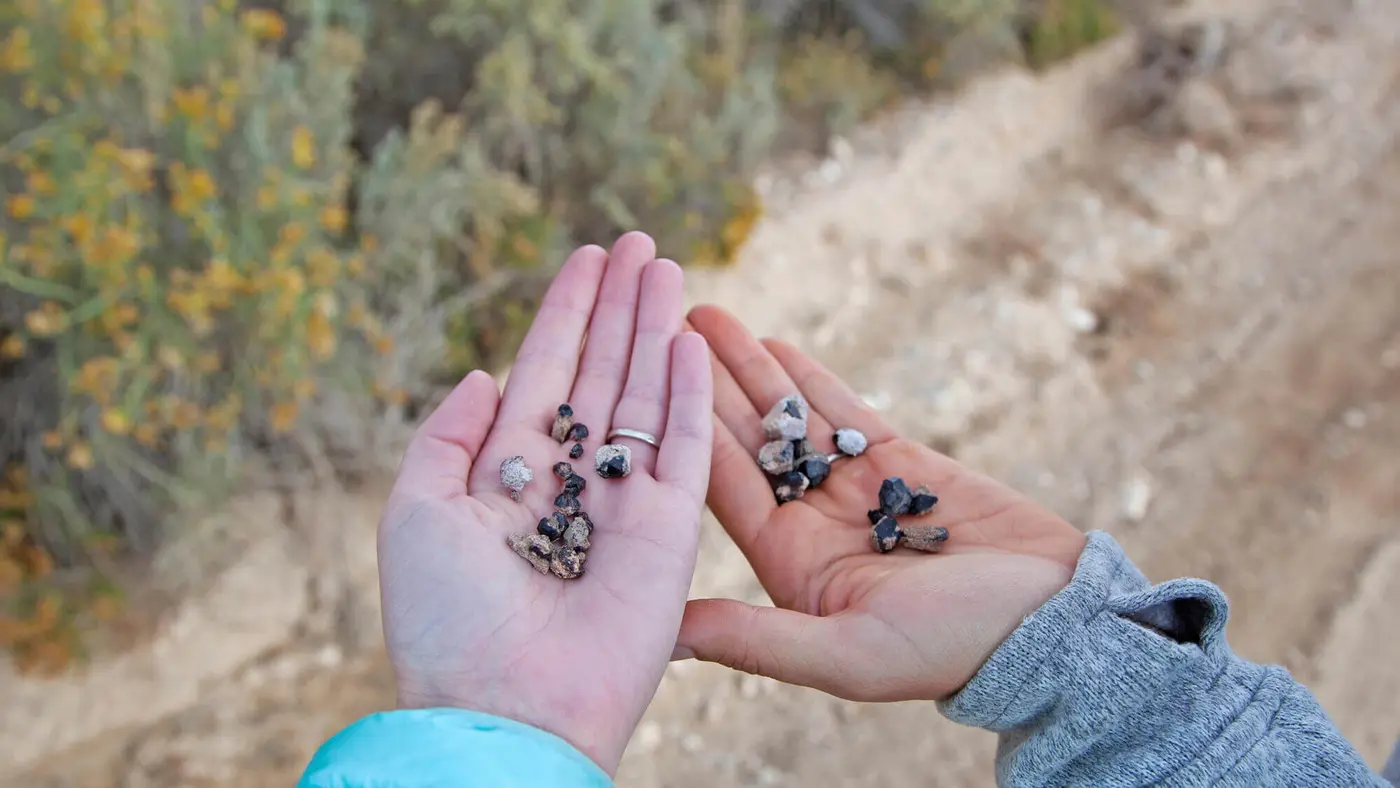
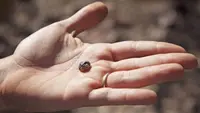
The sources describe the stones differently. The fact sheet gives the color range as brownish-red to hyacinth-red. The symposium page gives deep red to brownish red and orange, in sizes from small grains to a quarter inch, rarely half an inch. Nevada Outback Gems and the Ely tourism office describe dark maroon red to black crystals averaging a quarter to half an inch, with sharp terminations and a sparkling luster. On rare occasions, they say, crystals reach nearly an inch. Usually one crystal sits in each cavity, though larger vugs sometimes hold two or more.
The sources also disagree on gem quality. The BLM says most stones are not of perfect gem quality, “though most people go home happy with their finds.” The 1995 sheet allows that some perfect gem-quality stones turn up. Nevada Outback Gems holds that even the transparent ones are so dark that the tiniest faceted stone would look black. At most, it says, they might yield small glassy black cabochons. Travel Nevada notes that a collector who comes away empty-handed can buy polished stones at Garnet Mercantile in Ely.
A buried volcano, prospectors, and 1970
The garnets come from a volcano that erupted between 32 and 40 million years ago, in the era when mammals were becoming dominant and modern plants were evolving. According to the symposium page, Garnet Hill then lay several hundred feet below the volcano’s surface. Travel Nevada gives the volcano a cavity up to a mile in diameter. As the rhyolite cooled, gases opened pockets in it. The symposium page says the garnets grew from the last bit of liquid cooling within the rock. Nevada Outback Gems says they formed from the vapor phase at fairly high temperatures, as shown by the tridymite, which forms instead of cristobalite or quartz when silica crystallizes hot. That site compares the deposit to the topaz deposit at Topaz Mountain and the red beryl in the Wah Wah Mountains, both in Utah. All three formed from similar rhyolites in the same geologic province, and each produced a different crystal.
Prospectors probably first noticed the garnets in the 1870s while searching the area for ore. Travel Nevada suggests they cared far more about the copper ground just to the south. A. C. Spencer of the U.S. Geological Survey later wrote a report on the ore deposits in and around Ely that covered the garnets. The symposium page says the report has since been mentioned in various mineralogist magazines.
On December 22, 1970, Garnet Hill and the land around it, 1,280 acres or two square miles, were withdrawn from mineral entry and designated the Garnet Fields Rockhound Area. The purpose was to keep the land in public ownership for its recreational and scientific study values. The official name has stayed on the BLM’s paperwork, and locals have kept calling the place Garnet Hill. The 1995 fact sheet records one further report: small crystals of topaz have been found on the hill. The BLM adds that the report “has not been confirmed.”
Notable Events
- 1870sThe garnets were probably first noticed by early prospectors (1870's) searching for ore deposits in the area. ely2025.nckms.org
- 1970Garnet Hill and the surrounding area were withdrawn from mineral entry when the Garnet Fields Rockhound Area was created to ensure continued public recreational and scientific uses of the site. ely2025.nckms.org
People
- A. C. Spencer, Of the U.S. Geological Survey; wrote the report on the ore deposits in and around the Ely, Nevada area covering the Garnet Hill garnets, since mentioned in various mineralologist magazines.