
Galleta Meadows Sky Art
Borrego Springs, San Diego County, California. Metal Sky Art sculptures.
Details

- Where
- Borrego Springs, San Diego County, CA. No street address stated. Directions
- Getting there
- If you head south on Borrego Springs Road from Christmas Circle for about 4 miles, you will see a cluster of sculptures on both sides of Borrego Springs Road.
- Access
- Carry plenty of water. Stay alert to the possibility of encountering snakes and other wildlife. Be mindful of your vehicle's suitability for visiting some locations. Some art is quite far from paved roads, and cars have gotten stuck in soft sand. Please do not climb or touch the art works.
- Website
- underthesunfoundation.org
- Managed by
- Under the Sun Foundation.
- Established
- beginning in 2008.
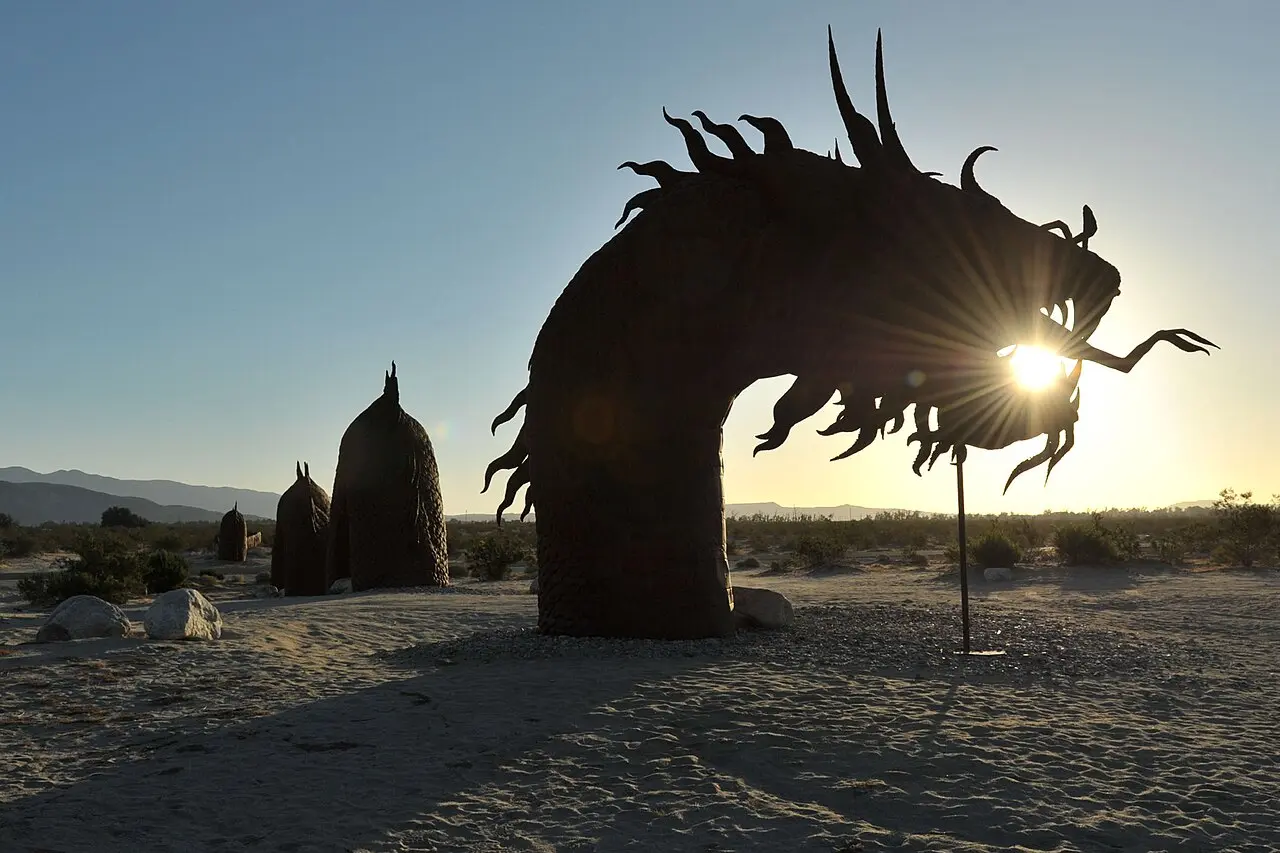
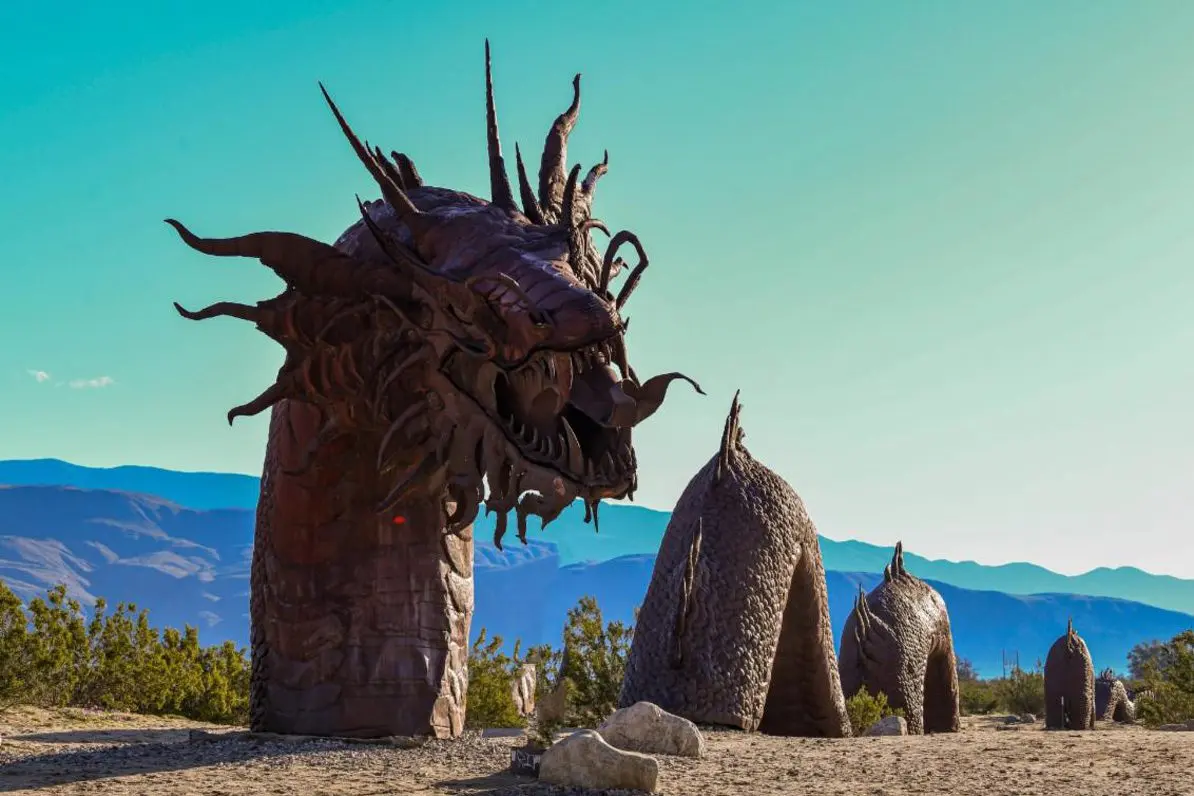
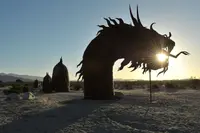
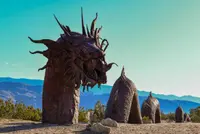
North of Christmas Circle, Borrego Springs Road passes through the body of a serpent. Its head, nearly fifteen feet tall by the photojournalist Richard Massey’s account, rears out of the desert on one side of the pavement. Its coils, 350 feet of steel in all, appear to burrow under the road and come up again on the other. A visitor can pull onto the shoulder and walk out to it.
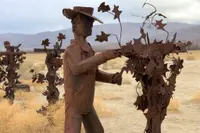
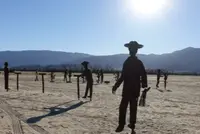
The serpent is one of the Sky Art sculptures of Galleta Meadows, the name Dennis Avery gave to the figures Ricardo Breceda built for his land. The Under the Sun Foundation’s map of March 2026 counts more than 130 life-size metal sculptures in approximately 50 groupings, spread across approximately eight miles of privately owned desert preserve. The foundation puts the land at more than 1,500 acres. Other counts run from “more than 100” (the Chamber of Commerce) to 133 (The Coast News). The figures are welded from scrap steel. Massey writes that each starts out shiny and turns to rust over time. Jo Farb Hernández, writing for SPACES Archives in 2014, observed that the weathered surfaces “appear surprisingly like natural hide.” No labels or signs stand beside them. That was Avery’s wish, so that visitors would meet the animals at full scale in a more natural way.
The town around them sits at 780 feet, inside the 600,000-acre Anza-Borrego Desert State Park, with the Santa Rosa and San Ysidro mountains on its edges. A free sculpture map is handed out at the Desert Nature Center on Palm Canyon Drive. The foundation’s own map is kept at the library, the Borrego Art Institute, and the Chamber. The first figure many visitors pass is Captain Juan Bautista de Anza on his horse, in front of the Chamber at 786 Palm Canyon Drive.
Sheep, a Jeep, and a scorpion north of town
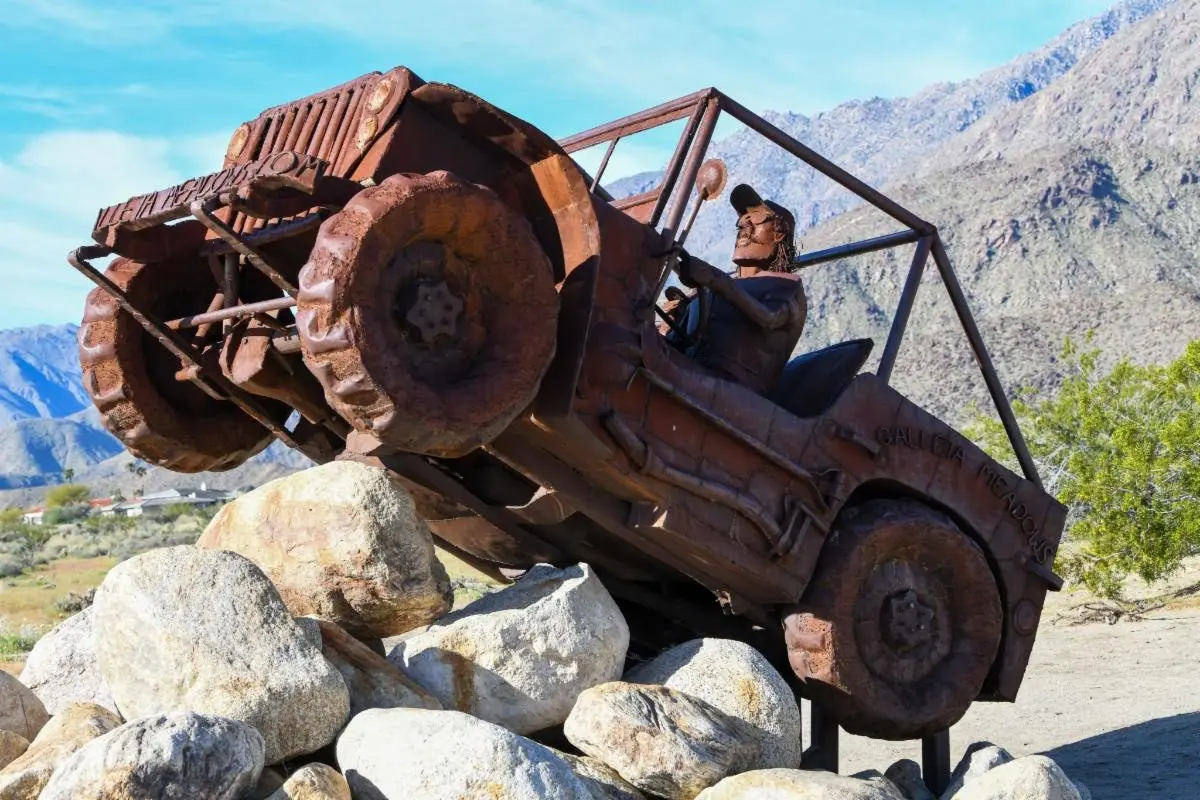
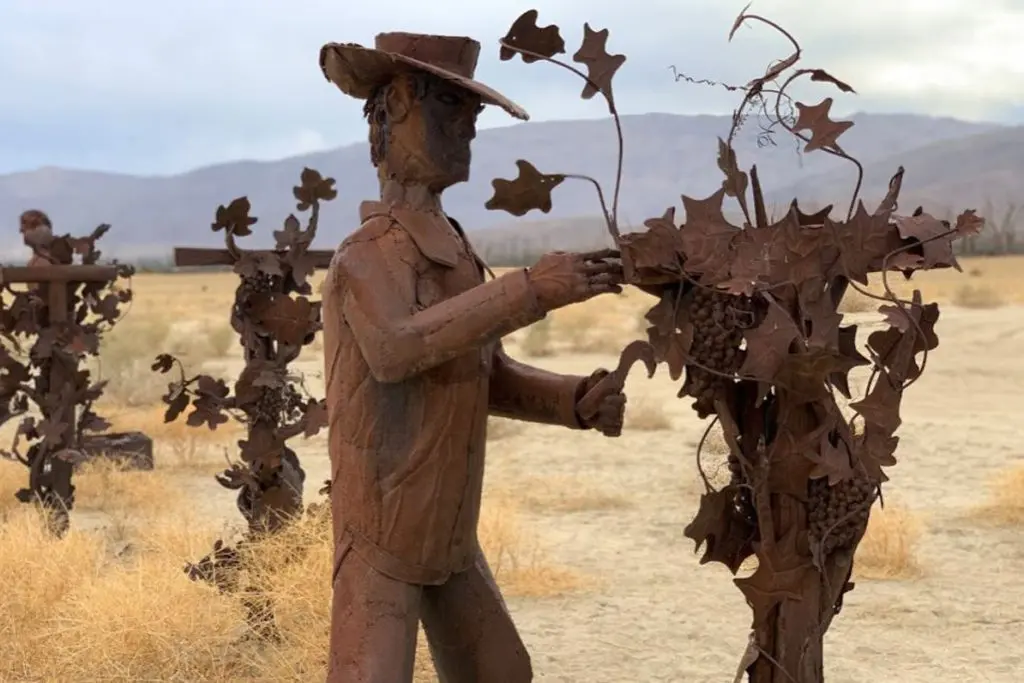
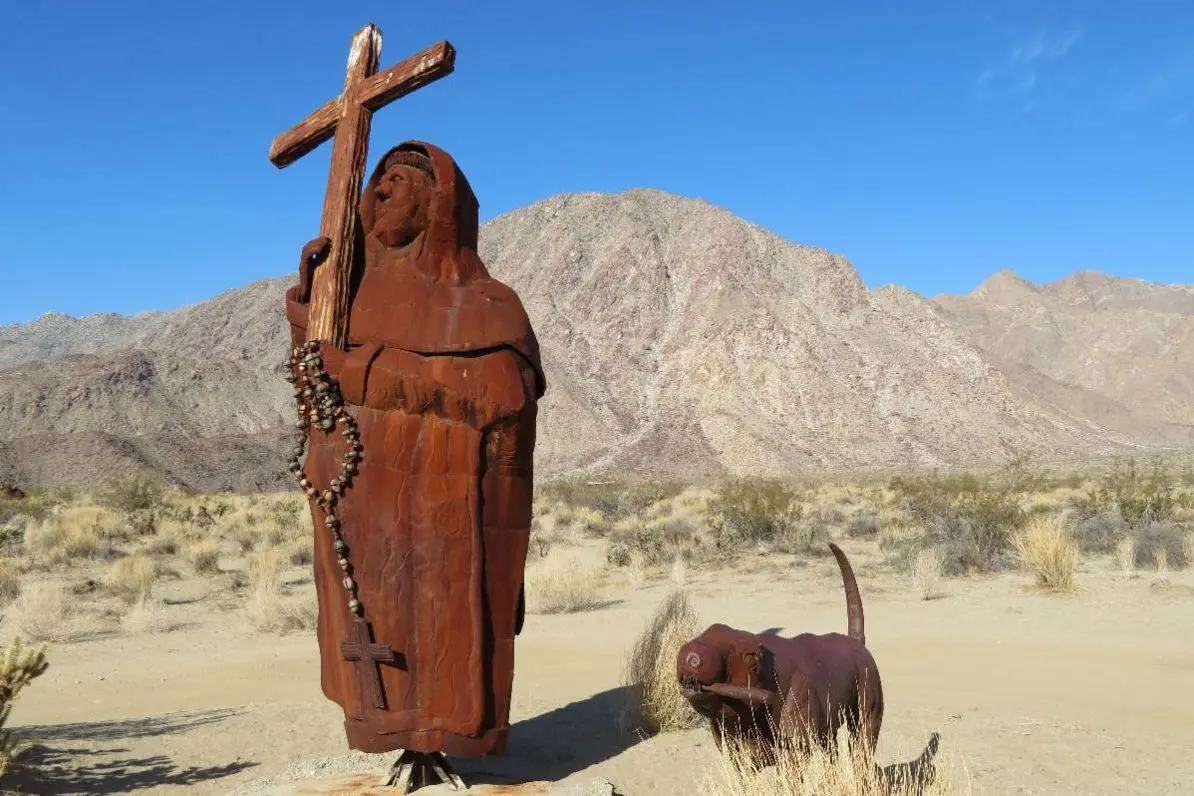
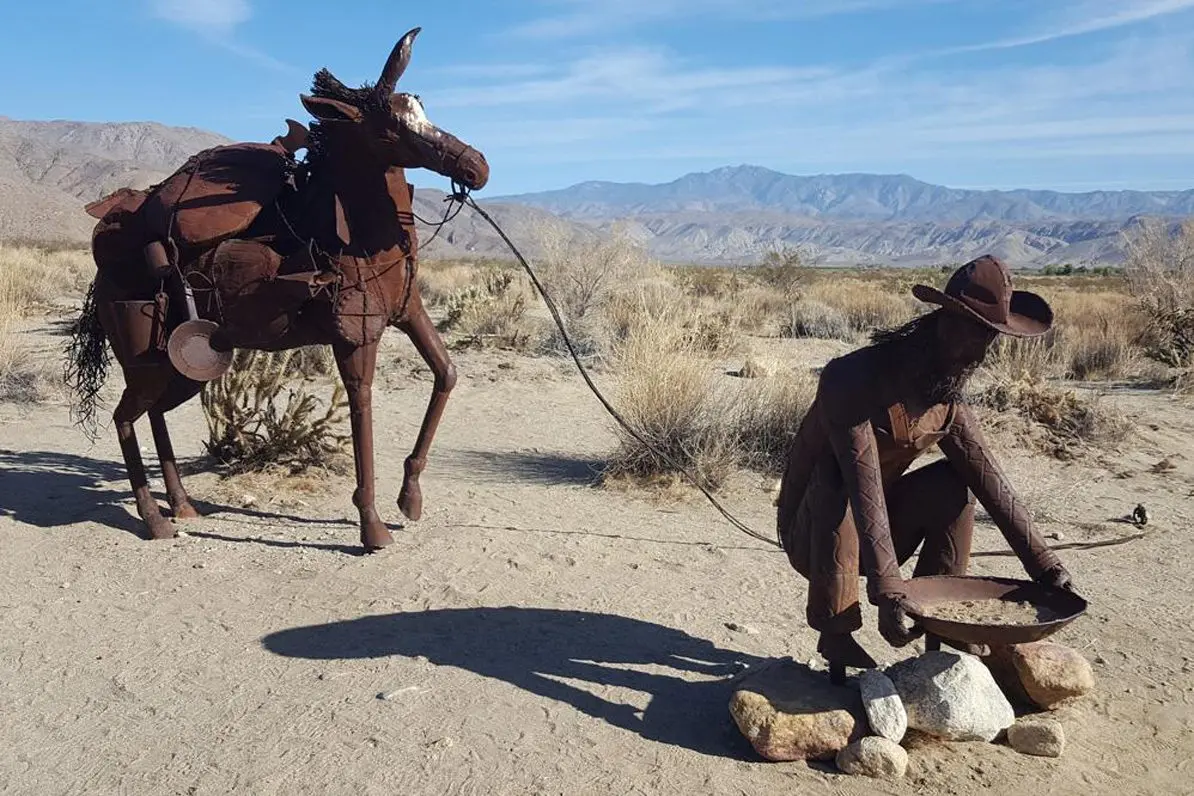
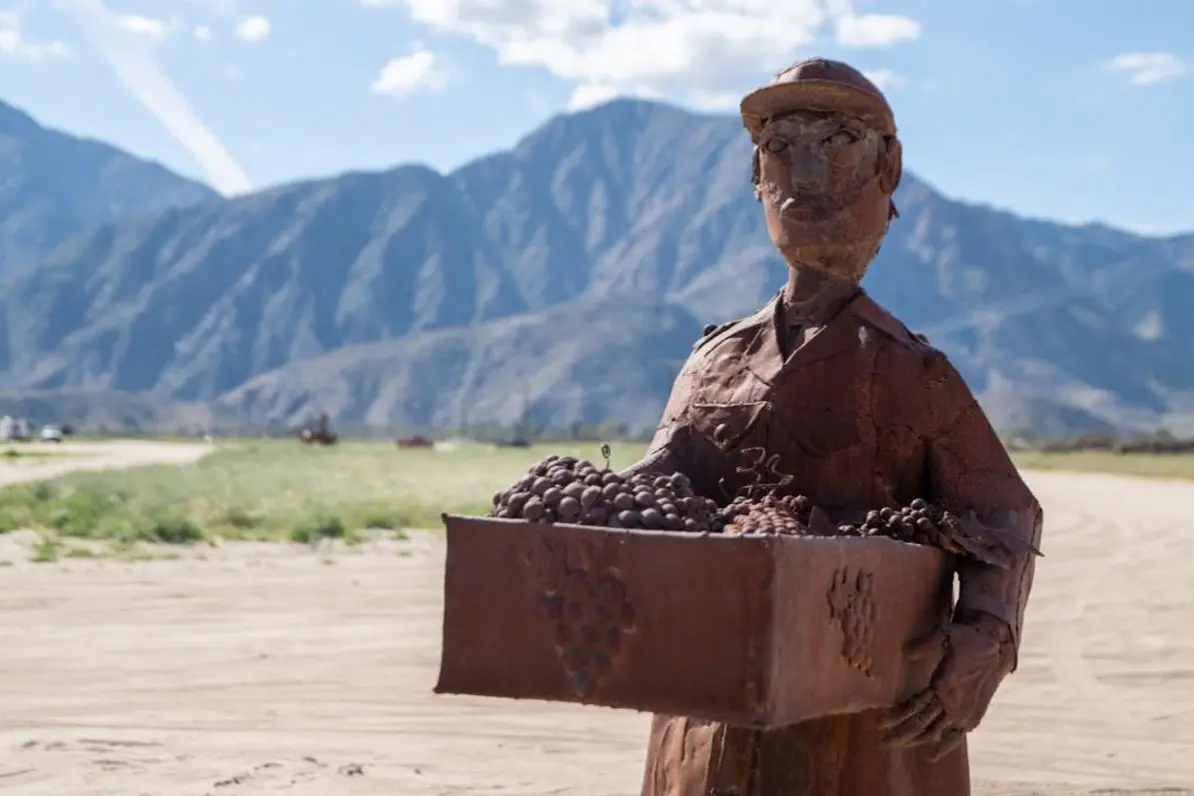
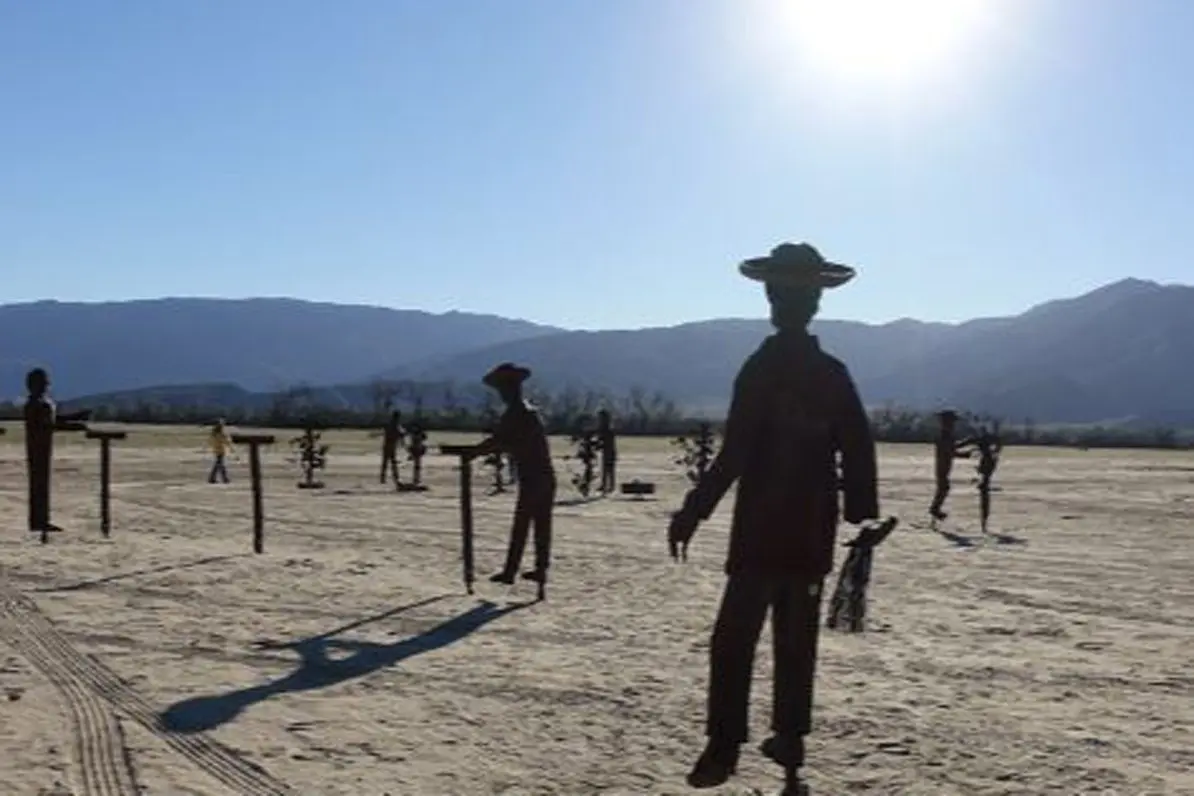
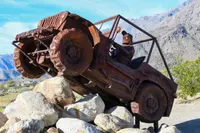
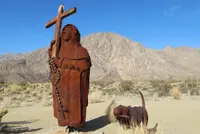
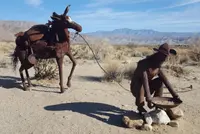
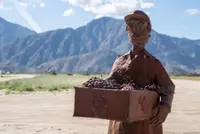
The Anza-Borrego Desert Natural History Association sends visitors north on Borrego Springs Road for three or four miles. A detour east on Big Horn Road leads to a grasshopper facing off against a scorpion and to a group of grape workers, listed on the foundation map as farmworkers. Back on Borrego Springs Road, the serpent crosses the road. At the corner of Henderson Canyon Road stand a padre and his dog, an Indian head, giant tortoises, and a 1946 Willys Jeep. Massey points to the flowing hair of the Jeep’s occupants. A gold miner and his mule are on the map’s list. Farther east on Henderson Canyon Road, a dirt road runs south, across from the turn to the Vern Whitaker Horse Camp, to a group of twelve Peninsular bighorn sheep.
In February 2026, Betsy Knaak, executive director of the natural history association, reported purple verbena and white evening primrose coming up along Henderson Canyon Road.
Elsewhere the map lists African elephants, a family of three llamas, Merriam’s tapirs in a group of six, a peccary family, kneeling Camelops, and gomphotheres in a group of three. It also lists Harlan’s ground sloths in three poses: one rearing, one fallen, and a mother carrying her baby.
Horses and tyrannosaurs to the south
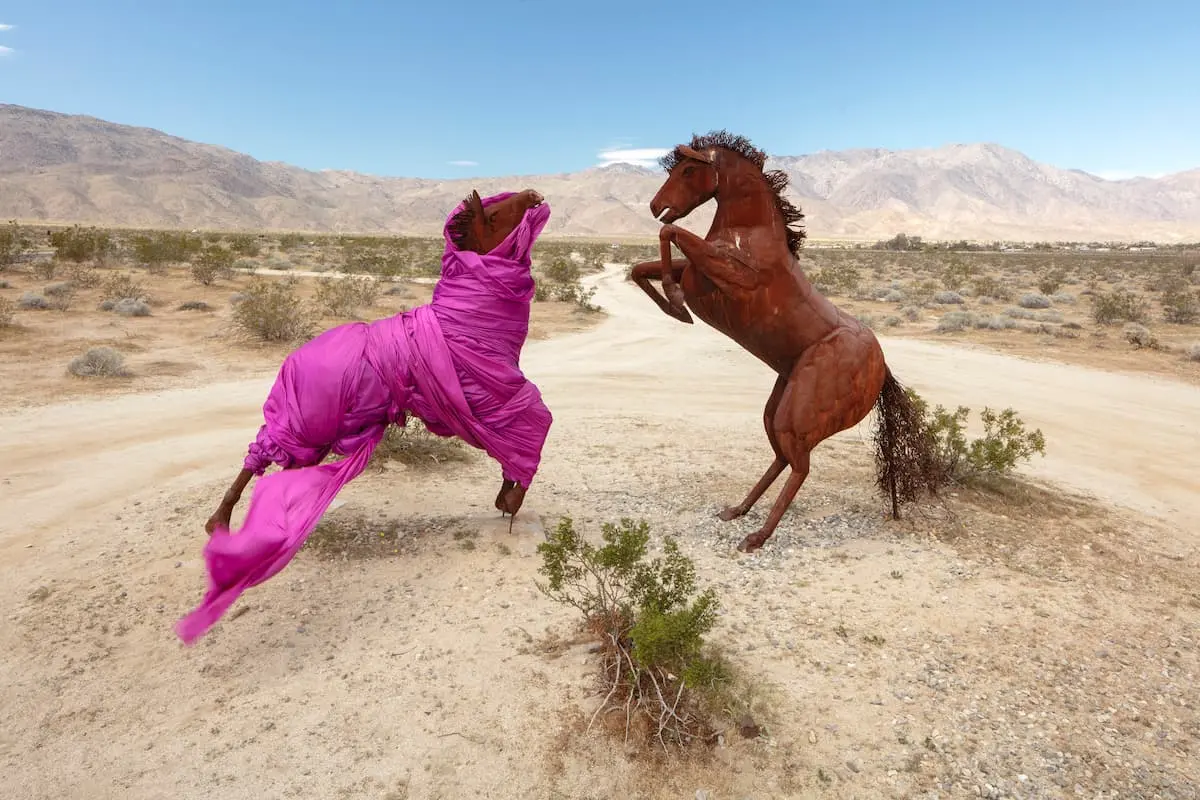
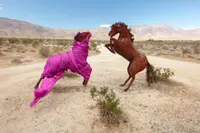
About four miles south of Christmas Circle, sculptures stand on both sides of Borrego Springs Road. The horses are close to the road. The dinosaurs are set farther back on the south side. Among the extinct horses on the map are a rearing pair, a bucking horse, a mother and foal, and a grazing pair. Gracile sabertooth cats work through the herd: one waits on a rock, one crouches with a horse in view, one rides a horse’s back, and two fight each other. Then come a Columbian mammoth family, a Spinosaurus with three babies, a Carnotaurus fighting an Allosaurus, and a pair of Utahraptors with a nest. A Tyrannosaurus adult stands with three juveniles. Massey’s sister was photographed among the T. rexes, which he counts among the dozen sculptures in that area a few miles south of town.
Accounts disagree about the Incredible Wind God Bird. SPACES gives the giant bird a 30-foot wingspan. Massey writes that the real bird had a wingspan of 20 feet, with fossils dating back 3.5 million years. One version of the figure sits in a nest of baby birds while a serpent bares its fangs. Another holds a peccary as prey.
The dinosaurs are the one departure from the record. “We had mammoths, camels, ground sloths, mastodons, and the giant birds,” the Anza-Borrego paleontologist George Jefferson told Borderzine in 2010. “Many animals we did have here, but not the dinosaurs. This was all underwater during their time.” According to The Coast News, the other animals roamed a valley floor that was lush, humid, and green six to seven million years ago. SPACES describes the area in the Pliocene as a riparian forest. The natural history association lists the Columbian mammoth, the giant bird Aiolornis, camels, the gomphothere, and the sabertooth cat among the animals whose fossils have been found nearby.
A T. rex on Interstate 215
Breceda was born in Durango, Mexico. He came to the United States and worked in construction. According to SPACES, a back injury from a fall in 1995 ended that work. Borderzine records his own account: “I’m a single parent and back in ‘95 I was doing nothing and Jurassic Park came out and my daughter said, ‘Let’s make a big one daddy.’” The Off-Road Motorsports Hall of Fame tells it differently. In that version, his daughter was seven, had just seen Jurassic Park 3, and asked for a life-sized dinosaur for Christmas. Massey says she expected a small decorative piece and received a T. rex twenty feet tall. SPACES makes it thirty.
Breceda’s early figures, he told SPACES, “were all squared off…they looked like refrigerators.” He taught himself to build internal frames and cover them with sheet-metal skins, welded together and pounded into place. His shop near Interstate 215 in Perris was called Perris Jurassic Park. Dennis Avery, the son of the founder of Avery Dennison, drove past it on his way to the University of Redlands, where two of his children were enrolled. “I saw these strange things being created,” Avery told Borderzine. “I lived out in Borrego Springs and when I met Ricardo I thought maybe he could create some of the animals.” The Coast News dates the meeting to 2007.
Avery’s open ground
Avery had bought his Borrego land in the early 1990s. SPACES reports that he was persuaded partly by people who wanted the open desert preserved. He ended up with three square miles of noncontiguous parcels. He had also met his neighbor Jefferson and underwritten Jefferson’s 400-page Fossil Treasures of the Anza-Borrego Desert, published in 2006. Breceda worked from that book’s illustrations. According to SPACES, the dinosaurs were added later, for Breceda and for the children who visit. Massey gives another version: Avery himself wanted the story to begin with creatures that roamed the area over 200 million years ago.
A camel was among the first figures placed, in 2008. Debbie Loza of Borrego Springs remembered telling her coworkers about it. “And they said, ‘Ok Deb, you’re seeing camels out in this desert…’ And the next day they had to come in and apologize because they had seen it too.” Of the gomphotheres, Avery said, “We took the gomphothere, which is a prehistoric elephant, and dropped them out there. It was very positive and the news showed up.”
Breceda welded the pieces in Perris and trucked them to the site. In 2010 he had a team of seven or eight men gathering scrap while he built each frame and skinned it. That year Avery told Borderzine that one sculpture cost about $1,000, but most ran $3,000 to $7,000. “My limit at first was $50,000 but we blew right past that.” He kept going. “I thought I was done. But people started complaining that we left something out.” The next figures scheduled, he said, were a gold prospector and his mule.
Avery said there was “no master plan.” When he died in July 2012, at 71, more than 74 groupings with 130 figures had been installed. “He meant the world to me,” Breceda said afterward. “He was a great man. He was a good friend of mine. What can I say? I owe him my life.”
Another last one
SPACES judged in 2014 that further works were unlikely. The natural history association writes that the count must stay rough “because each time Ricardo has announced his last one, another has appeared on the desert sands.” In late 2025 a snake and a roadrunner, 20 feet high and locked in a duel, went up near Borrego Springs. “When they fight each other,” Breceda said, “it is one of the biggest battles in the desert.”
The sculptures are now in the care of the Under the Sun Foundation, whose board includes Halina, Chris, and Theo Avery. The foundation asks visitors not to climb or touch the figures and not to cut new tracks with their vehicles. Some pieces stand well off the pavement, and cars have stuck in the soft sand. SPACES adds that this is rattlesnake country and recommends heavy boots. The foundation’s annual Candlewood Arts Festival invites artists to answer the sculptures with new work. The 2026 map marks four of those pieces as permanent: Allison Wiese’s Un Diálogo, Dos Conversaciones and Artifact of Attraction, Nery Gabriel Lemus’s I Stand Here Looking Back and Now I See the Present, and Debra Scacco’s Beneath the Clay.
Breceda now works on a twenty-acre spread along Highway 79 in Aguanga, where more than 500 of his pieces stand on display. Asked once which sculpture was his favorite, he answered, “I don’t know, I haven’t made it yet.”
Notable Events
- 1990sAvery had purchased the property in the early 1990s, persuaded in part by those who wanted the open space of the desert lands preserved; he ultimately bought three square miles of noncontiguous parcels. spacesarchives.org
- 2007Breceda has been called an accidental artist because of his serendipitous encounter with philanthropist Dennis Avery; the two met in 2007, and Avery commissioned him to create and install his works on some of the 3,000 acres near Borrego Springs he had purchased to save from development. thecoastnews.com
- 2008A camel sculpted out of metal and iron by Ricardo Breceda was one of the first figures placed at Galleta Meadows in Borrego Springs in 2008. borderzine.com
- 2008In 2008 Mr. Avery and Ricardo struck up a deal to create 133 magical mythical metal sculptures of spectacular scale and install them at what would be known as Galleta Meadows Estate. ormhof.org
- 2008While the majority of the pieces were created between 2008 and 2012, Breceda continues to receive commissioned works in the area. pizenswitchtimes.com
- 2008Beginning in 2008, Breceda began to fabricate numerous monumental animals for Avery's property, built out of scrap steel. spacesarchives.org
- 2012By the time of Avery's death in July 2012 more than 74 groupings with 130 figures had already been installed. spacesarchives.org
- 2025The newest Ricardo Breceda sculptures, the 20-foot-high dueling snake and roadrunner, were installed in late 2025 near Borrego Springs. thecoastnews.com
People
- George Jefferson, Anza-Borrego paleontologist who named the real prehistoric animals of the valley that the sculptures depict - mammoths, camels, ground sloths, mastodons and the giant birds - and said dinosaurs did not live here.
- Dennis S. Avery, Multimillionaire industrialist and philanthropist, son of the founder of Avery Dennison, who commissioned Breceda's sculptures for his Anza-Borrego desert property (1940-2012).
- Ricardo Breceda, Self-taught sculptor, born in Durango, Mexico, who fabricated the monumental welded-steel animals in his Perris studio and transported them by truck to the Galleta Meadows site (from 2008).
- Chris Avery, Board member of the Under the Sun Foundation, steward of the Galleta Meadows Sky Art sculptures.
- Halina Avery, Board member of the Under the Sun Foundation, the steward of the Sky Art sculptures of Galleta Meadows in Borrego Springs.
- Theo Avery, Board member of the Under the Sun Foundation, steward of the Galleta Meadows Sky Art sculptures.
Sources
- underthesunfoundation.org
- underthesunfoundation.org/downloads/skyartmap-map-march-27-2026.pdf
- abdnha.org/sculptures
- visitcalifornia.com/experience/ricardo-breceda-sculptures
- borregospringschamber.com/experience-borrego
- thecoastnews.com/after-rainy-fall-anza-borrego-desert-state-park-ready-to-bloom
- borderzine.com/2010/05/a-marvelous-metal-zoo-resurrects-prehistoric-desert-creatures-in-anza-borrego
- ormhof.org/component/zoo/item/metal-monsters-of-borrego-springs?Itemid=101
- spacesarchives.org/explore/search-the-online-collection/ricardo-breceda-for-dennis-s-avery-galleta-meadows-sky-art