Gallatin Valley Botanical at Rocky Creek Farm
Bozeman, Gallatin County, Montana. Certified organic farm.
Details

- Where
- 34297 Frontage Rd, Bozeman, MT 34297. Directions
- When
- Fall festival runs all through October: Fridays 1-5, Saturdays 9-5, Sundays 9-4 per the farm's newsletter.
- Season
- Summer June-Sept; Fall Sept 25-Oct 31; Winter Nov-May.
- Getting there
- From the east end of Bozeman drive east on Frontage Road 2.6 miles, just past Greenspace Landscaping turn left onto Kelly Canyon Cutoff Road, cross the railroad tracks and the creek; the blue homestead buildings are on the right.
- Fees
- Education field trips $8 per person, $150 minimum.
- Hours
- Market stand June 10-Nov 1: Tuesdays 9am-6pm, Thursdays 9am-6pm, Saturdays 9am-1pm; Nov 1-June 2: Wednesdays noon-6pm.
- Access
- You-pick fruit, vegetables, and flowers seasonally on Tuesdays, Thursdays, and Saturdays; come early.
- Walk-in or reserve
- One free reservation per vehicle for fall festival weekend visits.
- Phone
- 406-599-2361
- Managed by
- Matt and Jacy Rothschiller.
- Established
- 2003.
From the east end of Bozeman, Frontage Road runs 2.6 miles to Greenspace Landscaping, where Kelly Canyon Cutoff Road turns off to the left. The farm’s own directions tell drivers to cross the railroad tracks slowly, “check twice for trains!” Past the tracks the road crosses Rocky Creek, and the homestead stands on the right, its buildings painted blue. This is Gallatin Valley Botanical at Rocky Creek Farm: 57 certified organic acres in the Rocky Creek bottomlands, run by Matt and Jacy Rothschiller.
In October the farm is given over to the fall festival, which the farm counts as a Bozeman tradition of more than 30 years. The 2026 festival opened the last weekend of September and runs Fridays, Saturdays, and Sundays through October. Tractors pull hay wagons out to the pumpkin patch and the orchard. There are donuts, hot chocolate, fresh cider, and now and then a popup from a local business. Bozeman Magazine reported in 2025 that the apple cider donuts come out on Saturday and Sunday mornings. Visitors book one free reservation per vehicle, which keeps the parking manageable, and spend the afternoon seeing the animals, walking or riding to the orchard to pick a pumpkin, and eating at the picnic tables. Jacy Rothschiller’s newsletter of September 29, 2026, reported the first weekend had brought “so much of the community gathering at the farm to celebrate the changing of the seasons.”
Some things are missing from the 2026 season. A spring frost took the apples, so there is no apple picking this fall, and the berries are done for the year. Visitors can still pick flowers until the hard frost. The farm stand in the blue barn carries carving pumpkins, decorative gourds, dried flowers, and ornamental grasses. On weekdays, school groups come for field trips of about two hours. A farm educator leads them through stations on animals, pumpkins, cider, and the orchard, and each child takes home a hay wagon ride and a small pumpkin. The farm’s education page says children from all over the valley have come for years to run through the fields and climb the hay forts.
The press in the blue barn
The cider press is built into the historic blue barn. From late August into November it presses cider to order. Customers bring their own apples or pick from the orchard, and they can stand and watch the work. Pre-pressed cider is sold by the half gallon at the stand. The September 29 newsletter announced pressing on Wednesday and Saturday of that week, with “a big restock” on the way. Pete Fay, who started the press, described the process to National Geographic in 2014: “Dump our apples in the hopper, and watch your juice flow into the tank and down into the bottles.” He also said, “One tree can produce 33 gallons of cider, but you don’t have to have your own tree to press fresh cider.”
Fifty-seven acres on Rocky Creek
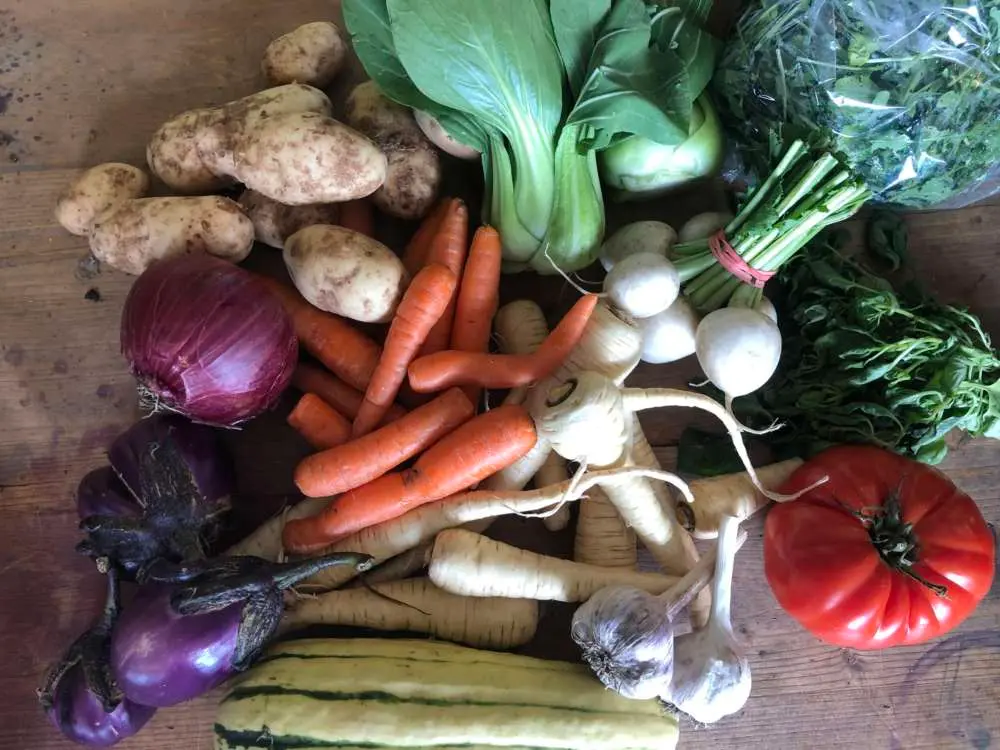
Behind the festival is a working farm. Each year it plants up to 150 varieties of vegetables, salad greens, and herbs. Four heated greenhouses and four mobile high tunnels keep produce coming through the winter. Jacy grows an acre of cut flowers: ranunculus, anemone, lisianthus, stock, sunflowers, sweet peas, and dahlias. She learned dahlias from her grandfather, who grew them at his home in Kalispell. Laying hens ride around the farm in a mobile coop, eating crop residue and insects. Meishan Berkshire cross pigs are fed leftover vegetables, apple mash, and pumpkins. Sheep graze down the spent crops, Red Ranger chickens are moved to fresh grass every day, and bees work the fields and the orchard.
In 2021 the farm crew described the farm’s sounds to Abundant Montana. Each spring a pair of sandhill cranes returns to forage in the fields. A killdeer whistles over eggs laid in a furrow. A starling perched above the pack shed imitates a hawk. The creek runs constantly, and about once an hour a train comes through Bear Canyon and passes the farm with a long rumble. In fall, elk bugle from the foothills. Jacy named her own preference: “My favorite work sound is the laughter and chatter of the crew out in the field, when things are just humming along and people are connecting.”
Children take part in much of the work. According to the Gallatin Valley Land Trust, week-long summer camps serve more than 200 local kids a year. Camp runs from 9 to 3:30 in the farm’s woodlands, fields, streams, barns, and meadows, and the day begins with chores: feeding the pigs, caring for the chickens, watering seedlings. Farm School runs in spring and fall. In winter Matt grooms Nordic ski trails. He began with four kilometers on the farm, then worked with neighbors and Montana State University, which owns land nearby, to extend them to 12.5 kilometers of classic and skate track. “From the Rocky Creek bottom,” he told the land trust, “you see the Gallatin Valley and surrounding mountains from a different aspect.”
Pete Fay’s hobby
The cider began as a hobby, according to an undated Bozeman Daily Chronicle profile by Joan Haines. Pete Fay was a weed-control specialist in Montana State University’s Plant and Soil Science Department. He and his then wife, Mary Jane, lived in Bozeman and had one apple tree. Fay built a wooden press from a kit and pressed that tree’s apples in about ten minutes. He was not ready to stop, so he sent his son to get a neighbor’s apples. Then a couple driving past saw the pressing and asked whether he would do theirs. Before long he was making 100 to 200 gallons a day each fall. “My hobby went berserk,” Fay said. “Bozeman is full of apples. After you make a couple of pies, what do you do with them?”
The Fays wanted a farm where the public could pick its own crops, and in 1981 they bought Rocky Creek. National Geographic gave a different account of how the press came to the farm. Fay knew his young trees would take years to bear, it said, so he installed a press in the barn and invited people to bring in apples from their yards. After Fay retired from MSU in 1996, he farmed full time and worked seven days a week in cider season. In the Haines profile he had 300 apple trees and a new press he called his “Jaguar,” able to make 3,000 to 12,000 gallons a fall. He considered Wealthy apples the best for cider. He never mixed batches, so each customer went home with cider from their own apples. “When you harvest your apples and bring them out here it’s like your connection to agriculture,” he said. “People generally like ‘their’ cider.” His only crabby customers, he said, were the ones who came for corn: “Maybe they’re from Illinois where the ears of corn are 8 feet long.”
Raspberries came next. According to another undated Chronicle story, Fay began U-pick raspberries after several years of experimenting with plants from Massachusetts. About 300 people came on one opening day. Fay gave out wide-mouth plastic jugs to tie at the waist with string, and charged 85 cents a half-pint or $10 a flat. “What counts more to me is that my kids can learn how nature works and that raspberries do not come from a supermarket,” said Bridget Westfall, who picked there with her children.
The pumpkin patch was in place by the time Tom Lutey wrote about it for the Chronicle. Hay wagons carried children to the field, where they climbed out through the sideboards and ran 30 yards into the patch before stopping for breath. No pumpkin in the field was bigger than a volleyball. About a third of them grew on the farm, and the rest came from a Belgrade woman and a friend of Fay’s in Shepherd. “I think we’ll probably leave here with about seven,” said Jeannie Etgen. “Our front porch has five or six steps.” Michael Speck, 9, of Clyde Park, said, “I’m just going to put a sticker on this one.” Fay told Lutey, “Wait till next week, we’re doing a festival. We’ll have booths and face painting, cider making.” In 2014 he described pig races to National Geographic: the pigs ran a track toward a pile of Oreos. “We can do about five races until the pigs get full and ignore us.”
In 2006 Fay worked with the Gallatin Valley Land Trust, using Gallatin County Open Lands money, to place a conservation easement on Rocky Creek Farm. The easement keeps the land open for agriculture, scenic open space, and wildlife. “It’s just a piece of magic,” Fay said of the land at the time. “I want it to stay a farm forever.”
A shovel in January
Matt and Jacy Rothschiller both earned biology degrees at Montana State. In 2000 and 2001 they lived in separate apartments in the same house on 8th Street in Bozeman, where Matt kept a garden. Jacy told Edible Bozeman about a dinner party where “somebody asked him what his dream job was and he said, ‘Oh, I want to be a farmer and grow vegetables for restaurants,’ and I looked at him and I was, like, ‘I can do that!’” They spent a year working on farms and in restaurants in Napa Valley, came back to Bozeman in 2002, and started Gallatin Valley Botanical in 2003.
The farm’s own account says they leased two acres of an alfalfa field in Manhattan. A 2014 Chronicle profile tells it differently. The couple ran a newspaper ad seeking land to rent, and nobody answered the first time. The second time, LaVonne Stucky of Serenity Sheep Farm Stay in Belgrade replied that she had 1.5 acres in Manhattan. “So, we went out there one January day with a shovel and we were able to stick the shovel in the ground and turn it over, so we were like, ‘Well, it looks good,’” Matt said. Matt kept waiting tables full time. They put up no deer fence that first year, and on the night before a lettuce harvest the deer ate the center out of every head. Later, Montana Ale Works paid for equipment to grow true baby carrots so the restaurant could serve local ones. “We paid them back in baby carrots,” Matt said.
The sources disagree on when they bought seven acres from Fay. The land trust and the 2014 Chronicle profile put it at 2007, and Edible Bozeman says January 2008. Fay gave them a good price. They raised Zachary and Ania in a small farmhouse that also served as the pack shed. Jacy was picking parsnips the day before one of the children was born in 2006. Over the following decade the two farms worked as one in practice. “We worked side by side, my equipment was their equipment,” Fay said. In early 2016 Fay, then living in San Diego, told them he was ready to retire. With help from HomeStake Venture Partners, the U.S. Department of Agriculture, and Montana Ale Works, the Rothschillers bought the 50-acre farm in a deal finalized in late October 2017, for a price Matt described as “in the low seven figures.” “If the property hadn’t already been conserved, it probably wouldn’t have happened,” he later said. The pumpkin patch, the berries, and the cider continued. The haunted swamp, an annual event under Fay, was discontinued. “I just can’t tell you how glad I was that the farm could stay a farm,” Fay said.
At about 10:15 on a Friday night in April 2020, a neighbor pounded on the Rothschillers’ door. Their barn, built in 1924, was on fire. The 23 animals inside died. The barn had also been used for events and for storing pumpkins in the fall. Matt had been inside it 45 minutes earlier and thought a heat lamp might have tipped over or exploded. He watched until 1 a.m., when a Fort Ellis firefighter told him there was nothing left to do. A GoFundMe raised more than $36,000 in about a day. “Something good coming out of something so bad,” Jacy said. In place of the old barn they planned a pavilion for events and a smaller barn for the animals.
That fall, with COVID-19 making schooling uncertain, the farm opened Farm School so grade-schoolers could learn outdoors. The same fall, Matt and Jacy grew thousands of pounds of carrots for the Community Carrot Project. Volunteers helped with the harvest, and the Montana Food Bank Network sent the carrots to food banks across the state.
Notable Events
- 1924The barn later housed animals, served as an event gathering spot and stored pumpkins in the fall. bozemandailychronicle.com
- 1981Wanting a farm where the public could pick crops themselves, the Fays bought Rocky Creek. bozemandailychronicle.com
- 1996After retiring from MSU, Fay concentrated on farming and worked long hours seven days a week in cider season. bozemandailychronicle.com
- 2003The owners leased two acres of an alfalfa field in Manhattan and seeded a farm focused on specialty vegetables for restaurants and farmers markets. gallatinvalleybotanical.com
- 2006Then-owner Pete Fay put Rocky Creek Farm under a conservation easement with Open Lands Program funds. bozemandailychronicle.com
- 2007The Rothschillers were looking to buy land, and Pete Fay gave them a good deal on land next to Rocky Creek Farm where they lived and operated GVB. bozemandailychronicle.com
- 2008The Rothschillers, who began farming in Manhattan in the early 2000s, had purchased seven acres from Rocky Creek owners Pete and Nancy Fay. bozemandailychronicle.com
- 2016Fay, then living in San Diego with his family, told the Rothschillers he was ready to retire. bozemandailychronicle.com
- 2017The owners acquired neighboring Rocky Creek Farm and operated the combined 57-acre parcel as Gallatin Valley Botanical at Rocky Creek Farm. gallatinvalleybotanical.com
- 2020Matt and Jacy helped steward the Community Carrot Project, growing thousands of pounds of carrots donated to the Montana Food Bank Network for food banks across Montana. abundantmontana.com
- 2020With widespread unpredictability due to COVID-19, GVB started a farm school as an outdoor learning option for local grade-schoolers. abundantmontana.com
- 2020The barn built in 1924 burned and 23 animals housed in it died; it had also hosted events and stored fall pumpkins. bozemandailychronicle.com
- Fay's cider business began through demand while he and his former wife Mary Jane lived in Bozeman with one apple tree; he was an MSU weed-control specialist. bozemandailychronicle.com
- Montana Ale Works gave GVB money to purchase equipment to grow baby carrots. bozemandailychronicle.com
- The owners had not installed deer fencing and deer ate a large portion of their hard work. bozemandailychronicle.com
- Matt and Jacy Rothschiller bought the 50-acre Rocky Creek property in a deal finalized in late October. bozemandailychronicle.com
- Pete Fay developed the U-pick idea after experimenting for several years with raspberry plants imported from Massachussets. bozemandailychronicle.com
People
- Cooper Etgen, Child whose family went pumpkin picking.
- Jeannie Etgen, Mother picking pumpkins with her family.
- Jennifer, Michael Speck's little sister, picking a pumpkin at the farm.
- Lea, Michael Speck's parent, visiting the pumpkin patch.
- Michael Speck, Child pumpkin picker from Clyde Park.
- Shane, Michael Speck's parent, visiting the pumpkin patch.
- Tara Bishop, Parent visiting the pumpkin patch with her children.
- Mary Jane, Pete Fay's former wife; lived with him in Bozeman when the cider business began.
- Anya, Child of Matt and Jacy; the parents shared child-raising and school responsibilities.
- LaVonne Stucky, Provided a Manhattan plot for the Rothschillers to start their farm after replying to their land-rental advertisement.
- Nancy Fay, Rocky Creek co-owner who sold land to the Rothschillers (around 2008).
- Pete Fay, founder and owner of Rocky Creek Farm; started the bring-your-own cider press tradition (from 1981).
- Bridget Westfall, Farm customer who brought her children to pick raspberries and learn about nature.
- Jacy Rothschiller, Owner and operator of Gallatin Valley Botanical (since 2003).
- Ania, Child of the farm owners, raised at the farm.
- Matt Rothschiller, Owner and operator of Gallatin Valley Botanical (since 2003).
- Zachary, Child of the farm owners, raised at the farm.
Sources
- gallatinvalleybotanical.com
- gvlt.org/news/rocky-creek-farm
- bozemanmagazine.com/articles/2025/10/01/125506-pumpkins-and-apples-a-bozeman-fall
- abundantmontana.com/amt-lister/gallatin-valley-botanical
- gallatinvalleybotanical.com/about
- bozemandailychronicle.com/fall-a-pressing-time-for-cider-man/article_4eb9967f-9fc8-543b-bba7-a866b18374c9.html
- bozemandailychronicle.com/picking-your-own-raspberries-part-of-the-fun-at-rocky-creek-farm/article_c8e7de06-b001-5e1b-a65a-db329a1387b1.html
- bozemandailychronicle.com/news/historic-rocky-creek-farm-barn-lost-in-fire-owners-plan-to-rebuild/article_62bdfce6-de1e-58b1-852e-ac900b5a1679.html
- bozemandailychronicle.com/news/business/rocky-creek-farm-sells-to-gallatin-valley-botanical/article_643be0c8-62f2-5c6e-86f3-2a75c5ebd5d0.html
- bozemandailychronicle.com/opinion/guest-columns/open-lands-a-part-of-our-agricultural-heritage/article_357a26ec-3de6-5cf6-9aba-33f73161aec3.html
- bozemandailychronicle.com/news/business/clocking-in-with-organic-farmers-matt-and-jacy-rothschiller/article_f9ba3ab0-e5bd-11e3-a241-001a4bcf887a.html
- bozemandailychronicle.com/children-find-pumpkin-patch-hard-to-resist/article_89667c6a-02ce-5e37-b031-7ad4d247a431.html
- ediblebozeman.com/meet-your-farmer/the-corner-piece-gallatin-valley-botanical
- nationalgeographic.com/travel/article/fall-family-activities
- abundantmontana.com/know-your-farmer-gallatin-valley-botanical