Fremont Point Cabin
Lakeview, Lake County, Oregon. Reconstructed cabin rental; Year-round.
Details

- Where
- 1301 South G Street, Lakeview, OR 97630. Directions
- When
- Available Activities.
- Getting there
- From Silver Lake, OR take Oregon Highway 31 east for 17 miles and then turn right onto Forest Service (FS) Road 2901. From FS road 2901, take a left onto FS Road 2901034. Parking for Fremont Point Cabin is at the end of FS Road 290134.
- Fees
- $40 per night, per group.
- Access
- Cabin available year-round; off-season access may be limited to foot or snowmobile because roads are not maintained in winter. When wet or snowy, FSR 034 may become slick and muddy, requiring four-wheel drive. Privacy gate at the cabin is opened with the reservation code. Cell phone service usually available. No cleaning or trash service; pack out. Bring water; dishes and cookware not provided; firewood not provided except for winter ski/snowshoe guests. Parking limited.
- Walk-in or reserve
- Online at www.recreation.gov or by telephone at (877) 444-6777.
- Phone
- (541) 576-2107
- Website
- recreation.gov
- Managed by
- U.S. Forest Service, Fremont-Winema National Forest (Silver Lake Ranger District).
- Established
- 2015.
- Coordinates
- 42.8666, -120.8343.
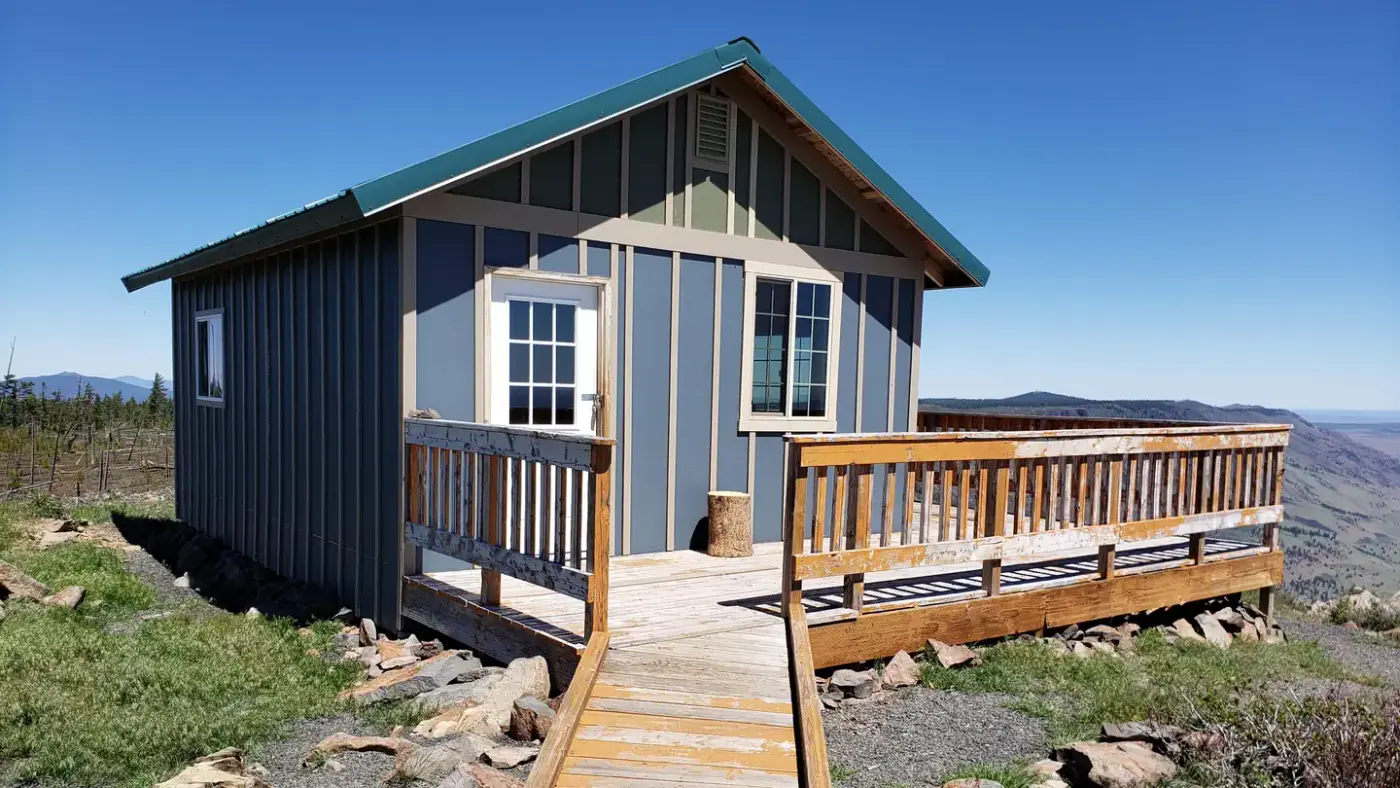
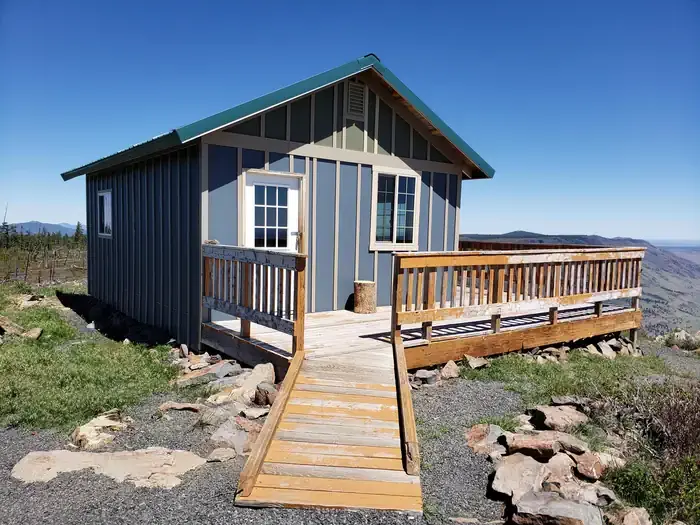
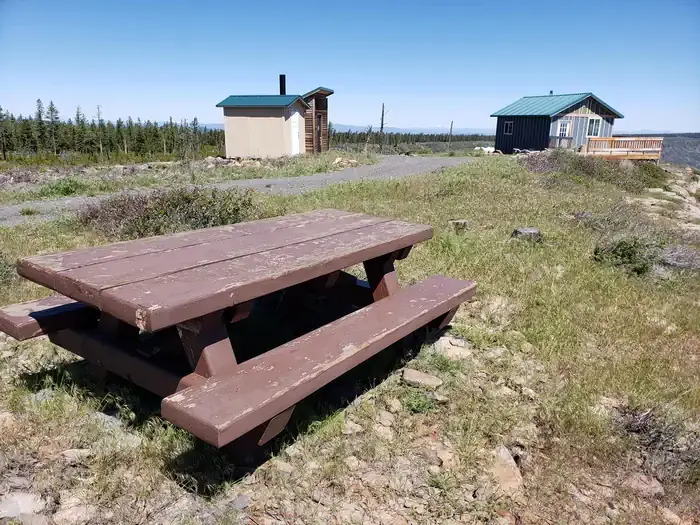
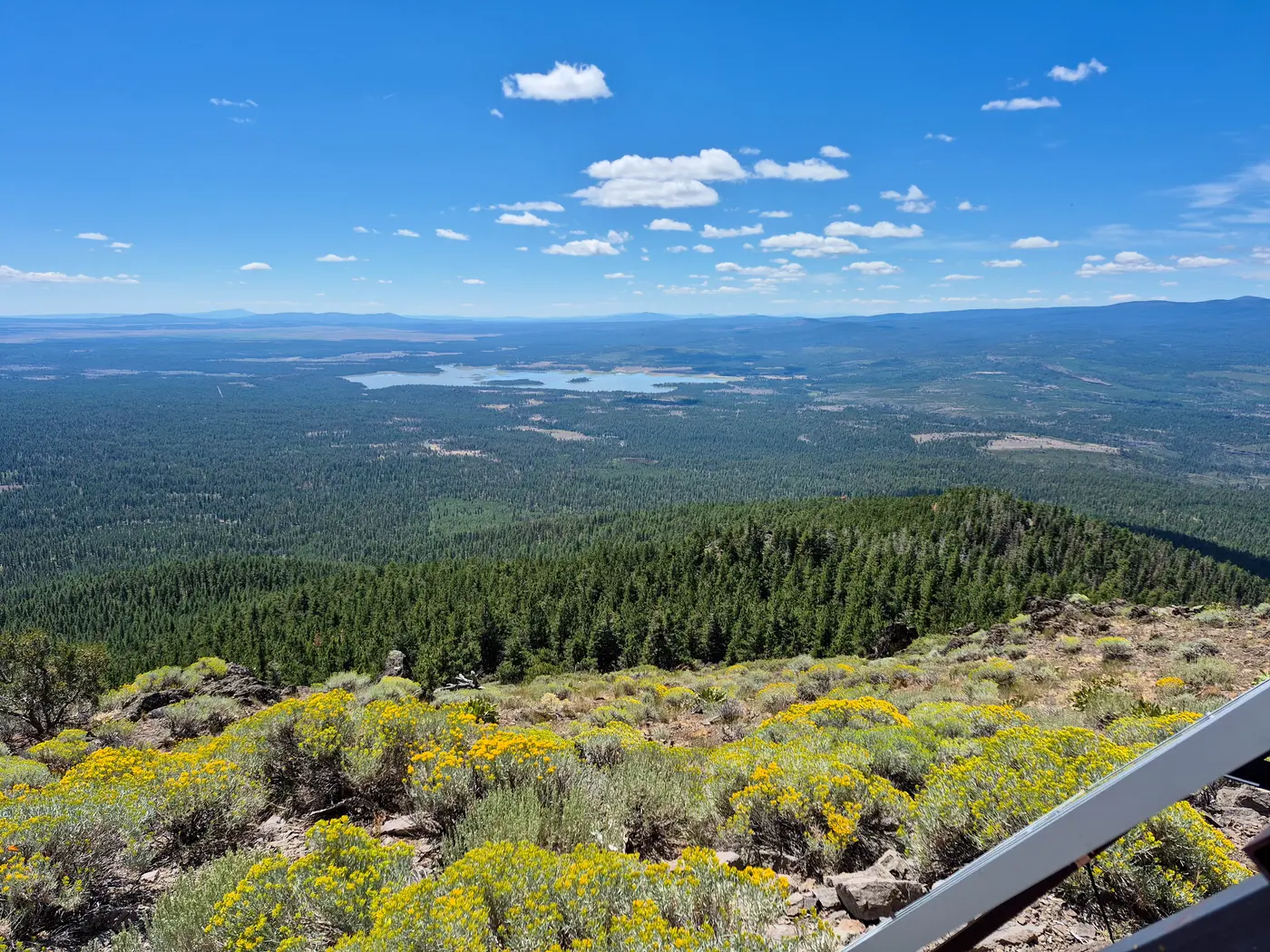
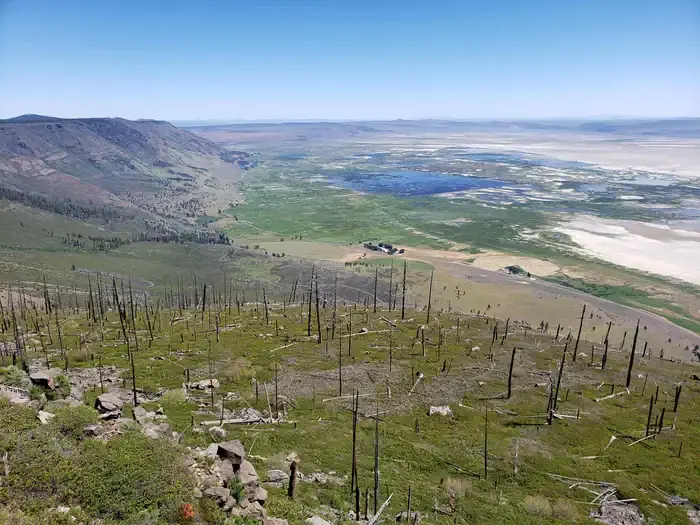
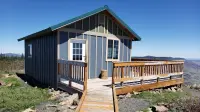
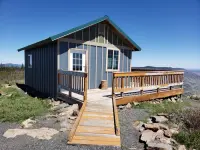
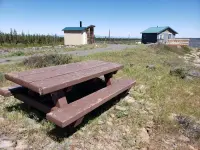
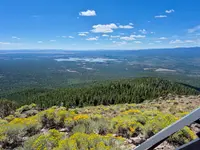
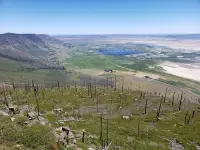
A quarter mile past the day-use area at Fremont Point, a privacy gate opens to the code on a reservation. Beyond it, the cabin stands on a vertical rocky overlook at 7,135 feet on Winter Rim, in north-central Lake County, about 3,000 feet above Summer Lake and the Great Basin high desert. It measures 24 by 16 feet. A porch wraps around part of it, forming a large two-sided deck that faces the lake and the valley floor. Outside are a picnic table, a fire ring, a wood storage box and a vault toilet.
Inside are a set of bunk beds, two twins, and a queen bed. The Forest Service’s own page calls it a double. There is a dining table with four chairs and a wood stove for heat. The kitchen corner holds a mid-sized refrigerator, a four-burner propane cooktop, counter and shelving, and a sink with no running water. Several propane lamps give the light. No dishes, cookware or drinking water are provided. Guests bring their own water and bedding, clean the cabin before leaving, and pack out what they packed in. Firewood is left in winter for parties who ski or snowshoe in, and other guests bring their own. The nearest convenience store is a 45-minute drive one way. Cell service, the Forest Service notes, is usually available.
The rim trail and the pines behind it
The Fremont National Recreation Trail passes 200 yards from the door and skirts the escarpment edge, with the valley in view below. It is used by hikers, mountain bikers and riders on horseback. A short walk west from the cabin leaves the rim for large ponderosa and lodgepole pine. Thirty minutes south, the historic Hanan Trail leaves a trailhead on FSR 28 for the headwaters of the Wild and Scenic Sycan River, marked by blazes on trees and rock cairns. The Oregon Timber Trail passes nearby, and hunters work Winter Rim to the west.
The cabin is a stop on Southern Oregon’s Basin & Range Birding Trail. Hairy Woodpeckers keep to the forest, Red Crossbills linger in the open, and hawks pass in September. “When we first drove up to the cabin, there was a couple people sitting there, watching birds,” the photographer Terry Musgrove told Portland Monthly in 2017. Down at Summer Lake are artesian hot mineral springs and the Lodge at Summer Lake. Musgrove recommends dinner there before the drive up, which he puts at some 90 minutes.
Gravel in summer, blue diamonds in winter
The summer approach from Paisley runs north on State Route 31 for 34.2 miles, to a turn between mileposts 64 and 65. From there the route follows graveled FSR 2901 west for 16.1 miles, then FSR 034 for 2.3 miles to the Fremont National Recreation Trailhead. The last .3 mile is a narrow access road with little room to park or turn. Rain or snow can make FSR 034 slick and muddy enough to need four-wheel drive.
The roads are not maintained in winter. In that season the cabin is generally reached on snowshoes, skis or snowmobile from a plowed snow park past the Sycan Electrical Power Substation, which is reached by way of Forest Service Road 28 south of Silver Lake. Blue diamond tags on trees mark a ski and snowshoe route of about 10 miles. Orange diamonds mark a snowmobile route of about 15. Halfway along is a shelter with a wood stove and firewood. The trail is not groomed and may have to be broken.
Winter Ridge, December 1843
The names on this rim came out of a storm. John C. Fremont’s second expedition reached Lake County in 1843 after the party, Kit Carson among them, decided not to winter at The Dalles. Against orders, they headed south with 25 men, 104 horses and mules, cattle, and a 223-pound cannon. The Bend photographer Loren Irving has traced Fremont’s camps from his journals. By Irving’s account, the party followed a Klamath chief’s advice and crossed the Sycan, which they took for the Sacramento. They then fought through 2 to 3 feet of snow to a Dec. 15 “mountain camp.” The next day, in a blizzard, they came out on the edge of the escarpment at Fremont Point and saw the chief’s promised “land of big water and no snow.”
“Rising rapidly ahead to this spot we found ourselves on the verge of a vertical and rocky wall of the mountain,” Fremont wrote. “At our feet — more than a thousand feet below — we looked into a grass prairie country, in which a beautiful lake, some 20 miles in length, was spread along the foot of this mountain . . . Shivering on snow three feet deep, and stiffening in a cold north wind, we exclaimed at once that the names of Summer Lake and Winter Ridge should be applied to these proximate places of such sudden and violent contrast.” A marker titled “Fremont Arrives,” at the Summer Lake Rest Area below, dates the moment December 16, 1843. Irving holds to the explorer’s word: “It’s not Winter Rim, it’s Winter Ridge.”
Accounts differ on what came next. Lee Juillerat wrote in the Herald and News in 2002 that Fremont spent a night at the cabin site. Irving has the party, wanting out of the storm, follow the ridge 6 miles north to what is now the Winkleman Trail. From there it took four hours to descend nearly 3,000 vertical feet in the dark to the valley floor. Fremont had bought a dog along the way and named it Tlamath. Later, Irving said, when the men were without food, “he eventually became dinner.”
A tower, a sleeping cabin, and $25 a night
Fremont Point was chosen in 1931 for an auxiliary lookout. On June 30 that year, the Lake County Tribune reported that a road crew would build a road to the point and that a telephone line would be strung from Pole Butte. Lookout records say a 72-foot all-steel Aermotor tower with a 7-by-7 steel cab was finished that September for $1,575.40. A visitor’s account dated October 6, 1931, describes nine miles of new road through tall timber, “over a road which keeps one nodding continually to imaginary neighbors,” until “suddenly the new 80-foot steel tower looms before us.” The heights vary by source. The Herald and News gives the tower as 90 feet, and the lookout historian Cheryl Hill gives it as 72 feet, built in 1936.
The Herald and News reported in 2011 that Civilian Conservation Corps crews built the cabin beside the tower in 1931 to house the people who manned it. For about 50 years it served them as a sleeping cabin. Cabin and tower were closed in the early 1980s. In the late 1980s Doug Uran, recreation specialist for the Silver Lake-Paisley Ranger District, helped preserve the cabin. The 2011 report says it opened for public use in 1990, with Juillerat the first public visitor to stay overnight. Juillerat’s own 2002 account says he and his dog Rocky stayed the day before the rehabilitated cabin officially opened in 1994. He remembered a cozy 12- by 14-foot cabin with two beds, two cots, a woodstove, a propane cook stove, dishes and a propane lantern.
“By night I sat outside, enjoying the sparkle of stars,” he wrote of that stay. “A shooting star flared across the night sky.” The next morning the sun rose over Abert Rim, and the lake and alkali flats below “shifted from pale brown to blue-gray and, as the sun climbed more steeply, a chalky, pale white.” In January 1995 he and friends were the first group to cross-country ski the 8-plus miles in. They stayed two nights and spent a day cutting their own trails through stands of tall ponderosa pine. At $25 a night, the cabin was booked more than 300 nights a year, often months in advance. It was the most popular rental on what was then the Fremont National Forest. In 1996 Oregon Field Guide filmed two renters there.
After the Winter fire
The Winter fire of 2002, also called the Winter Rim fire, swept across Fremont Point and destroyed the cabin. The tower was damaged badly enough that it had to be removed. That August, Carolyn Wisdom, the Silver Lake district ranger, spoke about rebuilding: “We’d all like to see it happen. We’re talking about it. The issue is how do you find the money.” Kent Russell, the forest’s recreation officer, said, “I’m optimistic. I place that as a high priority.”
By 2011 forest managers had finished most of the paperwork, including a 2010 reconstruction and expansion environmental assessment. “We want to rebuild something that’s historically correct,” Uran said. Tim Stack, a natural resource specialist for the forest’s Northeast Zone, said, “We want to rebuild it, but we don’t have the money. We want to see if we can get a groundswell of volunteers to help.” The two put the cost at about $10,000. They also floated a second, smaller cabin 2½ miles north along the rim, tentatively called the Carson Cabin.
The new cabin was finished in the summer of 2015 on the old footprint, built with donated money, donated materials and volunteer labor. It rents for $40 a night per group, and the fees go to its upkeep. Musgrove, who by 2017 had stayed in 71 Pacific Northwest cabins and lookouts, came in September of that year with his dog Woody. “We were there in September, and it got pretty chilly at night,” he said. “The stove did a really good job of heating the place up.”
Notable Events
- 1843Summer Lake and Winter Ridge were both named in 1843 by Captain John C. Fremont, leader of a US Army Topographical Corps expedition. hmdb.org
- 1980sThe cabin was decommissioned for use as a fire lookout in the 1980s. heraldandnews.com
- 1990After decommissioning, the cabin was repaired and opened for public use in 1990. heraldandnews.com
- 1994The writer stayed the night at the cabin the day before the rehabilitated cabin officially opened for public use in 1994. heraldandnews.com
- 2002The 2002 Winter Rim fire destroyed the 1931 original cabin. fs.usda.gov
- 2010Forest managers had completed most of the paperwork for rebuilding, including a 2010 Fremont Point Cabin Reconstruction & Expansion Project environmental assessment. kval.com
- 2015Reopened in 2015, the reconstructed cabin accommodates 3-4 people in a remote and tranquil setting on the rocky overlook. fs.usda.gov
- 2015The cabin site once housed Fremont Point's fire lookout tower; the cabin was destroyed in a 2002 forest blaze, and in 2015 volunteers and members of the Silver Lake ranger district decided to rebuild it and open it to outdoor travelers. pdxmonthly.com
- 2015The new cabin, rebuilt through donations of funding, materials, and volunteer labor, was completed in the summer of 2015 on the same footprint as its predecessor. recreation.gov
- After fighting through 2 to 3 feet of snow to a Dec. 15 mountain camp, Fremont's party reached the edge of the escarpment at Fremont Point the following day. heraldandnews.com
People
- Carolyn Wisdom, Silver Lake district ranger who said the Forest Service was talking about rebuilding the cabin and was the contact for people wanting to lend support.
- Kent Russell, Fremont-Winema National Forest recreation officer who called rebuilding the cabin a high priority and believed fee-program money might pay for it.
- Doug Uran, Silver Lake-Paisley Ranger District recreation specialist who helped preserve the cabin in the late 1980s and sought its rebuilding (late 1980s).
- Lee Juillerat, first public visitor to stay overnight in the Fremont Point Cabin (1990).
- John C. Fremont, explorer whose name Fremont Point and the Fremont Point Cabin carry; named Winter Rim (1843 and 1844).
- Tim Stack, Fremont-Winema National Forest natural resource specialist for the Northeast Zone, including the Silver Lake and Paisley ranger districts, who supported rebuilding the cabin.
Sources
- recreation.gov/camping/campgrounds/251769
- fs.usda.gov/r06/fremont-winema
- fs.usda.gov/r06/fremont-winema/recreation/fremont-point-cabin-recreational-rental
- heraldandnews.com/farewell-to-fremont-point-cabin/article_cf212162-a5d5-5347-ba69-900c2ffec0ec.html
- pdxmonthly.com/travel-and-outdoors/2017/12/you-want-to-book-this-new-oregon-forest-service-cabin-now
- traveloregon.com/plan-your-trip/places-to-stay/campgrounds/fremont-point-cabin
- oregonlookouts.weebly.com/fremont-point.html
- cherylhill.net/firelookouts/2015-10-28/fremont-point-cabin-rebuilt
- heraldandnews.com/news/after-fire-historic-fremont-cabin-may-be-rebuilt/article_0ebfd16a-582f-11e0-9bc7-001cc4c002e0.html
- heraldandnews.com/news/local_news/discovering-fremont/article_11c785a1-3f9e-5806-b12f-238601e77523.html