Free Enterprise Radon Health Mine
Boulder, Jefferson County, Montana. Radon therapy mine.
Details

- Where
- 149 Depot Hill Road, Boulder, MT 59632. Directions
- When
- Therapy includes 24-hour availability of radon room and underground mine gallery use daily from 9am-4pm (underground hours subject to change).
- Fees
- Full therapy $275.00 (unlimited hours for current season).
- Access
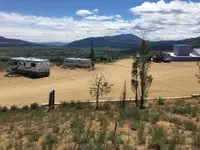
- RV Campground closed for Winter; all information subject to change.
- Walk-in or reserve
- Call first for availability: radon room by advance reservation only, full therapy purchase required, no minimum stay.
- Phone
- (406) 438-2906
- Managed by
- Ryan Lewis, Owner, Free Enterprise Radon Health Mine.
- Established
- Established 1952.
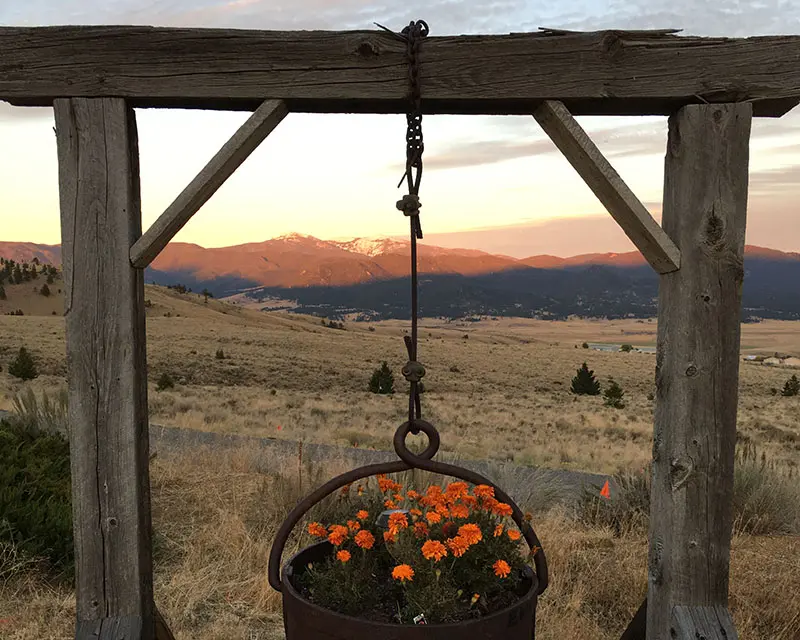
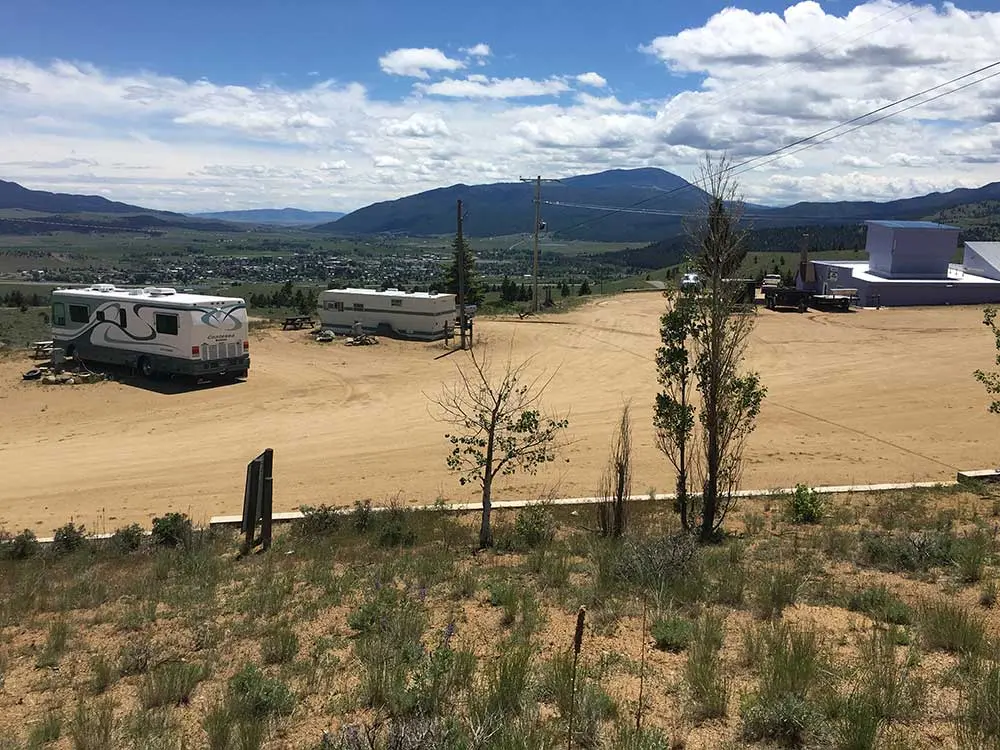
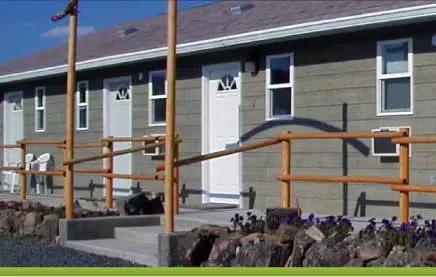
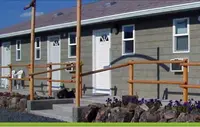
The Free Enterprise Radon Health Mine is a lavender building on a hillside less than two miles outside Boulder, with the town in the valley below and the Elkhorn Mountains around it. A Pacific Standard writer described its waiting room in 2016: visitors moving about with coffee cups, many with the knobbed knuckles and crooked fingers of arthritis. The room was mostly quiet apart from talk of the elk hunt and the hum of an old Otis elevator. The elevator is the way into the mine. It drops about eighty-five feet to the tunnel, a ride the Bozeman Daily Chronicle put at a minute and a half. The mine is owned by Ryan Lewis, great-grandson of the man who opened it, and he manages it with his wife, Leah.
Eighty-five feet down
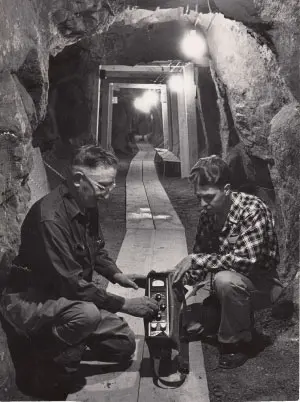
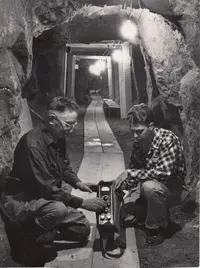
At the bottom is the gallery. Mark Singer, writing in The New Yorker in 2001, described it as a four-hundred-foot drift furnished with chairs, benches, tables, and bookcases. According to the mine’s own testing, radon in the air averages about 1700 picocuries per liter and normally ranges from 700 to 2200. The gallery is cold. On a June visit, a Chronicle photographer caught a temperature gauge reading 40 degrees Fahrenheit. Luke LeMieux, 74, of Boulder, sat in a recliner under heat lamps wearing a purple winter jacket. “I’m just crippled beyond hope,” she told the reporter on her fourth visit. “I thought, ‘What the heck, may as well try it.’”
Visitors have written on the timbers and rock walls in several languages. Carol Miller, 66, a retired operating room nurse from Indiana who travels in a motorhome, came down skeptical and “just here for the experience.” She added her own tag, “Windchaser Woman,” and said she would probably return. Bonnie Nelson of South Dakota keeps the dates of her visits on one of the posts. A Geiger counter is on display.
The treatment consists of sitting. The mine calls it self-treatment: a series of daily visits, which on an average stay comes to 30 to 60 hours over ten days. Wireless internet reaches the gallery, the surface room, and the lobby, and all sound must be muted in the therapy areas. The anthropologist Barbra Erickson studied the Montana mines from 1997 to 2001. She found no medical staff on the premises, no records or referrals required, and a rule that pregnant women and anyone under eighteen should enter only on a physician’s advice. She wrote that the state took a “hands off” approach but had stipulated thirty-two hours a year as acceptable exposure. Singer reported that the mine owners had agreed to that limit more than a decade before his visit.
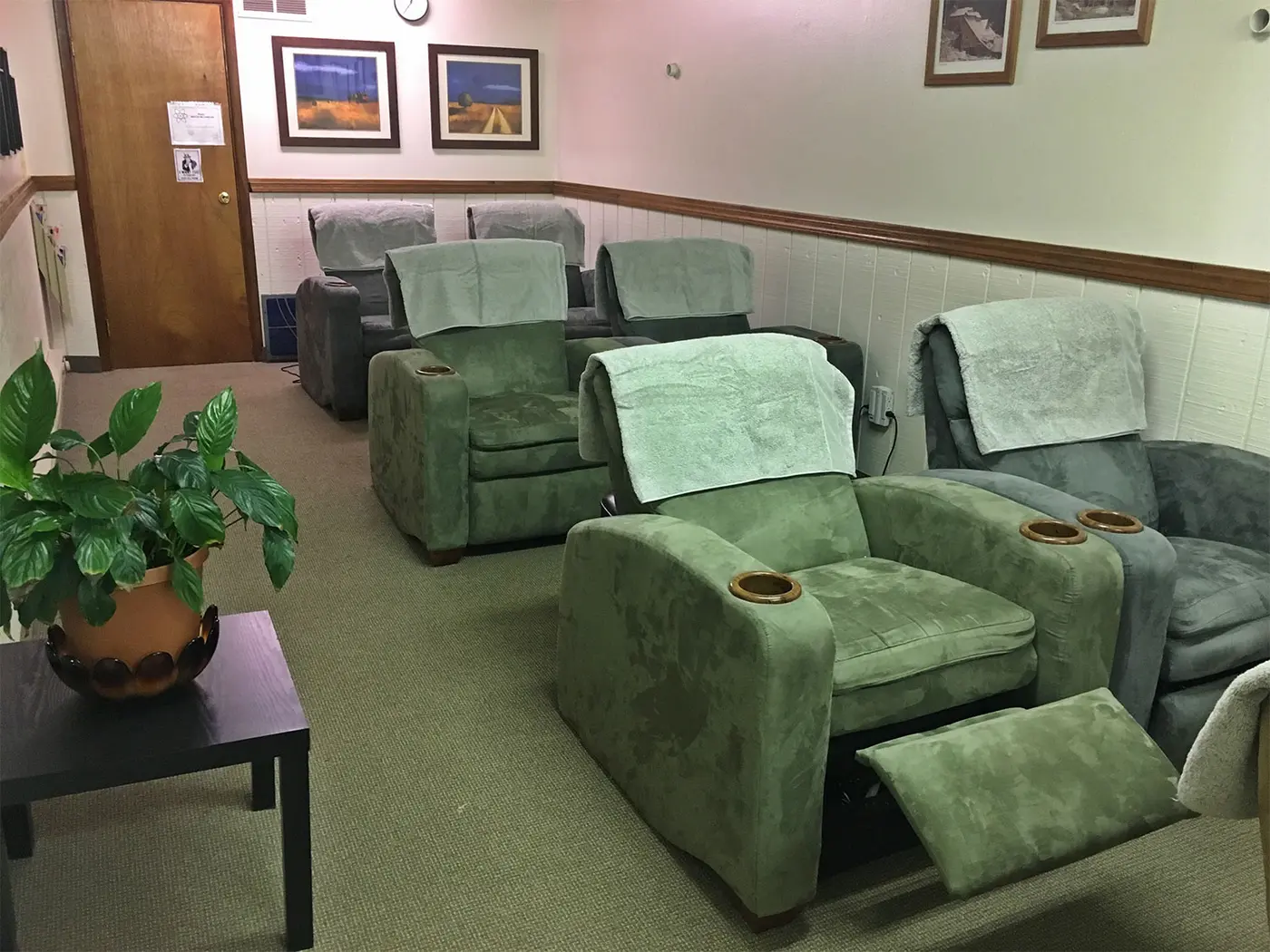
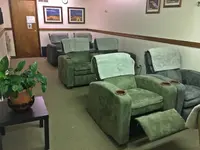
For those who will not go underground, there is the radon room at the surface. Air is pumped up from the 105-foot level of the workings, circulated through the room, and returned below. Pacific Standard said the room was designed for people too claustrophobic to ride the elevator. Singer described it in 2001 as a ten-by-forty-foot space with wall-to-wall carpeting, wood panelling, easy chairs, footrests, and a card table. Its shelves held old magazines, Reader’s Digest condensed books, and board games, and vents delivered air from the mine. A former custodian, a cousin of Patricia Lewis’s whom she referred to only as “previous management,” had named it the “Ionization Inhalatorium.” She called it the radon room. The mine lists it as open around the clock to registered guests, and an RV campground on the grounds closes for winter.
Banjos, cards, and a dog that went in backward
In December 1995 The New York Times found 78-year-old Fred Boyachek in the gallery playing a four-string banjo. He hoped to cure a degenerative retinal disease. His wife, Ruth, 72, had come for her sinuses. Two dozen other older visitors sat along the granite walls singing “You Are My Sunshine.”
Randy and Bonnie Nelson rode a Harley-Davidson from South Dakota and have come regularly since 1996, mainly for Randy’s arthritis. “They told me I had to slow down or I’d be crippled,” the retired municipal wastewater supervisor told the Chronicle from a cushioned bench in the mine. “It’s been basically a miracle for me.” Patricia Lewis, then the owner, said she cringed at that word. “We’re not a cure. We are not a miracle. There are mechanisms.”
Singer collected testimonials in 2001 and liked the ones about dogs best. Patrick McGowan, a retired ironworker who lived in Boulder, told him a story that went back to Wade Lewis. A dog was so hobbled by arthritis that it had to be coaxed into the mine backward. “After three or four days or weeks or whatever,” McGowan said, “that dog was running and chasing cats.” The next day, in the radon room, a couple from Oregon sat with their nineteen-year-old Shih Tzu, which they brought in for an hour a day.
The sources record the other side as well. The 1995 Times article reported radon in the mine at 750 times the federal action level. It quoted Christie Eheman, an epidemiologist with the Centers for Disease Control and Prevention: “It’s a carcinogen. You’re killing cells.” The mine’s brochure, as the Chronicle reported it, put a typical 32-hour session at about 6 millisieverts, roughly twice what a person receives in a year from natural sources.
A bursitis cure, as Wade Lewis told it
The ground was first claimed in 1924 by miners after silver and lead. The mine shipped a few small lots of ore and was abandoned. In 1949, Wade V. Lewis, a mining engineer and geologist, and two other locators found radioactivity in the old dump. They took a lease as the Free Enterprise Uranium Mine and dug down to 105 and 150 feet. Singer writes that Lewis was president and principal owner of the Elkhorn Mining Company, and that in 1949 the mine produced its first commercial quantities of uranium ore from one of three claims the company had staked. The Montana Historical Society holds the record of a 1952 speech Lewis gave to the Exchange Club in Butte on the Free Enterprise Uranium Mine.
The story of the turn comes in several versions. The mine’s own history says a Los Angeles woman visited in the summer of 1951 with her husband, who was there to look at the stock as an investment. A second version of the mine’s history describes him as her mining husband. After several trips underground, she found her bursitis gone. Singer gives the version Wade Lewis published in his 1955 book, “Arthritis and Radioactivity.” In it, a woman from California mentioned her bursitis on a tour, and Lewis “facetiously” told her the radiation might help. She was free of pain the next day. A second California woman with bursitis, an acquaintance of the first, came and was also relieved. “Thereafter,” Lewis wrote, “the stampede started.”
Pain sufferers demanded access while mining was still going on. The mine says nearly 1,000 were let in, for observation only. Singer writes that hundreds came in the following months, some in wheelchairs and some carried on litters. Life sent a photographer and a correspondent in June 1952. Erickson gives June 23, 1952, as the date the Free Enterprise officially opened for treatments. By then demand was heavy enough that Lewis had shut down mining and made safety and access improvements.
Other mines followed. Singer counts sixteen radon-therapy mines within a thirty-mile radius at the height. Pacific Standard reports more than a dozen by 1952, drawing more than 100,000 people in two years. Erickson cites local newspapers that put the visitors at tens of thousands by 1954. In a revised edition of his book, published nine years after the first, Lewis set out his theory that radon stimulated the body’s secretion of hydrocortisone and so eased inflamed joints. He ran the health mine for twenty-one years and died at 81.
From Seattle to Depot Hill
In 1994, his granddaughter Patricia Lewis and her husband, Burdette E. Anderson, left Seattle to run the mine. She had done office work for a shipping company, and he had repaired hydraulic pumps on heavy machinery. “We didn’t have a clue what we were getting into,” she told Singer.
The number of mines kept falling. The Times counted six in 1995, Singer found five in 2001, and later accounts name four: Free Enterprise, Sunshine, Merry Widow, and Earth Angel. Over four days in 2001, Singer met eleven customers and two elderly dogs at the Free Enterprise. Lewis was charging five dollars an hour, and the mine had reported eleven thousand dollars in taxable income the year before. In the off-season she asked visitors to use the radon room so she would not have to pay for electricity in the mine. In 2016 she told Pacific Standard that business had dropped to a tenth of its late-1980s peak. She needed about 300 clients to break even and was hoping for 200. To the Chronicle she blamed “radon hysteria,” a hard economy, and “good drugs.” “I don’t have 10 days,” she said, speaking for the modern patient. “I want to pop a pill.”
She and Anderson owned the mine through March 2014. That year her nephew Ryan Lewis, the fourth generation, bought it, and she stayed on to help manage it. Asked about her own daily exposure, she shrugged: “If I can’t sit in my own stew…” She kept research papers on hand for doubting visitors. “We are a last resort,” she said. “I’ve heard it so many times: ‘I cannot continue to live like this.’” On the volume of testimonials, she told the Chronicle, “there just can’t be that many liars.”
Notable Events
- 1949Mining engineer Wade V. Lewis, with two other locators, discovered radioactivity at the abandoned site. radonmine.com
- 1951A Los Angeles woman visiting with her husband for stock investment noticed her bursitis disappeared after several visits underground; word spread and the stampede began. radonmine.com
- 1952By 1952 demand was so great that Lewis closed his mining operation and reopened as a health mine after improvements for safety and accessibility. pmc.ncbi.nlm.nih.gov
- 1952The Free Enterprise Mine, the original radon health mine in Montana, officially opened for treatments. pmc.ncbi.nlm.nih.gov
- 1954According to local newspapers, by 1954 tens of thousands had traveled to Montana to visit the Free Enterprise or other local mines claiming radon. pmc.ncbi.nlm.nih.gov
- 1955Wade Lewis published the book Arthritis and Radioactivity, which promulgated the mine's origin legend. newyorker.com
- 1980sLewis said business had dropped to a tenth of its peak in the late 1980s. psmag.com
- 1994Lewis' granddaughter Patricia Lewis and her husband Burdette E. Anderson owned and operated the facility from 1994 through March 2014. montanaradonhealthmine.wordpress.com
- 2014Pat's nephew Ryan Lewis (4th generation) acquired the health mine in 2014. montanaradonhealthmine.wordpress.com
People
- Bonnie Nelson, Regular visitor with Randy from South Dakota (since 1996).
- Brad Erickson, Visitor from Forks, Washington, photographed in the radon lounge.
- Carol Miller, Retired operating room nurse visiting from Indiana; took the elevator into the mine to check it out.
- Luke LeMieux, Boulder visitor sitting under heat lamps at Free Enterprise.
- Patricia Lewis, Wade Lewis' granddaughter; owner and operator (1994 through March 2014).
- Randy Nelson, Regular visitor with his wife Bonnie, primarily for his arthritis (since 1996).
- Sandy Goehring, Former hostess who convinced her friend LeMieux to try Free Enterprise.
- Wade V. Lewis, mining engineer who discovered the radioactivity and managed the health mine for 21 years until his death at 81.
- Burdette E. Anderson, husband of Patricia Lewis; owner and operator (1994 through March 2014).
- Fred Boyachek, Banjo-playing mine visitor hoping to cure his degenerative retinal disease.
- Ruth, Fred Boyachek's wife, visiting for sinus trouble.
- Leah Lewis, co-manages the mine with her husband Ryan Lewis.
- Ryan Lewis, owner; Wade Lewis' great grandson, managing with his wife.