Fox Fire Farms
Ignacio, La Plata County, Colorado. Winery; Open May 15 to October 31.
Details

- Where
- 5513 County Road 321, Ignacio, CO 81137. Directions
- When
- Open May 15 to October 31 1 to 6 PM Thursday - Sunday; Friday nights June to Sept 6 to 9 PM.
- Getting there
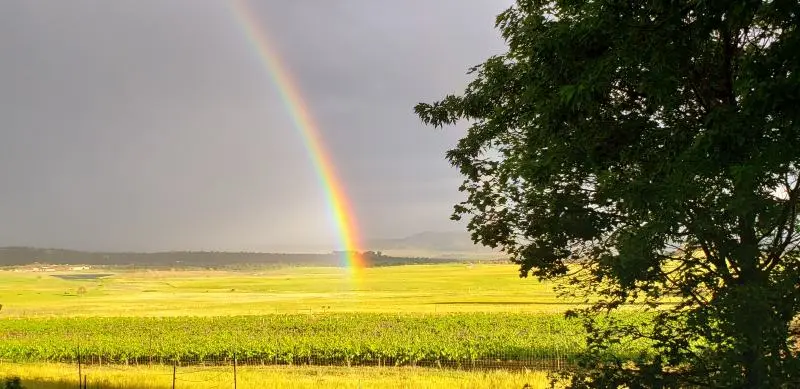
- Located 30 miles southeast of Durango and 45 miles southwest of Pagosa Springs as part of an 910 acre livestock farm, in a stunning Colorado setting.
- Fees
- $15.00 per person.
- Walk-in or reserve
- BY APPOINTMENT ONLY.
- Phone
- (970) 563-4675
- Website
- foxfirefarms.com
- Managed by
- Richard Parry.
- Established
- 1916.
A sheep is printed on every bottle of wine sold at Fox Fire Farms, and the flock is still out in the pastures. The farm covers 910 acres of livestock ground in the Pine River valley southeast of Ignacio, at an elevation of 6,500 feet. Sources disagree on the distances. The state wine industry’s listing puts the farm 25 miles southeast of Durango and 35 miles southwest of Pagosa Springs. The farm’s own home page gives 30 and 45.
The walk to the tasting room passes gardens that a 2018 newspaper account found full of flowers and bees, and flower beds and mown lawns that the owner, Richard Parry, credits to his wife, Linda. “Linda told me I had to change the look of the place,” he told the Pine River Times in 2016. “We cleaned up everything. She’s been very instrumental in getting it to look the way it does.”
The tasting room is open in the afternoons from mid-May through October. A tasting is $15 a person and a glass is $9. The farm invites visitors to bring a picnic and take a bottle out to the edge of the pastures. The Times described Fox Fire in 2018 as the only commercial winery in La Plata County.
Friday nights on the lawn
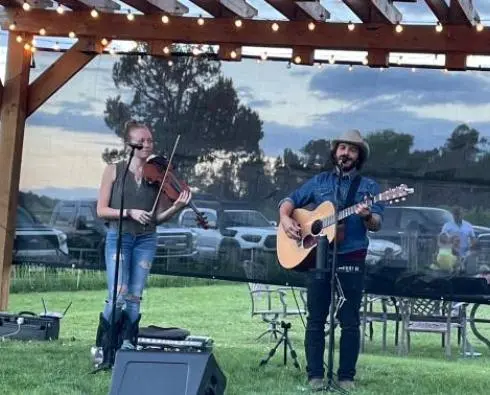
From the first Friday in June through the last Friday in September, the farm holds an evening of music, food and wine. Admission is free and all seating is outdoors on the lawns. When it rains, cancellations go up on the farm’s Facebook page.
The 2026 season opened on May 29 with Tyler Gummersall playing country and western “from Hank, Merle & George plus originals.” Later Fridays brought:
- Badly Bent, with traditional bluegrass
- Breezin, a seven-piece band
- the Devin Scott Duo on ukuleles
- the Bowmaneers, with Celtic music
- the Jeff Solon Jazz Band
KD’s Backcountry BBQ and Queva’s Taqueria did the cooking. In September the evenings moved an hour earlier, from 6 to 9 to 5 to 8. A few Saturday nights went on the calendar as well, among them “Starry Starry Night with Lisa Blue” on September 5.
The season opens with the Spring Art & Wine Fair, held in 2026 on Saturday, May 16, with local artists and three new wines poured for the reopening. The 2016 Times account also mentions a Taste of Spring event in May, when visitors could see the year’s baby animals, and an annual fundraising dinner for the Ignacio FFA. The first grape harvest of 2026 fell on Saturday, August 29. Parry put out a call for pickers to work from 8 in the morning until 5, with an hour for lunch.
Hybrids from Minnesota and Cornell
Parry makes the wine himself. “I do the wine making,” he said. “I’ve done many different things. It’s a personality type, always looking for a new idea.”
The first vines went in in 2004, and they were Vitis vinifera, the European wine grape. “In this particular location the grapes couldn’t survive the winters,” Parry said in an account the farm published in 2020. “We had a lot of trouble finding grapes that would grow here because of the cool climate,” he told the Times. “We spent several years finding ones that would grow here.” The grapes that survived were cold-climate hybrids. “The red came from the University of Minnesota, and the white came from Cornell University in upstate New York.” Vines take three years to bear, and a red needs two years of aging, “so that’s five years on the first vintage of red wine.” The first wine was made in 2009.
By 2016 Parry had eight acres in grapes and was adding an acre each year. In 2018 he was making wine from six varieties grown on the farm, plus five more from bought grapes, some from Palisade, or from juice. The farm now grows Marquette, Corot Noir, Traminette, Brianna, Petite Pearl, Marechal Foch, Vignoles and Aromella. Alongside them it pours Colorado-grown Cabernet Sauvignon, Riesling and Pinot Noir, a Muscat, a pomegranate wine, a Juliet Rosé and a dessert wine called Richard’s Ruby Port.
The Marquette won Best of Show at the 2015 Colorado State Fair, but sources differ on the vintage. The Midwest Wine Press reported a 2012 Marquette that took Best of Show and Triple Gold. The Times wrote in 2018 of a 2013 Marquette aged two years. Parry said that Marquette and his Traminette, which took a silver, were the only two hybrids entered. A 2015 Traminette was the only white wine to receive Double Gold at the 2016 Governor’s Cup. At the Colorado Uncorked event in Denver on October 18, 2025, the 2024 Aromella was named best white wine of the Governor’s Cup collection.
Warren Winiarski came to the tasting room as well. His 1973 Cabernet Sauvignon won the Judgment of Paris in 1976, and in 1968 he had consulted on Colorado’s first modern commercial winery. After judging the newly inaugurated Governor’s Cup in 2014, he began making regular trips around the state, and on one of them he tasted at Fox Fire. He found the wines “outstanding in their own character and refreshingly lovely.” Parry said: “I felt privileged that Warren was here! We discussed that we’re all working towards the same goal, really, uniform ripening.”
The Joneses come over from the San Luis Valley
The ranch began with Parry’s maternal grandparents, Arthur and Dovie Jones. They came from “the little Mormon settlement in the San Luis Valley,” in the Sanford and Manassa area, and moved into the Pine River valley sometime between 1913 and 1916. “Grandfather Jones was leasing land and raising sheep,” Parry said. “He bought out all the homesteaders in this valley.” The first land was purchased in 1916.
The Joneses kept sheep, a string of Holstein milk cows and a large house of laying hens. Over the years they also tried beef cattle, pigs and turkeys. They had two daughters: Alberta, born in the Ignacio area in 1909, and Evelyn. The girls kept a pet coyote and a pet cougar, and every day they rode their horses 2 miles to the one-room school.
Lower Spring Creek School
That schoolhouse still stands on the ranch. The surrounding land opened to homesteading in 1899. The farm believes the school was built between 1908 and 1915, and a La Plata County historic survey estimates 1908. One teacher taught grades 1 through 8, usually to 15 to 30 children. In the early years the teacher was usually a single woman, and the farm families took turns boarding her through the school year. Later, many of the teachers were local residents.
Alberta and Evelyn Jones attended from 1916 to 1924. Both went to college in the 1930s and became career teachers, and in the 1930s Evelyn came back to Lower Spring Creek to teach. She was fond of telling how she kept her recent marriage a secret, because the teacher was required to be single.
The school closed in 1948, when the Ignacio Consolidated School District #11 was formed. In 2009 Parry had it restored to its original condition.
Paddocks, lambs, and a name from Georgia
Evan Parry was “fresh out of New Mexico State, an engineer,” his son said, when he came to work on the Vallecito project, a dam begun in the late 1930s. He married Alberta Jones. Evelyn married Glen Payne, which brought the Paynes into the family; five generations of Joneses, Parrys and Paynes have now lived on the land.
Evan served with the Seabees in the Second World War and later worked for the Bureau of Reclamation and on the Navajo dam. After the war his father-in-law talked him into buying land and running sheep. “He had two careers,” Richard said, “and he kept the sheep business going at the same time. He died in 1967 when I was 12.”
Richard took over the ranch in 1971, at 17, and later earned a degree in finance and business administration. In the 1970s the Parry side of the land took the name Fox Fire Farms from the Foxfire books. Those books began as a student magazine at an experimental private school in Georgia, where students interviewed local people about southern Appalachian culture.
Around 1985 Parry gave up conventional sheep ranching for Alan Savory’s system of high-intensity rotational grazing, which moves stock the way wild herds move from place to place. He divided the pastures into about 80 paddocks. “We were probably one of the first in the Southwest to start implementing Alan Savory’s ideas,” he said.
At their peak the Parrys ran 1,500 ewes. Summers were spent on a grazing allotment on Middle Mountain above Vallecito, and winters on a BLM allotment west of Cortez. “That’s how it’s been done for generations – summer in the mountains and winter in the deserts,” he said. He later cut the flock to 700 and gave up federal ground. “I ‘sold’ that ranch (west of Cortez) to Bill Clinton when he declared Canyons of the Ancients. It was 9,000 acres.” The farm itself has measured as much as 2,200 acres.
Around 1997 Richard and Linda started an organic meat business. With their first website in 1998, they began shipping frozen lamb and beef to customers as far away as New York and Los Angeles. The volume grew until the animals had to go to Denver for processing, because Sunnyside Meats could not handle it. In 2010, with the winery growing, they stopped. “I couldn’t keep all the balls in the air,” Parry said. For several years the Parrys also hosted weddings. The livestock are now sold through conventional markets.
On August 26, 2016, at the 30th Centennial Farms ceremony at the Colorado State Fair in Pueblo, the farm was named among 23 families honored that year. The list entry read “Fox Fire Farms 1916 Ignacio/La Plata.” The family received a certificate and a sign to display on the ranch.
Notable Events
- 1908The school's construction date is believed to be within this range. foxfirefarms.com
- 1916The first land was purchased. durangoherald.com
- 1930Evelyn Jones returned to the school as a teacher. foxfirefarms.com
- 1948The school operated until the Ignacio Consolidated School District was formed. foxfirefarms.com
- 1970sThe Parry side of the family farmland took the Fox Fire Farms name from the Foxfire books. foxfirefarms.com
- 1971Parry said he took over running the ranch when he was 17. durangoherald.com
- 1985Parry learned Alan Savory's high-intensity rotational grazing system after conventional sheep ranching. durangoherald.com
- 1997Parry said they started an organic meat business, including his wife Linda. durangoherald.com
- 1998They had their first website. durangoherald.com
- 2004The first vines were planted. durangoherald.com
- 2009Parry said the first wine was made in 2009. foxfirefarms.com
- 2009Richard Parry had the schoolhouse restored to its original condition. foxfirefarms.com
- 2010Direct shipping of grass-fed frozen meat ended because the wine operation was growing. foxfirefarms.com
- 2015The Marquette red wine from 2013, aged two years, won overall Best of Show and commercial-wine Best of Show at the Colorado State Fair. foxfirefarms.com
- 2016Fox Fire Farms received Colorado's Centennial Farm award at the Colorado State Fair. foxfirefarms.com
- 2025Fox Fire Farms' Aromella won Best White Wine at the 2025 Governor's Cup collection at the Colorado Uncorked event 2025 held in Denver on October 18th. foxfirefarms.com
People
- Alan Savory, Originator of the high-intensity rotational-grazing system Richard Parry adopted.
- Arthur Jones, Co-founder who moved into the Pine River valley and bought the first farmland (1913–1916 arrival and first purchase).
- Dovie, Arthur Jones' wife who came from the San Luis Valley.
- Evan Parry, Richard Parry's father, an engineer who married Alberta Jones and kept the sheep business running (died in 1967).
- Glen Payne, Husband of Evelyn and part of the Payne branch of the farm family.
- Linda, Richard Parry's wife and participant in the farm's organic meat business.
- Richard Parry, Owner of Fox Fire Farms (took over running the ranch in 1971 when he was 17).
- Warren Winiarski, Visited Fox Fire Farms and met owner/winemaker Richard Parry.
- Alberta Jones, Richard Parry's mother; she married Evan Parry (born in the Ignacio area in 1909).
- Dovie Jones, Co-founder who moved into the Pine River valley and bought the first farmland (1913–1916 arrival and first purchase).
- Evelyn, Daughter of Arthur and Dovie Jones, career school teacher, and wife of Glen Payne.
- Alberta Jones Parry, Current owner's mother; attended Lower Spring Creek School (1916 to 1924).
- Evelyn Jones Payne, Current owner's aunt; attended Lower Spring Creek School (1916 to 1924).
Sources
- foxfirefarms.com
- coloradowine.com/winery/fox-fire-farms
- foxfirefarms.com/wine-tasting
- foxfirefarms.com/about-us
- foxfirefarms.com/winter-wine-tastings
- foxfirefarms.com/farm-history
- colorado.com/ignacio/fox-fire-farms-winery
- facebook.com/people/Fox-Fire-Farms-Winery-and-Events/100063713644172
- instagram.com/foxfirefarmswinery
- foxfirefarms.com/farm-history
- foxfirefarms.com/2023/03/08/fox-fire-farms-honored-as-colorado-centennial-farm
- foxfirefarms.com/news