Fourth of July and Gridley Days
Austin, Lander County, Nevada. Annual town events; Around the July 4th holiday.
Details

- Where
- Austin, Lander County, NV. No street address stated. Directions
- When
- July 3rd and 4th Gridley Days Rodeo 4th of July Lion's club BBQ and Fireworks and Austin Parade.
- Getting there
- U.S. Route 50 passes through Austin.
- Phone
- (775) 964-2200
- Website
- austinnevada.com
- Managed by
- Greater Austin Area Chamber of Commerce.
A rodeo and a parade on U.S. 50
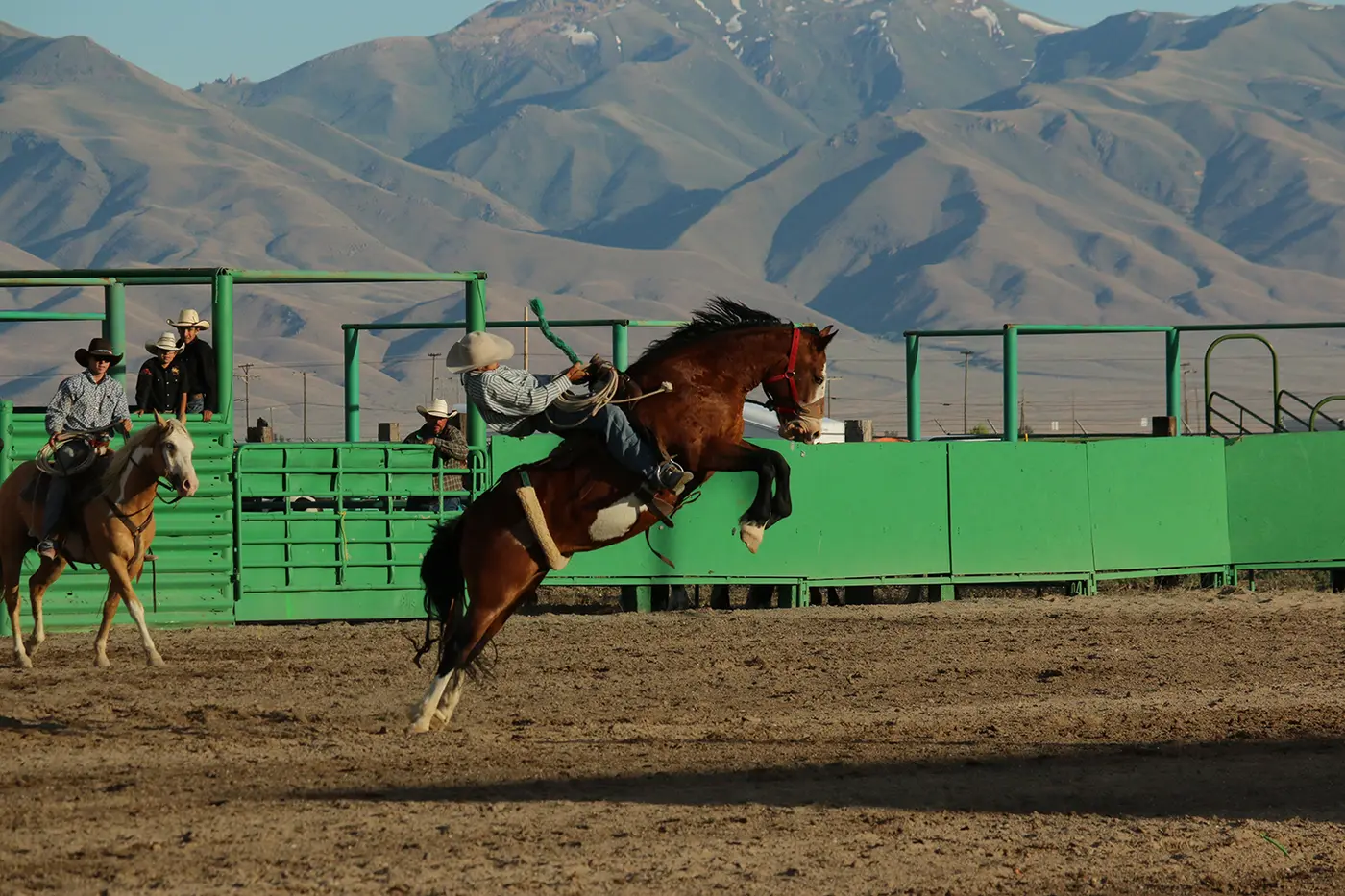
The 2026 calendar of the Greater Austin Area Chamber of Commerce gave July 3rd and 4th to the Gridley Days Rodeo. The Fourth itself went to the Lion’s Club barbecue and fireworks and the Austin parade. The rodeo is held at the Austin Fairgrounds. The Lander County Convention & Tourism Authority calls it “a traditional cowboy contest held annually around the July 4th holiday,” with bull riding, barrel racing, live music, food, and family activities over the weekend.
The parade has little distance to cover. Austin sits on the western slopes of the Toiyabe Range at 6,605 feet, and its Main Street is part of U.S. 50, the route billed as the “Loneliest Road in America.” Restaurants, bed and breakfasts, gift shops selling local gems and minerals, and “a few fine watering holes” fill the stone buildings along it. The county tourism authority puts the population at about 200. Margo Bartlett Pesek, writing for the Las Vegas Review-Journal in 2008, counted fewer than 350. Both figures come from a town that once held 10,000 people and ranked, in her account, as the second largest in Nevada. Legend has it that the Reese River silver rush, which founded the town, began in 1862 with a stone kicked over by a passing Pony Express horse.
Gridley Days in 2008
The celebration has not always fallen on the Fourth. Pesek’s column announced the 24th annual Gridley Days Celebration for June 13–15, 2008. The weekend she described had ghostly walks through historic sites, Irish and Scottish folk music, community breakfasts and barbecues, a parade, an evening street dance, games, and tournaments. At its center was a re-creation of an old race, run downhill with a 10-pound bag of flour. Auction proceeds then went to the Red Cross.
Fifty pounds of flour, April 1864
The race recalls Reuel Colt Gridley, an Austin merchant who lived from 1829 to 1870. According to the National Register nomination for his store, Gridley lost an election bet in April 1864 and had to march from his store through Austin carrying a fifty-pound sack of flour. Pesek adds that he carried it “up through town to the tune of ‘John Brown’s Body.’”
The sack was then sold, given back, and sold again to raise money for the U.S. Sanitary Commission, which cared for wounded Union servicemen. Pesek wrote that while “post-race libations flowed in the local hotspots,” the flour made the rounds at auction and raised $6,000 in Austin. Other towns challenged Austin, and the sack went on tour. The two sources give different totals for that tour. Pesek gives $275,000. The National Register form says Gridley raised “in excess of a hundred thousand dollars” in Nevada, California, and the East. The affair was heavily publicized at the time. Mark Twain, who had been Gridley’s schoolmate in Hannibal, Missouri, wrote about it in Roughing It.
The store on Water Street
The store Gridley marched from still stands at 247 Water Street, in what was called Upper Austin, above and east of most of the present town. It was built of granite in 1863 for Gridley and a partner, and it is also recorded as the Gridley & Hobart Store. The building is one story and faces south, with a wood-shingled front-gable roof and two front entries of unequal width. Both entries have French doors from a rehabilitation in the mid-1980s. An iron hitching ring is set into the masonry beside the left entry. Two short wooden posts with bolt ends rise above the ridge of the roof. They may once have held a bell.
Inside, the only surviving historic feature is the H-shaped timber frame at the foot of those posts, mortised and pegged. It carries carved and penciled initials, dates such as 1894 and 1902, and the words “Edward Myles, Austin.” Lander County owns the building. The Austin Historical Society runs it as the Gridley Store Museum. Its front carries a bronze state historic plaque, No. 119, and a sign reading “1,” a site number assigned in the 1950s. Behind it, the flanks of Lander Hill are still dotted with mine tailing piles.
An aide to the parade marshal
The Fourth of July parade had its officers in the nineteenth century too. Frances Slaven was born in Canada in 1842 and came to Austin in 1863 to teach at the school. By 1865 she was its principal. She married John R. Williamson, a merchant and later state senator, in 1868. Four of their children died of disease in 1876 and 1877. The Nevada Women’s History Project says she kept teaching and writing through these losses, stayed active in Austin society, and served as an aide to the Fourth of July Parade Marshal.
Her husband shot himself in April 1894. On November 30 of that year she helped organize a meeting on equal suffrage at the Austin courthouse, attended by about 125 people. The following year she was elected first president of the State Equal Suffrage Association. She died at her home in Oakland on December 21, 1919, and was buried in Austin on New Year’s Day, 1920.
Notable Events
- 1864Historical antecedent: Gridley lost an election bet and marched through Austin with a fifty-pound flour sack, then sold and resold it to raise funds for wounded Union servicemen. npgallery.nps.gov
People
- Frances Slaven Williamson, Aide to Austin's Fourth of July Parade Marshal.
- Reuel Colt Gridley, Austin merchant associated with the store and historical flour-sack episode (1829-1870).