_35.jpg)
_33.jpg)
_30.jpg)
_25.jpg)
Fossil Cabin
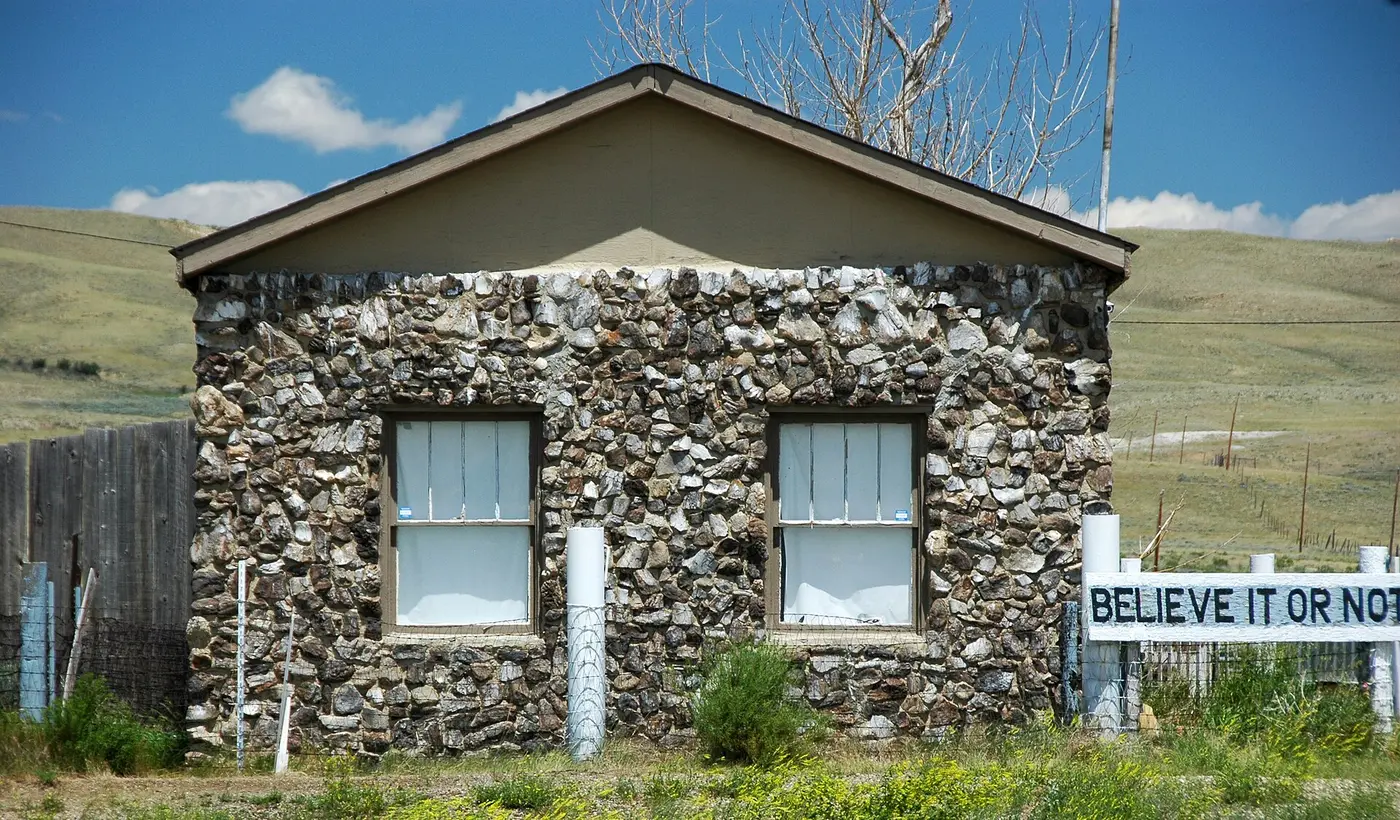
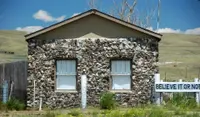
Medicine Bow, Carbon County, Wyoming. Dinosaur-bone building at the Medicine Bow Museum.
Details

- Where
- 405 Lincoln Highway, Medicine Bow, WY 82329. Directions
- When
- Mon - Sat: 10am - 4pm; Sundays and Holidays: 10am - 2pm.
- Season
- Memorial Day to Labor Day; off-season by appointment.
- Getting there
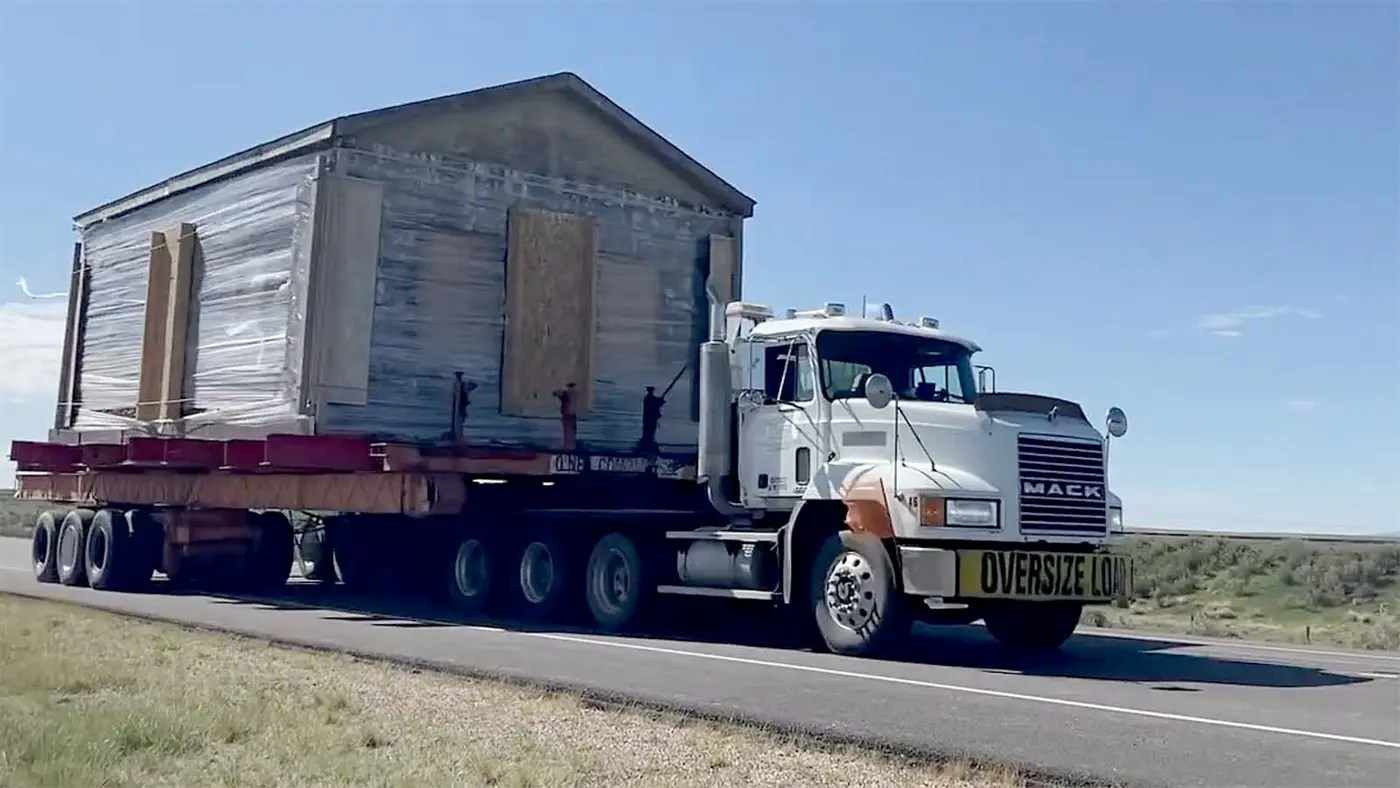
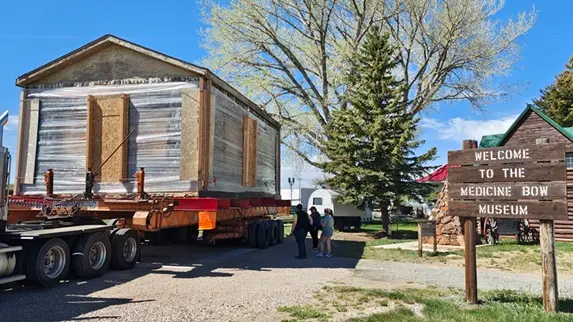
- A 7-mile crawl this week to a new permanent home at the Medicine Bow Museum.
- Fees
- Admission by Donation.
- Access
- The roughly 52-ton cabin and all 6,000 of its dinosaur bones were quietly moved from its original site to Medicine Bow on Wednesday; now right next to the museum.
- Phone
- 307-379-2383
- Managed by
- Medicine Bow Museum.
- Established
- Built by Thomas Boylan in 1932.
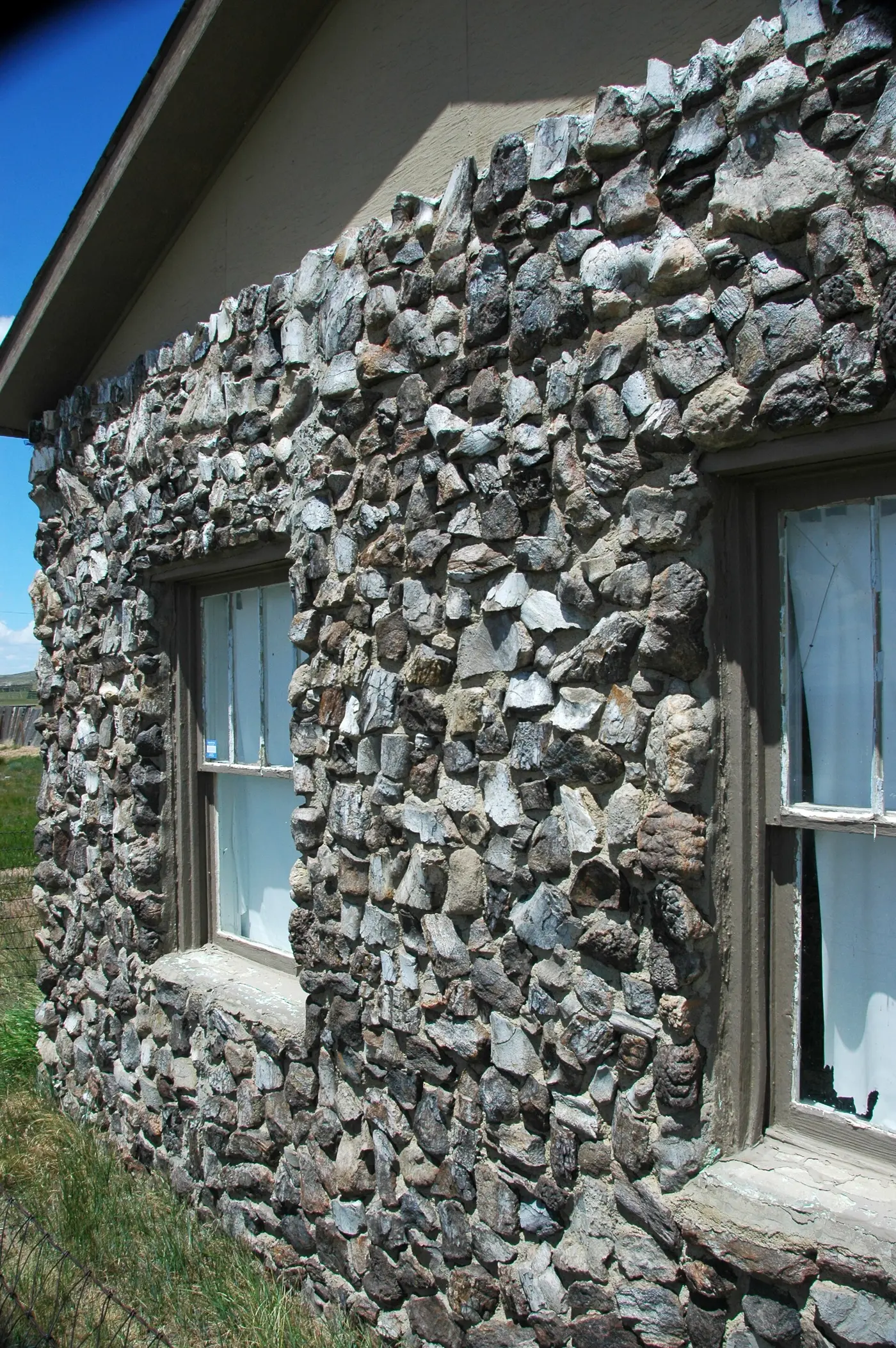
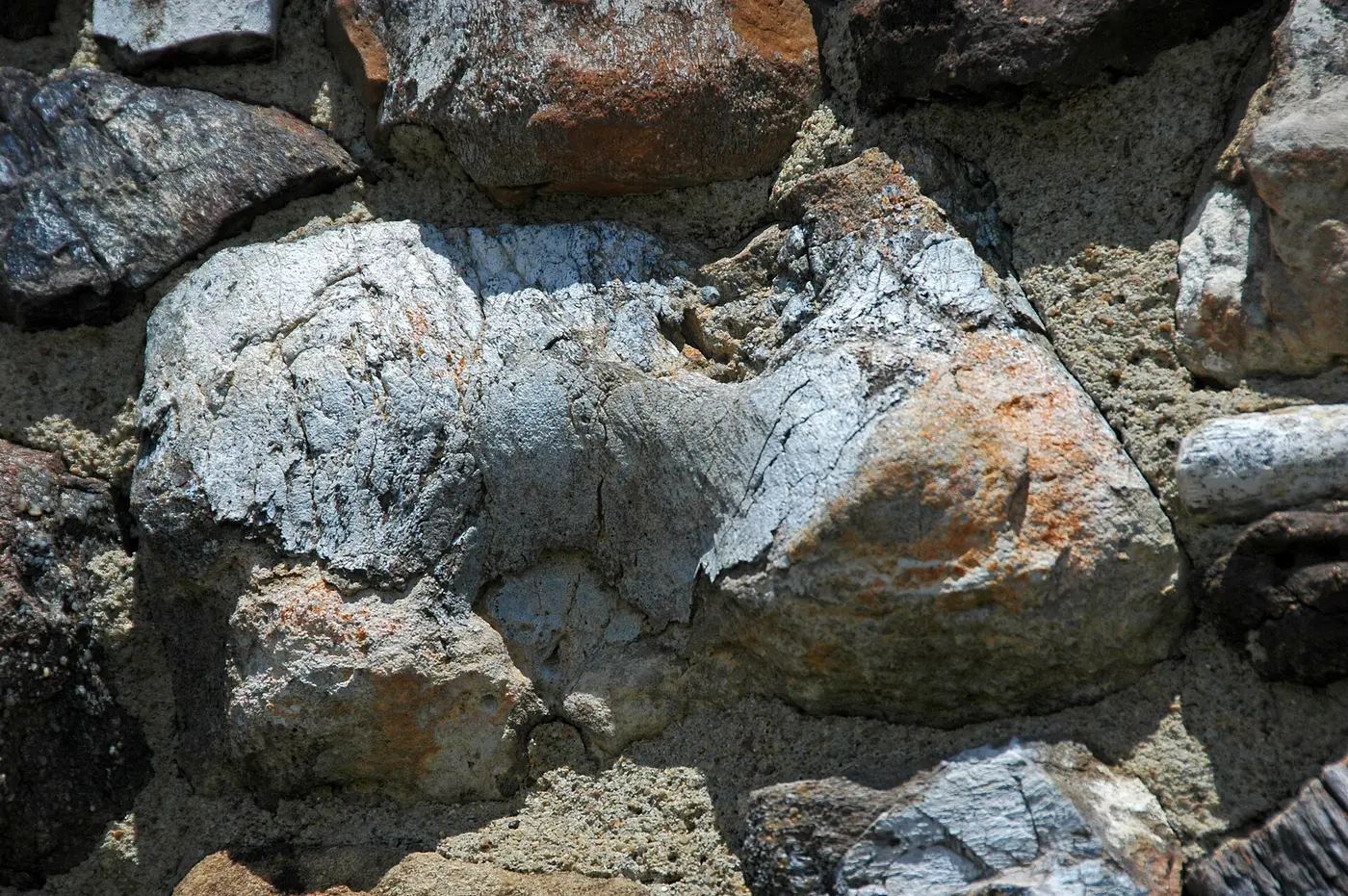
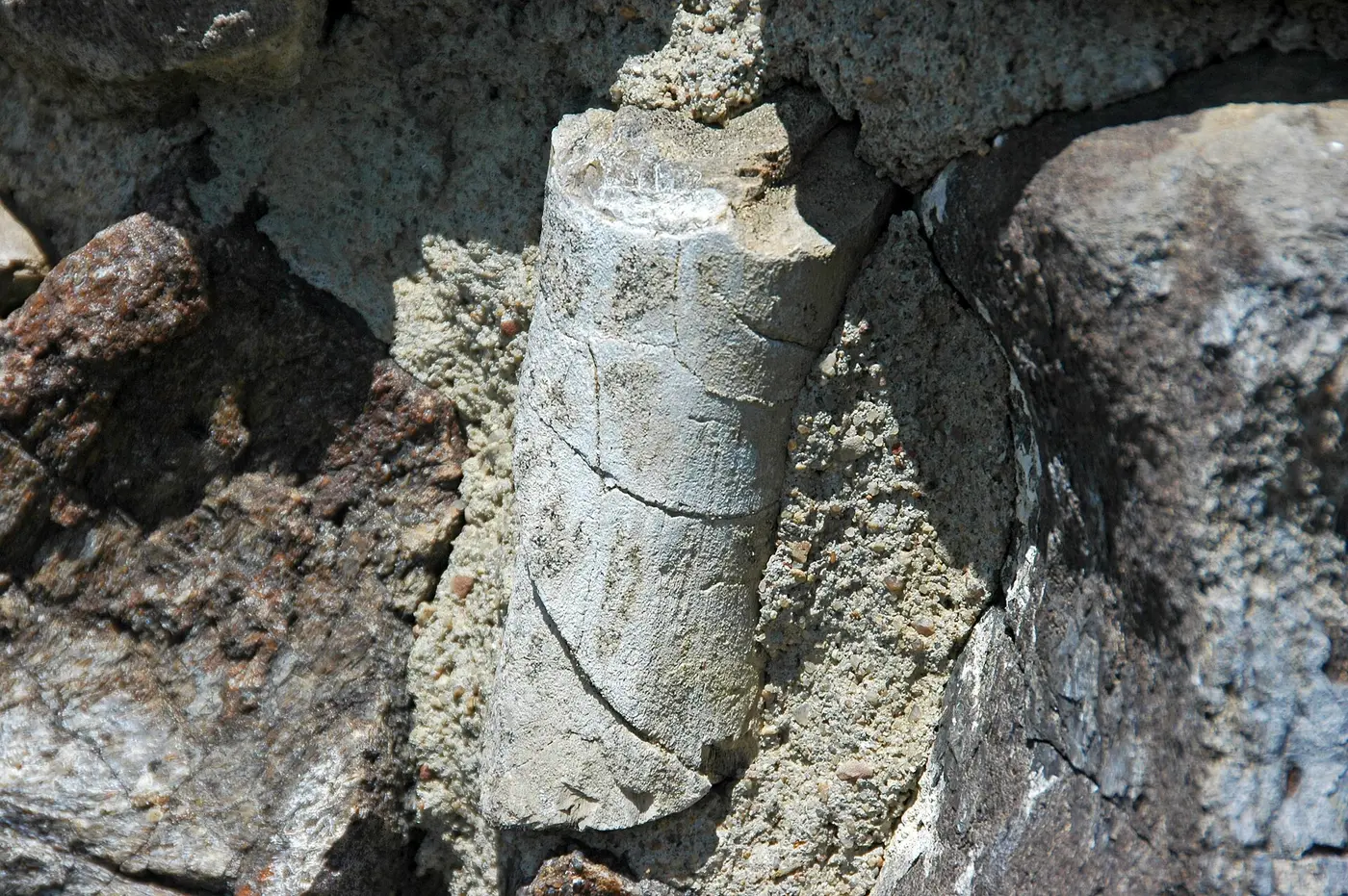
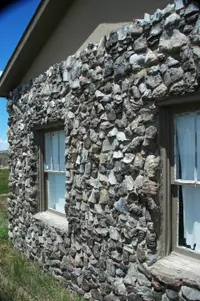
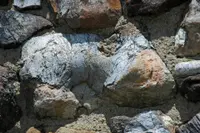
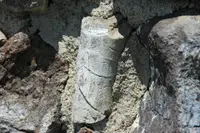
The Fossil Cabin sits on a concrete pad on the grounds of the Medicine Bow Museum, beside Owen Wister’s cabin and across the Lincoln Highway from the Historic Virginian Hotel. It is one story and rectangular, twenty-eight feet four inches by eighteen feet four inches. Its walls are dinosaur bones from Como Bluff, laid in random courses with wide mortar joints and a very small amount of rock. The National Register nomination counts 5,796 bones and gives the weight as 102,166 pounds. Cowboy State Daily put the count at 6,000-some and the weight at roughly 52 tons. A Bigfoot99 report spoke of more than 5,000 plant and animal fossils. A University of Wyoming dinosaur specialist who examined the bones found a variety of species but no complete specimen. Cowboy State Daily allows that a bone or two of allosaurus, stegosaurus or apatosaurus may be among them.
Its neighbors make up the rest of the museum. The collection is housed in the Union Pacific depot, which burned on July 24, 1913, and was rebuilt that year. Wister’s cabin was moved down from Jackson Hole by the Lions Club as a bicentennial project. Beside it stands a memorial of petrified wood, put up in 1939 by the Historical Landmark Commission of Wyoming. The grounds also hold a sheep herder’s wagon and a Union Pacific caboose. “You will be greeted by volunteer ranchers and locals,” one visitor, Meadow, wrote of the museum, which sells dinosaur toys and coloring books alongside old west books. Mayor Justin George pointed out that the cabin will once again stand near a gas station.
The bone walls can be seen from outside, but the interior was not ready in 2026. Once the building was set down, contractors were to pour more concrete to fix it to the pad, and the interior was to be renovated so visitors could get around inside. In May 2026 the cabin was not expected to open to guests until the following year. The museum also plans to weatherize the windows and roof so the cabin can stand another hundred years. Dawndee Yocom, the new museum director, said she had not yet decided what programs the museum would build around it.
Seven miles on a flatbed
The move took seven or eight years of planning, by the count of Sharon Biamon, the former museum director. She raised money for the first mover’s quote. “But it turned out that he couldn’t do it,” she said. “It was just too heavy. He didn’t have the equipment.” The Friends of the Medicine Bow Museum then hired O’Neil House Moving, a North Dakota firm that cost more and was paid for partly with grants.
Foreman John Coppe said Thomas Boylan had built the cabin with little regard for its structural integrity. It had no proper foundation. Crews framed it inside and out, welded steel bracing between I-beams slid beneath it, and dug out around it to build a movable platform. Then they wrapped the whole thing in plastic so loose material would not fall off on the road. “Fossils are brittle,” said Megan Stanfill of the Alliance for Historic Wyoming, who watched the move. “They’re very easily crumbled.” The mortar worried the mayor more. “It looks like concrete,” George said. “But from what I understand, it doesn’t have any Portland (cement) in it, which helps hold things together. So if you think about shaking something like that? It’ll just turn to sand and fall apart if you shake it too much.”
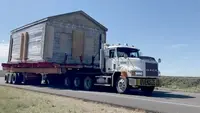
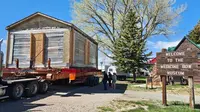
The town did not announce the move, because George did not want U.S. 30 clogged with spectators. On Wednesday, May 13, 2026, the cabin rode a trailer seven miles from Como Bluff to Medicine Bow, a trip of 44 minutes. George paced while he waited. When the cabin showed on the horizon, still in one piece, he let out his breath. Contractors then spent three days easing it onto the pad.
The bluff and the bone wars
The cabin had stood for 94 years on the north side of U.S. 30/287 by Como Bluff, about five miles east of Medicine Bow by most accounts. Bigfoot99 put the site at roughly seven. The bluff is part of the Morrison Formation, which is hundreds of feet deep and holds millions of years of deposition. In 1877 two Union Pacific employees at the Como Bluff station, out hunting antelope, by the museum’s telling, came on huge bones. WyoHistory names them as William Reed and William Carlin and dates their letter to the Yale paleontologist Othniel Marsh to July 19, 1877. That letter set off Wyoming’s first dinosaur rush.
Marsh sent crews west, and the bones went east in bulk by rail from the depot at Medicine Bow. Edward Drinker Cope soon sent his own teams. The two men had become enemies after Marsh publicly pointed out that Cope had put the head of an Elasmosaurus on the wrong end of its spine. At Como Bluff their camps armed themselves, spied, bribed each other’s workers, and smashed or dynamited bones rather than leave them to the rival. Hundreds of bones came out of the bluff, the museum notes, the Carnegie diplodocus among them.
A homesteader’s dinosaur
Thomas Boylan was born in California in 1863 and came to Wyoming in 1892. He worked for sheep and cattle companies near Lander, Medicine Bow and Rock River. In 1908 he and Grace Boylan homesteaded at the base of the bluff, beside what would become the Lincoln Highway, where he planned a gas station. He began gathering bones about 1915, according to WyoHistory, or in 1916, according to the Deseret News. “At first I planned to get enough of them together to mount a complete dinosaur skeleton,” he told a reporter in 1938. “However, erecting such a skeleton is a long and costly task for an individual to undertake.” The university specialist confirmed he did not have enough for one.
After seventeen years of collecting, by the National Register’s count, or sixteen, by the Alliance’s, Boylan built a house of bone instead. Most sources date it to 1932. The Deseret News, citing the Rawlins Daily Times, says Boylan and his son finished it in time for the 1933 tourist season and opened the gas station beside it. Until the cabin was done, the Boylans ran a museum in the stone house next door, where they lived. Postcards sold in 1935 and 1936 called it “The strangest building in the world,” “World’s oldest building” and the “building that used to walk.” The Deseret News adds “Creation Museum.” Robert L. Ripley called it the “world’s oldest cabin” in his syndicated “Believe It or Not.” The Deseret News dates that to 1938, and Bigfoot99 to seven years after the cabin was built.
After the interstate
Boylan ran the station and museum until he died in 1947. Grace Boylan, called Gracey in the Deseret News, kept both going until the late 1960s. Interstate 80 was finished in 1970, about 20 miles to the south, and traffic on Route 30 fell away. The Medicine Bow historian Marvin Cronberg counted 82 businesses in the area wiped out, Boylan’s station among them. The gas pumps were removed.
The accounts of the cabin’s later owners do not agree. The Deseret News says Gracey Boylan sold it in 1973 to Paul and Jody Fultz of Medicine Bow. They ran it as a summer museum for many years, then took visitors by appointment only in the 1990s. In that account the cabin reopened in 2001 under curator Mike Lewis and was closed again by 2013, pending, in the Town of Medicine Bow’s words, the “acquisition of a suitable manager.” WyoHistory says the sale came in 1974 and that the new owners’ parents lived in the house and ran the museum until 1992. Bigfoot99 names the buyers as the Nash family, who ran a dinosaur museum there until 1992 and gave the empty building to the Medicine Bow Museum in 2018.
The cabin was added to the National Register on April 11, 2008. A man from North Carolina had offered to buy it and move it there. The nomination called the idea “amusing but also indicative of just how underappreciated it is on its home turf.” In 2016 the Alliance for Historic Wyoming found the farmhouse abandoned and sagebrush as big as small dinosaurs grown over the property. Some tourists chipped fossils out of the walls, and displays inside were stolen. Travelers kept pulling over all the same. “I drive this country all the time,” George said. “And there are always vehicles stopped there where it used to sit at Como Bluff.”
Notable Events
- 1908Thomas and Grace Boylan homesteaded near the later cabin site. wyohistory.org
- 1915Boylan began collecting bones from Como Bluff, intending to assemble a complete skeleton that would attract travelers to his gas station. wyohistory.org
- 1933Boylan and his son completed the cabin in time for the 1933 tourist season and opened the gas station beside it. deseret.com
- 1938The cabin gained national attention when Robert L. Ripley called it the 'world's oldest cabin' in his syndicated 'Believe It or Not' feature. deseret.com
- 1947After Thomas Boylan died, Grace Boylan took over the gas station and fossil museum and operated them until the late 1960s. wyohistory.org
- 1970Completion of Interstate 80 cut traffic on Route 30 and wiped out 82 businesses in the area, including Boylan's gas station. deseret.com
- 1973Boylan's widow sold the cabin to Paul and Jody Fultz of Medicine Bow, who ran it as a summer museum. deseret.com
- 1974The cabin was sold to the Nash family in 1974, and they operated a dinosaur museum there until 1992. bigfoot99.com
- 1990sAfter many years of summer museum operation, the Fultzes began taking visitors by appointment only. deseret.com
- 2001The cabin reopened to the public when Mike Lewis took over as curator. deseret.com
- 2008Fossil Cabin was added to the National Register of Historic Places. wyoshpo.wyo.gov
- 2013As of 2013 the cabin was closed, according to the Town of Medicine Bow, for want of a suitable manager. deseret.com
- 2018The Nash family donated the vacant building to the Medicine Bow Museum. bigfoot99.com
- 2026O'Neil House Moving transported Fossil Cabin seven miles from Como Bluff to its permanent home at the Medicine Bow Museum. bigfoot99.com
- Seven years after the cabin's construction, Ripley's Believe It or Not! named it the World's Oldest Cabin because its walls used Jurassic-era bones. bigfoot99.com
People
- Jody Fultz, Co-owner with Paul Fultz who ran the cabin as a museum (From 1973, by appointment only in the 1990s).
- Mike Lewis, Curator under whom the cabin reopened to the public (From 2001).
- Paul Fultz, Buyer of the cabin with his wife; ran it as a summer museum (From 1973, by appointment only in the 1990s).
- Robert L. Ripley, Syndicated 'Believe It or Not' feature writer who billed the cabin as the world's oldest (1938).
- Grace Boylan, Co-homesteader and operator of the gas station and fossil museum after Thomas Boylan's death (until the late 1960s).
- Thomas Boylan, Builder of the Fossil Cabin; worked for sheep and cattle companies near Lander, Medicine Bow and Rock River before filing a homestead near Como Bluff (Born in California in 1863; came to Wyoming in 1892).
Sources
- wyohistory.org/encyclopedia/fossil-cabin
- wyoshpo.wyo.gov/index.php/programs/national-register/wyoming-listings/view-full-list/436-fossil-cabin
- medbowmuseum.org/visit
- cowboystatedaily.com/2026/05/15/wyomings-fossil-cabin-worlds-oldest-building-moved-to-medicine-bow-museum
- bigfoot99.com/bigfoot99-news/fossil-cabin-arrives-at-new-home-in-medicine-bow