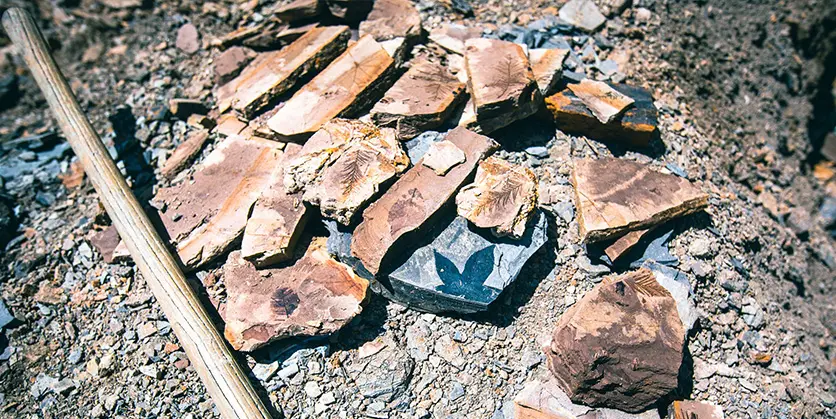
Fossil Bowl fossil dig
Clarkia, Shoshone County, Idaho. Fossil digging site with a motocross track on the same property.
Details

- Where
- 52450 Hiway 3, Clarkia, ID 52450. Directions
- Getting there
- About 30 minutes south of St. Maries on State Highway 3 at mile marker 52 1/2; follow signs for the Fossil Bowl motocross track on the same property and pull up to the house.
- Fees
- $10 per person to dig all day; cash.
- Access
- No services on site; bring water, lunch, snacks, sunscreen, hats, sturdy closed-toed shoes, and pants that can get dirty; the site can get very hot.
- Phone
- (208) 245-3608
- Website
- fossilbowl.com
- Established
- Fossil bed discovered in the early 1970s.
There is no fancy sign. About 30 minutes south of St. Maries on Idaho State Highway 3, near mile marker 52½, signs point to a motocross track called the Fossil Bowl. A visitor who has come for fossils pulls up to the house on the same property, pays $10 cash, and can dig all day. The hillside above the house is the bottom of a lake, roughly 15 million years old, and it comes apart in the hand.
Butter knives at the hillside
Diggers break chunks of wet, clay-like soil out of the bank. A 2008 Spokesman-Review account has them taking a Pulaski to it. Each chunk holds thin layers “almost like pages of a book stuck together,” in the words of Avista’s 2020 guide to the dig. The tool is a dull butter knife: slide it between the layers, wiggle it, and the block splits open. Inside are leaves, pine needles, seeds, sticks, branches, flowers, and now and then a fish a little larger than an anchovy. Two Swedish researchers writing in Deposits Magazine name leaves of oak, laurel, pine and birch that look nearly identical to living ones, and they report that acorns sometimes turn up.
Some leaves come out of the clay still brown, greenish or dark rusty red, and the color turns dark once air reaches it. “My favorite part is the colors,” the owner, Kenneth Kienbaum, told the Spokesman-Review in 2008. “Some of the leaves are still red. Some are brown. It’s just amazing.” Flowers and leaves come easily, he said. Fish do not: “We find fish – but this year has not been a good one for ‘fishing.’ It’s been a while since I found one.”
Visitors keep as many fossils as they want. They wrap them in newspaper brought from home and leave them wrapped about six weeks to dry. If someone found something very unusual, Kienbaum said, he would ask to hold it long enough for one of the professors to document it and then send it back to the finder. “My dad wanted it to be like that. I’m following his wishes.” A photograph with that story shows Riley Kienbaum helping visitors break rocks.
The site has no services, and it can get very hot. The guides advise bringing water, lunch, sunscreen and hats, and wearing closed-toed shoes and pants that can get dirty. The track’s own page calls the Fossil Bowl a place “where the cell service doesn’t reach,” and Avista suggested carrying a paper Idaho road map.
Engines beyond the clay bank
The dirt bikes are close by. The 2008 account says they buzz next to the dig until a digger bent over the clay hears only a faint hum. The track’s Facebook page describes “50 years of motocross, fossils, and traditions,” and its 2026 posts read as a season’s log. One day in late May held a woods race, a kids race and a hard enduro. In June there was talk of taking a race up “the Devil’s Drop to Heavens Gate.” More than 170 riders entered on one Saturday in July, and a P.R.O. race ran August 8 and 9.
For the 250th Fourth of July, the track held a chuck wagon potluck on Saturday night, with $250 in cash split among the best “most American” dishes. There were pit bike races, an all-American parade lap for riders in flags and festive gear, and fireworks, allowed so long as they were lit by the starting line and finished by 10 p.m. Beforehand, 67 loads of dirt had gone onto the track. Jeff Walton guessed the number first and won a free race entry.
August brought the K.O. Rumble and a gear exchange with nothing priced: “If you need something, grab it.” That same month the track lost Matt Green, who had coached and cheered riders there. The page wrote that people at the track “stepped up—making lunches, filling in where needed,” and that racing went on Sunday for him. September brought a “bra and panty race,” another chuck wagon, and a season finale with a free cowboy breakfast and $4,000 in rider payback.
Between races the tractors work the ground. They deep-till the track, a water truck stands by when the dirt is dry, and the tractors themselves get painted. On October 2, 2026, the page said the track was being groomed for weekend practice, with “one last tractor haul for the year.”
A snowmobile track and a phone call
The racing came before the fossils. Bill Rember of the University of Idaho and Kenneth Kienbaum date the find to 1972. Avista and a 2022 paper in Fossil Imprint say only the early 1970s. Francis L. Kienbaum was building a snowmobile track, digging into the hillside above his home, when strange-looking material full of leaves spilled out. His son told it this way in 2008: “My dad didn’t know what it was. So he called the University of Idaho. They said something like, ‘Sir, it’s fall, there will be leaves on the ground’ but my dad knew this was something unusual.”
Eventually University of Idaho paleobotanist Jack Smiley made the trip to Clarkia. “The professor said, ‘We knew something like this was here, but we never saw it before,’” Kienbaum recalled. “My dad and Smiley didn’t quite get along at the beginning, but once my dad realized what was here, he decided to leave the site as it was and keep it open to the public.” Smiley identified a fossilized lake bottom full of leaves, sticks, seeds and fish. According to Avista, the Clarkia Flora, as scientists call it, set the course of his research for the next 20 years and became the subject of countless dissertations and theses.
The snowmobiles kept running. Francis’s brother Jerry Kienbaum, later the owner of a vintage snowmobile museum in Spokane, was his partner in the track. Sno Pro USA reports that the oval, called “The Fossil Bowl,” hosted WSSA circuit racing from the early 1970s to the mid-1980s. Deposits Magazine says the track became a motocross course ten years after the discovery. Kenneth Kienbaum grew up on the place and inherited it when his father died, two years before the 2008 story.
The lake under the track
The Clarkia lake formed when a Columbia River Basalt flow dammed the proto-St. Maries River near the present town of St. Maries. The Swedish authors and a 2024 piece in The Conversation put that at about 16 million years ago; Rember’s abstract gives 15 to 15½ million. By the Deposits account, the lake was narrow and deep, 100 to 150 meters, and filled with silt and clay in perhaps 10,000 to 100,000 years. Wind did not stir its bottom water, which stayed cold and without oxygen, so the scavengers and bacteria that break down remains could not live there, and sinking leaves lay undisturbed.
Ash from eruptions tied to the Yellowstone hotspot, and to a lesser extent the Cascade volcanoes, falls in bands through the clay. The section exposed at the racetrack is roughly 9 meters thick. The most recent dating of those ash layers, cited in the 2022 paper, places the flora at 15.78 million years, give or take about 39,000 years. In the scientific literature the dig is locality P-33, the Fossil Bowl Race Track site, which that paper calls the best-known source of the Clarkia flora. Deposits Magazine calls the deposit a lagerstätte, a term reserved for the world’s finest fossil beds.
The finds keep coming. In the winter of 1976 Rember collected a small leaf at P-33 and listed it provisionally as Nuphar. In 2022 it was formally described as Nymphaea, the first water lily from Clarkia, one leaf among tens of thousands. The specimen is so rare that it could not be borrowed and had to be studied in natural sunlight at Morrill Hall at the University of Idaho in Moscow.
Laboratories have extracted chlorophyll derivatives from P-33 leaves. DNA has been sequenced from two Clarkia leaves, though some have argued it may come from bacterial contamination. A team led by Hong Yang and Qin Leng studies Clarkia’s lake sediments as a stand-in for the ancient lake deposits of Jezero Crater on Mars.
In 2009, North Idaho College students led by Bill Richards were hunting fish fossils at the north end of the Kienbaum family racetrack when they split open a tree squirrel. It was preserved as a carbon film of skull, forelimbs, ribs and spine, and was estimated at about 492 grams in life. It was the first four-legged animal scientists had found at Clarkia, and it went to the Burke Museum in Seattle. “To actually have the whole outline of the body like that is very unusual,” said Gonzaga paleobiologist John Orcutt.
Notable Events
- 1970sThe snowmobile oval track called "The Fossil Bowl" in Clarkia had WSSA Circuit Racing from the early 1970's to the mid 1980's. snoprousa.com
- 1972The first discovery of fossils in the Clarkia area was during the construction of a snowmobile racetrack. lib.uidaho.edu
- 1972Francis L. Kienbaum was building a snowmobile track; as he dug into the hillside, strange-looking material spilled out that was full of leaves. spokesman.com
- 2009Students led by North Idaho College Professor Bill Richards, searching for fish fossils at the north end of the Kienbaum family racetrack, found a tree squirrel fossil, the first four-legged animal scientists have uncovered in Clarkia. gonzaga.edu
People
- Francis Kienbaum, Made the original discovery at the site while he was excavating for a snowmobile racetrack, ten years before it was converted to the motocross racetrack.
- Bill Rember, University of Idaho geologist, director of UI's Tertiary Research Center, who has been unearthing and studying the Clarkia fossil flora for decades.
- Charles Jack Smiley, University of Idaho-connected geologist and paleobotanist who identified the find; the Clarkia Flora shaped much of his research for the next 20 years.
- William C. Rember, University of Idaho co-author who collected the Fossil Bowl Race Track site specimen described in the paper.
- Jerry Kienbaum, Snowmobile race track partner with his brother Francis Kienbaum at The Fossil Bowl.
- Francis L. Kienbaum, built the snowmobile track where the fossils were found; decided to leave the site as it was and keep it open to the public.
- Jack Smiley, University of Idaho paleobotanist who made the trip to Clarkia.
- Kenneth Kienbaum, owner; grew up there and inherited the Fossil Bowl when his father died.
- Riley Kienbaum, helps visitors to the Fossil Bowl break rocks.
- Hong Yang, Leader of a research team using fossil remains and biogeochemistry to reconstruct past environments of the Clarkia Miocene Lake region.
- Qin Leng, Leader of a research team using fossil remains and biogeochemistry to reconstruct past environments of the Clarkia Miocene Lake region.
Sources
- myavista.com/connect/articles/2020/07/local-treasures-fossil-digging
- facebook.com/p/Fossil-Bowl-100063724775941
- depositsmag.com/2019-03-11/the-clarkia-flora-16-million-year-old-plants-offer-a-window-into-the-past
- publikace.nm.cz/file/6eedf17277a04adde3b04cb9627aca5e/36046/11_Gee.pdf
- theconversation.com/studying-lake-deposits-in-idaho-could-give-scientists-insight-into-ancient-traces-of-life-on-mars-216853
- spokesman.com/stories/2008/jun/23/digging-for-garnets-and-fossils-in-gem-state
- lib.uidaho.edu/digital/mric/archive/paleobotany-and-stratigraphy-of-lake-clarkia.html
- pmc.ncbi.nlm.nih.gov/articles/PMC5995101
- snoprousa.com/nw-vintage-snowmobile-museum-gallery.html
- gonzaga.edu/news-events/stories/researchers-find-squirrel-fossil-at-clarkia-idaho-site