

The Blacksmith Shop
Vancouver, Clark County, Washington. Blacksmith shop; Year Round.
Details

- Where
- 1001 E. Fifth St., Vancouver, WA 98661. Directions
- When
- Blacksmithing demonstrations are provided when volunteers are present. Please call (360) 816-6244 to find out if there will be a demonstration on the day of your visit.
- Getting there
- From I-5 take the Mill Plain Boulevard exit (Exit 1-C) and head east; turn south onto Fort Vancouver Way; at the traffic circle go east on Evergreen Boulevard; the reconstructed fort site and its parking lot are south of the visitor center.
- Fees
- $10 per person ages 16 and up for the reconstructed fort; receipt valid for seven days; cashless, credit/debit and payment apps; ages 15 and under free; all Interagency passes honored.
- Hours
- Reconstructed Fort Vancouver (Vancouver, WA facilities): Tuesday through Saturday, 9:00 AM - 4:00 PM; closed Sunday & Monday.
- Access
- Parking in designated lots at the Visitor Center, at the reconstructed fort (1001 E. Fifth St.), and at Pearson Air Museum (1115 E. Fifth St.).
- Walk-in or reserve
- No.
- Phone
- (360) 816-6244
- Website
- nps.gov
- Managed by
- National Park Service.
- Established
- 1824-1825 (the fort's first smithy, set up by William Cannon).
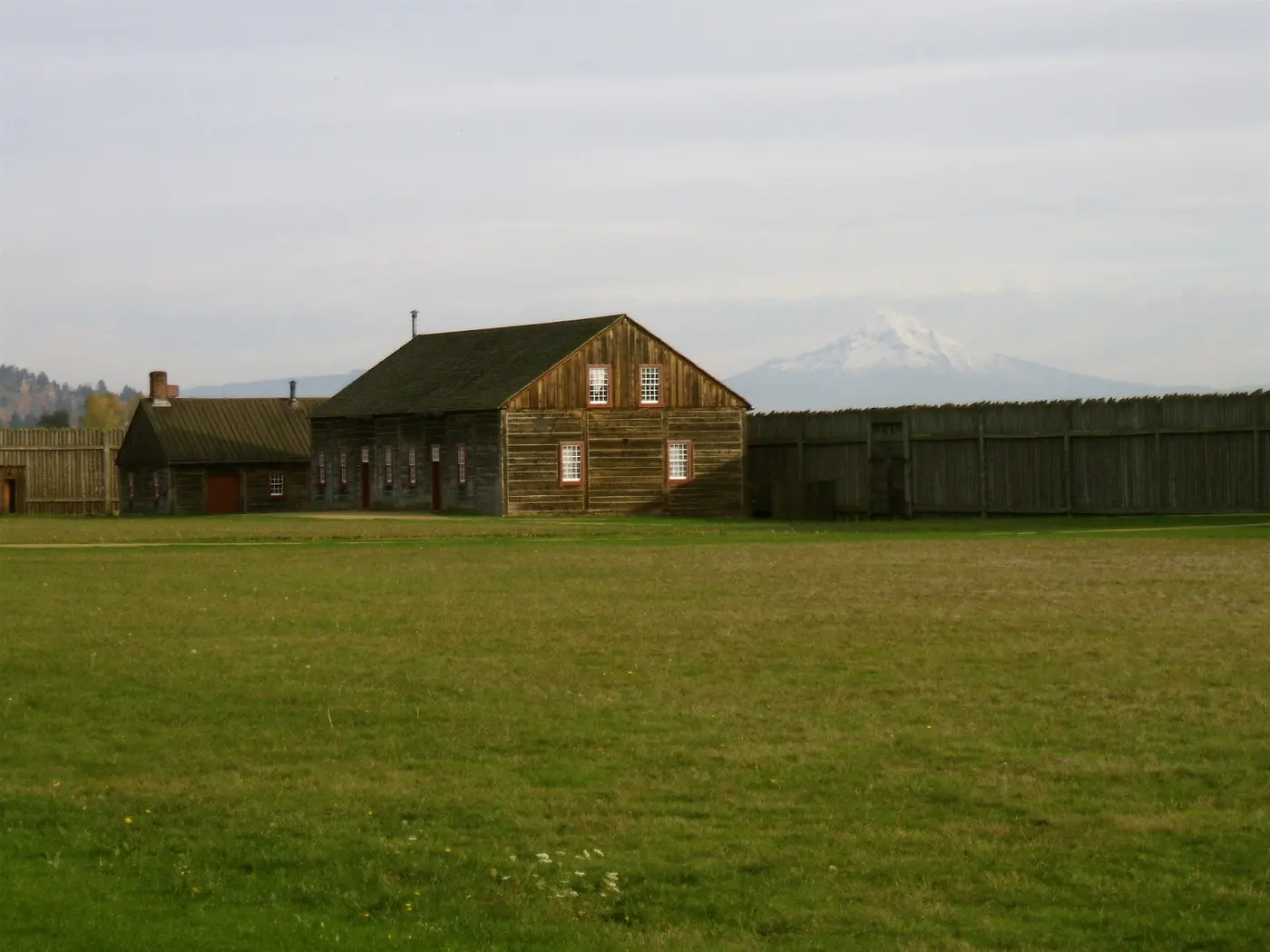
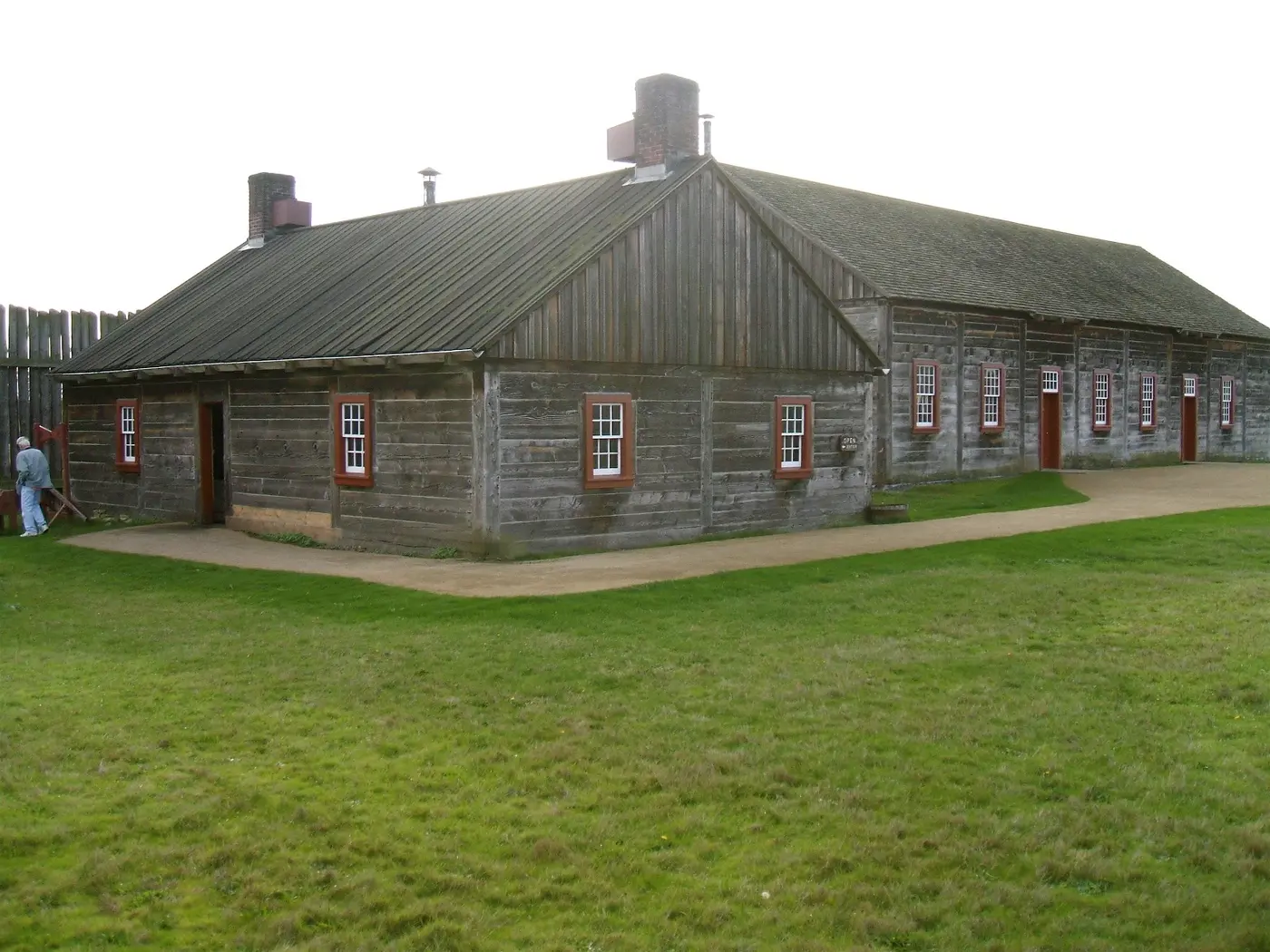
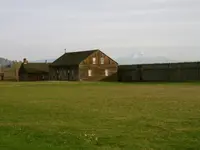
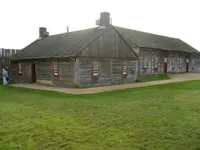
Inside the stockade of the reconstructed Fort Vancouver, on the north bank of the Columbia River in Vancouver, Washington, paths of decomposed granite lead to the southeast corner and the Blacksmith Shop. The floor inside is gravel. There are bumps and dips at the doorways, and the room is often dim, darker still on a cloudy day. Staff and volunteers work here making historically accurate tools and hardware from iron, as the Hudson’s Bay Company’s smiths did in the 1800s. A stop runs five to thirty minutes.
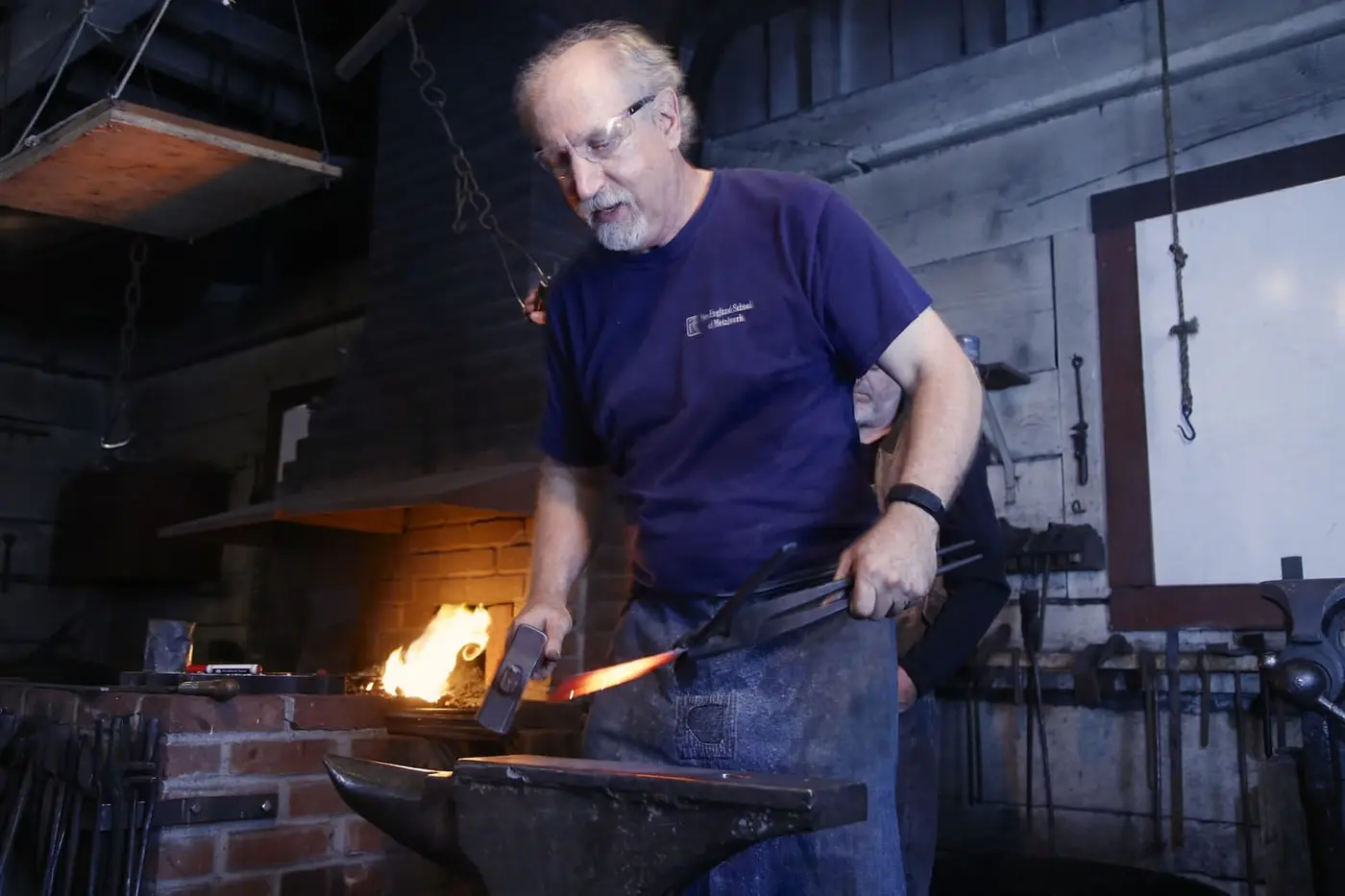
In October 2015 the visiting master blacksmith Jay Close stood in the shop holding tongs and glowing metal in one hand and a hammer in the other. He flattened a piece on the anvil that would be curved to hold the handle of a garden rake. He had come to demonstrate and to give tips to the volunteers. The Columbian’s account of his visit began in the small historic garden at the fort entrance. With 1,500 acres of vegetables once under cultivation, it noted, the company’s gardeners must have needed rakes.
The demonstrations depend on volunteers. They are enrolled as Volunteers-in-Parks and trained through the Trades Guild, and an apprentice program is being developed with park staff. Their work is limited to what the company’s smiths did in the shop during the fur trade era, and it centers on British blacksmithing of about 1825 to 1846. The ranger at the Contact Station just inside the fort gates takes the entrance fee. On the morning of a visit, the station can say whether a smith is expected.
The building represents the shop as it stood in 1845–46. In those years the work went on every working day. The smith built a fire of coal or charcoal and pumped a bellows to drive it upwards of 2,000 degrees Fahrenheit. He laid in bars of wrought iron or steel shipped from Britain until they turned red-hot, then bent and beat them on the anvil. The Park Service describes the shop of that time as often sweltering and dirty.
A bellows under a fir
When the company arrived in the winter of 1824–1825, the nearest blacksmith shop was at Fort George, on the Oregon coast near present-day Astoria. The builders of the first Fort Vancouver, on a bluff above the river, needed nails and tools. William Cannon supplied them. He was an old Astorian, entered in the company’s records as William Canning. In late 1824 or early 1825 he set up bellows and an anvil under a tree, up the hill north of that first fort, and pounded out nails and other construction hardware. Tradition, as the Park Service historian John A. Hussey recorded it, puts the forge under a majestic fir. Hussey thought that iron work for repairing the brig William and Ann, which anchored off Fort George on April 11, 1825, was perhaps done there.
Early in 1829 the fort moved down onto the river plain, and the smithy went with it, inside the pickets. Its exact location is not known. The shop chosen for reconstruction was a different building, put up between about 1836, when the stockade was enlarged to the east, and 1841. On July 25, 1841, Lieutenant Emmons of the Wilkes expedition drew a ground plan marking the “Blacksmiths shop--4 furnaces” in the extreme southeastern corner of the enclosure. Two sketches by members of the same party, one by Eld and one attributed to Agate, show two structures in that corner. The author of the park’s historic structure report could not account for the discrepancy. Henry N. Peers’s “Line of Fire” map, drawn shortly after the great fire of September 1844, shows one building there. Lieutenant Vavasour’s plan of late 1845 shows the “Smith’s Shop” on about Emmons’s spot, with an “Iron Store” directly east of it.
Vavasour’s fellow officer Henry J. Warre spent the winter of 1845–46 at the fort and later wrote: “Within the stockade were several dwelling houses, a kitchen, oven, blacksmith’s house and shop, and cooperage.” The structure report found no supporting evidence for Warre’s account. Its author observed that a shop with four forges would have been crowded, noisy and dirty, and that its inventories list nothing for domestic use. The question of whether any smith lived within the pickets remains open.
Four furnaces and eight men
H. H. Spalding, arriving with the Whitman party in the fall of 1836, counted “8 or 10 blacksmiths constantly at work.” In October 1838 James Douglas told the London directors that nine “tradesmen and others” were engaged at the “Forge.” The rolls for that outfit list only four blacksmiths, so the others were apparently laborers or voyageurs assigned to help. The clerk George B. Roberts later recalled eight men in the shop, seemingly in the mid-1840s. The Outfit 1845 rolls name four smiths. George Aitken drew £35 a year and had served about ten years, and by salary he was the chief. Joseph Ovide Beauchamp, George Folster (b), and Thomas Scott drew £30 each. One Park Service page says the fort at one point employed five blacksmiths in two shops, with another shop upriver at the sawmill. Another says at least four worked at any one time.
The sawmill shop, several miles upstream, is better described than the one inside the fort. Lieutenant Charles Wilkes visited in 1841 and wrote that it made axes and hatchets for the trappers: “Fifty of them, it is said, can be manufactured in a day, and twenty-five are accounted an ordinary day’s work.” He added that the Indians who sought them were very particular that the axe have a certain shape, “somewhat like a tomahawk.”
The shop in the southeast corner was the principal depot smithy. It produced bolts, eyes and straps for building and repairing ships and barges, down to the finest parts for beaver traps and gun repair. It also turned out nails of many sizes, hinges, door pulls and hasps. In 1836 Narcissa Whitman reported the smiths “all” employed making farming utensils for the American Board’s Oregon missions. A visitor in the early 1840s wrote that the “best Cary ploughs can be had to order from an excellent blacksmith at the place at 31-1/4 cents per pound.” The Sale Shop inventories of the mid-1840s list “country made” hunters knives, canoe adzes, swingletree irons, crooked knives, drawing knives, horseshoes and fish spears.
Large quantities of finished ironware still came from England. The choice turned on cost. On March 20, 1843, Chief Factor McLoughlin wrote: “We have ordered 50 of these traps with springs on trial, and if the springs answer our purpose and are cheaper than we can make them here, we shall order all we require from England.”
Sea coal from London
Coal for the forges was bulky and took cargo space from more profitable goods. In 1839 the London directors told McLoughlin they meant to send “no Coals” in 1841. He answered on November 20, 1840. Coal from Vancouver Island and the Cowlitz River had been tried and found wanting, he wrote, and charcoal he had made from local woods in 1826–27 had not answered. “You will see the absolute necessity there is that you send us coals by the Vessel to sail from London in 1841,” he wrote. The Governor and Committee relented for 1841 and 1842. They suspected, however, that he had made his charcoal wrong, “as the best iron of Sweden and Norway is produced and worked by charcoal made from fir.”
Governor George Simpson, at Sitka late in 1841, arranged for the Russian American Company to send two charcoal burners for a year. One reached the depot the next spring. McLoughlin reported that the Russian had failed, having found that “the wood of this place, does not answer to make Coals so well as that at Sitika [sic].” The imports of sea coal continued.
The trade in skilled smiths thinned after that. David Smith, serving in Outfit 1852, was the last man listed as a blacksmith on the Fort Vancouver rolls. In the summer of 1857 Chief Factor Dugald Mactavish told W. F. Tolmie at Nisqually to get his beaver traps from Victoria. “I have had some springs made but they are not the thing,” he wrote. “There are in fact few black smiths in the Country who understand how to temper them.” On June 15, 1860, the day after the company abandoned the post, a board of army officers found the shop standing in its old position, “long since abandoned” and ruinous. The fort burned to the ground in 1866. Whether by accident or arson remains a mystery.
Strap iron and a quenching pit
By 1947 the fort site was an open field. That year the Park Service archaeologist Louis Caywood collected 3,555 pieces of strap iron from the blacksmith shop. His excavations there in 1947 and 1952 turned up fourteen parts of trade axes in various stages of manufacture. From them the process could be traced and four sizes measured, from 2 inches wide down to 1-1/4. Detailed work began in the fall of 1973 under J. J. Hoffman. In 1974 his crew uncovered a soot-stained floor, a forge clean-out pit, an anvil foundation and a barrel-lined quenching pit. Rectangular postholes along the west wall apparently marked workbenches, vise frames and post drills.
The 1961 act made Fort Vancouver a national historic site and opened the way to reconstruction. In the fall of 1977 the regional office, looking for economies, considered dropping the shops. Staff led by Sam Vaughn, chief of interpretation and resource management, urged keeping them. Phase III of the reconstruction began in December 1980 with Lewis Koue and Murray Slama as consulting architects, and the shop was finished by September 1981.
In March 1982 the park hired Michael Darrig as museum technician and blacksmith to furnish the shop and develop living-history interpretation. Darrig and Superintendent James Thomson disagreed over the shop’s basic purpose. In 1987 Darrig won a classification appeal that made his position a wage-grade blacksmith. In 1990 Dave Herrera replaced Thomson and supported the program’s growth.
Darrig began recruiting and training volunteers in the spring of 1982. That first year some thirty volunteer blacksmiths worked an average of five days a week. By late spring they were producing iron objects for the Blacksmith Shop itself and for the Indian Trade Shop.
Notable Events
- 1824William Cannon or Canning set up bellows and an anvil under a tree and made construction nails and hardware. npshistory.com
- 1825The London-based Hudson's Bay Company established Fort Vancouver to serve as the headquarters of the Company's interior fur trade. nps.gov
- 1829When the fort was moved closer to the river four years later, the shop was relocated inside the palisade walls. nps.gov
- 1836Narcissa Whitman reported that the fort's blacksmiths were all employed making farming utensils for the American Board's Oregon missions. npshistory.com
- 1836The Blacksmith's Shop recorded by the Wilkes expedition had been built between the time the stockade was enlarged to the east about 1836 and the date of Emmons's visit. npshistory.com
- 1839Directors intended to send no coal in 1841 and evidently urged McLoughlin to find another forge fuel. npshistory.com
- 1840McLoughlin replied that local coal sources had failed and his earlier charcoal experiment had not answered the purpose. npshistory.com
- 1841The Governor and Committee continued coal shipments but questioned whether McLoughlin had made charcoal correctly. npshistory.com
- 1841The Emmons ground plan of the Wilkes expedition shows the Blacksmiths shop with four furnaces in the extreme southeastern corner of the fort enclosure. npshistory.com
- 1841George Simpson arranged for Russian American Company charcoal burners to instruct Fort Vancouver workers. npshistory.com
- 1843McLoughlin requested beaver traps with springs to test whether English springs answered the purpose more cheaply than local manufacture. npshistory.com
- 1844The Line of Fire map drawn by Henry N. Peers shortly after the great conflagration shows the Blacksmith's Shop, though unidentified, in approximately the position depicted by Emmons. npshistory.com
- 1852David Smith was the last blacksmith to be listed as such on the Fort Vancouver rolls, serving during Outfit 1852. npshistory.com
- 1857Dugald Mactavish advised W. F. Tolmie at Nisqually to obtain beaver traps from Victoria. npshistory.com
- 1860Army appraisers found the shop standing in its old position, but long since abandoned and ruinous. npshistory.com
- 1866Whether Fort Vancouver burned by accident or arson remains a mystery; the source does not establish this particular shop's fate. columbian.com
- 1866The fort burned to the ground; what can be visited today is a reconstruction built on the archaeological footprint of the original fort. nps.gov
- 1947National Park Service Archaeologist Louis Caywood's excavations began the process of locating the remains of the Hudson's Bay Company fort. nps.gov
- 1947Caywood collected 3,555 pieces of strap iron from the blacksmith shop during the excavation season. npshistory.com
- 1947Archeologists excavated the site of the blacksmith shop within the pickets in 1947 and 1952, finding fourteen parts of trade axes in various stages of manufacture. npshistory.com
- 1960sReconstruction based on the archaeology began; the fort stockade and several buildings have been reconstructed and can be explored by visitors. nps.gov
- 1961The bill designated Fort Vancouver a national historic site and enlarged its permitted boundaries. npshistory.com
- 1973Rectangular postholes by the west wall apparently indicated workbenches, vise frames, post drills, and other equipment. npshistory.com
- 1973More detailed excavation began under J. J. Hoffman; work was unfinished when the report chapter was written. npshistory.com
- 1974The crew unearthed the shop and found a soot-stained floor, forge clean-out pit, anvil foundation, and barrel-lined quenching pit. npshistory.com
- 1977The regional office considered cutting the shops; staff led by Sam Vaughn urged retaining them. npshistory.com
- 1980Phase III reconstruction began with Lewis Koue and Murray Slama as consulting architects. npshistory.com
- 1981The shop was completed despite earlier proposals to reduce the number of reconstructed buildings. npshistory.com
- 1982Demonstrations began with some 30 volunteer blacksmiths working an average of 5 days a week. npshistory.com
- 1982The group began producing iron objects for the blacksmith shop and Indian Trade Shop. npshistory.com
- 1982Darrig was hired as museum technician/blacksmith to furnish the shop and develop living-history interpretation. npshistory.com
- 1987Mike Darrig won a classification appeal converting his position to wage-grade blacksmith. npshistory.com
- 1990Dave Herrera replaced James Thomson and supported blacksmith-program growth. npshistory.com
People
- Jay Close, Master craftsman working in the reconstructed shop.
- Louis Caywood, National Park Service Archaeologist assigned to locate the original Fort Vancouver (1947 to 1952).
- William Cannon, Also William Canning in Company records; established the first depot forge and made construction nails and hardware (Late 1824 or early 1825).
- Edward J. Kurtz, Acting Regional Director who sought lower-cost reconstruction techniques.
- Lewis Koue, Phase III consulting architect (December 1980).
- Murray Slama, Phase III consulting architect (December 1980).
- Sam Vaughn, Chief of Interpretation and Resource Management; led staff advocacy to retain the shops in reconstruction.
- Dave Herrera, Superintendent supporting blacksmith-program growth (1990).
- James Thomson, Superintendent who disagreed with Darrig over the shop's basic purpose.
- Michael Darrig, Museum technician/blacksmith hired to furnish the shop and develop living-history interpretation (March 1982).
- Allan Morrison, Appears in the blacksmith roster under general charges (Outfit 1838).
- André Lachapelle, Included in the roster, but may not have been a blacksmith at this time (First identified as such in Outfit 1837).
- André Louttit, Listed under Columbia Charges, perhaps not at Fort Vancouver.
- Chief Factor McLoughlin, Ordered imported trap springs on trial to compare performance and cost with local manufacture (March 20, 1843).
- David Smith, Last blacksmith listed as such on the rolls examined by the report (Outfit 1852).
- Dr. H. A. Tuzo, Fort resident who testified to ordinary and very large shop forges for ship work and similar tasks (1850s).
- Dugald Mactavish, Chief Factor advising that traps be obtained from Victoria (Summer 1857).
- Francois Bouvet, Received extra wages for blacksmith service (Outfit 1828).
- George Aitken, Seems to have been chief blacksmith if salaries were any indication (Outfit 1845).
- George B. Roberts, Clerk who later recalled men in the shop without specifying a date (Seems to have meant the mid-1840s).
- George Folster (b), Blacksmith listed at the depot (Outfit 1845).
- George Folster, Veteran smith, first on the fort's rolls for Outfit 1830 (Outfit 1830).
- Governor George Simpson, Arranged Russian charcoal instruction for Fort Vancouver workers (Late 1841).
- Greely Sargent, Listed as a blacksmith (Outfit 1833).
- H. H. Spalding, Visitor who reported smiths constantly working at the depot (Fall 1836).
- Henry J. Warre, Officer who kept a fort journal and later described a blacksmith's house and shop (Winter 1845-46).
- Henry N. Peers, Drew the Line of Fire plan showing the shop, though unidentified (Shortly after September 1844).
- Isaac Thibault, Also spelled Thibeault; listed as a blacksmith (Outfit 1833).
- J. J. Hoffman, Supervised detailed shop-site excavation (Fall 1973).
- James Baker, Appears in the partial blacksmith roster (Outfit 1839).
- James Dickson, Appears in the partial blacksmith roster (Outfit 1837).
- James Douglas, Reported forge staffing to the London directors (October 1838).
- Jean Baptiste Roi, Appears in the partial blacksmith roster (Outfit 1838).
- Jean Racine dit Noyer, Listed as a blacksmith (Outfit 1833).
- John Alexander Saunders, Listed as assisting the blacksmiths (Outfit 1833).
- John Flett, Listed under general charges, perhaps not at Fort Vancouver.
- Jonathan Moar, Jr., Appears in the blacksmith roster under General Charges (Outfit 1850).
- Joseph Ovide Beauchamp, Blacksmith listed at the depot (Outfit 1845).
- Joseph Plouffe, Appears in the partial blacksmith roster (Outfit 1842).
- Kaihé, Appears in the partial blacksmith roster (Outfit 1849).
- Kenneth Campbell, Appears in the blacksmith roster under Columbia Charges (Outfit 1841).
- Lieutenant Emmons, His plan described four shop furnaces (1841).
- Lieutenant Vavasour, Drew a fort plan showing structures in the extreme southeast corner (Late 1845).
- Louis R. Caywood, Excavated the apparent shop-site perimeter after preliminary testing (1952; preliminary testing in 1947).
- Narcissa Whitman, Reported smiths making mission farming utensils (1836).
- Thomas Scott, Blacksmith listed at the depot (Outfit 1845).
Sources
- nps.gov/thingstodo/fovablacksmith.htm
- nps.gov/fova/planyourvisit/hours.htm
- nps.gov/places/fovablacksmith.htm
- nps.gov/fova/planyourvisit/fees.htm
- nps.gov/fova/planyourvisit/directions.htm
- npshistory.com/publications/fova/hsr/chap5-2.htm
- npshistory.com/publications/fova/adhi/chap4.htm
- npshistory.com/publications/fova/adhi/chap8.htm
- nps.gov/fova/learn/historyculture/oldfova.htm
- columbian.com/news/2025/may/31/clark-county-history-fort-vancouver-burned-in-1866-arson-or-an-accident
- columbian.com/news/2015/oct/04/blacksmithing-still-a-hot-trade
- nps.gov/fova/learn/historyculture/hbcfort1.htm
- nps.gov/fova/planyourvisit/bssthemes.htm