Fort Peck State Fish Hatchery
Fort Peck, Valley County, Montana. Fish hatchery.
Details

- Where
- 277 Highway 117, Fort Peck, MT. Directions
- When
- The visitors center is open 7am-4pm Monday through Friday and 8am-5pm Saturday and Sunday.
- Getting there
- Address is 277 Hwy 117, just below the town of Fort Peck, accross the road from the paleontology field station.
- Fees
- No Site Fees.
- Access
- Pets must be on a leash at all times; discharge of weapons prohibited year round.
- Walk-in or reserve
- Tours are by appointment only.
- Phone
- 406-526-3689
- Website
- myfwp.mt.gov
- Managed by
- Montana Fish, Wildlife & Parks.
- Established
- Opened in the spring of 2006.
- Coordinates
- 48.01769, -106.44568.
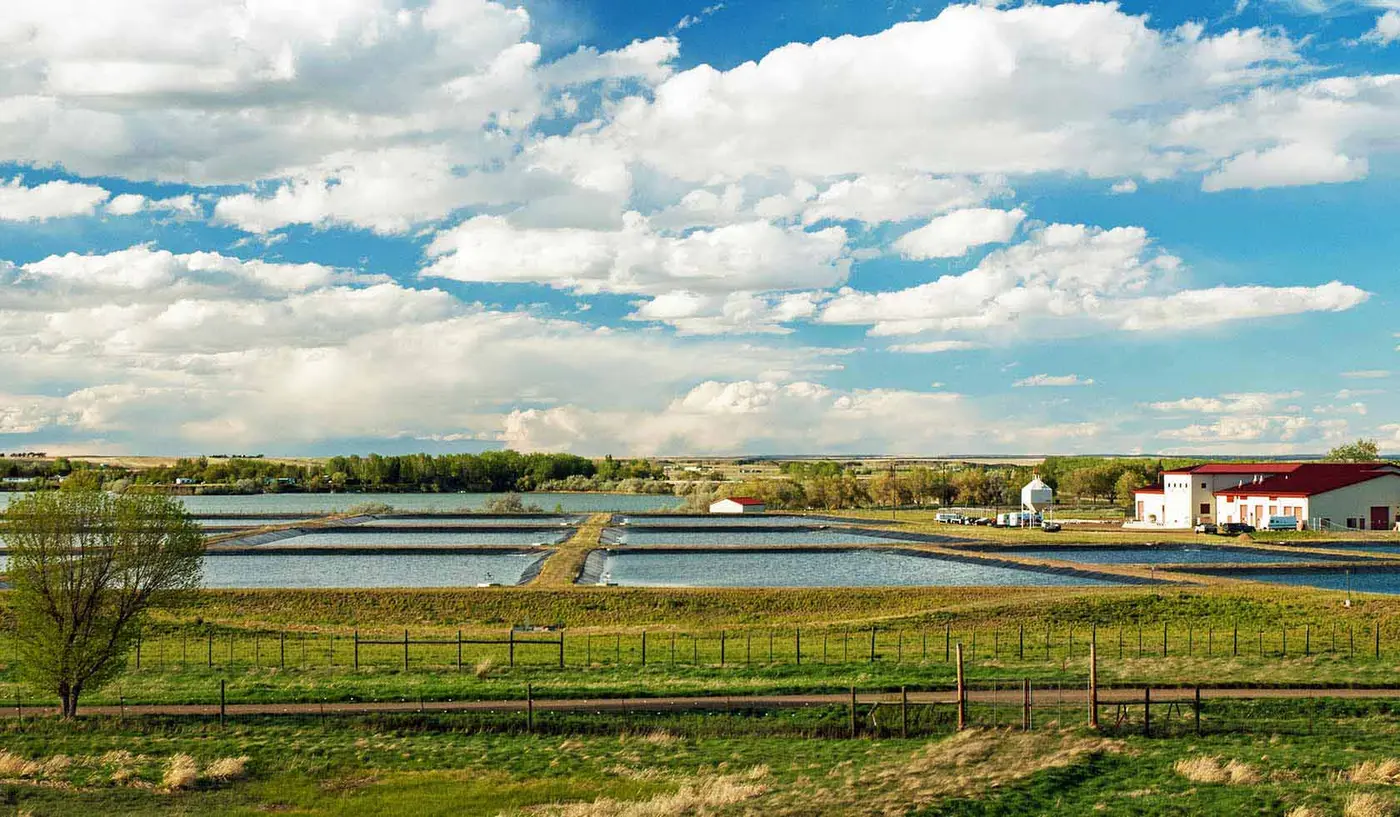
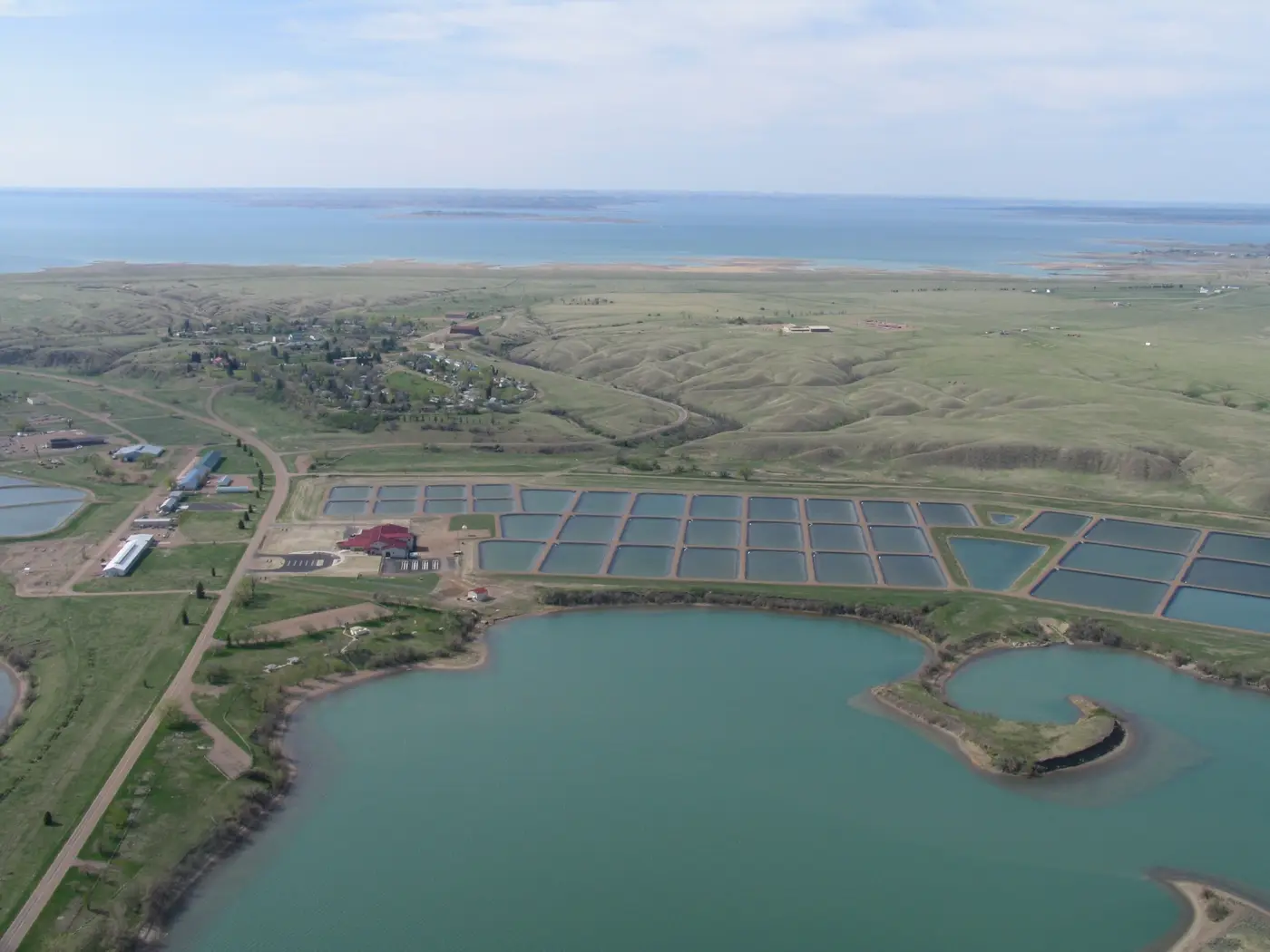
The Fort Peck State Fish Hatchery stands on the west side of Highway 117, just below the town of Fort Peck and across the road from the paleontology field station. Its grounds lie next to the First Fort Peck Reservoir Dredge Cut, at an elevation of 2,059 feet. The visitor center holds an information kiosk and map, a meeting room, flush toilets, and an interpretive display that explains the hatchery’s several species and the system that controls its water flow and temperature. Guided tours of the hatchery itself are by appointment only, arranged through the public phone line. Pets go on a leash.
Tanks, ponds, and raceways
The Army Corps of Engineers owns the hatchery, and Montana Fish, Wildlife & Parks staffs and runs it. It opened in the spring of 2006 to rear warm- and cool-water fish, among them walleye, northern pike, chinook salmon, and rainbow trout. Indoors are 64 rearing tanks, with incubation capacity for up to 125 million walleye eggs and 500,000 chinook salmon eggs. The Visit Montana listing adds room for 350,000 rainbow trout eggs. Forty outdoor ponds hold fingerling warmwater fish through spring and summer.
Eight concrete raceways serve the salmon, but the two listings disagree on the season. FWP says the raceways rear chinook released in fall. Visit Montana says they rear chinook and rainbow trout released in spring. According to Visit Montana, a computer monitors the system that regulates water flow and temperature. FWP puts the staff at four, and Visit Montana counts three and a half full-time positions. By both accounts the hatchery produces millions of fish for the state.
State law sets the hatchery’s order of work. Montana Code 87-3-235 was enacted in 1999 and amended in 2005, 2009, and 2017. It describes a multispecies hatchery near Fort Peck dam whose purpose is “to provide healthy warm water game fish to improve the warm water fishing opportunities in Montana with minimal impact on cold water fish populations.” It names the species to be given priority: largemouth and smallmouth bass, walleye, sauger, black and white crappie, channel catfish, yellow perch, northern pike, pallid sturgeon, paddlefish, tiger muskellunge, and bait fish such as cisco. Cold-water species “may not displace or reduce the propagation of warm water species at the hatchery.” The statute’s first version dates from the 1999 legislature, the session that walleye anglers had set out to reach.
An angler at the Governors Cup
Citizens for a Fort Peck Hatchery tell the story in a history published by Montana Walleyes Unlimited. They date the first public mention of a new warm-water hatchery to the 1998 Montana Governors Cup Walleye Tournament, where a tournament angler said Montana needed one. A meeting followed at the VFW in Glasgow, attended by FWP, Corps of Engineers staff, and the public. The citizens hired the clerk of court to take notes. In the citizens’ account, after several hours of back and forth, “it became apparent that FWP wasn’t interested in working with the public to secure a hatchery.” They decided to go around the agency and find a legislator who would carry a bill to the 1999 legislature.
Rep. Sam Kitzenberg agreed to draft the bill and carry it. The citizens organized and held public meetings in towns across central and eastern Montana. They also put up hatchery signs, paid for by Walleyes Unlimited groups, businesses, and private individuals.
In 1999 the Corps, and Lake Manager Roy Snyder in particular, offered 97 acres next to the Dredge Cuts below the dam. A letter from the head of the Omaha District backed the offer, on condition that state and federal lawmakers approved the hatchery. Don Groven, editor of Fish Tales magazine, wrote numerous articles supporting the project. Groven also had a connection to someone who spoke with Senator Conrad Burns, and Burns agreed to draft federal legislation if the state bill passed. Warm-water anglers offered to pay their share through a $5.00 warm water fish stamp.
The fight in the legislature was hard. Trout Unlimited and other sportsmen’s groups opposed the hatchery. FWP called itself neutral, a claim the narrative doubts. The bill passed the Montana House by one vote and the Senate 37 to 13, and the governor signed it into law.
A rainy Saturday in Glasgow
On February 3, 2000, Burns introduced S. 2027, the Fort Peck Fish Hatchery Authorization Act of 2000. Its findings said that eastern Montana had only one warm-water hatchery, and that a disease or infrastructure failure there could imperil fish throughout the region. They said Montana had paid to stock Fort Peck Lake since 1947. They also said that projects intended as part of the Fort Peck project had never been completed, “to the detriment of the local communities flooded by the Fort Peck Dam.” The bill set the federal share of construction at 75 percent. Toward the remaining share, it credited the state’s stocking costs since 1947 and the cost of access roads to the lake.
The Senate subcommittee on fisheries, wildlife, and water held a field hearing on the bill at 10 a.m. on Saturday, April 29, 2000, at the Cottonwood Inn in Glasgow. Senator Michael D. Crapo of Idaho presided. Rain had fallen the night before, and on the flight up from Billings nothing could be seen. Burns recalled that when he was told “I wish it was a prettier day,” he answered, “Don’t say one bad word about those clouds.” He added, “We haven’t seen very many of them, and so we need rain.” Crapo said, “I see country like this and my mouth is watering. In fact, I want to come back and go fishing.” Of Kitzenberg’s daily lobbying, Burns said, “I don’t know who pays his phone bill.” The witnesses included Kitzenberg, Chuck Lawson as chairman of the citizens’ group, Carl Seilstad of Montana Walleyes Unlimited, and Robert McColly of the Valley County Electric Cooperative.
Burns’s prepared statement laid out the open questions. The Corps put the total cost at approximately $18.7 million. The local cooperative had raised concerns that power to the hatchery should be delivered through the co-op, while the Corps and the state had discussed low-cost project power from the dam. State law also capped the state’s share of operating costs at what the fish stamp brought in. Because the hatchery would raise pallid sturgeon, Burns hoped part of its operating costs would remain a federal responsibility. Senator Max Baucus sent word that he would cosponsor the bill.
A bank loan and a groundbreaking
By the citizens’ account, Burns, Baucus, and Rep. Rehburg (their spelling) were all on board by the funding stage. The plan counted what the state and six counties around the lake had spent over 60 years as the local share: building and maintaining roads, stocking fish, building campgrounds, and similar work. A feasibility study still needed $250,000 in cost share. The citizens and Snyder proposed paying it from stamp proceeds. Sam Waters of First Community Bank then lined up 16 banks, credit unions, and a telephone company to take equal shares of the loan.
After the study, the ponds were built and the building was designed. When citizens saw the final plans, they found them altered to include a good deal of cold-water rearing equipment. They say that because the work was so far along, the public agreed to what they call “an inflated 22 million dollar hatchery.” Ground was broken in 2002, and the hatchery was dedicated in 2006. The citizens’ history closes with a word to anyone who doubts the labor it took: “GO AHEAD, TRY IT.”
Notable Events
- 1998A tournament angler publicly raised the need for a new warm-water hatchery at the Montana Governors Cup Walleye Tournament. montanawalleyesunlimited.net
- 1999The Corps and Fort Peck Lake Manager Roy Snyder offered land beside the Dredge Cuts below Fort Peck Dam. montanawalleyesunlimited.net
- 2000Mr. Burns introduced the hatchery authorization bill, which was referred to the Senate Environment and Public Works Committee. govinfo.gov
- 2000The Senate subcommittee held a field hearing in Glasgow on the Fort Peck hatchery authorization proposal. govinfo.gov
- 2002The hatchery groundbreaking took place. montanawalleyesunlimited.net
- 2006The hatchery was dedicated. montanawalleyesunlimited.net
People
- Bob Smith, Full Senate committee chairman who looked favorably on the hatchery project.
- Chuck Lawson, Hatchery campaign advocate commended by Senator Baucus.
- Max Baucus, Senator who supported and cosponsored the hatchery authorization bill.
- Michael D. Crapo, Senate subcommittee chairman who held the Glasgow hatchery-authorization field hearing (2000).
- Baucus, Federal supporter of the hatchery by the funding stage.
- Conrad Burns, Senator who agreed to draft federal hatchery legislation contingent on state passage.
- Don Groven, Fish Tales editor who wrote in support of the hatchery and had a connection to Senator Conrad Burns.
- Governor Roscoe, Named by the Citizens narrative as the governor who signed the state hatchery bill.
- Rep. Rehburg, Federal supporter of the hatchery by the funding stage, as spelled in the Citizens narrative.
- Roy Snyder, Fort Peck Lake Manager who offered land for the hatchery project (1999).
- Sam Kitzenberg, State representative who agreed to draft and carry hatchery legislation.
- Sam Waters, First Community Bank representative who obtained commitments for the feasibility-study loan.