Fort Bridger Mountain Man Rendezvous
Fort Bridger, Uinta County, Wyoming. Mountain man rendezvous.
Details

- Where
- 37000 I-80BL, Fort Bridger, WY 37000. Directions
- When
- Last held September 4–7, 2026; next year’s date not yet stated.
- Getting there
- Southwest Wyoming, approximately three miles off I-80, exit 34.
- Fees
- $5.00 per person 12 and up; children 11 and under free.
- Hours
- Gates 8 a.m. to 6 p.m.
- Access
- Guests remaining after dark must wear period attire. Participation in trading and contests also requires period attire.
- Walk-in or reserve
- Primitive campers and traders apply by invitation; traders and food vendors due January 1, primitive campers March 1, for year of rendezvous.
- Phone
- 307-782-3842
- Managed by
- Fort Bridger Rendezvous Association.
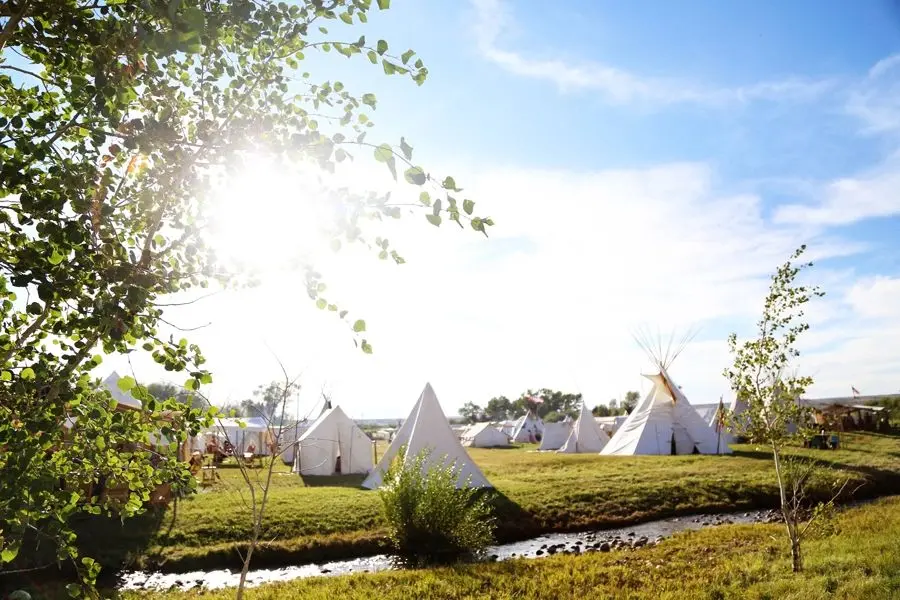
Each morning of the Fort Bridger Mountain Man Rendezvous begins with a flag ceremony at 8 a.m. at the Flagpole, the hour the gates open. Beyond the flagpole lie the 37 acres of Fort Bridger State Historic Site, about three miles off Interstate 80 at exit 34, where Groshon Creek flows through the middle of the old fort among aspen groves and pines from the military era. For four days the grounds fill with lodges and canvas, traders’ blankets, black powder smoke, and people dressed as they might have dressed before 1840. The rendezvous falls on Labor Day weekend, which the Fort Bridger Rendezvous Association describes as the first weekend of September. The 2026 gathering ran September 4 through 7.
The event celebrates the Fur Trade Rendezvous Era, which its organizers place in the Rocky Mountains between 1825 and 1840. The association, a volunteer board whose mailing address is in Clinton, Utah, runs the rendezvous on a state historic site under the Wyoming State Parks Division. A leader titled the Booshway heads it, with a Segundo as second. For 2026 the Booshway was Blair Hope and the Segundo was Brian Squires. Traders and primitive campers come by invitation only. The general public pays $5 at the gate, and children 11 and under enter free. State rules prohibit alcohol.
Calico, buckskin and the 1840 line
The association’s dress code holds that all visible clothing must predate 1840: hats and bonnets, shirts, coats, pants, dresses, shoes, blankets, jewelry, and weapons of every kind. Women wear period dresses or a blouse and skirt. Prescription glasses are acceptable. Sunglasses are not. The rules define period dress as handmade clothing of buckskin, leather, calico, cotton, wool, canvas, or other materials used before 1840. They exclude plastic buttons, rubber-soled shoes, and contemporary boots and shirts. Mountain men’s and women’s attire counts, and so do American Indian dress and Scottish and Highlander clothing.
The code is required of traders and of campers in the Primitive Camp. A visitor in ordinary clothes may walk the grounds by day. Anyone who wants to throw a hawk, shoot, or enter a cooking contest must wear period dress, period footwear included. Guests who stay after dark must also be in period attire, or they are escorted off the site. Residents of the Tipi Village are expected to keep themselves and their camp pre-1840 at all times.
The same standard governs Trader’s Row. A Trade Committee inspects every trade space and removes anything that does not belong to the years 1820 to 1840. Signs must be handmade. A trader caught breaking the rules a third time is asked to close up shop, and the association notes a waiting list of traders ready to take the spot. Virginia Giorgis of the Bridger Valley Pioneer walked the row at the 2022 rendezvous. She found furs, hides, beads and seed beads, knives, and candles, and noted that “some traders take a little stretch to make the era such as selling modern-day Mexican blankets.” Traders may not sell food of any kind, including candy, pickled eggs, jerky, root beer, or sarsaparilla. Food is sold only in the Food Vendors area, which Wyoming State Parks lists as food from the 1800s.
Four days in September 2026
The 2026 schedule, posted at the registration building and subject to change, filled the days. The Golden Spike Pipe Band marched around Trader’s Row at noon, 2 and 4 p.m. The Dusty Mocs Dance Troupe, Native American dancers, performed at the Bandstand as often as four times a day. “Can you feel the drum under your feet?” the association asked in an August post. After the weekend it thanked the dancers: “We have had the privilege of watching your children grow over the years.” The Children’s Candy Cannon fired at the Bandstand at noon, 2 and 4.
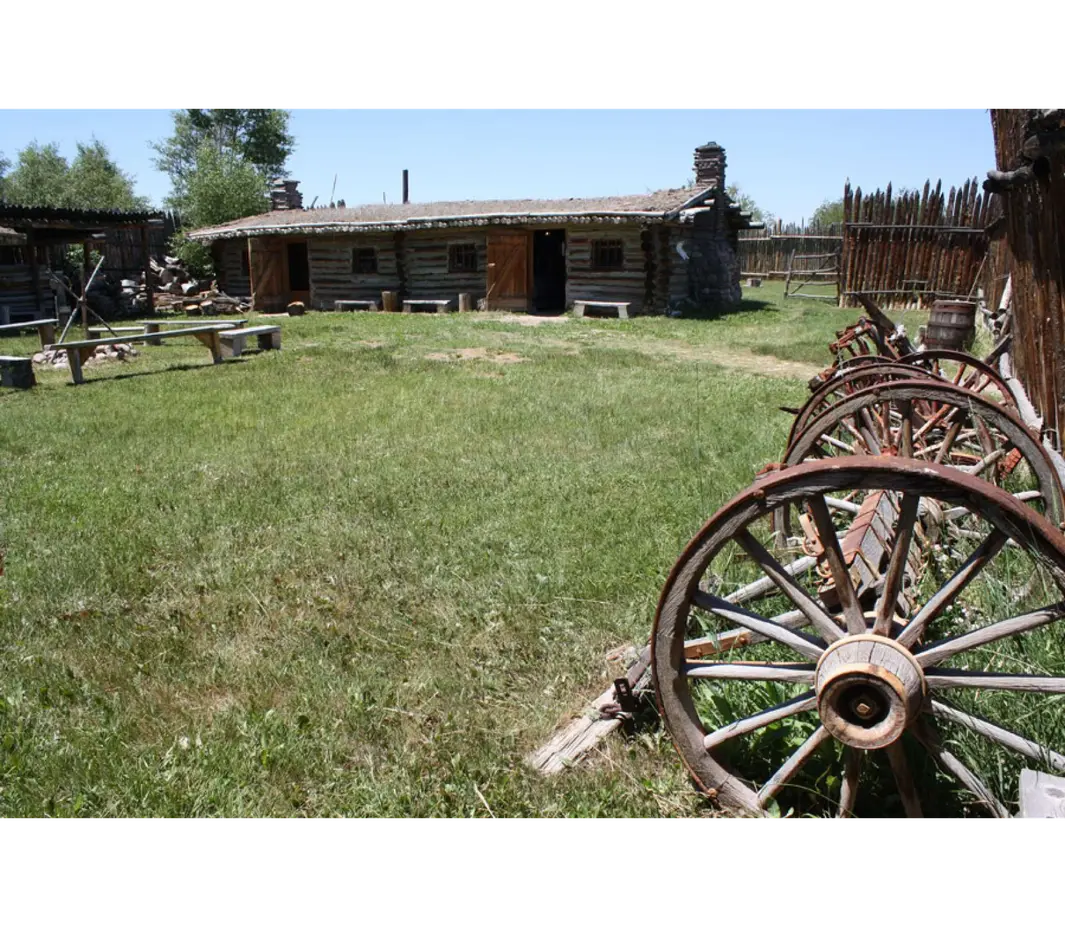
Primitive demonstrations of the Fur Trade and Colonial eras ran from 11 a.m. to 4 p.m. at Bridger’s Stockade. At the southeast corner of the museum, David Meek spoke twice daily on “Legendary Mt Man Joe & Virginia Meek.” On Sunday at 5 p.m., Dudley Gardner gave a historical lecture by the museum.
Saturday, the association says, is the busiest day. The shooting range held a combined shoot at 8 a.m., a flintlock-only shoot after noon, and a women-only smoothbore and pistol shoot at 1:30. Archery ran from 9 to noon, and the hawk and knife competition began at 8. Children under 12 played games east of the Bandstand: a water relay, a hoop race, gunnysacks, corn toss, frying pans, and tug-of-war. At 2:30 came the Women’s Frying Pan Toss, in which, the association wrote, the ladies “have the honor of tossing the pan at their other half.” The Mountain Momma Run started at the same hour, and the Mountain Man Run, a timed race, followed at 3:30.
On Sunday morning a Lutheran congregation held services at the Bandstand and the Church of Jesus Christ of Latter-day Saints met at the Mormon Wall. The youth-only shoot followed at 9. In 2026 it drew what the association called a record 29 shooters under 16. They competed for trader bucks and a rifle donated by Tennessee Valley Muzzleloader, and a trader called Cricket added a pistol. Parents and children cooked eggs at the New Guard House. At noon a cannon fired at the Rodeo Grounds. That afternoon the clothing contest was held on the west side of the New Guard House, in several categories. In the fire-starting contest beside it, each entrant started three separate fires with flint and steel, using a different material for each, and the last fire had to pop popcorn.
Monday was the short day. The Graybeard Mountain Man Run went off at 10 a.m. “You gotta have grey in your beard to play,” the association wrote. At 1 p.m. east of the Bandstand came Doc’s 19th Annual Adult Candy Cannon, with all adults invited.
The council fire and the Buckskinner’s Ball
Flags come down at 6 p.m. On Saturday and Sunday the council fire is lit at the Bandstand at 7, with raffles and prize drawings. On Saturday in 2026, children drew the tickets, and a man named Cody Wayne won a Damascus hawk made by 307 Forge. That same night marked the nation’s 250th birthday, and veterans, police officers, first responders, and firemen retired several flags. “Not a dry eye in the crowd,” the association wrote. Sunday’s prizes included a mystery box, a quilt, a 10-by-10 wall tent, a grand rifle and a second rifle, and a buffalo robe.
After Saturday’s council fire, around 8 p.m., the Buckskinner’s Ball begins east of the Bandstand. In 2026 the band Frayed Knot played. The schedule invited “Mountain Folks” to “come and dance or just listen to the music.”
Five eras along Groshon Creek
The rendezvous fills a site with many layers. Wyoming State Parks interprets five eras of occupation at Fort Bridger: Mountain Men, Mormons, Military, Milkbarn/Motel, and Museum. Seven routes passed through: the Oregon, California, Mormon Pioneer, Pony Express, Overland, and Cherokee trails, and the Lincoln Highway. At the entrance stands David Clark’s statue of Jim Bridger. Inside are a replica of Bridger’s trading post, the 1884 Commanding Officer’s Quarters, and a building that served as infantry barracks, then a milk barn, and now houses the museum. The site counts 27 historic structures, 4 replicas, and 6 modern buildings.
At least 20,000 people died along the Oregon Trail, Wyoming Public Media reported in July 2026, and some of them rest at Fort Bridger. Grounds staff consistently receive reports from people who think they have seen or heard storied figures of the West in ghostly form. Superintendent Josh Camp, who sits on the association’s board, told the station that the mountain man market is relatively small. To draw new visitors, the site scheduled a ghost hunt for July 30 through August 1, 2026, led by Marie Mason. “There is something special here at Fort Bridger, and most people can feel it when they come onsite,” Camp said. “As a scientist, you need to either prove something does exist, or you need to prove it doesn’t. Ghosts inhabit that mysterious region where you really can’t do either.”
Plews, top hats and a handful of tepees
Rendezvous is a French word for meeting. The Bridger Valley Pioneer explains the original rendezvous as a place designated in the fall where mountain men traded their furs, or plews, for goods that would otherwise cost cash. The plews bought a year’s supplies. The fur companies, the paper says, thought it better to keep the trappers in the wilderness than to send them east to resupply. The men spent their winters trapping beaver for the top hats worn by gentlemen in the East. The modern gathering recalls the supply trips west of the entrepreneur William Ashley.
The Pioneer writes that the Fort Bridger Rendezvous grew from a handful of tepees into the second-largest visitor event in Wyoming, behind only Cheyenne Frontier Days. The association calls it one of the largest mountain man gatherings in the nation. By the 26th annual rendezvous, September 4–7, 1998, more than 200 lodges and tepees stood on the site. Traders, buckskinners, mountain men, American Indians, and hunters demonstrated crafts of the 1840 era and competed at hawk throwing and muzzleloading. Bobby Bridger, a great-grand-nephew of Jim Bridger, performed twice daily with his troupe, and Governor Jim Geringer took part.
The 47th annual rendezvous ran August 30 to September 2, 2019. The next year’s was canceled over COVID-19 concerns. At the 49th, in 2022, the thermometer read 90 degrees and above with hardly a breeze. Giorgis reported a bumper crowd on Saturday and lighter traffic Sunday afternoon and Monday, as “the Rendezvouers and the flatlanders (tourists)” walked the grounds under blue skies. In 2025, Wyoming Public Media reported, around 50,000 people attended.
The 2026 rendezvous began in the wet. Days before the gates opened, the board was setting up in the rain and posted a warning to the camps: “Try to keep your powder dry!”
People
- William Ashley, Entrepreneur whose supply trips west are recalled by the rendezvous.
- Bobby Bridger, Jim Bridger's great-grand-nephew; performed twice daily with his troupe at the rendezvous (1998).
- Gov. Jim Geringer, Took part in the rendezvous (1998).
- Jim Bridger, Great-grand-uncle of rendezvous performer Bobby Bridger.
- Josh Camp, Superintendent of the Fort Bridger host historic site.
Sources
- fortbridgerrendezvous.net
- fortbridgerrendezvous.net/maps
- fortbridgerrendezvous.net/registration
- fortbridgerrendezvous.net/info
- fortbridgerrendezvous.net/fbra-board
- fortbridgerrendezvous.net/sponsors
- facebook.com/Fort-Bridger-Rendezvous-Association-101344216616594
- wyoparks.wyo.gov/index.php/events-fort-bridger
- wyoparks.wyo.gov/index.php/places-to-go/fort-bridger
- img1.wsimg.com/blobby/go/0fb0b141-a490-492d-9e9a-854a1a2243a2/2026%20Fort%20Bridger%20Rendezvous%20Schedule%20of%20Event.pdf
- img1.wsimg.com/blobby/go/0fb0b141-a490-492d-9e9a-854a1a2243a2/downloads/Rules-%26-Regulations.pdf?ver=1790008949604
- alpha.creativecirclecdn.com/nmcwyw/files/20240125-173415-f99e0d965b3a9bb3e3d5b81f73a20821.zip~20220909.pdf
- wyomingnews.com/rocketminer/community/remember-when/article_ab25c65e-0839-50f3-a37c-8523fa4e472c.html
- wyomingpublicmedia.org/arts-culture/2026-07-24/ft-bridger-conducts-a-paranormal-investigation-into-their-haunted-history