
Foris Vineyards
near Cave Junction, Oregon in the Illinois Valley region, Josephine County, Oregon. Estate winery and tasting room; Year-round.
Details

- Where
- 654 Kendall Road, Cave Junction, near Cave Junction, Oregon in the Illinois Valley region, OR 97523. Directions
- When
- Open daily 11am to 5pm (except on holidays).
- Access
- Family Friendly Outdoor seating Bike Friendly Dog friendly Large groups welcome (please call ahead) Picnics welcome Tours available.
- Walk-in or reserve
- Walk-in visitors welcome.
- Phone
- 800-843-6747
- Website
- foriswine.com
- Managed by
- Ted and Meri Gerber, family-owned.
- Established
- Foris has been quietly sitting here since 1974.
- Coordinates
- 42.1195417, -123.5499694.
The rock tasting room on Kendall Road
The tasting room at 654 Kendall Road is built of stone, and the stone came out of the ground it stands on: tailings washed down from nineteenth-century gold diggings. The winery’s own account says the walls show the range of that rock, Oregon jade among it. Ted Gerber laid them. He told The Oregonian’s Michael Alberty that his model was Scott Nearing, the professor who left academia and went to Maine with his wife to live off the land. “One of his books taught me how to build a stone wall, which inspired me to build the walls of our tasting room. Nearing was kind of America’s first hippie, in a way,” Gerber said.
The winery calls itself the Northwest’s southernmost. It sits in the Illinois Valley, inside the Rogue Valley appellation, about 25 miles east of the Pacific, and the estate vineyard lies at about 1,500 feet against the forested Siskiyou Mountains. Visitors walk in without reservations, and picnics, dogs, and bicycles are welcome. In early September 2026 the winery posted that its flower garden was “again in full bloom,” with a bird perched on a sunflower, and that tastings were free. Heidi, Terri Gerber’s daughter, manages the tasting room and wine club and plans that garden each year, starting every flower and vegetable from seed. Travel Southern Oregon reports that Ted’s daughter Alicia also works in the tasting room.
The wines on the counter are mostly Alsatian varieties, Pinot Gris, Pinot Blanc, Gewürztraminer, Riesling, and Muscat, with Pinot Noir and Chardonnay beside them. In November 2025 Alberty found the Pinot Blanc and dry Gewürztraminer selling for $17 at the winery. Asked what Foris is best known for, winemaker Stephanie Pao chose Pinot Noir. By late September 2026 the winery reported “the Beginning of the End” of that year’s harvest. Despite tariffs and lost Canadian accounts, it wrote, the vineyards “still yielded abundant grapes.”
Gold-mine gravel and gravity water
The soil under the home vineyard is largely a mine dump. On the U.S. Department of Agriculture’s soil survey of Josephine County, a good part of the ranch is classified that way. Miners working Althouse Creek, on the far side of the hill south of the winery, cut two tunnels through to dispose of creek gravel, and they used them from the early 1850s until the late 1930s. According to the winery, the first, the Emerald tunnel, took four or five men ten years to dig in the 1850s and 1860s. The second came about twenty years later and paid better in gold. The longest runs 1,200 feet. Because the ranch lies about 100 feet below the creek, the dump had no limit on what it could take.
Flumes spread the rock as it came out, and it sorted itself as it fell. The winery’s land page says the result is about 20 acres of tailings in three grades. Boulders the size of a basketball and larger lie nearest the tunnel mouths and now grow pine and cedar. Gravel and silt lie farther out, and the vines grow on those. The winery buildings stand on gravel 10 to 20 feet deep. What had probably been low, swampy ground was left well drained. When Gerber bought the place, he told Alberty, the miners’ old wooden flumes could still be seen.
The tunnels still carry Althouse Creek water downhill to the winery, the house, and the gardens. It arrives by gravity, with no pump. The winery says several employees take it home to drink.
A strong back and little money
Gerber graduated from what was then California State University, Hayward, in 1969, after studying political science and public administration. His first job, Alberty reports, was making cardboard wine boxes for a Bay Area glass factory. He made wine at home from Gilroy grapes. The man who sold him the grapes knew of a grower near Roseburg, Oregon, who was having success ripening wine grapes. His advice, as Gerber tells it: “Move to Oregon. You can get started with a strong back and little money.” A college friend had told him about the Illinois Valley. Gerber went through temperature records from the Smoke Jumper Station at Cave Junction and ripening records from the Oregon State University experiment station at Jacksonville. The winery’s home page says those records covered 30 years and Gerber’s own story page says forty. In 1971 he showed the numbers to Amand Kasimati, a professor at the University of California, Davis, who agreed they “looked workable.”
That year Ted and Meri Gerber bought 15 acres in the hills above Cave Junction. Wikipedia places them near the abandoned mining town of Holland. The winery’s home page says Oregon then had only 13 wineries and the Rogue Valley had none. Gerber writes that he knew this first property was poor grape land, but it put the family in the valley where they could look for a better one. They built a house there, later sold it, and came with the back-to-the-land movement of the 1960s. “We soon learned self-sufficient had several draw backs,” Gerber writes, “moss is not a good toilet paper, it causes rashes.”
The sources disagree on when the present site was bought and first planted. Alberty gives 1974 for the purchase and 1975 for the first vines, which were grown from cuttings bought from Myron Redford at Amity Vineyards in the Willamette Valley. Wikipedia says 80 acres were added in 1975. The winery’s land page and a 2017 press release also give 1975 for the first planting. Wikipedia, the winery’s “Discover” page, and its Facebook profile give 1974. Farmers had passed over the ground because of frost. Gerber’s account is that cheap plastic pipe made it affordable to sprinkle the vines on frosty spring nights, and that until then no one had grown commercial horticultural crops in the valley. Cattle and dairying were the only agriculture, both in slow decline, so he bought vineyard land at grazing-land prices. Wind machines came later. While clearing fields he turned up arrowheads, mortars, and pestles. “I asked an anthropologist from Southern Oregon University to come around and take a look at what I’d found,” Gerber said. “He said that I live where the wealthy Native Americans lived.”
In 1977 Oregon State University imported a few dozen French clones of Pinot Gris, Pinot Blanc, and Gewürztraminer, and Gerber was one of six growers in the state to receive them. In 1978 he began selling grapes to wineries around the Pacific Northwest. Some Chardonnay cuttings planted in 1980 turned out to include about 20 Pinot Noir vines by mistake, and the family made home wine from them. “The wine was terrible,” Gerber writes. In 1986 the Gerbers released wine under their own Foris label.
Money for the expansion came partly from the prunings. From the mid-1980s to the mid-1990s, Meri ran a business making wreaths from grapevine cuttings. At one point it had more than 500 customers and employed up to six women, who wove the wreaths at home so they could watch their children. The Gerbers delivered the cuttings to them, and the women brought the finished wreaths to the winery to be paid. “I can certainly remember making those wreaths on cold December days and tearing up the skin on my hands and fingers,” Alicia Gerber told Alberty.
The next turn came with the Dijon clones. In 1989 Oregon State released nine clones of Pinot Noir and Chardonnay from Dijon, selected for wine quality, and each grower could get 25 plants of each. The winery’s “Discover” page says greenhouse propagation produced 7,200 plants in the spring of 1990, or eight acres, which it calls the largest Dijon planting in the United States. Gerber’s story page says the 225 plants became a ten-acre planting. In 1991 and 1992 Foris sold all its prunings to California grafters, after first explaining to them what a Dijon clone was. Within a couple of years California was growing enough of its own, and that market went away.
Maple Ranch and Cedar Ranch
Maple Ranch, a few minutes east of the home vineyard, was deeded to settlers by President James Buchanan shortly before the Civil War. Its first owners dug for gold and copper and found little. A hard-rock tunnel still runs several hundred yards into the mountain. The Johnson family farmed it from the late nineteenth century until the Second World War. They were fiddle players with a pump organ in the main house, and they made violins on the side. One maple that fell in 1932 supplied about 60 violin backs, and some of those instruments sold for up to $25,000. Their hand-hewn beams are still in the barn and granary.
The ranch declined from the early 1940s as farming became a sideline to mill work. In 1972 three families took it over and renamed it Rainbow Ranch. The grandfather had played with big bands in the early 1940s. His son and daughter taught school in Cave Junction. The crop, as Gerber puts it, was “an Herb,” with greenhouses for starter boxes and attics for drying. A sealed corner of the granary, now a house, still holds the indoor grow room, with dirt floor, reflective walls, and plugs for the lights. Gerber was hired to plow the fields now and then, and only later learned he had been making the farm look active. Wild Vitis californica grew on the creek banks. The growers were eventually arrested. In the fall of 1986 Ted and Meri formed a partnership with his mother and stepfather, Marge and Bob Maple, to buy the ranch. The name honors both the Maples and the bigleaf maples along its three creeks. The winery calls it its best Pinot Noir site. Wikipedia reports that the 1994 Maple Ranch Pinot Noir was served at a White House dinner in 1997.
Cedar Ranch, a mile down the road along Sucker Creek, came to Foris by way of the law. In the late 1980s the U.S. Marshal seized it from an owner who had been watched for 17 years. According to the winery, he made a mistake in his marijuana import business and fled to Mexico. The Gerbers told the marshal the vineyard had to be kept up until it was resold, and they farmed it for him for three years and for the next owner for two. Foris bought the Chardonnay, which it almost labeled “Chateau Rico.” Later owners abandoned the vines, and a couple bought the ranch so their ten wolfhounds could run. Half of it went to a Crescent City commercial fisherman, Tom Timmer, for whom Foris planted 21 acres and kept the books until 2025. In 1996, before Foris owned the ranch, Sucker Creek flooded and carried off the pump, the power pole, and the transformer, and none of them was found. In 2008, as Gerber tells it, the bank said Foris was not borrowing enough money. The loan closed in November 2008, and 46 acres went in the following spring.
The sources count the estate differently. The home page says 255 acres. A 2023 press release lists five ranches with 200 acres planted out of 400. Gerber himself speaks of four ranches and 150 planted acres, and Alberty gave about 150 acres of 20 varieties in 2025.
Winemakers and the family
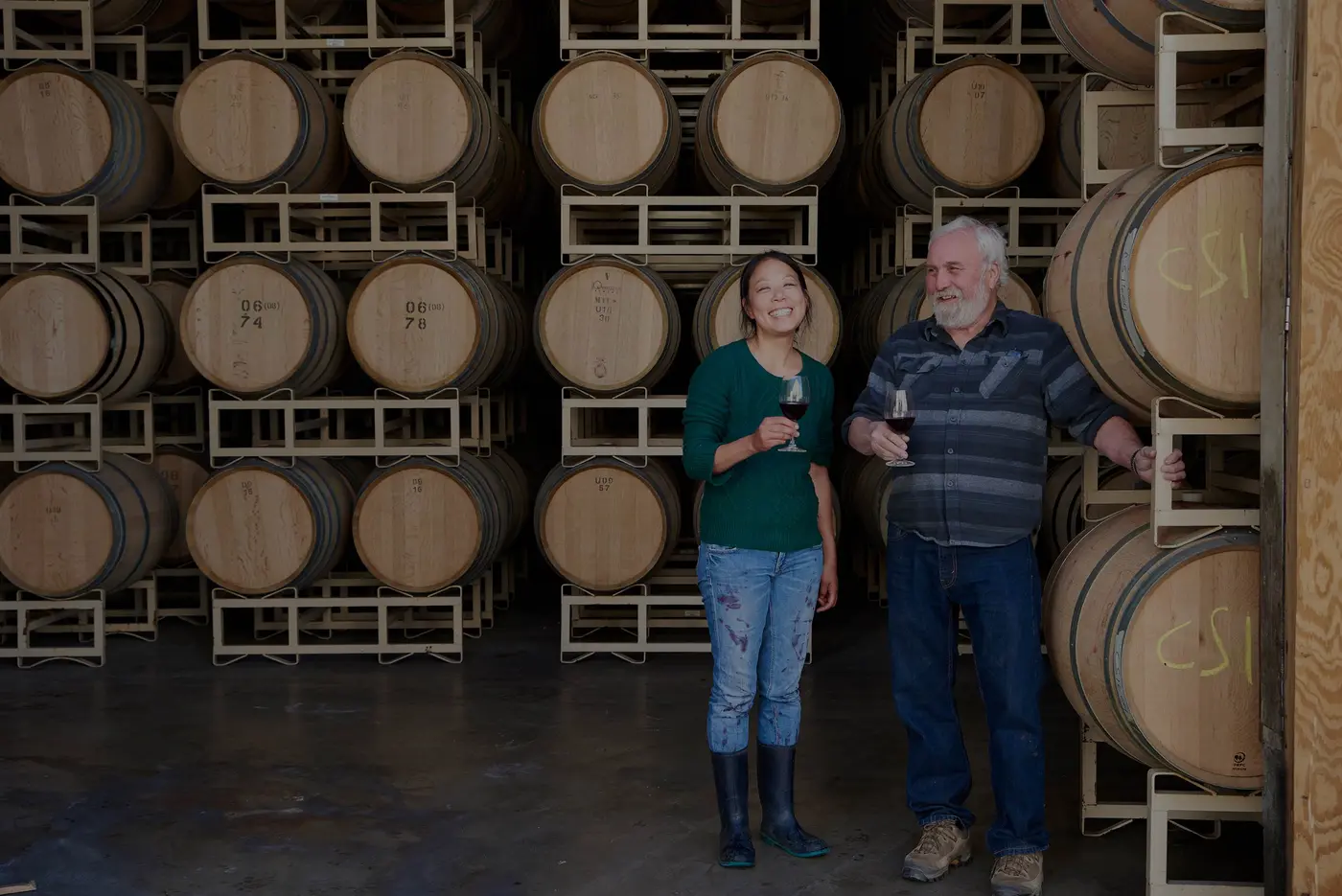
According to Wikipedia, Gerber hired the French-trained winemaker Sarah Powell in 1990, and she left in 2001. Bryan Wilson followed in 2007. Stephanie Pao replaced him on March 13, 2017. Gerber called it “only the fourth change in winemakers in 31 years.” Pao holds a degree in molecular biology and studied viticulture and enology at UC Davis. A 2023 release calls her Oregon’s first Chinese American female winemaker. “The opportunity to work with a grower with such depth of experience in a site is rare,” she said when she took the post.
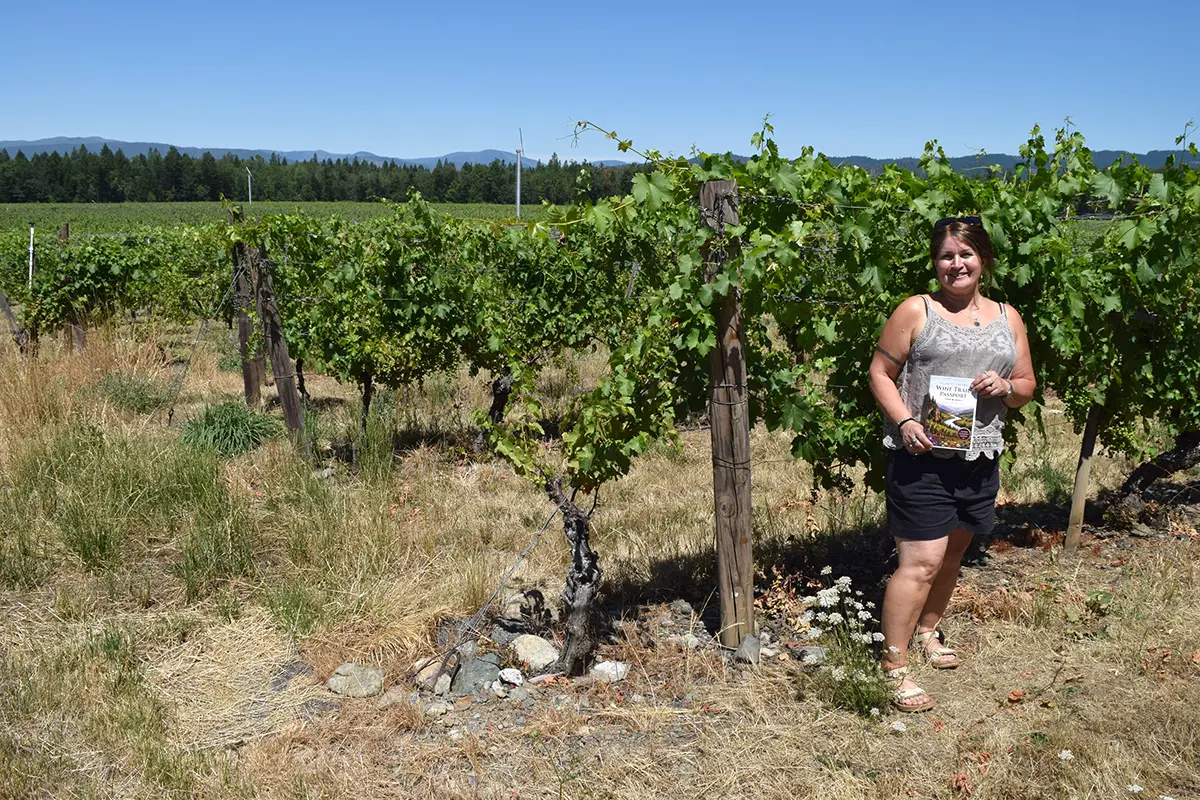
Meri Gerber died in 2000 after a long illness. That year the couple received the Oregon Winery Association’s Founders Award. Alicia came home during her mother’s illness and stayed, and she lives on Maple Ranch with her children, Skylar and Ava. Ted married Terri, a health professional, in 2003, and she keeps the vineyard books. Heidi and her family live on Cedar Ranch. In April 2023 Foris joined the Portland distributor Mitchell Wine Group. In July 2026 it became one of four stops on the new Illinois Valley Wine Trail, whose $25 passport also covers Augustino Estate, Bridgeview, and Deer Creek. The Illinois Valley News photographed Alicia Gerber in front of the vines, holding a copy of the passport.
Notable Events
- 1850Four to five men took ten years to dig the first tunnel. foriswine.com
- 1850sAlthouse Creek tunnels disposed of mining gravel on part of the winery property. foriswine.com
- 1932A fallen maple supplied about 60 violin backs. foriswine.com
- 1940Farming declined and became a sideline to lumber-mill work. foriswine.com
- 1971Bought land and moved to the valley to look for a plantable site, although the initial property was not good grape land. foriswine.com
- 1972New owners revived Maple Ranch and called it Rainbow Ranch. foriswine.com
- 1974In 1974, Ted Gerber began growing grapes, and in 1978 he started selling them commercially to wineries across the Pacific Northwest. foriswine.com
- 1975The home vineyard's first planting was in 1975. foriswine.com
- 1975With cuttings purchased from Myron Redford at Amity Vineyards in the Willamette Valley, the Gerbers planted their first vines in 1975. oregonlive.com
- 1977When Oregon State University imported from France a few dozen clones of Pinot Gris, Pinot Blanc, and Gewurztraminer in 1977, Gerber was one of six growers in the state to receive them. foriswine.com
- 1978In 1978 Gerber started selling grapes commercially to wineries across the Pacific Northwest. foriswine.com
- 1980The US Marshall confiscated the property after its owner made a mistake in his marijuana import business and fled to Mexico. foriswine.com
- 1980Approximately 20 Pinot Noir plants were mistakenly mixed with Chardonnay cuttings planted in 1980. foriswine.com
- 1980Meri built a grape wreath business. foriswine.com
- 1986After years of providing fruit to various vintners in southern Oregon, the Gerbers in 1986 started producing their own wines under the Foris label. foriswine.com
- 1986Ted and Merideth formed a partnership with Bob and Marge Maple to expand the vineyard. foriswine.com
- 1990With greenhouse work, Gerber planted 7,200 plants of the Dijon clones in the spring of 1990, giving Foris Vineyards eight acres and the largest Dijon planting in the U.S. foriswine.com
- 1991Foris sold all its prunings after educating California propagators about Dijon clones. foriswine.com
- 1996Sucker Creek flooded and carried away the pump, power pole and transformer before Foris ownership. foriswine.com
- 2000Meri died after a lengthy illness. foriswine.com
- 2003Ted married Terri, a health professional. foriswine.com
- 2008Purchased the 74-acre property in 2008. foriswine.com
- 2014The home vineyard's most recent planting is stated as 2014. foriswine.com
- 2017Foris announced Pao's appointment effective March 13. foriswine.com
- 2023Foris joined Mitchell Wine Group's portfolio effective immediately. foriswine.com
- 2025Foris did the books and farming for adjoining Timmer Vineyard until 2025. foriswine.com
- President James Buchanan deeded the land to early settlers. foriswine.com
People
- Alex, Heidi's daughter, part of the Foris family.
- Alicia Gerber, Ted's daughter; grew up in the family vineyard.
- Ava, Alicia's daughter, living on Maple Ranch.
- Cole, Heidi's partner, part of the Foris family.
- Heidi, Foris office, Wine Club and Tasting Room manager; assists winemaker.
- Meri Gerber, founder; operated a grape wreath-making business that helped finance vineyard expansion and the construction of the winery (1980s and 1990s).
- Skylar, Alicia's son, living on Maple Ranch.
- Ted Gerber, founder; built the walls of the tasting room, inspired by a Scott Nearing book.
- Terri Gerber, Ted's present wife; keeps the vineyards' books (2003).
- Terri, Vineyard bookkeeper, employee safety and winery administration.
- Bob Maple, Ted's stepfather; Maple Ranch partner (fall of 1986).
- James Buchanan, President who deeded Maple land to early settlers (Some time just before the Civil War).
- Marge Maple, Ted's mother; Maple Ranch partner (fall of 1986).
- Tom Timmer, Commercial fisherman for whom Foris planted an adjoining vineyard.
- Meri, Ted's late wife; built the grape wreath business (mid 1980’s to mid 1990’s).
- Stephanie Pao, winemaker (since 2017).
- Bryan Wilson, Departing Foris winemaker moving to a boutique winery closer to Medford.
- Julianne Allen, Director of Sales and Marketing.
- Edwin Martinis, Mitchell general manager describing its Foris partnership.
- Myron Redford, of Amity Vineyards; sold the cuttings for the first vines.
Sources
- foriswine.com
- foriswine.com/visit
- southernoregon.org/cities/cave-junction/eat-drink/wine-wineries/foris-vineyards-winery
- foriswine.com/stories
- foriswine.com/land
- foriswine.com/wp-content/uploads/2017/06/Stephanie-Pao-PR.pdf
- foriswine.com/wp-content/uploads/2023/04/FORIS-press-release-now-working-with-Mitchell.pdf
- foriswine.com/about
- foriswine.com/discover-foris-winery
- oregonlive.com/wine/2025/11/strike-thanksgiving-gold-at-this-cave-junction-winery.html