Ford Cabin
Polebridge, Flathead County, Montana. Forest Service cabin; May 20 through March 31 annually.
Details

- Where
- Polebridge, Flathead County, MT. No street address stated. Directions
- When
- Check-out time is 1200 pm. Check-in time is 2 pm.
- Getting there
- Ford Cabin is 45 miles up North Fork County Road 486. Take Nucleus Avenue north through Columbia Falls and turn east on Railroad Street; it becomes North Fork Road.
- Fees
- $50 per night.
- Access
- North Fork Road is gravel, rough in spots, and intermittently plowed in winter; four-wheel drive and chains are recommended in winter.
- Walk-in or reserve
- Reservations and fee information are through Recreation.gov.
- Phone
- 406-387-3800
- Website
- fs.usda.gov
- Managed by
- Flathead National Forest.
- Established
- Built in 1922 by Ralph Thayer as part of the Ford Ranger Station.
- Coordinates
- 48.87559974, -114.37762175.
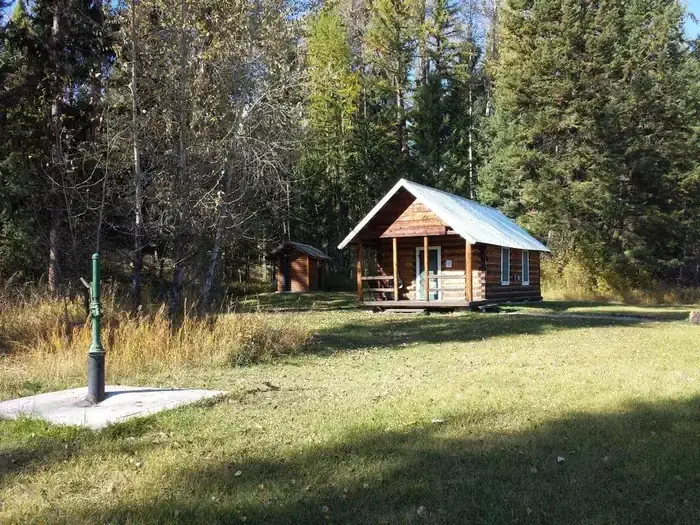
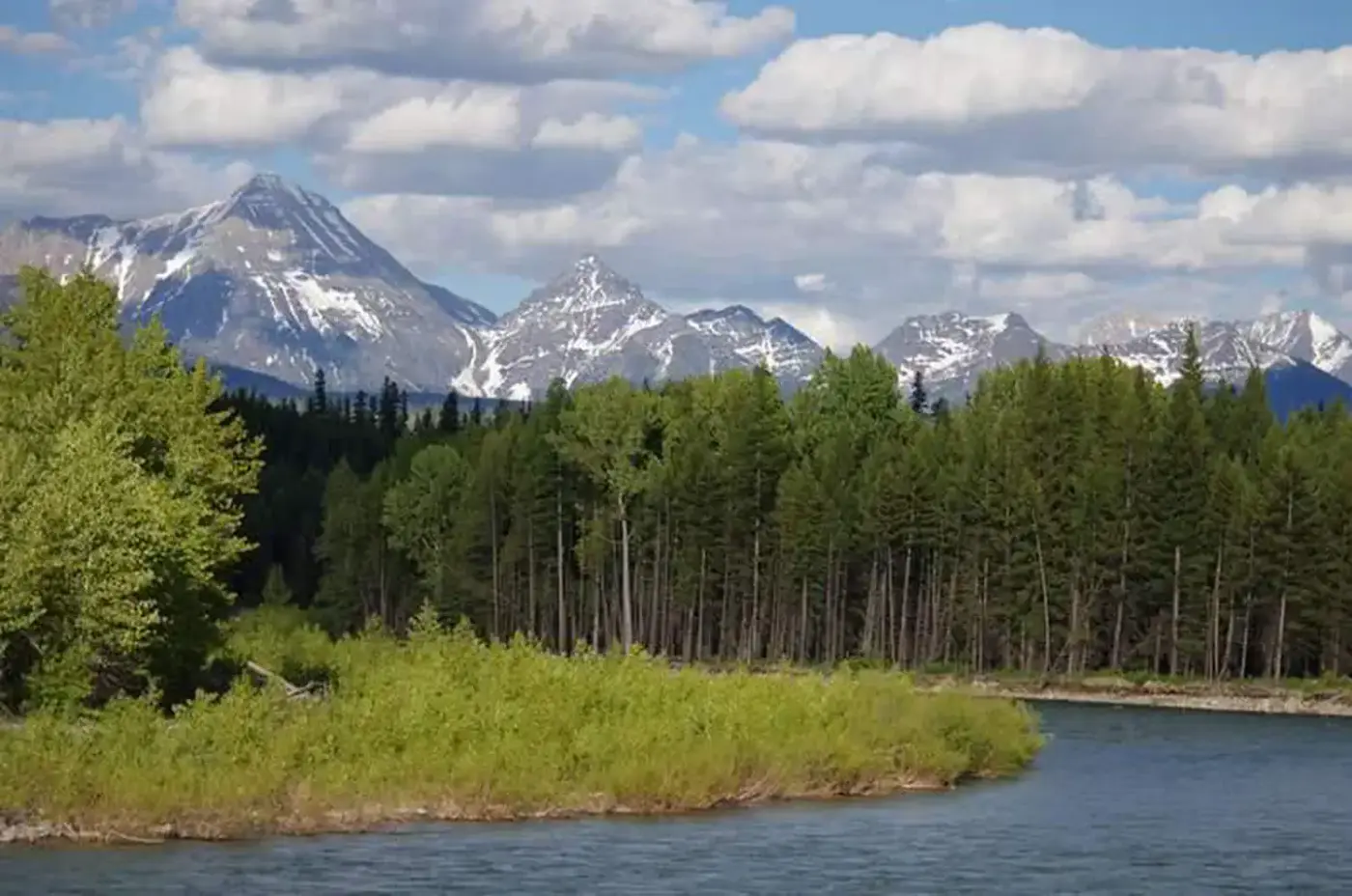
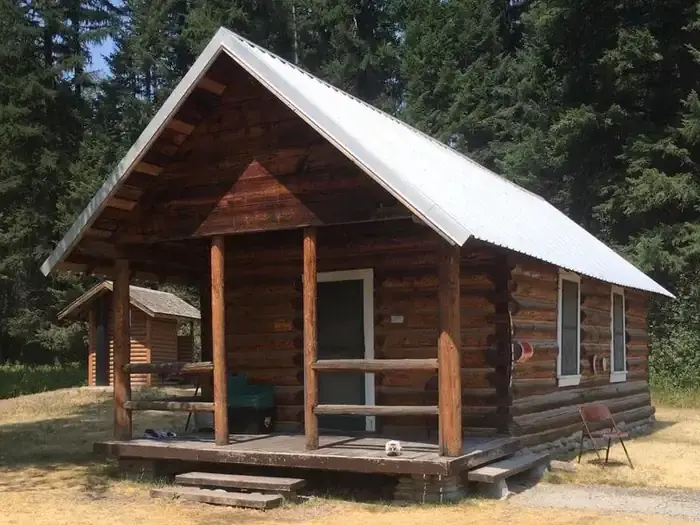
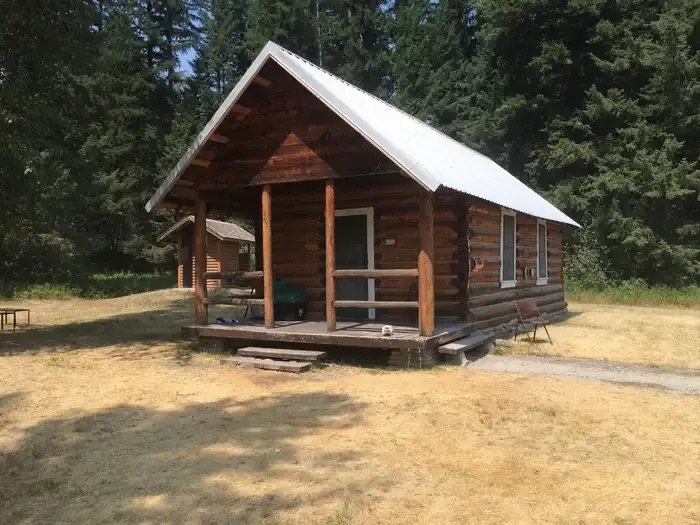
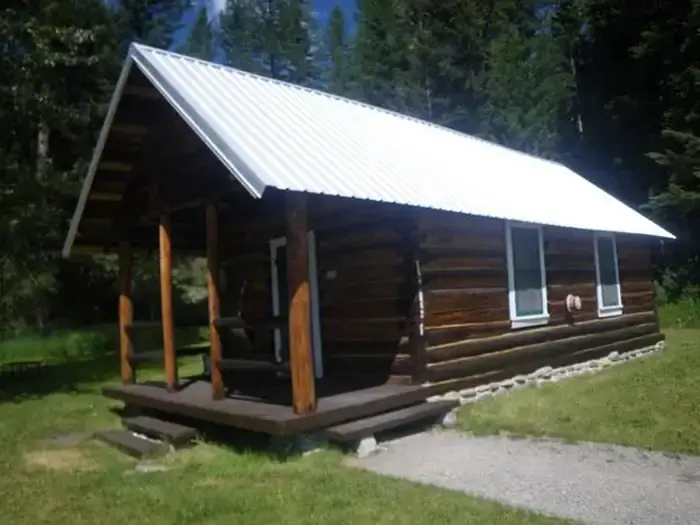
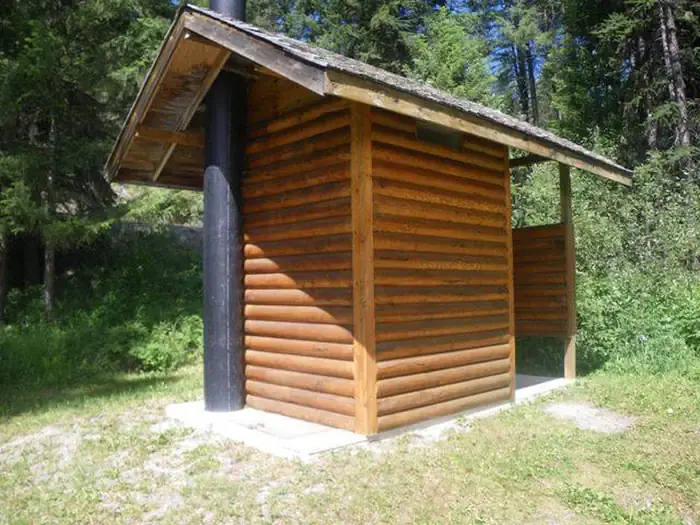
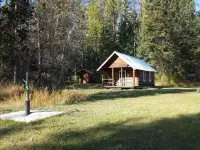
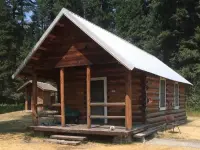
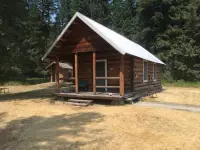
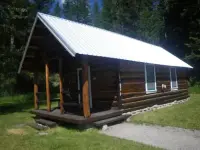
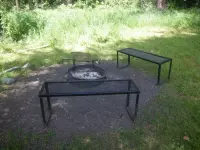
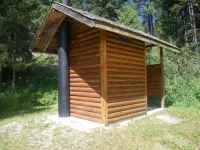
Forty-five miles up the North Fork Road from Columbia Falls, most of it gravel, Road 308 turns off and crosses Tepee Creek on a small bridge. Ford Cabin stands on the right. It is a log cabin with a small covered front porch, set on a grassy field beside a stand of pine near the Wild and Scenic North Fork of the Flathead River. A vault toilet stands nearby. Inside are two bunk beds and a double bed, enough for six people, along with a propane stove, propane lights, a heater, and a few cooking and eating utensils. There is no electricity and no refrigerator. The door has a combination lock, and the code arrives in the reservation letter.
The cabin on Road 308
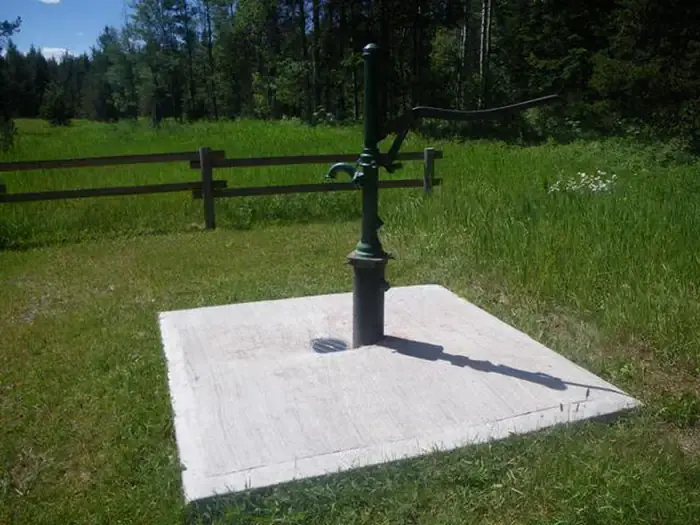
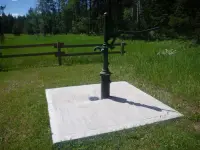
Flathead National Forest rents the cabin from late May through March 31. The Forest Service gives the opening date as May 20, and Recreation.gov gives it as May 22. A hand-pump well supplies drinking water from April 1 to November 30. Visit Montana’s listing says the pump was to be available beginning July 2009. Winter guests haul their own water. The cabin may stand empty for long stretches, and Recreation.gov notes that mice may be present; traps are kept inside. Guests are asked to leave the thermostat at 55 degrees when they are away, to save propane, and to clean the place before they go.
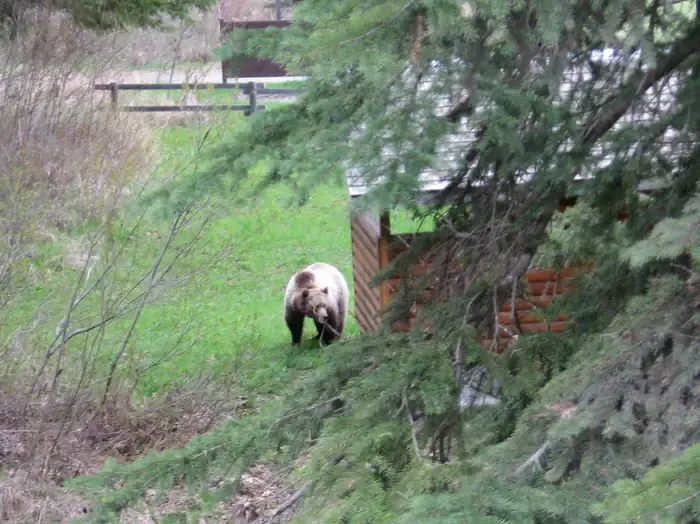
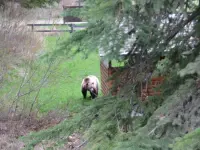
Grizzly bears live in this country. All food, drink, coolers, and garbage are stored inside the cabin. Elk and moose range here too. The river holds rainbow and cutthroat trout, and floaters run it from the Canadian border to Polebridge on Class I and II rapids. The Polebridge Mercantile, about half an hour’s drive away, carries limited supplies. In winter the North Fork Road is plowed only intermittently, and four-wheel drive and chains are recommended. Visit Montana notes that snowmobiles are barred from the Ford access area from October 15 to May 10. Canada lies to the north, and Glacier National Park lies to the east.
A ford and a flying machine
The station took its name from a crossing. At a gathering at the old Ford schoolhouse on July 17, 2025, Lois Walker of the North Fork History Project said that people forded the river there. There was also what they called a flying machine. The school’s parent-teacher association bought a rope to stretch across the river, and a rider pulled across in a small car. Homesteaders had raised the schoolhouse in 1918 on land given by Harry and Lena Holcomb, and by Walker’s records it never held more than seven or eight children. It served as the meeting hall of the upper valley, and its PTA planned a dance for July 1919 in honor of Ralph Thayer, who had just returned from France. A fire at the Wurtz cabin killed two of the Wurtz children that month, and the dance was put off until later.
Begun before the war
Thayer had gone to work for the Forest Service in June 1911. In his own account he packed four horses out of Moran Ranger Station to help move the office and files from Indian Creek, near the Henshaw Ford. He wrote that there was “no regular trail, just the best way to get through.” That summer he helped skid logs for Moran Ranger Station. “Between cooking and times chasing smoke,” he wrote, the crew hung an emergency telephone line.
Larry Wilson, interviewed in 2011, said Thayer “had just started building the cabin at the Ford Ranger Station when he left for World War I.” He finished it after he came back, working for the Forest Service. The Forest Service dates the cabin to 1922. A Forest Service photograph of the station from the 1920s carries the label Blackfeet Forest.
The station stayed in use for decades. Wilson himself worked there, setting up telephone communication with the lookouts. Robert D. Ross was stationed out of Ford with a crew clearing the Whale Creek Road, and he remembered their camp cook, a man called Frenchie. Lois Walker has said that Ross Wilson later moved a surplus barn from the station to the property he shared with Katie.
“He ran like a deer”
Wilson called Thayer “probably one of the more famous early rangers up here.” He said Thayer “ran like a deer” and laid out most of the trails on the Forest Service side of the North Fork. Once, running through the woods, Thayer jumped a big downed tree and landed in the middle of a grizzly bear. He kept running and got up a tree, but the bear caught him by the leg and pulled his boot down. Badly hurt, he walked six or nine miles out (Wilson could not recall which) to where someone picked him up. “He didn’t run as fast after that,” Wilson said. In February 1937 Thayer and a fellow ranger made a big-game study in the Pentagon area of the Spotted Bear River. A snowslide buried his partner on Pentagon Creek. Thayer heard it from Wall Creek and turned back to look for him, and the two met near the Pentagon cabin.
Thayer homesteaded 160 acres just south of Wilson’s place. He was among the last of the North Fork homesteaders to die. Asked whether Thayer had ever married, Wilson said, “I think he married five or six times. He had lots of wives; he just outlived them is all.” Near the end, Thayer called Wilson from the soldiers’ home and offered him the remaining 120 acres at $1,000 an acre. “Well I thought maybe you would buy it and you wouldn’t subdivide it,” Thayer told him. Wilson said he lacked the money. The land went to the horse loggers Johnny Matheson and Ed Ernst, and as soon as Thayer was dead, Wilson said, they cut it into 10-acre parcels.
Notable Events
- 1922Ralph Thayer built the cabin as part of the Ford Ranger Station. fs.usda.gov
People
- Ralph Thayer, Builder of Ford Cabin (1922).
- Frenchie, Cook at the crew's camp organized out of Ford Station, recalled by Robert D. Ross.
- Robert D. Ross, Forest Service crew member stationed out of Ford for the Whale Creek Road clearing project.
- Ross Wilson, Moved a surplus barn from Ford Ranger Station to his and Katie's property, according to Lois Walker.
- Larry Wilson, Worked at Ford Ranger Station, setting up telephone communication with the lookouts.
Sources
- recreation.gov/camping/campgrounds/234337
- fs.usda.gov/r01/flathead/recreation/ford-cabin
- visitmt.com/listing/ford-cabin-13905
- flickr.com/photos/fsnorthernregion/5842432713
- commons.wikimedia.org/wiki/File:Ford_Ranger_Station_1920s,_Blackfeet_Forest_(5842432713).jpg
- nflandowners.org/nflawp/wp-content/uploads/2015/03/Larry_Wilson_Fall_2011.pdf
- nflandowners.org/nflawp/wp-content/uploads/2026/04/6-Coffee-at-Ford-Schoolhouse-7-17-25.pdf
- nflandowners.org/history/transcripts/Robert%20Ross%20consolidated%20transcript.pdf
- fs.usda.gov/r01/flathead/recreation/ford-cabin
- fs.usda.gov/sites/nfs/files/r01/flathead/publication/trails-past.pdf
- npshistory.com/publications/usfs/region/1/early-days/4/sec29.htm
- npshistory.com/publications/usfs/region/1/flathead/story/chap28.htm
.jpg)