Fish Springs Trout Hatchery
Big Pine, Inyo County, California. Trout hatchery.
Details

- Where
- 215 Fish Springs Road, Big Pine, CA 93513. Directions
- When
- Open 8:00 a.m. to 3:00 p.m.
- Getting there
- 3 miles south of town of Big Pine, take Fish Springs Road west.
- Access
- See the Emergency Closures page before visiting a CDFW office, facility or property.
- Phone
- (760) 938-2242
- Website
- wildlife.ca.gov
- Managed by
- California Department of Fish and Wildlife.
- Established
- 1952.
Three miles south of Big Pine, in Inyo County, Fish Springs Road turns west to a state trout hatchery, open from 8:00 a.m. to 3:00 p.m. The California Department of Fish and Wildlife runs it. Tule elk are often seen in the country around it, along with mule deer and, in the department’s words, “myriad other wildlife.”
Raceways and a tank room
The fish a visitor sees are in the raceways outside. These are concrete channels 1,000 feet long, fed by two groundwater wells that deliver water at a constant 60°. The department’s history page counts three production raceways. A consultant’s alternatives analysis prepared for the department by McMillen, Inc., dated February 2025, says six were added in 1972.
The trout start indoors. A hatchery building put up in 2009 holds twenty deep tanks. Eyed eggs shipped from other facilities hatch there in upwelling jars, and the fry stay until they reach about 2 inches, large enough to go out to the raceways.
By the department’s figures, the facility produces an average of 500,000 pounds of catchable trout a year, about half a pound apiece, for roadside waters in Inyo and Mono counties. It also supplies around 100,000 fingerling rainbows a year for stocking from the air. The history page names the catchables as rainbow and Eagle Lake trout. The Eagle Lake fish is a rainbow strain native to Eagle Lake and its Pine Creek tributary, known for its resistance to highly alkaline water. A program to preserve it began in the 1950s, as flows into Pine Creek diminished. A department release from 2025 lists rainbow, brown, and Lahontan cutthroat trout. The rainbows raised for anglers are now sterile triploids.
Springs from a lava escarpment
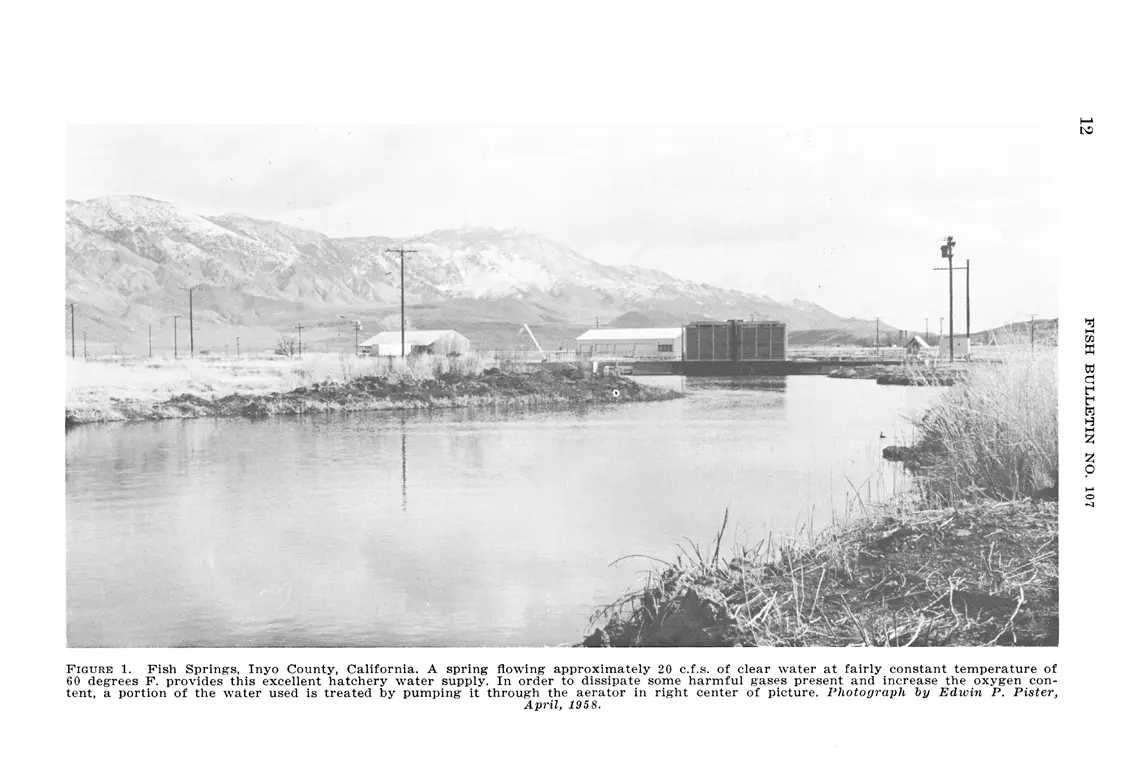
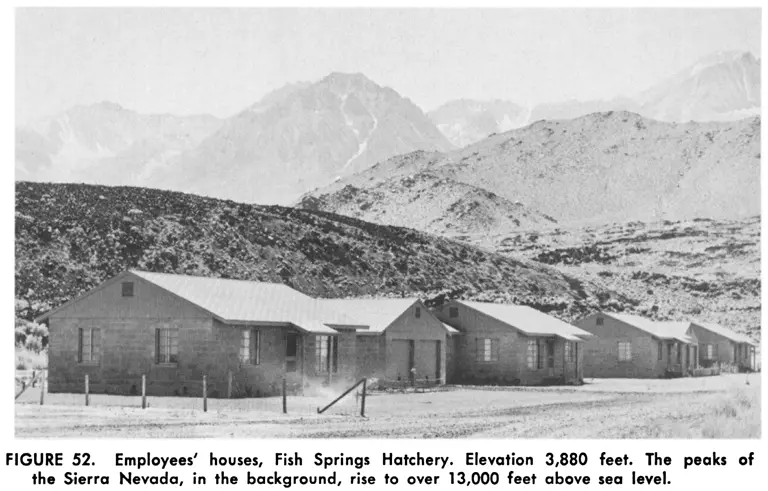
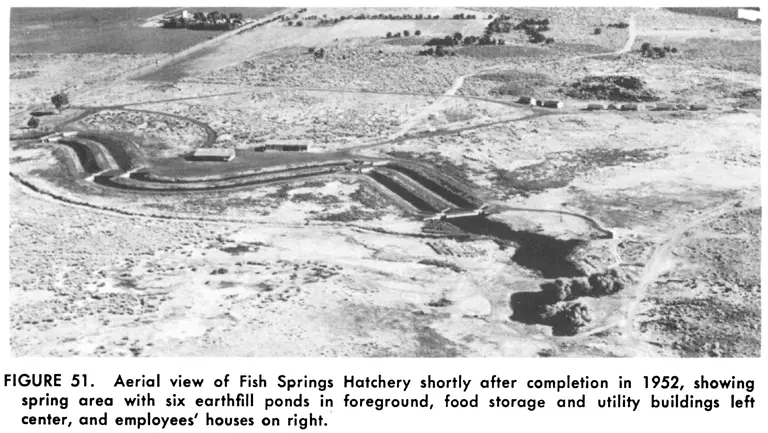
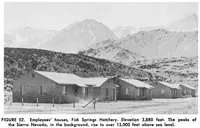
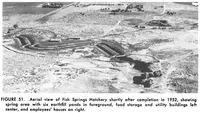
When the hatchery was built in 1952, its water came from a number of springs rising from a lava escarpment on the site. They flowed an average of 18 cubic feet per second at a constant 61°. The Wildlife Conservation Board paid for all of the construction, and the hatchery was dedicated on June 27, 1952, to rear catchable rainbow trout for the Inyo-Mono area. The fish were raised in two parallel series of earthen ponds about 1,700 feet long, which produced around 190,000 pounds of trout a year. Four staff houses went up the same year: simple concrete-block buildings with gable roofs and steel sash windows.
The springs had once been a source of native fish for the Big Pine Paiute Tribe. Tribal member Ross Stone has told of his grandfather living near the springs and his father fishing in the ponds. “The native fish were much better” than the planted trout, he maintained.
According to the Sierra Wave, Fish Springs went dry after two Los Angeles Department of Water and Power wells were activated in 1970. The department dates its conversion to wells and concrete raceways to 1972. The wells pump about 20,000 acre-feet a year, and the water circulates on to the Owens River. In 2024 Sally Manning, the tribe’s environmental director, told the Inyo County Water Commission that when both wells are running, one pumps 11,000 to 12,000 acre-feet a year and the other about 8,000. A five-acre pond beside the hatchery is dry. On a county tour in 2022, those present had to guess where its boundaries had been.
Loaded to the gunwales
In 1984 whirling disease shut down the state’s Mt. Whitney hatchery near Independence, and Fish Springs took on its production. “We were pushing everything off to the Fish Springs hatchery (near Big Pine) and had them loaded to the gunwales raising every fish they could possibly grow,” Bill Rowan, supervisor of the Department of Fish and Game’s Eastern Sierra hatcheries, told the Los Angeles Times in 1989. “It’s scary when you have that many fish, and all you need to have is a power outage, then you lose your wells and your whole crop.”
In 2003 the trouble was money. Layoffs of seasonal hatchery workers threatened to leave no drivers to deliver trout. Mono County officials received an emergency $10,000 to help rehire five seasonal workers at Hot Creek and Fish Springs. “The one thing we do not want to hit the angling rumor mill is that Fish and Game will not be stocking fish in Mono County for the rest of the season,” said Dan Lyster, the county’s director of economic development.
A bacterium from the Mojave River
In spring 2020 the bacterium Lactococcus garvieae was found in California for the first time, at the Mojave River State Fish Hatchery. The department looked to the two Owens Valley hatcheries, Fish Springs and Black Rock, to make up the loss. Together they held about two million trout, and both happened to be running their annual tests for infection. On June 25 the results came back positive, and both were quarantined. By July 21 it was clear the outbreak could not be contained. The remaining options were to watch the fish die slowly in their raceways or to euthanize all three million fish at the three hatcheries. On July 29 state officials began exposing the trout to high concentrations of carbon dioxide, then emptied and disinfected the raceways. “We got into this line of work because we love fish,” said Jay Rowan, the department’s hatchery production manager. “It sucks.”
With the fish gone, the wells were shut off, and the county watched its monitoring wells. In November 2020 Manning told the Water Commission that the water table was recovering in the deep aquifer, and that this was a chance to see whether the spring would flow again. The chairperson, Teri Red Owl, asked whether restocking and pumping could be delayed to allow more recovery. In January 2021 the water department’s Aaron Steinwand reported that disinfection was complete, that new eggs were close to arriving, and that one supply well would be turned on. He saw no obvious recovery in the shallow monitoring wells except those directly across from the hatchery, though two deep wells had recovered notably. Manning read the data as recovery and called for a recommendation to remove the hatchery or reduce its pumping. The Sierra Wave later reported that the water table in the area rose four to eight feet during the shutdown.
The infection returned in the summer of 2022. That June the Inyo County Board of Supervisors reconvened from Independence to the hatchery to see the effects of pumping. Supervisors, staff, tribal members, and locals arrived but could not enter the grounds because the bacterium was present. Manning and Noah Williams, the tribe’s water program coordinator, made their case, and it was on this tour that Stone spoke of his family at the springs. The department said its water use could be cut by 12 percent. The tribe wanted the springs running again. “The Tribe is asking for support; we’re not being asked to solve the problem,” said Leslie Chapman, the county’s chief administrative officer. In April 2024 the department’s Russel Black described two projects to the Water Commission: a mid-pond aeration system due to be finished in September 2024, and variable-speed valves to be installed from September to December 2024.
The afternoon of May 20, 2025
The February 2025 analysis listed several upgrades in its selected alternative, among them replacing the well houses’ diesel backup generators with propane. On the afternoon of Tuesday, May 20, 2025, the power went out in the Owens Valley for more than two hours. The hatchery runs on Los Angeles Department of Water and Power electricity and has backup diesel motors to keep the water pumping during outages. A software issue had left them non-operational. When a hatchery loses power, water levels drop, flows stop, dissolved oxygen falls, and temperatures rise quickly. The department estimated that 75 to 80 percent of the stock was lost, including eggs and fingerlings meant for the following year and catchable fish for that season.
“We’re devastated by the loss of these fish, which were the product of years of hard work and round-the-clock care by our expert hatchery staff,” said Russell Black, the department’s Inland Deserts Environmental Program Manager. The department expected the loss to affect Eastern Sierra fish plants for the next two seasons. It looked to its other hatcheries for eggs and fish and explored buying eggs from private vendors. A contractor had already been scheduled to come to the hatchery on Thursday, May 22, to diagnose the software issue.
Notable Events
- 1952Four houses at Fish Springs were simple concrete block houses with gable roofs and steel sash windows. npgallery.nps.gov
- 1952The hatchery was originally constructed, obtaining water from springs on the on-site lava escarpment. wildlife.ca.gov
- 1970Fish Springs went dry after two wells were activated; the adjacent five-acre pond was dry when the tour took place. sierrawave.net
- 1972Six raceways, 1,000 feet in length, were added to modernize the facility and rear larger fish. nrm.dfg.ca.gov
- 1972Modernized to concrete raceways supplied by two groundwater wells; the page describes three 1,000 foot long production raceways. wildlife.ca.gov
- 1984Bill Rowan recalled pushing production to Fish Springs, loading it to capacity to raise every fish it could grow. latimes.com
- 2003Mono County officials received an emergency $10,000 to help rehire five seasonal workers at Hot Creek and Fish Springs after cuts threatened trout delivery. latimes.com
- 2009A hatchery building with 20 deep troughs was constructed, providing egg incubation in upwelling jars and early rearing in the troughs. nrm.dfg.ca.gov
- 2020Fish Springs and Blackrock were infected; Fish and Wildlife shut off wells, disposed of all fish and undertook disinfection, with new fish expected during winter. inyowater.org
- 2020State officials quarantined the two hatcheries and investigated the extent of the outbreak. journalism.berkeley.edu
- 2020The bacterial infection lactococcus garvieae first appeared in Eastern Sierra hatcheries in 2020 and later made a comeback; infected fish are being euthanized, an inoculation has been developed, and a county tour could not enter the hatchery premises because of its presence. sierrawave.net
- 2021CDFW stated disinfection was complete, eggs for Fish Springs and Black Rock were close to arriving, and one supply well would be turned on. inyowater.org
- 2022Supervisors, staff, tribal members and locals went to the hatchery but could not enter because of lactococcus garvieae. sierrawave.net
- 2024CDFW described mid-pond aeration, which should finish in September of 2024 if there were no delays, and variable-speed valves planned to start in September 2024 and finish in December 2024. inyowater.org
- 2025A sustained power outage in the Owens Valley on the afternoon of Tuesday, May 20, 2025, lasted more than two hours while the hatchery's backup diesel motors were non-operational due to a software issue. wildlife.ca.gov
- 2025CDFW estimated between 75-80% of fish stock was lost, including eggs and fingerlings for next year and catchable fish for the current year. wildlife.ca.gov
- The outbreak proved uncontainable; the remaining options were to watch the fish die slowly or euthanize all three million. journalism.berkeley.edu
- State officials began euthanizing trout with high concentrations of carbon dioxide, then emptying and disinfecting the raceways; Rowan hoped for a vaccination program. journalism.berkeley.edu
- Annual infection tests at Fish Springs and Black Rock came back positive for lactococcus garvieae. journalism.berkeley.edu
- The hatchery was dedicated; construction had been funded entirely by the Wildlife Conservation Board. web.archive.org
People
- Daris Moxley, Reiterated the request to ask Fish and Wildlife how much water the hatchery requires.
- Edie Trimmer, Expressed concern about excess hatchery water going to Los Angeles rather than local mitigation projects.
- Lynn Boulton, Suggested asking Fish and Wildlife exactly how much water is necessary to run the hatchery.
- Nancy Masters, Provided public comments during the Fish Springs Hatchery update.
- Philip Anaya, Provided public comments during the Fish Springs Hatchery update.
- Sally Manning, Tribal environmental director who advocated for restoring springs and habitat around the hatchery.
- Aaron Steinwand, Inyo Water Department representative reporting the hatchery shutdown and disinfection to the Water Commission.
- Teri Red Owl, Water Commission chairperson who asked whether restocking and pumping could be delayed to allow more groundwater recovery.
- Holly Alpert, Inyo Water Department representative who introduced CDFW's update on hatchery concerns.
- Jon Klusmire, Questioned the pumping allocation between the hatchery and the Big Pine wellfield.
- Russel Black, CDFW presenter discussing concerns about Fish Springs and the water-saving projects.
- Jay Rowan, California Department of Fish and Wildlife hatchery production manager who led the response to the bacterial outbreak.
- Bill Rowan, Supervisor of the Department of Fish and Game's Eastern Sierra hatcheries; described shifting fish production to Fish Springs.
- Dan Lyster, Mono County director of economic development, warning of the economic harm if fish stocking stopped after hatchery staffing cuts.
- Adam Perez, LADWP aqueduct manager who joined the hatchery water-use discussion but could not make commitments.
- Dan Tonseth, CDFW hatchery manager who told the Board water savings could be achieved.
- Leslie Chapman, Inyo Chief Administrative Officer who characterized the Tribe's request as one for support.
- Noah Williams, Tribal water program coordinator presenting the case about hatchery pumping and dry springs.
- Ross Stone, Tribal member who addressed the hatchery tour and shared family memories of the springs and fishing ponds.
- Russell Black, CDFW Inland Deserts Environmental Program Manager speaking about the hatchery's fish losses and recovery.
Sources
- wildlife.ca.gov/Fishing/Hatcheries/Fish-Springs
- wildlife.ca.gov/Fishing/Hatcheries/Fish-Springs/History
- wildlife.ca.gov/Fishing/Hatcheries/Fish-Springs/Species-Raised
- web.archive.org/web/20241215033646/https://www.noaa.gov/sites/default/files/legacy/document/2020/Oct/07354626232.pdf
- npgallery.nps.gov/NRHP/GetAsset/NRHP/00000034_text
- latimes.com/archives/la-xpm-1989-05-01-sp-2249-story.html
- latimes.com/archives/la-xpm-2003-aug-06-me-fish6-story.html
- journalism.berkeley.edu/projects/acteria-attacking-californias-trout
- inyowater.org/wp-content/uploads/2021/01/WC_minutes_16Nov20-final-minutes.pdf
- inyowater.org/meetings/water-commission/water-commission-meetings/wc_minutes_21jan21-draft-minutes-als
- inyowater.org/wp-content/uploads/2025/04/2024Apr22-WC-Draft-Minutes_ha.pdf
- sierrawave.net/inyo-supervisors-take-a-look-at-water-use-at-fish-springs-fish-hatchery
- wildlife.ca.gov/News/Archive/power-outage-causes-failure-at-eastern-sierra-hatchery
- nrm.dfg.ca.gov/FileHandler.ashx?DocumentID=229466
- nrm.dfg.ca.gov/FileHandler.ashx?DocumentID=15297