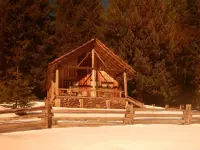
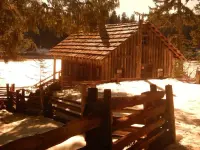
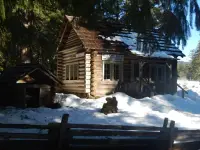
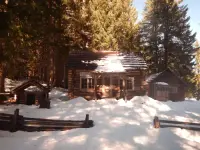
Fish Lake Remount Depot Cabins
McKenzie Bridge, Linn County, Oregon. Cabin; mid-November to mid-April.
Details

- Where
- McKenzie Bridge, Linn County, OR. No street address stated. Directions
- When
- Check in at 2:00 p.m.; check out at 1:00 p.m.
- Getting there
- From McKenzie Bridge, Oregon, follow Highway 126 east for 22 miles to Fish Lake Interpretive Site.
- Fees
- $95.00 per night.
- Access
- Fish Lake Interpretive Day Use is the gateway to the Fish Lake Historic Site, also known as the Fish Lake Remount Depot.
- Walk-in or reserve
- Overnight stays are by reservation only; walk-ins are not allowed.
- Phone
- 541-822-3381
- Website
- recreation.gov
- Managed by
- Willamette National Forest.
- Established
- 1924.
- Coordinates
- 44.40528, -122.00583.
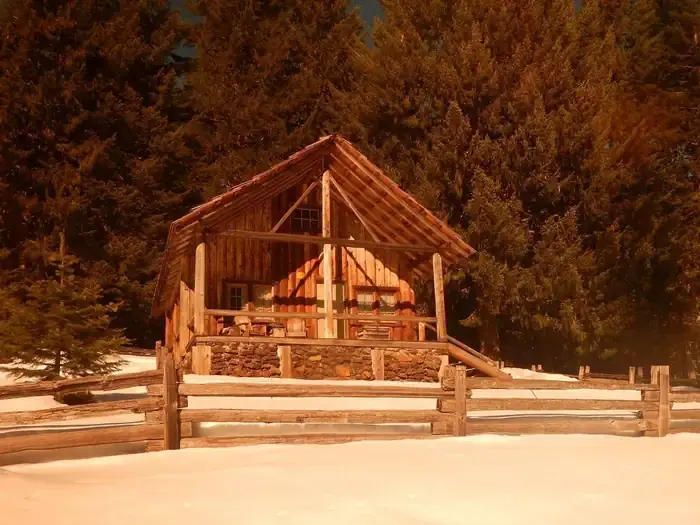
From Lava Lake Sno-Park on Highway 20, the way to the Fish Lake Remount Depot crosses the highway and follows blue diamond markers into dense evergreen forest. The Forest Service gives the distance as about three-quarters of a mile on its cabin pages and about one mile in its directions. Guests walk, ski, or snowshoe in, carrying their own water, because neither cabin has water or electricity. At the end of the trail is a compound of log and wood buildings at 3,200 feet, on 16.81 acres of gently sloping, south-facing plateau above Fish Lake in Linn County.
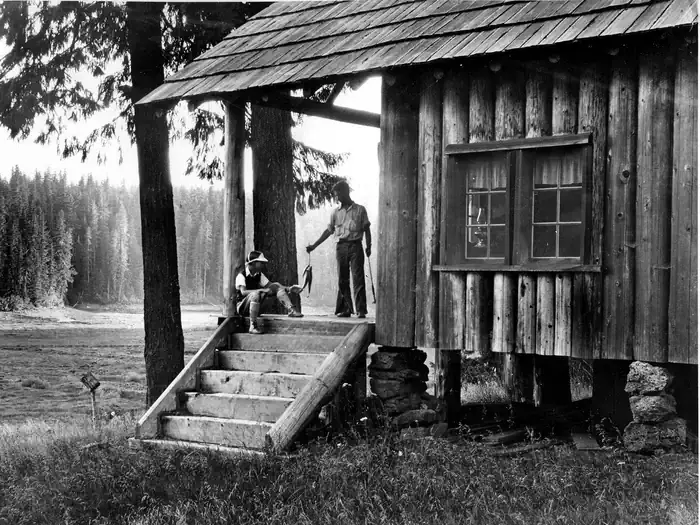
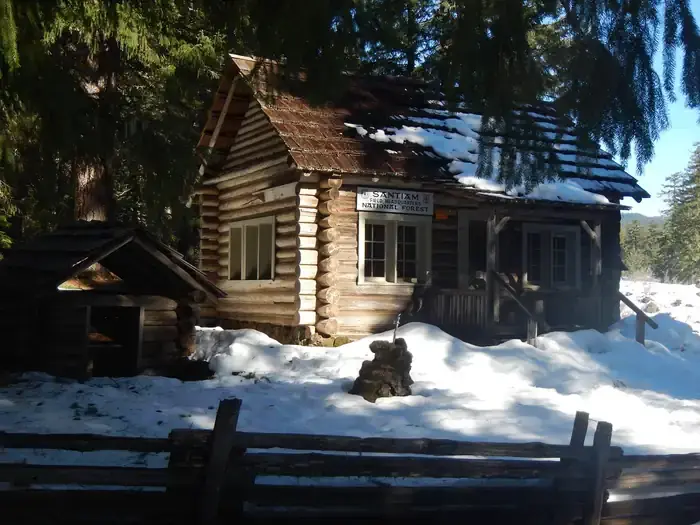
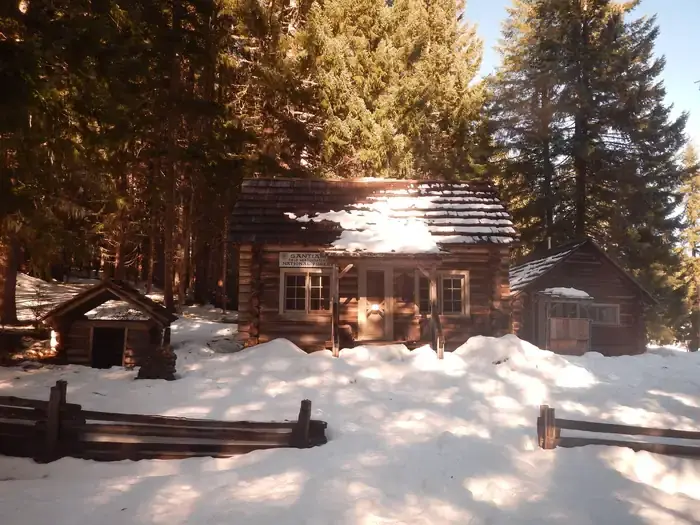
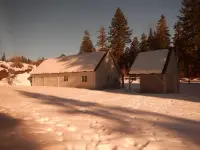
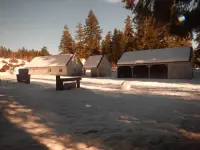
Two of those buildings are rented overnight in winter. The cabin pages give the season as mid-November to mid-April, and the day-use page says November to early April. The Commissary Cabin stands on a hill northeast of the depot archway and has a bedroom and a kitchen. The Hall House, a supervisor’s cabin, has three rooms: a bedroom, a common room with a hideaway bed, and a kitchen. Each cabin has a full-size bed, a table and chairs, a sofa, propane stoves for heat and cooking, solar-powered lights, and basic cookware. The key is kept in a combination lock box beside the door. An outhouse with a pit toilet stands nearby.
A lake that drains to meadow
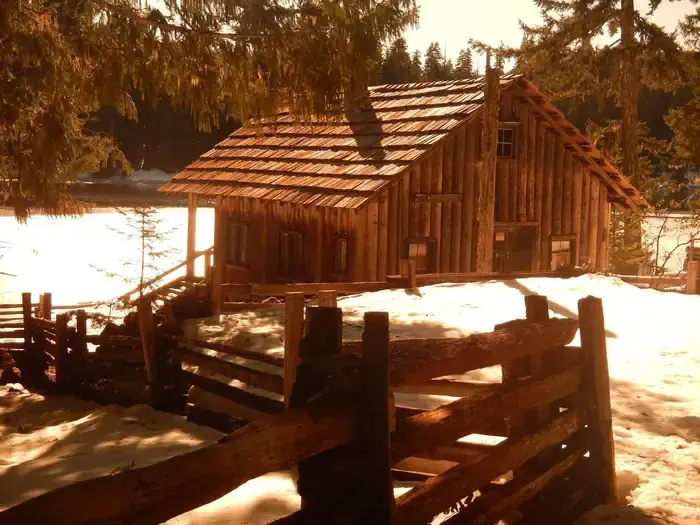
From the cabins the view runs to Fish Lake and its forested shoreline. The lake holds water only in winter and spring. In summer the water drains underground and leaves a meadow. A day-use area on Highway 126 has picnic tables, interpretive signs, a canoe launch, and a viewing platform at the lake’s edge. In winter its pull-out, about an eighth of a mile from the cabins, is used for unloading gear but not for overnight parking.
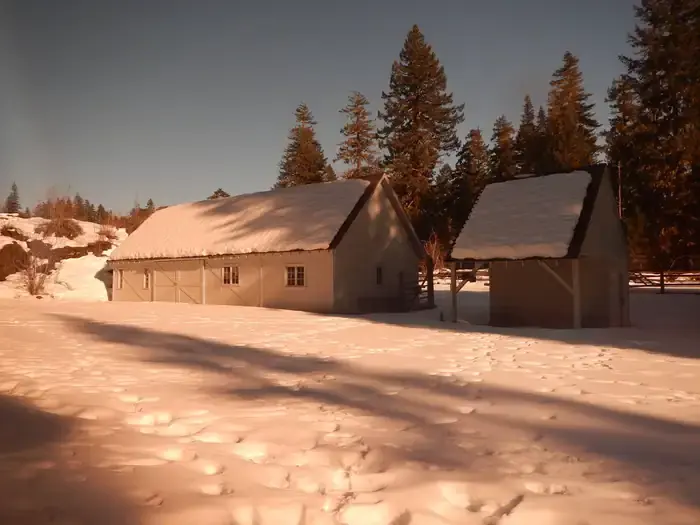
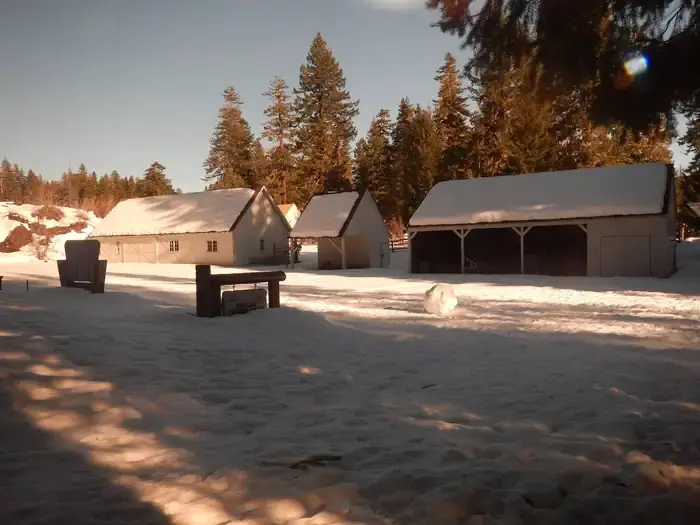
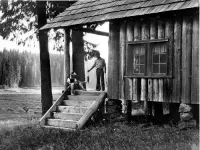
The Oregon historic site record counts eighteen historic buildings, structures, and sites on the grounds, built of local timber and lava rock. The northern part is the 1920s station, a group of log buildings that handled fire patrols and dispatch. The southern part is 1930s work by the Civilian Conservation Corps, built for pack animals. The Santiam Wagon Road cuts through the grounds, and a visitor entering along it reaches the CCC buildings first:
- the barn, with stalls for ten horses or mules
- the closed storage building, which served as tack room and blacksmith shop
- open storage for vehicles and equipment
Farther in are the older buildings:
- the Dispatcher’s Cabin, whose switchboard connected lookouts, guard stations, and district offices across the forest
- the spring house, where a cold spring ran beneath the floor to keep perishable food
- the Hall House garage, built of boards cut at an on-site sawmill that no longer exists
Sections of the original stone corral survive, along with a pioneer grave beside the road.
In summer, volunteer site hosts keep the place. In 2025 the lead volunteer was Ginger Morten, who greeted each week’s incoming hosts and led tours. The Friends of Fish Lake newsletter reported that returning visitors know her by name and that she spends quiet evenings with her dog, Timber.
The toll road and the snowbound Gibsons
According to the Friends of Fish Lake, Indian tribes came to the area in spring and summer to hunt, fish, and collect huckleberries, crossing the slopes to trade with neighboring tribes. In 1859 Andrew Wiley, John Bradenburg, and John Grey went looking for a route across the Cascades to link the towns of the Willamette Valley. The Willamette Valley and Cascade Mountain Wagon Road Company was incorporated in 1864 and had the first passable route across the mountains by 1866. That toll road, the Santiam Wagon Road, passed Fish Lake, and in 1867 the company built a roadhouse there. Between July and September, more than 100 wagons often camped along the lakeshore. The grave beside the road belongs to a mother and child, and the Living New Deal dates it to 1875.
The road also held travelers through winter. In January 2025 Jim Ellickson-Brown wrote to the Friends of Fish Lake with a passage from the obituary of his great-great-grandfather, John Henry Gibson, who died in 1912. In late fall of 1883 the Gibson family left Lebanon for Eastern Oregon and was “caught at Fish Lake, in the Cascade mountains, where they were snowbound for several weeks.” The eldest son, Wm. L. Gibson, already living in Umatilla County, “left at once for the camp, and by carrying food on snowshoes on drifts as deep as 30 feet for several miles, and by working for a number of days, succeeded in saving them from starvation.”
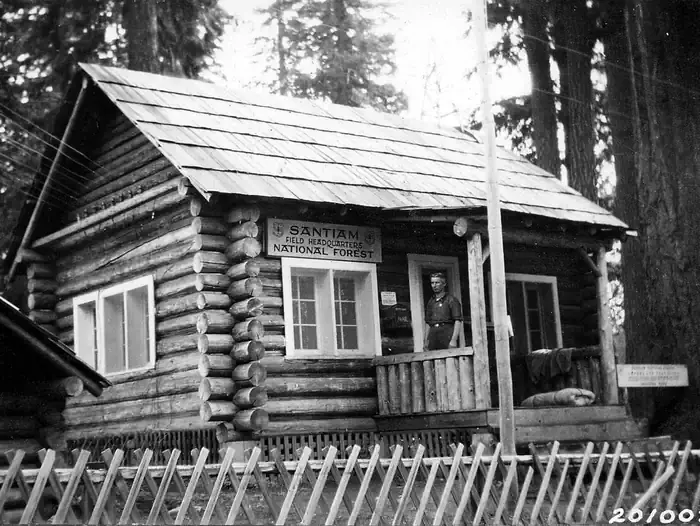
Marvin J. Nye had worked the toll gate at the way station, and about 1904 he provided the first organized fire protection in the area. The Forest Service first used Fish Lake as a ranger outpost in 1905. In 1906 it withdrew 20 acres around the lake from homestead entry to serve as a central base for fire patrols. Travel on the wagon road declined, and the way station closed in 1907. By 1911 the site was summer field headquarters for the newly created Santiam National Forest. In 1914 the Forest converted it into the Fish Lake Guard Station and replaced the old way station buildings.
Log cabins and a CCC barn
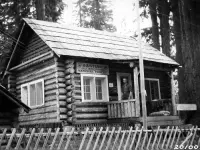
The log cabins were built by Forest Service firemen under superintendent John Short. The sources disagree on their dates. According to the Friends of Fish Lake, the first fire crew stationed at the site built the Dispatcher’s Cabin in 1921. They date the Commissary, the spring house, and the Hall House to 1924. Recreation.gov says the cabins were built in 1924.
Another history in the dossier gives a longer sequence:
| Building | Year | |---|---| | Dispatcher’s cabin and commissary | 1921 | | Outhouse | 1922 | | Springhouse, fire hose house, and fireman’s cabin | 1924 | | Supervisor’s cabin | 1925 | | Garage | 1928 |
The supervisor’s cabin took its name, the Hall House, from Santiam National Forest Supervisor C. C. Hall, who used it as his summer residence. The Commissary was built to store tools and was later converted to a residence.
During the 1920s the station served as field and dispatch headquarters for the Santiam National Forest, the predecessor of the Willamette. Its staff also handled sheep and cattle grazing permits and monitored mining operations.
From 1934 to 1939 the CCC kept a side camp at Fish Lake. The state record names it as part of the Mary’s Creek spike camp. Four-man crews under Charley Blanding, Harold Bowerman, and Joe Stevens built the following:
- the open storage shed and the closed storage building, both in 1934
- the barn, dated 1934 by the Friends and 1935 by the Living New Deal
- a gas and oil shed in 1935
- corrals in 1936
- a stock driveway, built 1936 to 1939, which replaced an older wagon-road path for moving animals from the corrals down to the lake pasture
A CCC bath house near the barracks no longer stands. Heavy snow in 1958 collapsed the original bunkhouse, and a new one went up in 1960.
Pack strings to 2005
The Wilderness Act of 1964 restricted vehicles in wilderness areas, and Fish Lake was revitalized as a remount station to serve them. Packers, often called mule skinners, hitched as many as 20 horses or mules into a single string and carried food, tents, and field gear.
Lloyd Van Sickle was a Forest Service packer. The Friends of Fish Lake place him at Fish Lake from 1971 to 1984, and another account has him managing the packing operation from the 1960s on. During his time some of the historic buildings faced burning for lack of maintenance funds. Van Sickle helped protect them and began the first restoration.
The Forest opened a few cabins to winter rentals in 1997. According to the Friends of Fish Lake, the last Fish Lake packer and pack string passed through in 2005, 100 years after the depot was established. Recreation.gov still describes the compound as a rest and resupply station for the Forest Service horse packer.
In 2010 the Friends of Fish Lake, a group of volunteers and Forest Service retirees, signed a memorandum of understanding with the Forest to maintain and restore the site. The state and the National Park Service record the Fish Lake Guard Station as listed in the National Register of Historic Places on June 27, 2014. The Living New Deal gives the year as 2016.
Sprinklers on the shakes
The Friends’ annual work week in June 2025 included a membership meeting and potluck. On June 17 the group gave Rolf Anderson the first Mike Kerrick Leadership Award, and the pavilion was named the Anderson Pavilion in his honor.
From June 20 to 22, fifteen teachers and three facilitators stayed at Fish Lake for an educators’ workshop, held in cool, rainy weather. Board member Phil Hufstader and his wife Laurie cooked a cowboy dinner, and Casey Hufstader led a pack string demonstration. That summer Dick Kreager rebuilt the split-rail fence.
In August 2025 volunteer site hosts reported a lightning-caused wildfire near the site. That year Syndy Zerr of Wildfire Mitigation Network completed a wildfire mitigation strategy for the site and donated her work. It led to several measures:
- propane tanks were buried
- the Friends bought sprinklers for the roofs of the Hall House and its garage
- the Forest Service installed sprinklers on the Commissary and the Dispatcher’s Cabin
- fire-retardant coating was applied to the roof shakes
On June 23, 2026, the Forest Service, the Friends of Fish Lake, and Wildfire Water Solutions signed an agreement for a wildfire protection project. After the annual work week, Wildfire Water Solutions installed and tested a temporary emergency water system across the grounds. A permanent system is to follow once site surveys are done.
The project came from Joe Stutler, a new member with 35 years in the Forest Service and 20 with Deschutes County. “When my long-time friend and fire service colleague Dean Vendrasco (FOFL board member), gave me a tour of the historic site,” Stutler said, “I said we can’t let this place burn down.”
Notable Events
- 1859Andrew Wiley, John Bradenburg, and John Grey sought to find a route across the Cascades to link the cities and towns of the Willamette Valley. npgallery.nps.gov
- 1864The Willamette Valley and Cascade Mountain Wagon Road Company was incorporated; by 1866 the first passable route across the Cascades was completed, and the Santiam Wagon Road toll route passed Fish Lake. npgallery.nps.gov
- 1867The Willamette Valley and Cascade Mountain Wagon Road Company built a roadhouse for Santiam Wagon Road travelers. friendsoffishlake.org
- 1883A descendant's account published by Friends of Fish Lake describes a family snowbound at Fish Lake for several weeks. friendsoffishlake.org
- 1904Marvin J. Nye, who had previously operated the toll gate at the way station, provided the first organized fire protection in the area. npgallery.nps.gov
- 1905The U.S. Forest Service first used Fish Lake as a ranger outpost. friendsoffishlake.org
- 1906The Forest Service withdrew 20 acres around Fish Lake from homestead entry for a central base for fire patrols and a future administrative site. npgallery.nps.gov
- 1907Travel over the wagon road waned and the Fish Lake way station closed. npgallery.nps.gov
- 1911The site served as the location of the summer field headquarters for the newly created Santiam National Forest. npgallery.nps.gov
- 1914The Forest converted the former way station into the Fish Lake Guard Station as a summer field office, replacing the original way station buildings. npgallery.nps.gov
- 1920sThe site served as the field and dispatch headquarters for the Santiam National Forest. friendsoffishlake.org
- 1921The first fire crew stationed at the site built the cabin; its switchboard connected lookouts, guard stations and district offices. friendsoffishlake.org
- 1921The Forest expanded the station with rustic log buildings: dispatcher's cabin and commissary (1921), outhouse (1922), springhouse, fire hose house, and fireman's cabin (1924), supervisor's cabin (1925), and garage (1928). npgallery.nps.gov
- 1924The Commissary was originally built to store tools and later converted to a residence. friendsoffishlake.org
- 1924Hall House was the summer residence for Forest Supervisor C.C. Hall; the nearby garage used boards cut at an on-site sawmill. friendsoffishlake.org
- 1924A cold spring flowed under the building to refrigerate perishable food. friendsoffishlake.org
- 1924The rustic wood structures included a dispatcher’s cabin, springhouse shed, garage/woodshed, and fire hose shelter. fs.usda.gov
- 1934The barn provided stalls for 10 horses or mules. friendsoffishlake.org
- 1934Closed Storage served as the tack room and blacksmith shop. friendsoffishlake.org
- 1934Open Storage housed vehicles and equipment. friendsoffishlake.org
- 1934The CCC operated a side camp at Fish Lake to improve the remount depot, assist firefighting, and develop recreation opportunities. livingnewdeal.org
- 1960The bunkhouse replaced earlier sleeping quarters used by the CCC in the 1930s. friendsoffishlake.org
- 1960A new bunkhouse was constructed to replace the original one collapsed by heavy snowfall. npgallery.nps.gov
- 1964With the Wilderness Act's restrictions on vehicles, the Fish Lake Guard Station was revitalized as a remount station for managing newly designated wilderness areas. npgallery.nps.gov
- 1997The Forest opened up a few of the cabins to winter recreation rentals. npgallery.nps.gov
- 2005The site's last packer and pack string passed through, according to Friends of Fish Lake. friendsoffishlake.org
- 2010The non-profit Friends of Fish Lake, volunteers and Forest Service retirees, entered a Memorandum of Understanding with the Forest to maintain and restore the historic character of the Fish Lake Historic Site. fs.usda.gov
- 2014The Fish Lake Guard Station historic district was individually listed. heritagedata.prd.state.or.us
- 2025Syndy Zerr prepared a strategy that led to burying propane tanks and installing roof sprinklers. drive.google.com
- 2025Friends of Fish Lake established an interest-bearing endowment for restoration and preservation using funds already on hand. drive.google.com
- 2025The pavilion was honorarily named in recognition of Rolf Anderson's leadership. drive.google.com
- 2026Wildfire Water Solutions donated time and resources to install a temporary emergency distribution system and would maintain it. drive.google.com
- 2026The Forest Service, Friends of Fish Lake and Wildfire Water Solutions signed an agreement to implement a wildfire protection project. drive.google.com
People
- Dean Vendrasco, Friends of Fish Lake board member who gave Stutler a historic-site tour.
- Joe Stutler, FFL member who invited Wildfire Water Solutions to develop a wildfire protection plan (2026).
- Syndy Zerr, Prepared the site's wildfire mitigation strategy (2025).
- Cara Kelly, Re-elected Friends of Fish Lake director.
- Casey Hufstader, Led the pack-string demonstration.
- Cheryl Friesen, Board member coordinating educator workshop participants and facilitators.
- Dick Kreager, Rebuilt the split-rail fence.
- Don Allen, Re-elected Friends of Fish Lake director.
- Doug Macdonald, Re-elected Friends of Fish Lake director.
- Ginger Morten, Lead volunteer for the onsite host program (2025).
- Jim Denney, Board member who led a historic-site tour.
- Kathy Harbick, Re-elected Friends of Fish Lake director.
- Laurie, Phil Hufstader's wife; helped cook the educator-workshop cowboy dinner.
- LeaAnn Mikkelson, ONREP educator-workshop organizer thanked for making the second workshop a success.
- Mike Kerrick, Namesake of the leadership award.
- Phil Hufstader, Board member who cooked the educator-workshop cowboy dinner.
- Phil Raab, Re-elected Friends of Fish Lake director.
- Rolf Anderson, First Mike Kerrick Leadership Award recipient; pavilion honorarily named for his leadership.
- Steve Mealey, Board member coordinating educator workshop participants and facilitators.
- C.C. Hall, Forest Supervisor whose summer residence was Hall House (1924).
- Lloyd Van Sickle, Packer who protected buildings from burning for lack of maintenance funds and initiated the first restoration (1971 to 1984).
- John HenryGibson, Family head in the snowbound-family account, according to his descendant quoting an obituary.
- WM. L. Gibson, Son said in the quoted obituary to have brought food on snowshoes and saved the snowbound family from starvation.
- C. C. Hall, Santiam National Forest Supervisor whose summer use of the supervisor's cabin gave that cabin the name Hall House.
- Charley Blanding, directed CCC four-man crews that built the remount buildings at Fish Lake (1934-1939).
- Harold Bowerman, directed CCC four-man crews that built the remount buildings at Fish Lake (1934-1939).
- Joe Stevens, directed CCC four-man crews that built the remount buildings at Fish Lake (1934-1939).
- John Short, superintendent of the Forest Service firemen who built the station's log cabins.
- Marvin J. Nye, toll-gate operator at the way station who provided the first organized fire protection in the area (circa 1904).
Sources
- recreation.gov/camping/campgrounds/234174
- fs.usda.gov/r06/willamette/recreation/fish-lake-remount-depot-commissary-cabin
- fs.usda.gov/r06/willamette/recreation/fish-lake-remount-depot-hall-house-cabin
- fs.usda.gov/r06/willamette/recreation/fish-lake-interpretive-day-use
- friendsoffishlake.org/buildings
- drive.google.com/file/d/1sBtaOfavNkw8ILjhjgs7sWpYc0JFS32P/view?usp=drive_link
- npgallery.nps.gov/NRHP/GetAsset/db2ed4be-36eb-4b0e-91c1-4f17fcf55fc1
- friendsoffishlake.org/history
- livingnewdeal.org/sites/fish-lake-willamette-national-forest-or
- heritagedata.prd.state.or.us/historic/index.cfm?do=v.dsp_printRecord&resultDisplay=669152
- npgallery.nps.gov/NRHP/AssetDetail/db2ed4be-36eb-4b0e-91c1-4f17fcf55fc1
- recreation.gov/camping/campgrounds/234174